Past/Lives Flashback #4: Videomania – Rosebery, NSW
Original article: The Marina Picture Palace/Videomania/For Lease – Rosebery, NSW

The Marina, 1941. Image courtesy City of Botany Bay Local History Image Archive.
Sometimes revisiting a place can reveal secrets you missed the first time. Case in point, the rotting behemoth on the side of Gardeners Road formerly known as Videomania. In its glory days this was the grand Marina picture palace, which operated until 1984 – a time when video killed the theatre star.
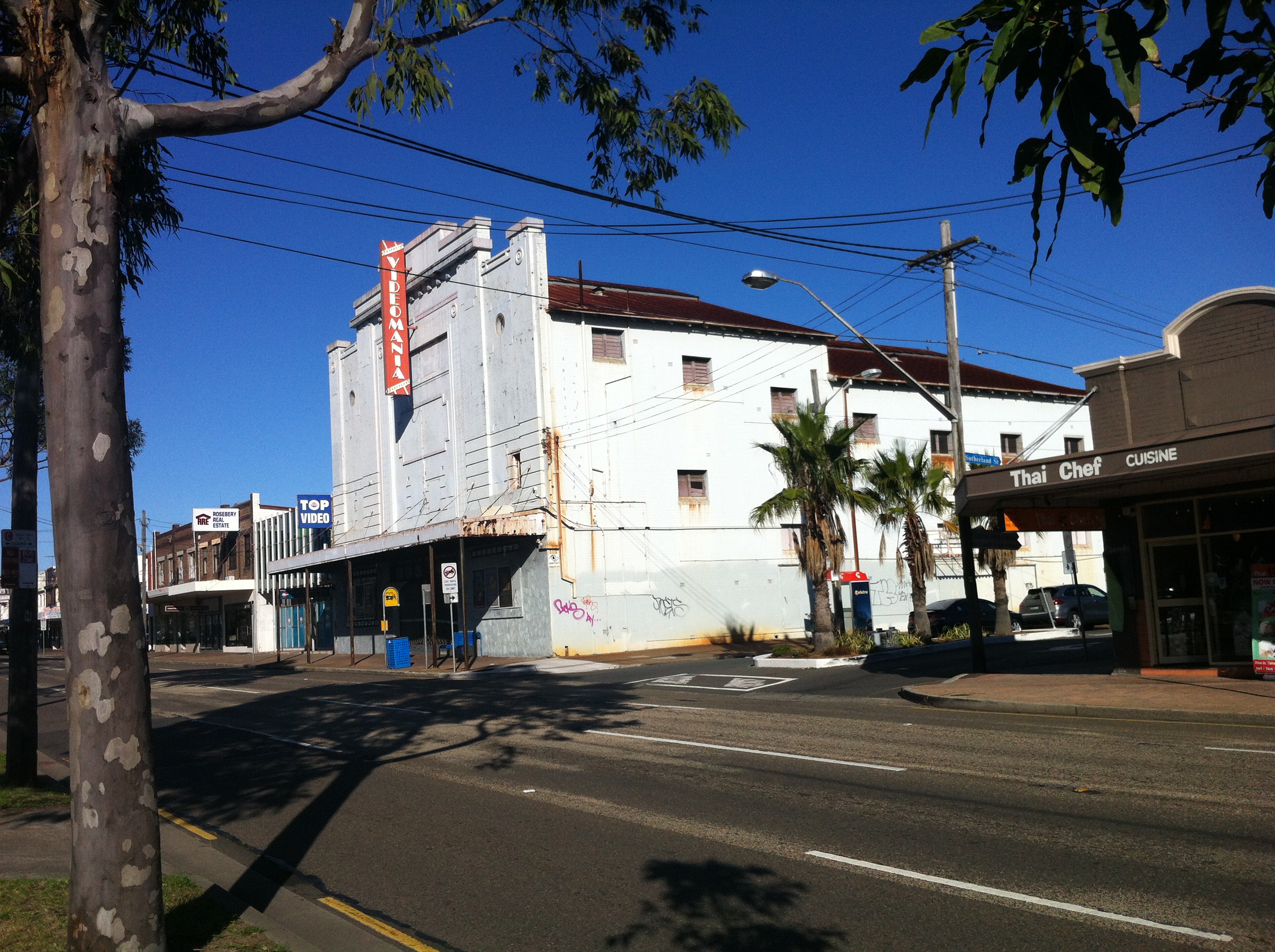
I tried to get the same angle as above, I really did.
Another place for which time seems to stand still, Videomania remains relatively unchanged since last year. Sure, there are some new posters up along its face and there’s a new cupcake shop in the old bank next door, but the building itself is no different.

We can only speculate as to how long those promo guys were waiting, longing to plaster the front of the place with their posters. I suppose the temptation became too much at some point, much to Jack Dee’s benefit.

Even Leonardo is still there, ever vigilant. And he’d want to be, given the former theatre’s seedy surroundings…
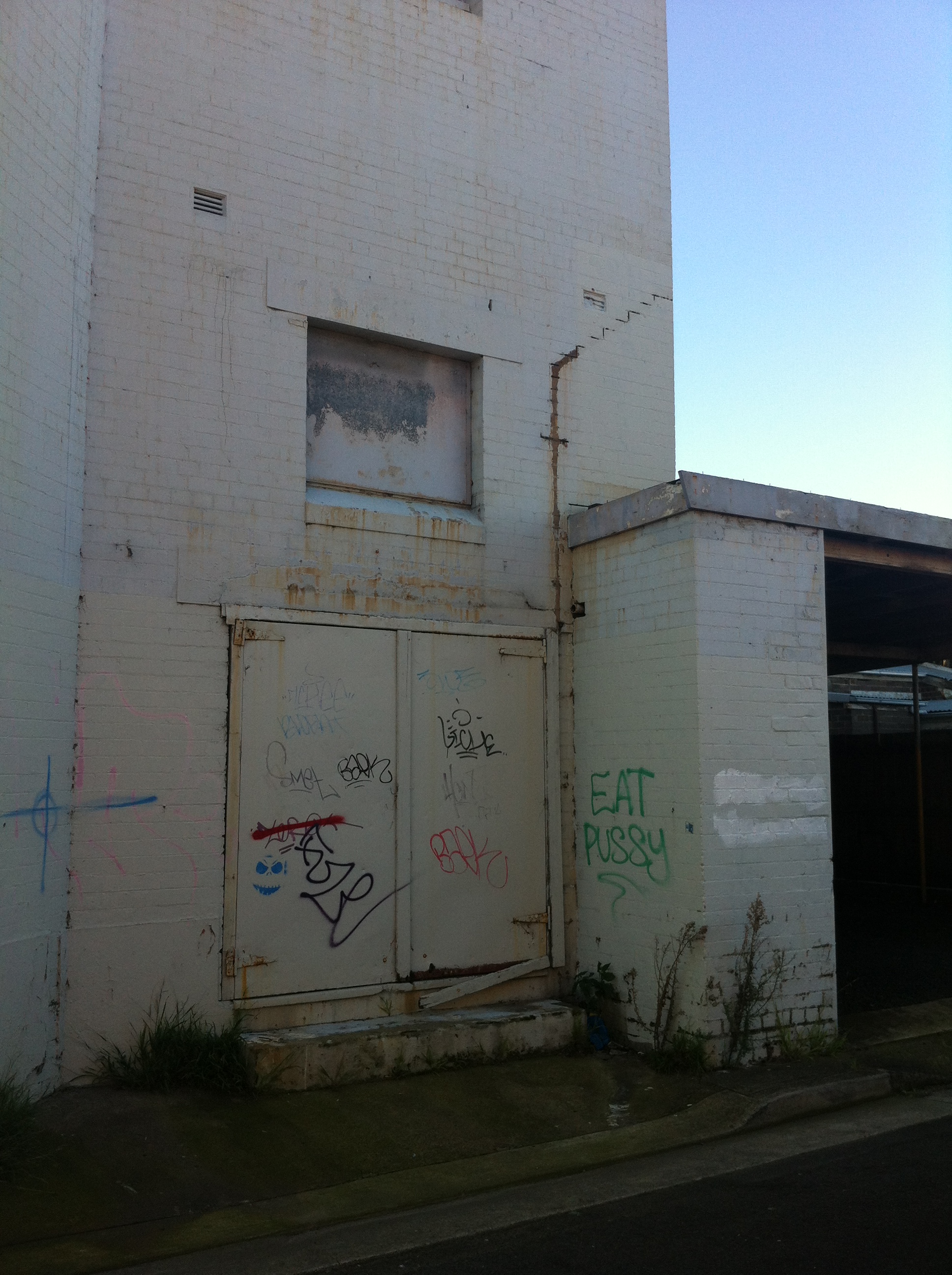
Out the back, I encounter some inspiring graffiti and little else. The place may still be for lease, but they certainly haven’t expended any effort making it presentable.

I’m guessing that vacuum doesn’t work.

Just when I was thinking to myself that there was nothing left to discover here, I found it. It’s something that was probably there last time, but I just happened to miss in the excitement of seeing a Ninja Turtle in the last place you’d expect to see one. See? The gluey remnants still attached to the side appear to vaguely form the word ‘Roxy’, another name this theatre went by at some point in its illustrious life. But that was just the primer. Have a look at this:
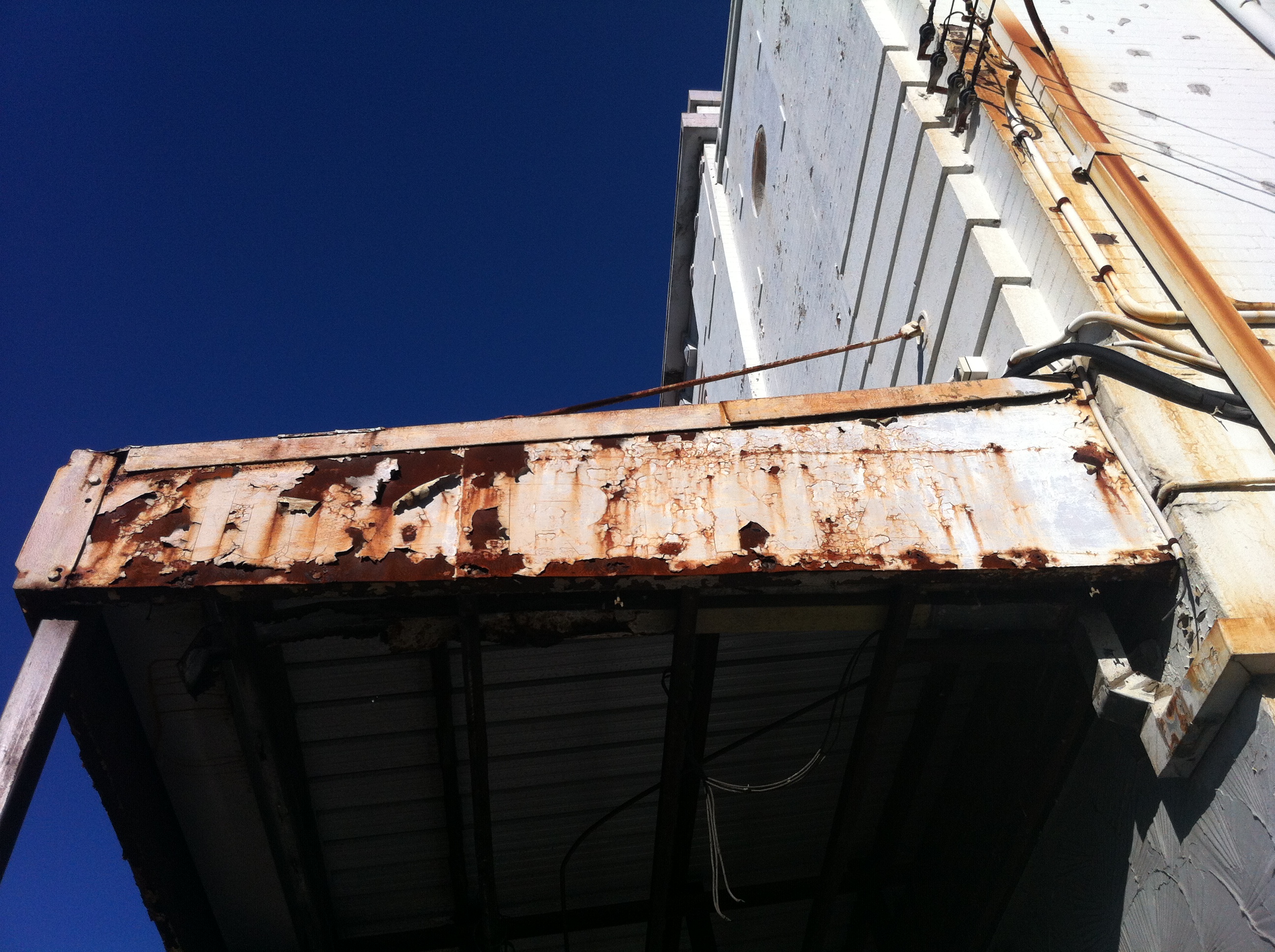
Can you see it? Look really closely, and maybe try squinting. Still no good? Okay, let’s get a bit closer…

How about now? The ‘R’ or maybe the ‘N’ should hit you first, and then from there it’s easy. Yes, amazingly, the awning’s decorative ‘MARINA’ lettering has somehow survived, allowing us an even deeper glimpse into the past than it was thought possible. Now all we need to do is arrange a screening of ‘Puddin’ Head’ inside. Maybe we should get in touch with the owners?
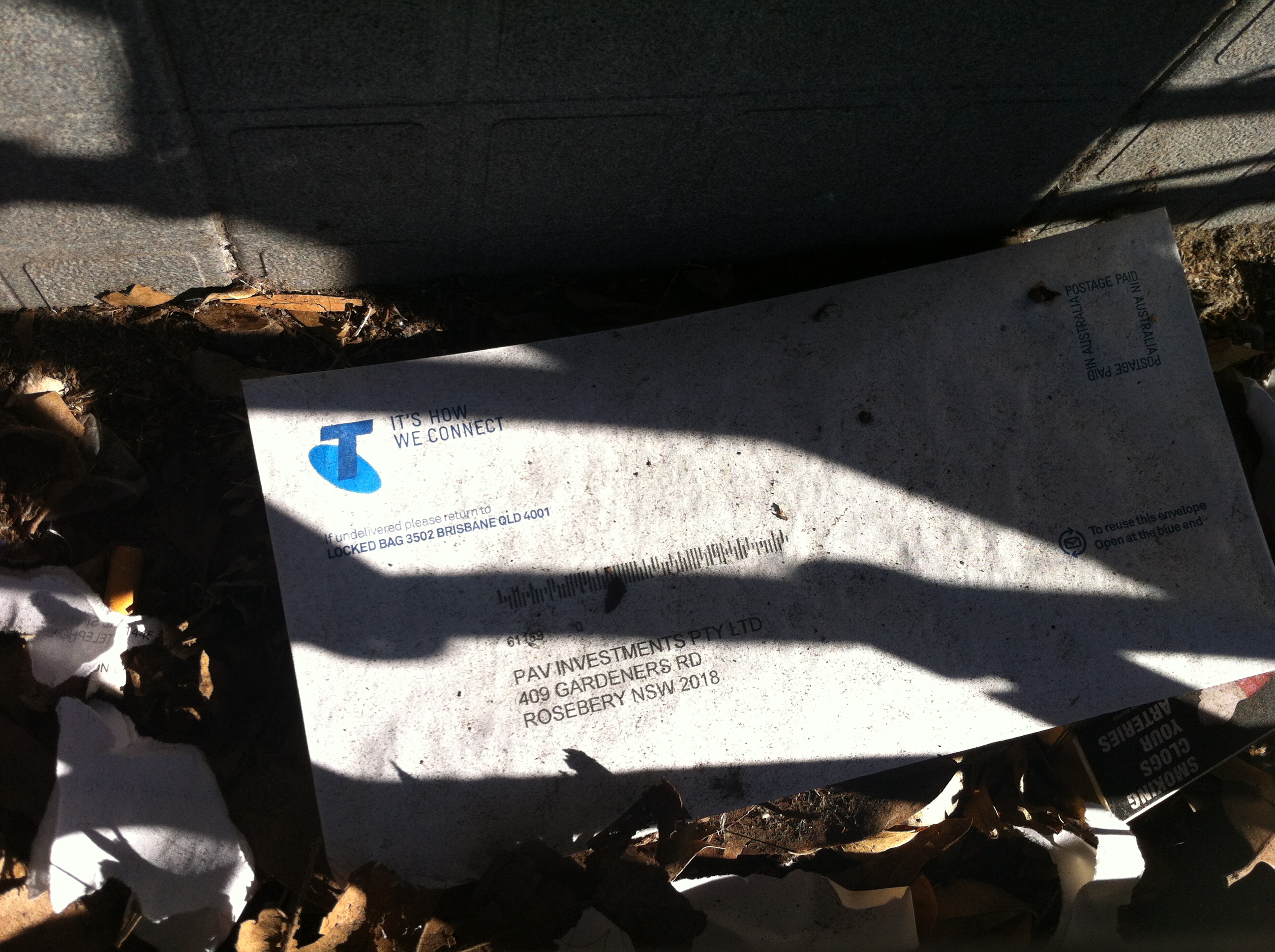
We’re in the home stretch now, only three to go. Here’s a clue for the next entry: it’s another theatre.
ROCKIN’ UPDATE: The development-minded Vlattas family, owners of the Cleveland Street Theatre and the Newtown Hub, are currently renovating the Marina with the aim of turning it into a live music venue. My suggestion: keep Leonardo as your bouncer. Thanks, reader Rozie!
Past/Lives Flashback #5: The Hartee’s Saga, Part V: Hartee’s Revenge – Manly Vale, NSW
Original articles: The Hartee’s Saga Parts I, II, III and IV
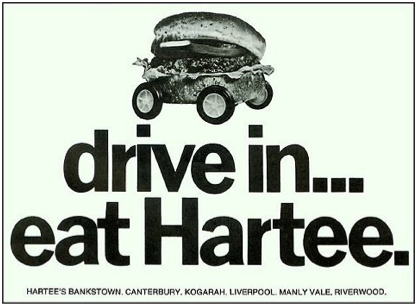
Sometimes it’s hard to keep a good burger down. For those who haven’t followed the long, sad story of the Hartee’s hamburger franchise, here’s a quick recap.

Hartee’s Earlwood
With the advent of American fast food franchises in Australia in the late 60s and early 70s, Kelloggs teamed with the US-based Hardees burger chain to start Hartee’s, the first Australian fast food restaurant (despite its very red white and blue beginnings).
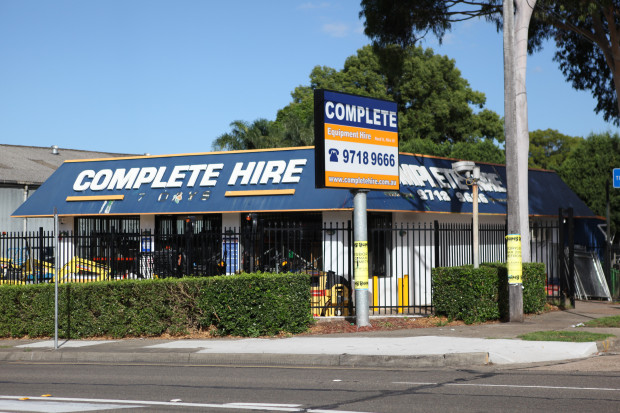
Hartee’s Canterbury.
It was a near-instant success. Whether it was down to underlying xenophobia towards overseas brand names, smart management or just plain delicious burgers, by 1973 Hartee’s was king of the fast food hill in Australia.

Hartee’s Punchbowl.
Complacency became the daily special from then on, with a series of extravagant HQ upgrades and new outlets sprouting like weeds all over Sydney. Despite this, the chain was beginning to haemorrhage cash at a pretty severe rate, and McDonald’s was aggressively making major headway into the Australian scene. Something had to give.
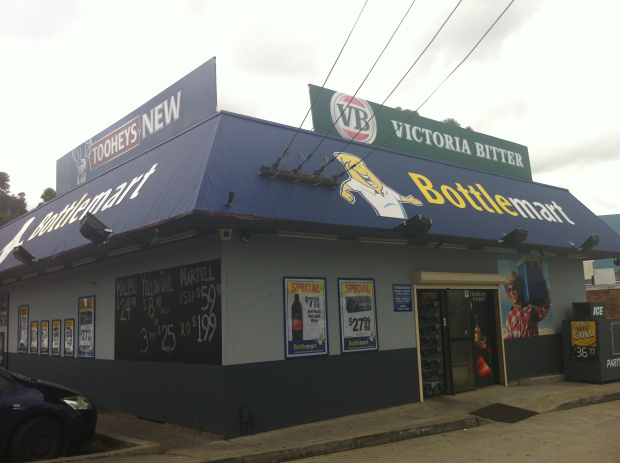
Hartee’s Bankstown. Not pictured: the Pal delivery truck.
And give it did, here at the Bankstown Hartee’s in 1975, when a current affairs program, acting on a tip-off, exposed the outlet as having served dog food in burgers. Overnight, Hartee’s packed up and disappeared, leaving only husks behind, and that’s where the story seems to end.
Except thanks to reader Phil, there’s a final piece of the puzzle to be put in place. I’d previously written that only the four former Hartee’s above still existed in any form around Sydney… Well, we all make mistakes. Just ask Bankstown Hartee’s.
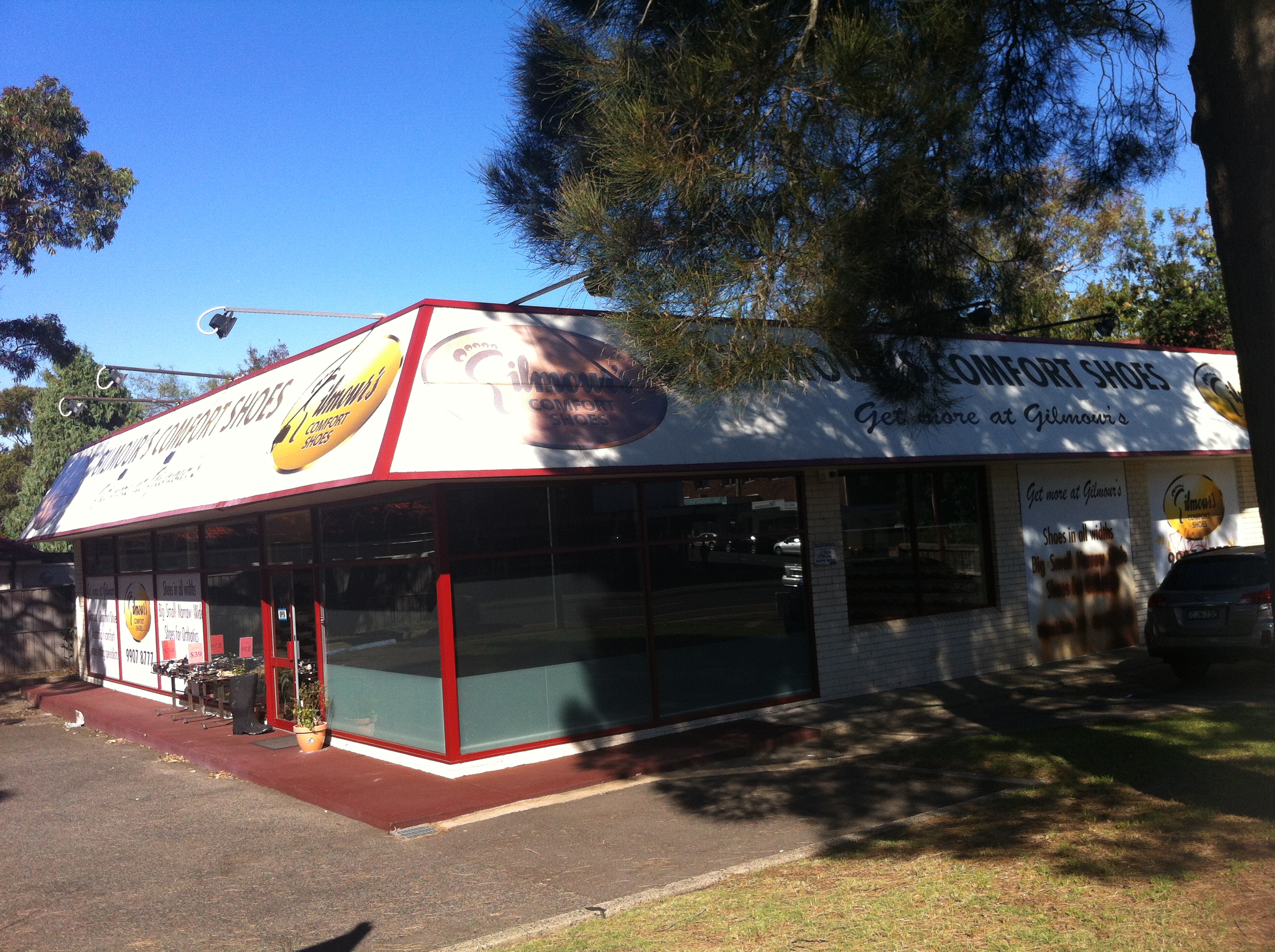
Behold, the Manly Vale Hartee’s still stands. It’s currently Gilmour’s Comfort Shoes, but it pretty obviously fits in with the Hartee design.

In fact, this may be the most well-preserved Hartee’s still in existence. The Gilmour’s sign appears to be stuck on over the red roof, so it’s possible the Hartee’s logo remains underneath.

The original lights are still in place, designed to illuminate the Hartee’s name. Also still in place, as per Phil’s advice…

The original outdoor seating area! Now it’s presumably the shoe shop manager’s car park (c’mon, look at the prestige offered by that strange piece of land). Inside are just shoes, but really, they’ve served worse and called it burgers.
It’s not really a happy ending, or an ending at all, but it is (I’m guessing) the final footnote on what by now must be the most definitive account of the Hartee’s affair out there. There are still many mysteries surrounding the story (truly, more questions are raised than answered), but maybe one day one of those faceless, guilt-ridden Hartee’s executives will come out of hiding and reveal more. Hell, I’d even settle for the guy who served the dog food. As ever, if you know more, please let Past/Lives know. And RIP Hartee’s – we hartlee knew ye.
In the meantime, let’s take a minute to remember those four powerful words that watered more mouths than Mount Franklin, that were a city’s guilty pleasure in a time before Big Macs and Whoppers…in a time when a nation could feed itself.

Hartee’s Kogarah, November 1973. Image courtesy State Library of NSW.
Past/Lives Flashback #6: Regent Street Station – Chippendale, NSW
Original article: Mortuary Station/Regent Street Station – Chippendale, NSW
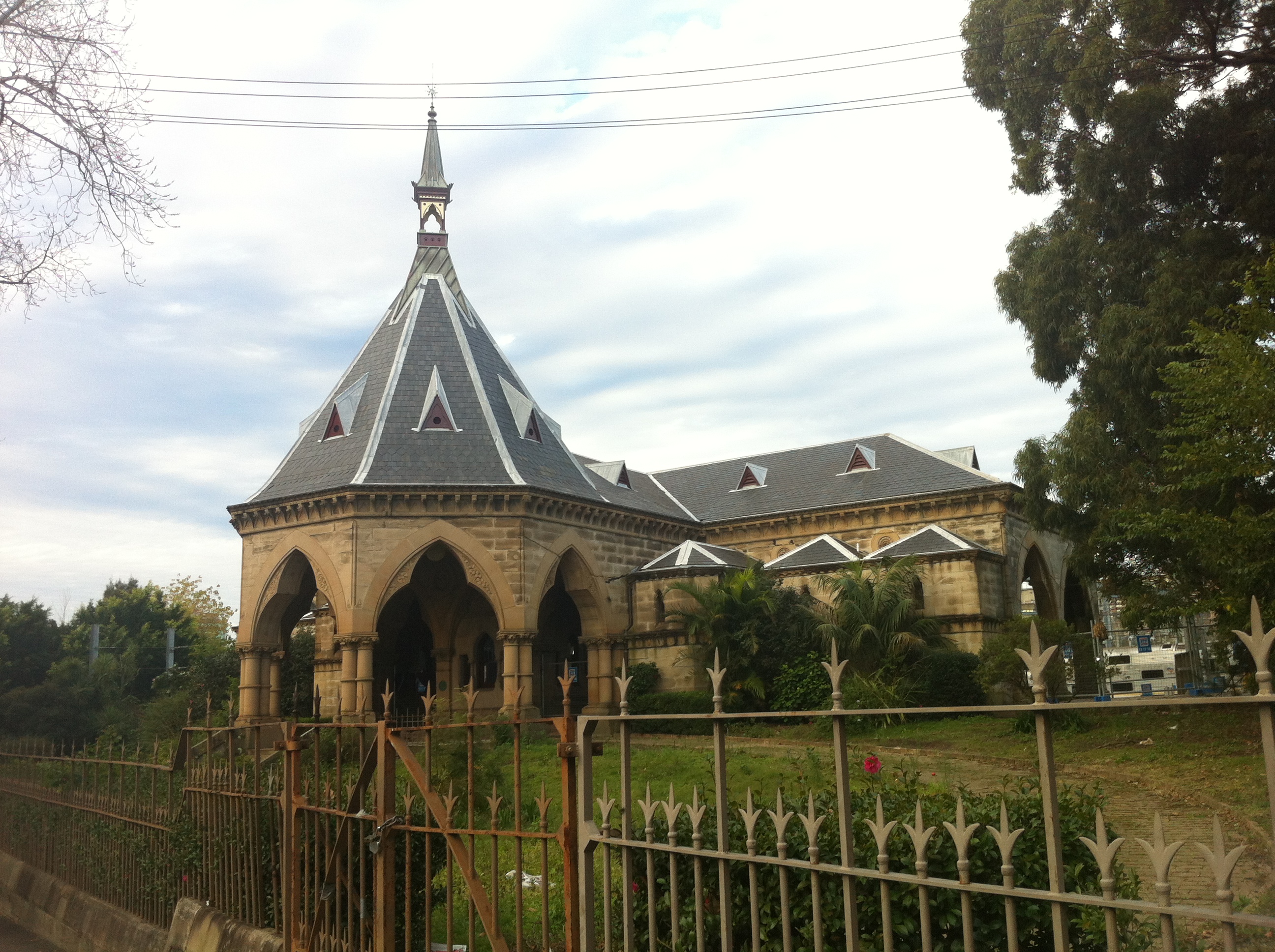
When you’re a 144-year-old building custom built for a purpose long redundant, excitement comes in fits and starts. A renovation here, a graffiti attack there. Occasionally you’ll have a tour group come through, but with today’s concerns, even that’s a rare treat.
And so goes the continued existence of Regent Street’s Mortuary train station.

Continually hogging the city’s rail refurbishment efforts (c’mon, Central needs some attention! It’s a dive), ‘Ol’ Morty’ sits where it’s always sat, a stranger to change and a fully functioning time warp. If you want to go and see it, it’s a safe bet to put it at the bottom of your ‘To Do’ list – this place will likely outlive you.
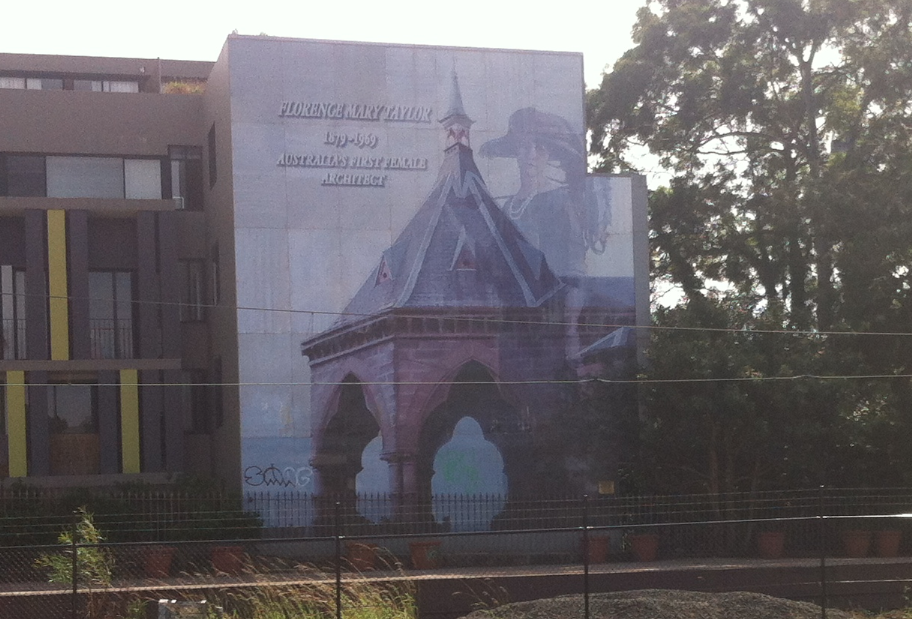
So with that in mind, let’s take a look at the curious mural that stands beside the station facing east. I mentioned this last time, and it continues to baffle me.
Florence Mary Taylor arrived in Sydney in 1884. Her father worked for the sewerage division of the Department of Public Works, and she would assist him in his work. When he died in 1899, Florence studied architecture and became a draftsman, going on to co-found the Town Planning Association of NSW in 1913 and joining the Institute of Architects in 1920. As the mural itself says, she was Australia’s first female architect.
When her husband George Taylor died in 1928, Florence continued to edit and publish three of their eleven engineering journals. She died at Potts Point in 1969, leaving behind a legacy of achievements (including becoming the first Australian woman to fly in 1909) that did much to further the public acceptance of women in industry.
Which is all fine – but I’m still not sure what she has to do with the Mortuary Station, which was completed ten years before her birth. As I’ve mentioned, the Regent Street station and its receiving end were designed by colonial architect James Barnet.
Still, using the ever eye-catching station to highlight Taylor and her achievements isn’t a bad thing at all, even if her ideas are more ingrained in Sydney’s layout than seems obvious. Throughout her career, Taylor was an advocate of, among other things, a harbour tunnel crossing, a distributor freeway in the Eastern Suburbs, and somewhat less popularly, the demolition of Hyde Park Barracks. Maybe that’s why there’s no mural of her there.
Past/Lives Flashback #7: Rick Damelian – Leichhardt, NSW
Original article: Rick Damelian/For Sale – Leichhardt, NSW

Over the last year, you’re likely (I would hope) to have enjoyed a healthy bank balance, a good credit rating, a roof over your head. Simple stuff that the people of Sydney take for granted. Rick Damelian on the other hand…

When we last left the epic tragedy that is the Rick Damelian saga, things weren’t looking too good for both Rick and his former dealerships. Despite their desirable location along Parramatta Road at Leichhardt, the caryards, weren’t attracting any offers, and Rick himself was staring down the barrel of a pretty severe bankruptcy.
But hold on. Look there, in the window…is that what I think it is? Let’s take a closer look.

Your eyes aren’t deceiving you. In November 2012, these showrooms finally sold, and since then have returned to doing what they did so well at the peak of Rick’s success – selling cars.

Even on the roof, Rick’s private helipad has been obscured by a legion of cars. The staff might want to check to make sure Rick isn’t living in one of them.

Remember Ric’s Cafe, the on-site licenced restaurant that was the jewel in the crown of Rick’s decadence? It’s since been replaced by even more cars! It’s funny, Rick might not be in the situation he’s in today if he’d just thought to sell a few more cars instead of food and helicopter rides. Live and learn, I guess.

Further down the road, a modestly priced used car dealership has set up shop on Rick’s old turf. So toxic was the land, so tarnished was the site’s reputation as a car seller that the signs feel the need to be as explicit as possible: “WE BUY CARS! WE SELL CARS!”. It’s a trick Rick didn’t seem to be able to employ in his last years: speaking the language of the customer. Having cars onsite helps too, I’d imagine.

Rick’s old bedfellow, Honda, has returned as well. Formerly the core of Rick’s sales strategy, Honda left Rick holding the bag when the Japanese tsunami decimated their inventory, and some speculate that this marked the beginning of the end of the Damelian empire.
Yet here they are.
Fancy that: it’s easier to come back from the ravages of a tsunami than it is to survive Rick’s management.

One thing Honda has held onto are Rick’s ‘Dealer of the Year’ awards. I can see what Honda’s trying to do…but Honda – you issued these awards. It’d be like me giving myself the ‘Blog called Past/Lives of the Year’ award.

Over the road, Morris has set up shop at the old Rick Damelian Prestige lot. A few examples of Rick’s flamboyance remain: the floodlights, the pointless sign on the far left, the Hollywood-style palm trees. But the cold, impersonal MG style sits heavily at odds with these elements, further highlighting their uselessness. But fortune hasn’t been so kind to the man himself. As Rick Damelian and his wife sit together in their $3.3m McMahons Point townhouses, arguing over whose turn it is to heat up the beans tonight, the banks and other creditors hover over him like a hawk. Should he decide to sell his two townhouses – thereby leaving himself, his wife and his mother homeless – he’s so in debt that he’s likely to receive nothing. It’s reported that Rick has just $73 left in his bank account, and can’t even afford to buy a car. You really have to feel for his wife at a time like this…with no car, she may never get off her Ls.
After nearly 40 years in car sales, Rick’s biggest accomplishment was establishing his own name. That’s not necessarily a bad thing – take Dick Smith for instance – but it meant that Rick’s triumphs and tragedies didn’t stick to Honda, or Fiat or whatever brand of car he was flogging at the time, they stuck to him.
$200m-a-year sales? “Damelian’s business savvy creates sales juggernaut.”
Your new car sucks? “I wouldn’t buy from Rick Damelian again.”
While it’s true that the financial crisis hit everyone hard, Rick’s lavish showrooms didn’t help him weather the storm. And since he put himself forward so often, it was his name that thousands daily saw stagnating as they passed his high-visibility caryards at the top of Taverner’s Hill.
No matter what should happen in the future, the name Rick Damelian will forever be tied to car sales, and there are plenty of dealers who would kill for that kind of association. At least in his downfall, Rick has provided a cautionary tale for the next generation hungry to make an impact as the world’s financial situation improves. Fitting then, that it appears it’s harder to expunge Rick’s name from his old dealerships than it is from bankruptcy court.
Past/Lives Flashback #8: Sydney Olympic Park – Homebush, NSW
Original article: NSW State Abattoirs/Sydney Olympic Park – Homebush, NSW
 It’s hard to believe it’s been a year since I last visited this place. The blood-soaked history of Sydney Olympic Park is perhaps the most heavily researched article on Past/Lives, yet all that knowledge is quick to fall away when you’re actually standing on site, inhabiting the space where it all went down. The post-Easter Show cleanup only serves to strip back the gaudy decorations designed to distract from the past, leaving today’s visitors with one of two visions: the glorious Olympics, or the violent abattoirs.
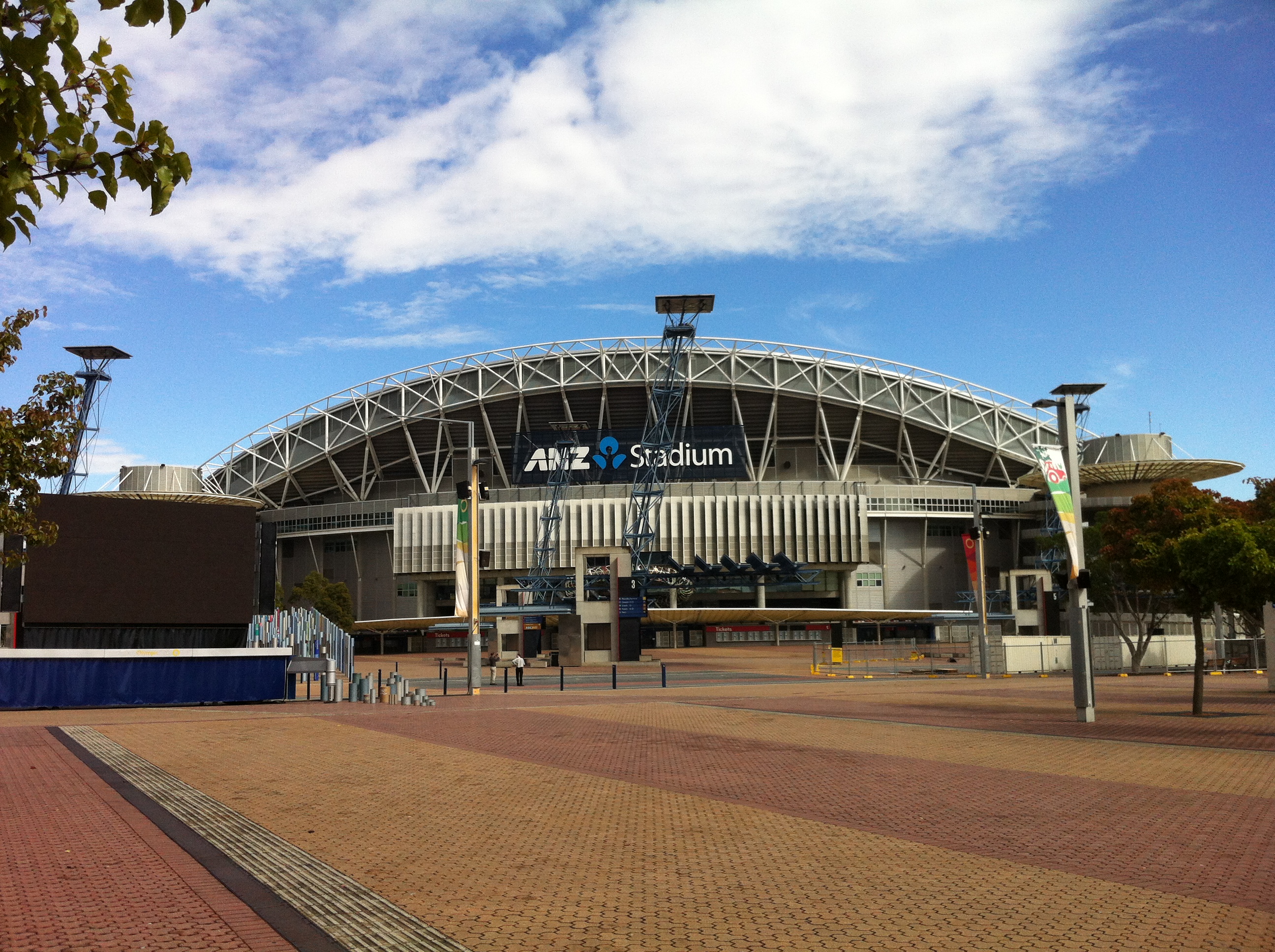
Apart from the hubbub surrounding the Easter Show, change visits the Olympic zone about as often as I do (read: not much). The stadium seems to have settled on ANZ as its name for the time being, just as the arena’s heart still belongs to Allphones. During my refresher course on the ins and outs of the Olympic era of the site’s history, I laughed when I learned the arena’s actual name is the ‘Sydney Super Dome’. For the first time ever, Allphones sounds comparatively low-key.
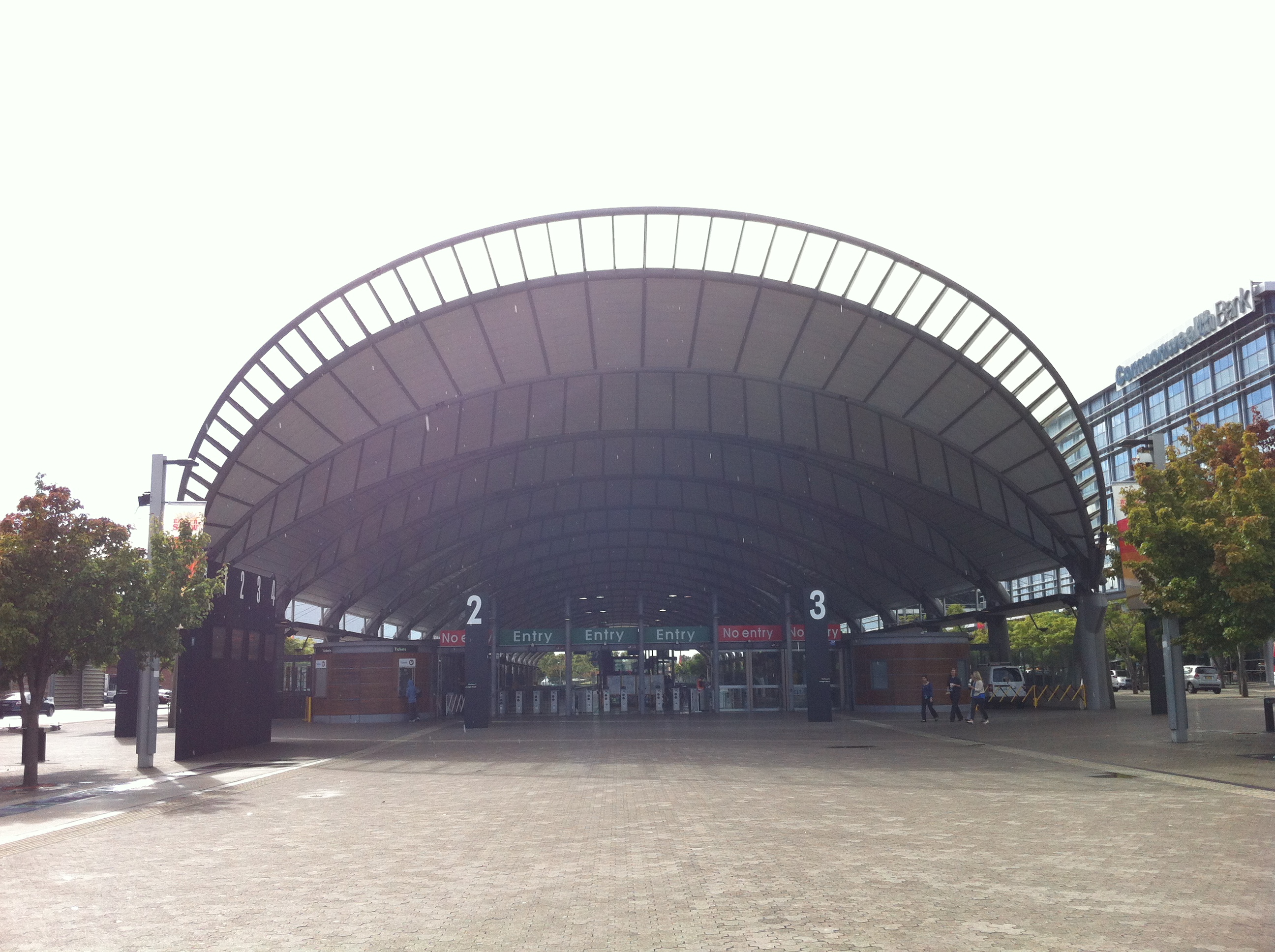
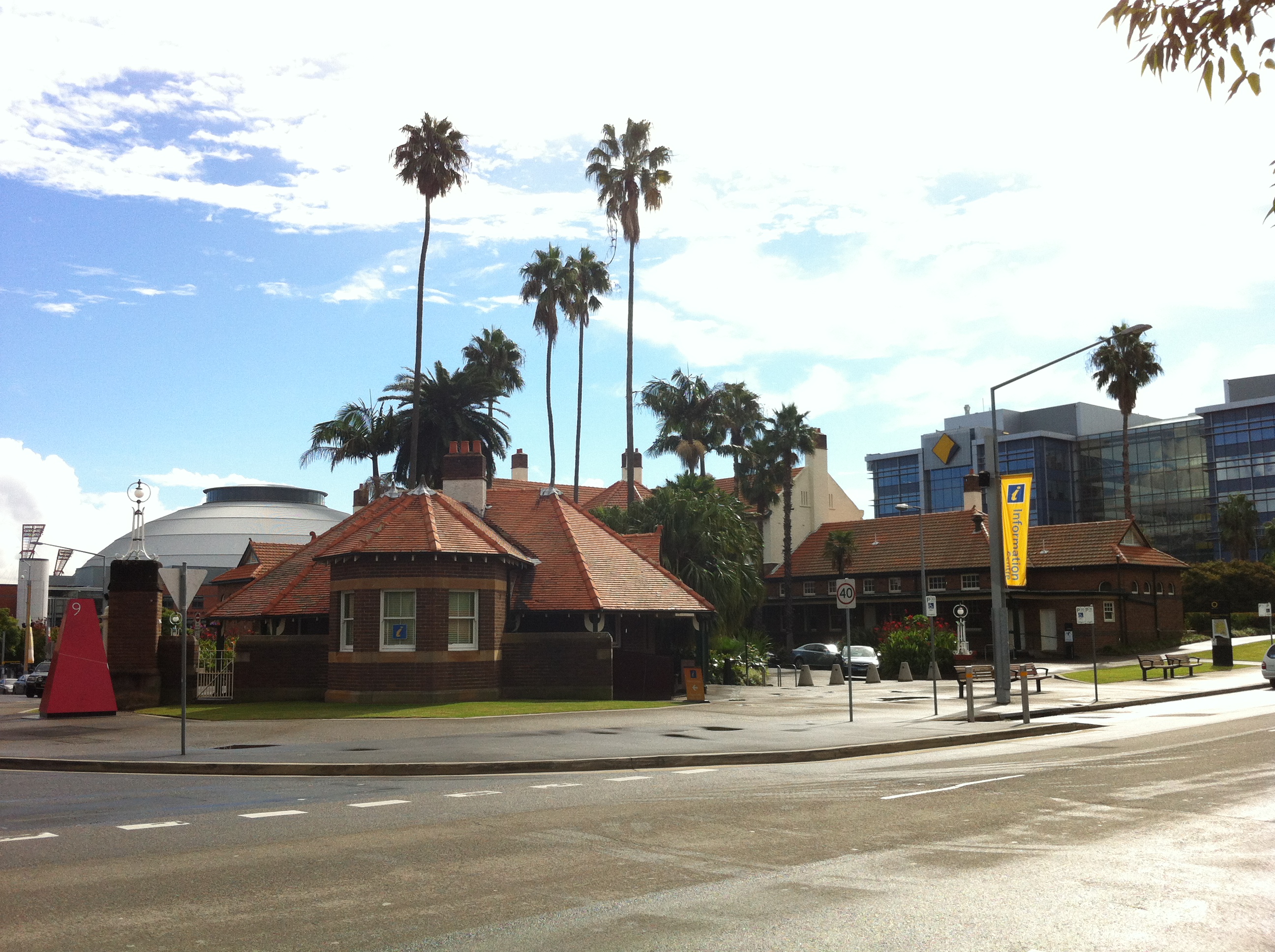
So since change is such a stranger here, it’s going to be more beneficial to take a look at some of the landmarks around the Olympic site that betray its brutal past. We didn’t touch on too many last time, with the Abattoir Heritage Precinct being the natural focus. First up is Olympic Park station, the last stop of the train line which delivers thousands of Easter Show-goers to the park each year…
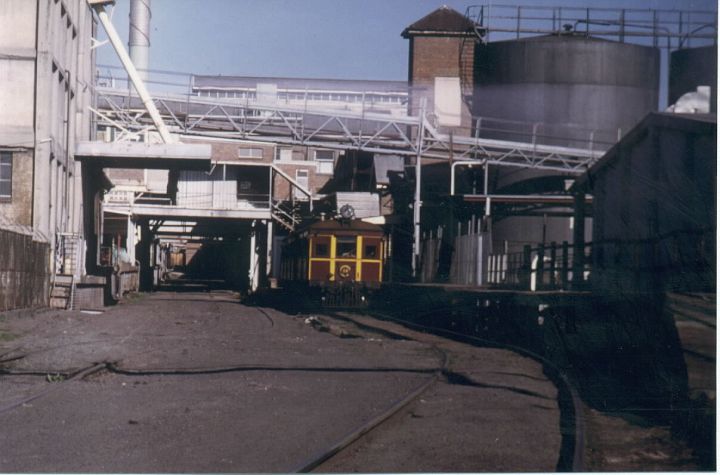
Abattoir platform, 1982. Image courtesy Graeme Skeet/NSWrail.net
…just as it delivered hundreds of thousands of animals to their deaths each year for decades, some as recently as 25 years ago. Granted, it isn’t the exact same station (although if it was, abattoir workers would have enjoyed the most stylish station in Sydney), but its location is approximate to the original. A complete train line (with stations opening from 1915) served the abattoir and the nearby brickworks, with country trains deviating from the existing rail network at Lidcombe and Flemington to deposit country animals to the abattoir. Employees could catch their own trains from a small platform at the end of Pippita Street, Lidcombe.
As the abattoir declined, the need for employees did so as well, and in 1984 the abattoir line was closed, with the facility itself closing in 1988. The entire Homebush Salesyard Loop, on which the Olympic Park line is based, was closed in 1991. In 1996, the Pippita Street station became the last of the abattoir stations to be demolished, and interestingly, the street itself was absorbed into the huge Dairy Farmers site nearby (now, why do you think that’s there?). The brand-spanking-new Olympic Park loop line opened in 1998, with most of the Homebush Salesyard Loop repurposed to be a part of it.
Now, since that was a little…dry, let’s get wet.

The Sydney Olympic Park Aquatic Centre was the first part of Olympic Park to be constructed following the closure of the abattoir, unless you count Bicentennial Park, which opened in 1988. The Aquatic Centre opened in 1994, with the rest of the park completed by 1996. As such, the Aquatic Centre is the ‘middle child’ of the Olympic Park, with a design sensibility halfway between Bicentennial Park and the stadiums that followed. It’s a strange beast, and one made even stranger by my near-absolute certainty that when it first opened, its entrance was in fact this:
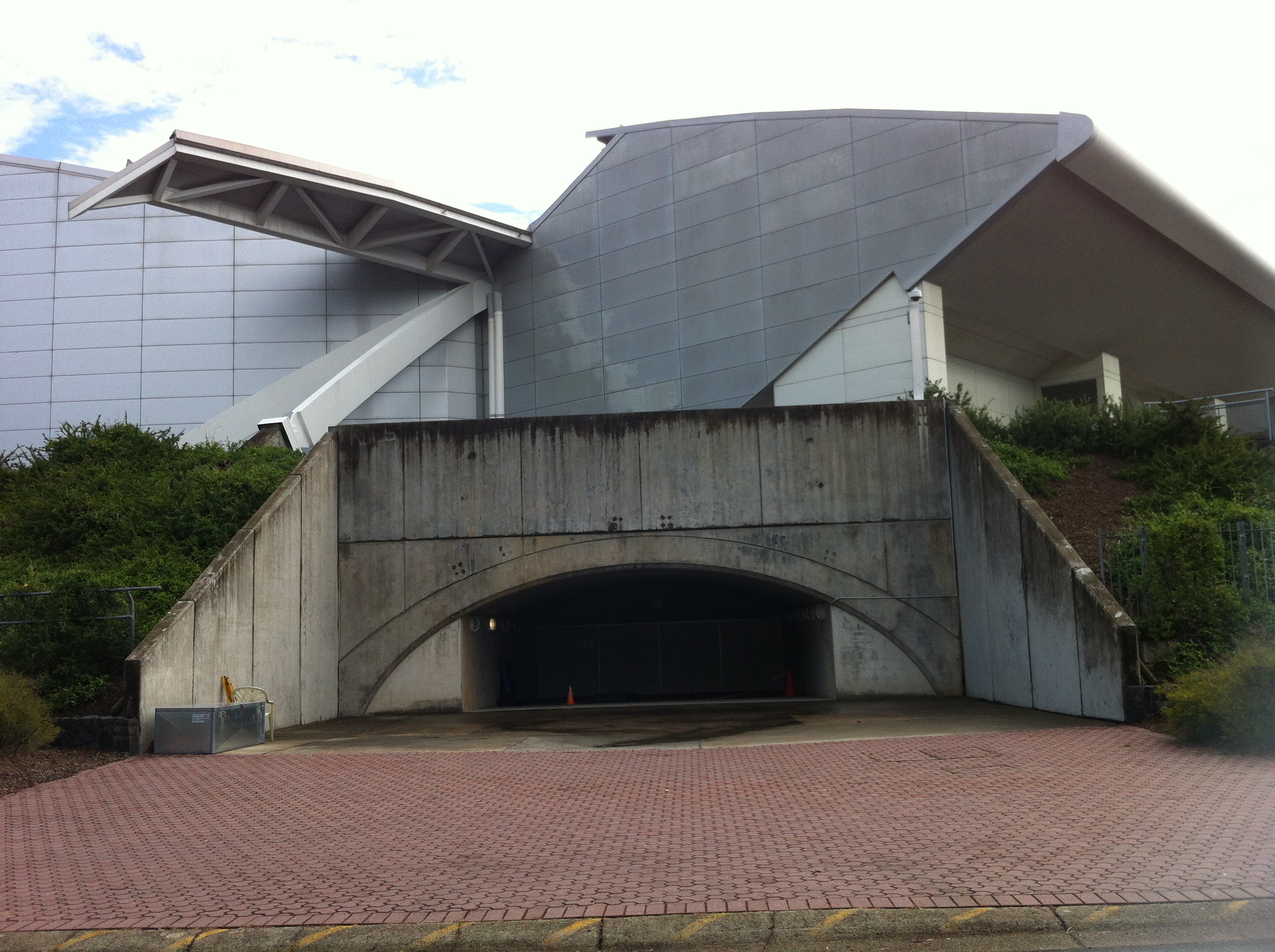 Sometime in 1995, I attended a birthday party at the exciting new Aquatic Centre, which was rumoured on the playground to have a whirlpool and slides. I don’t remember any slides, but I do have a distinct memory of our posse leaving behind a rubber WWF wrestler toy, tossed high up in those bushes on the left in a fit of excitement…while we were hanging around the entrance. Does the Iron Sheik still reside in those bushes today, subsisting on a diet of ants, rainwater and the occasional small bird? Nearly 20 years later, I still wasn’t game enough to climb up and find out. But I did go in for a closer look…
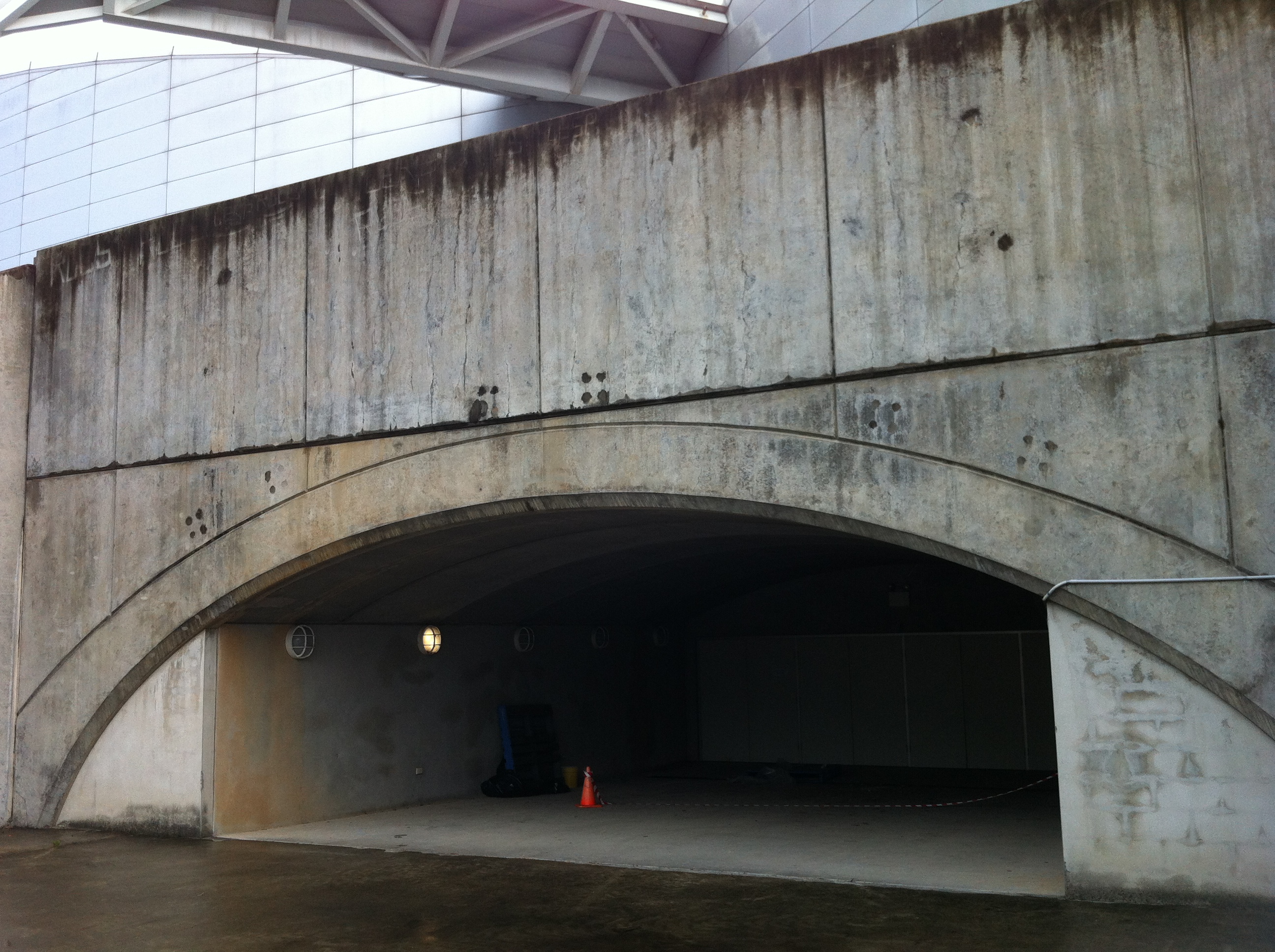
The appearance of those bolt marks, where the original entry sign was probably attached, seems to validate my memory of this being the main entrance. The doors underneath now serve as an emergency exit. If anyone can shed some light on this mystery, drop a line in the comments below. My theory is that when the Aquatic Centre opened, the entrance was here because it faced away from the abattoir site (and at the time, a huge construction site), but when the rest of the park was completed, the entrance was moved around to the opposite end of the facility, a spot which pretty much faces the Abattoir Heritage Precinct (and everything else, in keeping with the Olympic spirit of inclusion and togetherness). Today’s entrance looks a lot more ‘Olympic’ anyway, so it was probably a change for the best. Still…
 Our last stop is just down the road from the Aquatic Centre. Back in the 70s and 80s, Swire (then Woodmasons Cold Storage) would have been one of the places to store the freshly processed animal carcasses on ice before being shipped to the nearby butcheries and markets. For a cold storage facility (and for Dairy Farmers), this was the perfect location…when the abattoir was there. How it’s still able to do business is a stone cold mystery, but I guess that’s why they’re no longer Woodmasons.
See you next time, when we’ll attempt to go for a drive…

 Past/Lives of the Near Future