Shea’s Creek/Alexandra Canal – Mascot, St Peters, Alexandria NSW
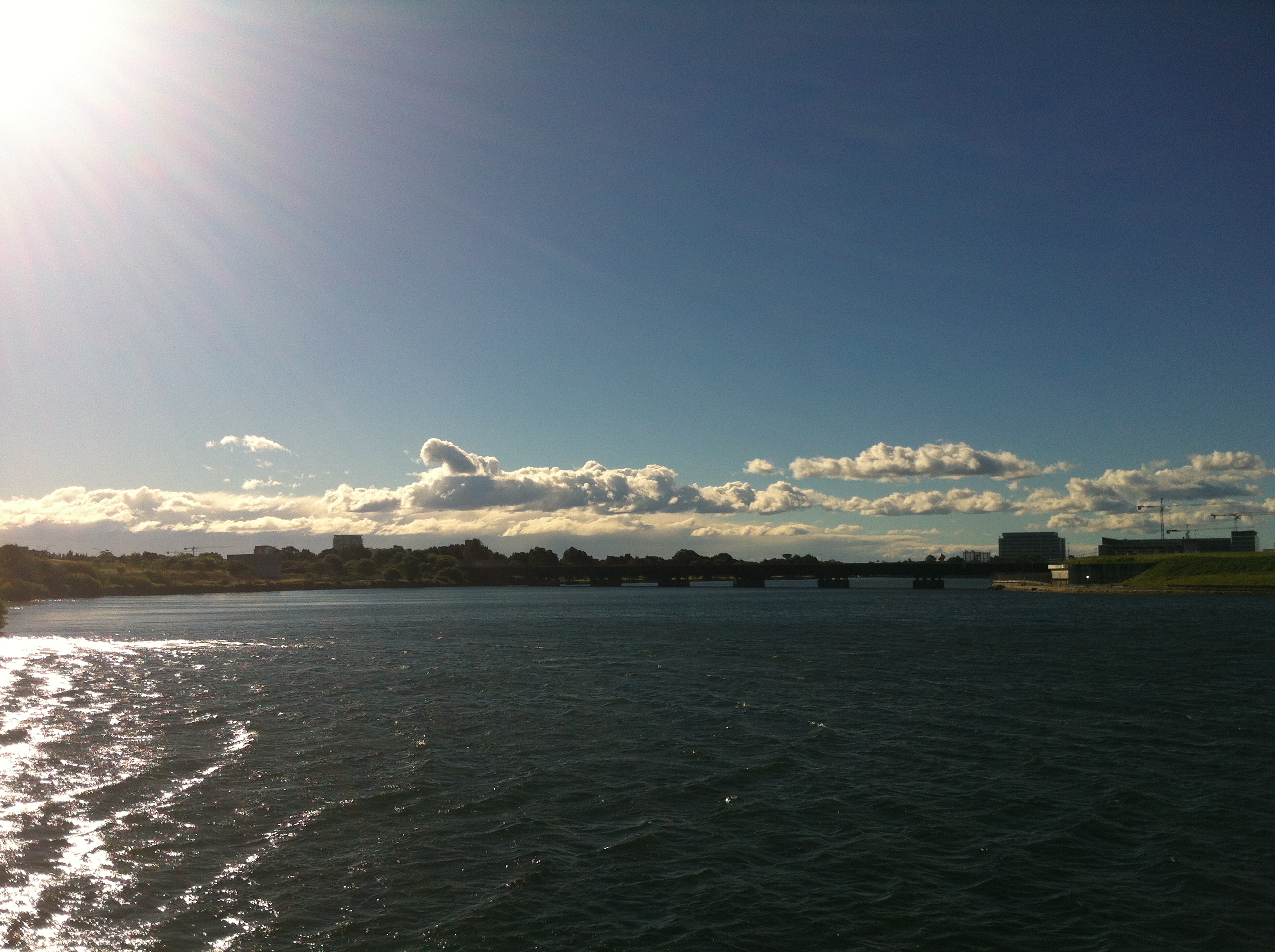
Cooks River
You’re looking at Sydney’s most polluted waterway. And I thought Rhodes was bad.
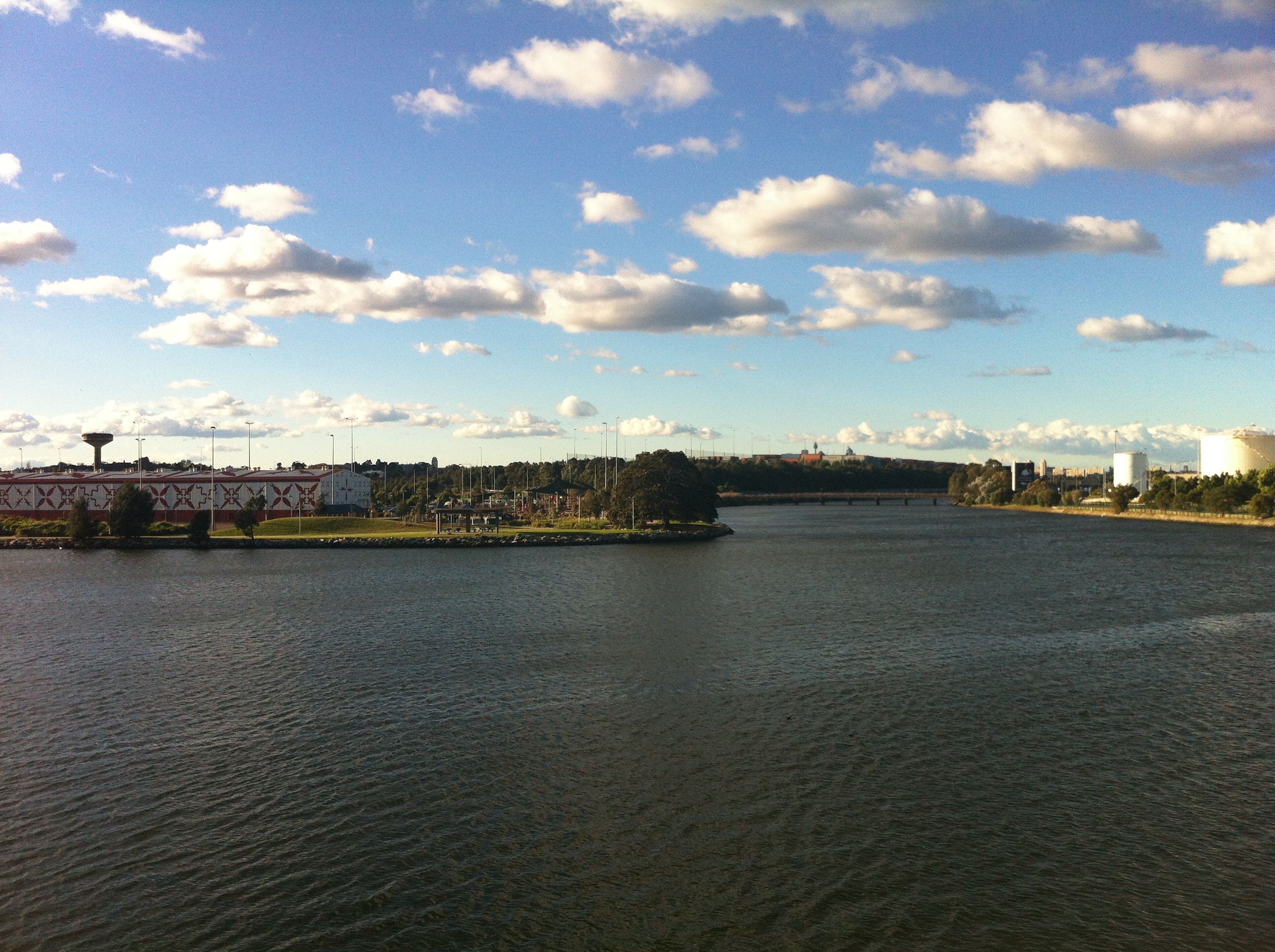
The Botany Bay end of Alexandra Canal
In the late 1880s (it’s always the 80s), someone envisaged a grand canal stretching from Botany Bay to Sydney Harbour. It would start at the Botany Bay end of the Cooks River, and lead all the way through the city before opening up at Circular Quay, thereby giving the Eastern Suburbs the island refuge from the great unwashed they’ve always wanted. To that end, I’m surprised it never happened.

Former Shea’s Creek opening
Shea’s Creek, a small offshoot of the Cooks River, was chosen as ground zero for the new tributary, which was supposed to act as an access route for barges to transport goods between the multitude of factories set up along the creek in the area. Factories including brickworks, tanneries and foundries. Factories that drained their runoff directly into the canal. A canal that is, according to the EPA, “the most severely contaminated canal in the southern hemisphere”. So keen to pollute were the industrial warlords of yesteryear that they had to invent waterways to defile.

At the time the canal was constructed, Sydney’s roads were a terrible mess completely unsuitable for transporting goods, making an aquatic access route more practical. Thankfully, Sydney’s roads today…uh…they…they’re pretty uh…let’s get more canals happening.

So near and yet so far
Between 1887 and 1900, Shea’s Creek was ripped up and turned into the canal. By 1895 it was looking unlikely that it would ever reach Sydney Harbour. The NSW Government had decided that as a sewer, the Shea’s Creek Canal as it was known then was doing a good enough job as a carrier of stormwater and runoff, and that there probably wouldn’t be a need to spend all those pounds carrying on with the project. Tenders were called again to complete the canal in 1905, but there were no takers.
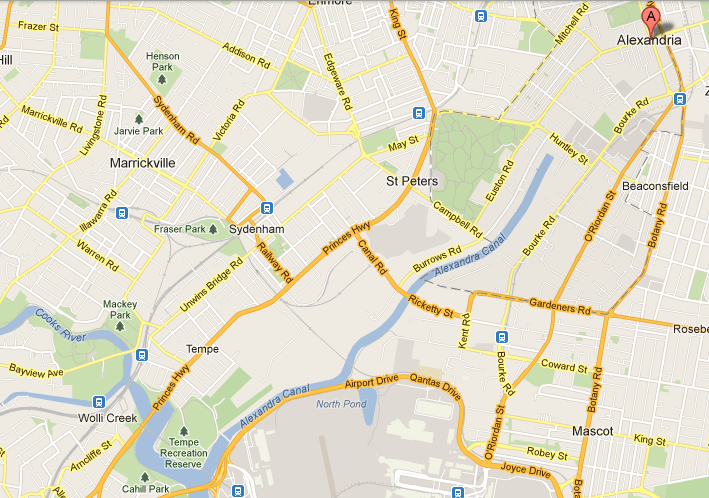
Image courtesy Google Maps
The canal was renamed the Alexandra Canal in 1902, after the then-Queen Consort Alexandra. Coincidentally, the suburb that the canal ended in, Alexandria, was also named for her. I bet she was proud, too.
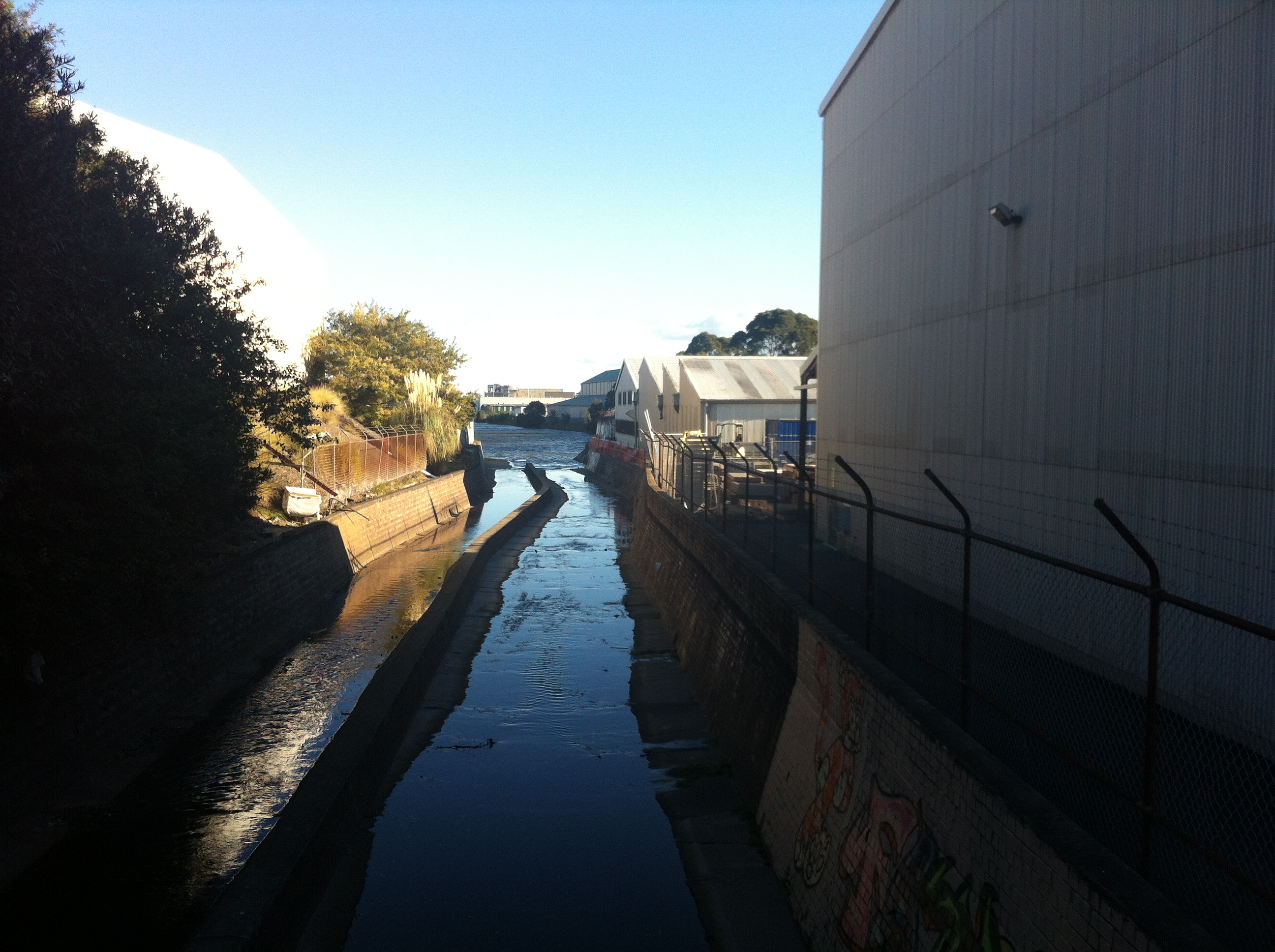
From a scream to a whimper
This is how it ends. The mighty canal winds down to a stormwater drain, which then continues to wind up through Alexandria before disappearing. Apparently, the cost of the already 4km canal was so prohibitive as to cancel the rest of the project. It might also have been that the powers that be were trying to save lives, for in creating the Alexandra Canal, they had also created…a bloodthirsty monster!
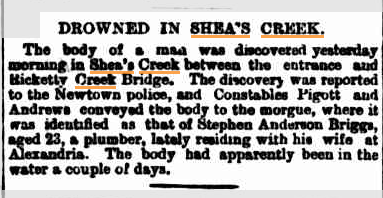
Sydney Morning Herald, 11 Dec 1903
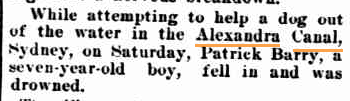
Horsham Times, 13 Jun 1919
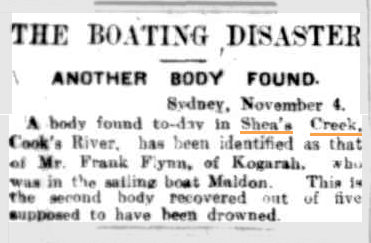
Adelaide Advertiser, 6 Nov 1922
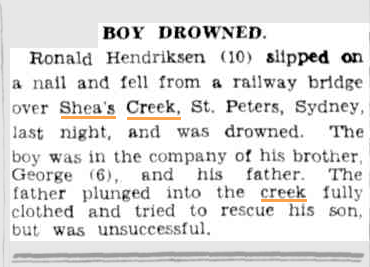
Courier Mail, 15 May 1934
There have been several attempts since 1998 to clean up the canal, add cycleways (more cycleways!), cafes and restaurants, and generally make it a nice place to be.

As you can see, it hasn’t happened yet. Maybe when the city’s insane lust for cycleways finally stretches the canal to Sydney Harbour, that fantasy can be realised.
The Plaza Theatre/Maxy’s Roller City/Planet Hollywood/McDonald’s – Sydney, NSW

Image courtesy Simon Fieldhouse.
Sydney’s Plaza Theatre was once one of many elegant cinemas and theatres lining George Street’s entertainment strip. Like many cinemas, its business was damaged by the advent of television, and today it has the distinction of being arguably the world’s fanciest McDonald’s.

McDonald’s George Street interior, 2012.
Built for Hoyts in 1930, the Plaza sat alongside venues such as the Century Theatre (which became an indoor BMX track in what could only have been the 80s) and the Crystal Palace Arcade.

Erecting the neon sign, The Plaza Theatre, 1935. Image courtesy State Library of NSW.

Hoyts Plaza Theatre, 1966. Image courtesy City of Sydney Archives.
Despite many of its contemporaries being bulldozed around it, the Plaza stood firm until 1977, when it was closed as a cinema and reopened as Maxy’s, a disco skating rink. The changing face of entertainment.

The Plaza as Maxy’s, 1983. Image courtesy Helen Grant/Sydney Cinema Flashbacks.
Surprisingly, the idea of a disco roller rink wasn’t fashionable for long, and the Plaza played host to Mickey D’s and video arcades for most of the 1980s.
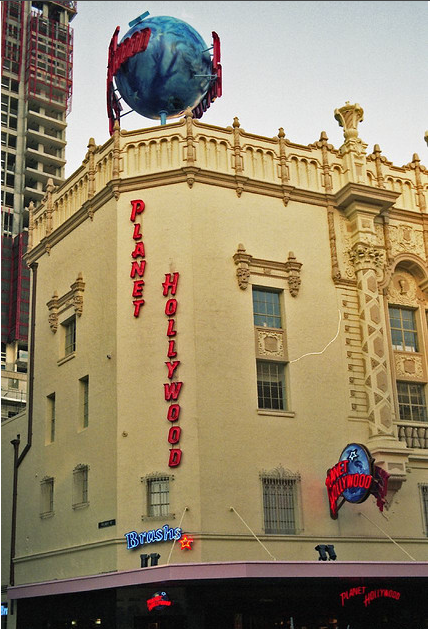
Planet Hollywood Sydney, 1996. Image courtesy Steve Newbury.
The Plaza’s northern end was once again immersed in the world of cinema in 1995 when the Stallone-Schwarzenegger-Willis-Moore joint Planet Hollywood came to Sydney, establishing itself in the former arcade. According to this photo taken in 1996, PH shared its space with Brashs, another 90s success story. By 1999, both ventures would be out of business.

Today, some lazy entrepreneur has taken the already-tacky Planet Hollywood aesthetic and adapted it into the Star Bar, another of modern George Street’s entertainment offerings. Not sure how many stars you’d see here these days. The Plaza in its present state is yet another example of Sydney trying to disguise the brazen pimping of itself to the lowest bidder by hiding behind facades of the past. If it looks vintage, it seems that much more respectable. What isn’t considered is that drunken eyes can’t appreciate all the lovingly preserved heritage fronts, and as George Street continues to slide into the gutter, the death grip it has on these buildings only serves to drag their illustrious reputations and history down with it.
STAR STUDDED UPDATE: Reader Cameron says: “Star Bar was originally created by Planet Hollywood to replace Brashs when it failed which had the same owner, Star Bar was created so Planet Hollywood could profit from gambling without tarnishing its family image. The two coexisted for a while. A bizarre fact, this restaurant was a real cash cow and extremely profitable when it closed, a case of embezzlement I believe. The real crime there was the removal of the original cinemas Spanish themed ceiling for the extra headroom and replaced with a high blue ceiling. The Star Bar is now run by the same group that has the even tackier Shark Bar! now with no sharks……”
Sounds like the sharks haven’t left at all, actually. It’s almost inconceivable that shady types would be running places like this (especially the Shark Bar), but there you go. Thanks, Cameron!
Bristol & Co Real Estate/Map World/Citymart – Sydney, NSW

The idea of a small real estate agent such as Bristol & Co. sitting in the middle of the city seems strange now. It’s hard to imagine that a small fry like Bristol could ever compete in an environment full of franchises and big name firms. Likewise, the current incarnation of the building, Citymart, seems ill-equipped to compete with the 7-Elevens and City Conveniences of downtown Sydney, primarily because it’s closed and near empty.
Map World is another instance of a shop too small for its ambitions. It probably did alright in 2000, but in an age where everybody’s phone knows the city better than your average taxi driver, Map World’s pretty much fallen off the map. With a track record of three duds, maybe it’s just an unlucky shop.
Western Distributor On-Ramp/Road Hammock – Sydney, NSW

Here’s something completely stupid: this carriageway is the Western Distributor passing over Kent, Day and Margaret Streets near Wynyard. Below it is…a bit of road that…goes nowhere, and does nothing.
The Western Distributor began life in the early 1960s as a way to relieve traffic on the Harbour Bridge. Sydney’s extensive underground rail system meant that the Distributor couldn’t be built as a series of tunnels, so viaducts were the sensible alternative. That’s where the sense stopped.
The only reason the Western Distributor existed was because the designers of the Harbour Bridge and existing road system didn’t use enough foresight. You’d think that planners of the WD would employ twice as much foresight to make sure that further modifications weren’t necessary. Well, two times nothing is still nothing.
The original plan for the Western Distributor had westbound traffic exiting the city via the Glebe Island Bridge. For those who aren’t familiar with the bridge in question, here’s a picture:
That’s it there, below that huge, multi-lane bridge. If you can’t see it, squint. The two-lane Glebe Island Bridge had been built in 1903 to provide access to the Glebe Abattoir, and it includes a swing bridge to allow boats through. Surprisingly, this bridge proved to be unable to handle the traffic spewing forth from the Western Distributor, and in 1984 the NSW Government proposed another bridge. Good thinking! The Anzac Bridge was completed by 1995 (!), and opened in December of that year. It features a great height to allow boats through.
Of course, when the Distributor had been designed, it was flowing towards a small bridge. Now that it had a giant, capable bridge to lead into, the one-lane road itself suddenly seemed a bit lacklustre. In 2002 (!!), work commenced to widen the Western Distributor throughout the city, which brings us back to our original ridiculousness.

Here’s the other end, just in case you were thinking it went somewhere.
This bit of suspended road was originally an on-ramp for the Western Distributor, with access from Margaret Street. When the road above our piece here was widened, it claimed the on-ramp’s space and ended Margaret Street’s usefulness in the scheme of things. For a time it was used as a parking bay (illustrating the lengths the City of Sydney Council is willing to go to to make a buck out of parking). The ramp was then severed at both ends, and now sits hanging above the street, useless and surreal.
The happy ending to this story is that after the implementation of each of these emergency patches to the highways of Sydney, traffic in the city was never a problem ever again.
Dianetics Volcano/Video Billboard – George Street, Sydney NSW

On a stormy night in 1996, the Church of Scientology made its mark on the George Street entertainment strip in the form of Sydney’s most bizarre advertising initiative. The site, on the east side of George Street, was formerly the Roma Complex; a row of shops including the Roma cinema torn down in the early 1990s to make way for the current setup. Now comprised of a variety of smaller shops, the address is most notable for including the Metro Theatre, a popular music venue, and as the former home of Galaxy World, a video arcade.
Someone in the Church of Scientology saw an opportunity to educate the people of George Street in the ways of Xenu et. al., and in mid-1996 a giant illuminated volcano facade was erected above Galaxy World, with a giant video screen at the peak. The screen played commercials for Scientology founder L. Ron Hubbard’s 1950 book Dianetics over and over and over as smoke burst from the volcano, while testing centre was established nearby so that anyone interested in the ad could have their situation evaluated by the experts. What had been originally intended was that the screen would be directly used by the Church of Scientology to advertise the religion/cult, but after that proposal was denied by the Sydney City Council, a compromise was reached in the form of the Dianetics ads. Celebrity Scientologists Kate Ceberano and Nancy Cartwright appeared at the unveiling, which was forced inside due to the thunderstorm.

George Street Volcano, 1996. Image courtesy suburbia.net.
After just a few months, the brightly coloured volcano had faded, and so had the public’s compulsion to humour the Church of Scientology. Then-Sydney Lord Mayor Frank Sartor offered to pull the volcano down as early as November 1996. At some time in 2000, long after the advertisements had stopped erupting, the facade caught fire, and remained in its burnt state for nearly a year afterward. When the volcano screen was first erected, it was agreed that it would only be up for six years, but here we are in 2012 and although the volcano is gone, the screen and an ugly facade remain. It’s a surprise it’s still there, given Sydney City Council’s tendency to overhaul all things George Street every couple of years.

Turn around, you fools. George Street, 1998. Image courtesy Edmund Cheng.
Speaking of erections and eruptions, a few enterprising young scallywags took the obvious opportunity to broadcast porn through the screen for a prank at some point in the late 1990s, and given that’s the least creepy thing the setup was ever used for, that’s a good place to end this article.
PS. Oh, the 24hr Bar Ace advertised alongside the volcano isn’t there anymore either. It’s two Japanese restaurants now.

 Past/Lives of the Near Future