Riverwood Pantry/Hing Loong Dressmaking & Alteration – Riverwood, NSW

They don’t make ’em like this anymore. Once upon a time, just after the Second World War, Herne Bay was a suburb notorious for violence and poverty. During the war the United States Army had established a hospital barracks in the area (which is why many local street names have a distinctly American flavour), but once the war was over the hospital buildings were converted to public housing by our old friends the Housing Commission.
Within a decade of the advent of commissioned housing, Herne Bay had become a no-go zone. Overcrowding begat poverty, poverty begat crime, and crime begat Riverwood. In 1957, in an effort to repair the suburb’s reputation, Herne Bay was newly christened Riverwood. That’ll do the trick. Don’t think to try and combat any of the aforementioned problems or anything, just change the suburb’s name. Maybe all those no-goodniks will think to themselves “But I live in Herne Bay, not Riverwood!” and move away!
But the rebranding effort didn’t stop there. Private development sprang up, and the small shopping village made a concerted effort to present a friendlier face and reforge the suburb into a place you’d want to live.
One of these was likely the Riverwood Pantry. 1960s by name, 1960s by nature, the Pantry would have provided cakes and treats to both the working class Riverwegians and the undesirable leftover Herne Bayers. The woman behind the counter would have called everyone ‘love’ and ‘pet’ even though she knew all their names. They would have had the same cake in the window for so long that it became fused to the paper doily it was sitting on.
As we move today towards all-in-one shopping experiences and self-service supermarkets, there’s no room for this kind of shop anymore. No one cares what your name is, and cakes no longer need doilies. At some point, having failed its mission, the Pantry went the way of all things, leaving behind a Riverwood with a reputation for crime, poverty and general unpleasantness. Maybe it’s time for another name change.
Hurstfield – Act III: Nemesis (1988-2013)
I began to lose control…

What, you mean it didn’t before?
By 1988, the decade-old Westfield Shoppingtown at Hurstville was outgrowing its baby clothes. The centre had been crafted as the perfect milkshake to bring the boys to Hurstville’s yard, but it had worked too well. The public’s insatiable hunger for more shops, more variety, more ways to waste their money had grown, while the centre itself had remained essentially the same.
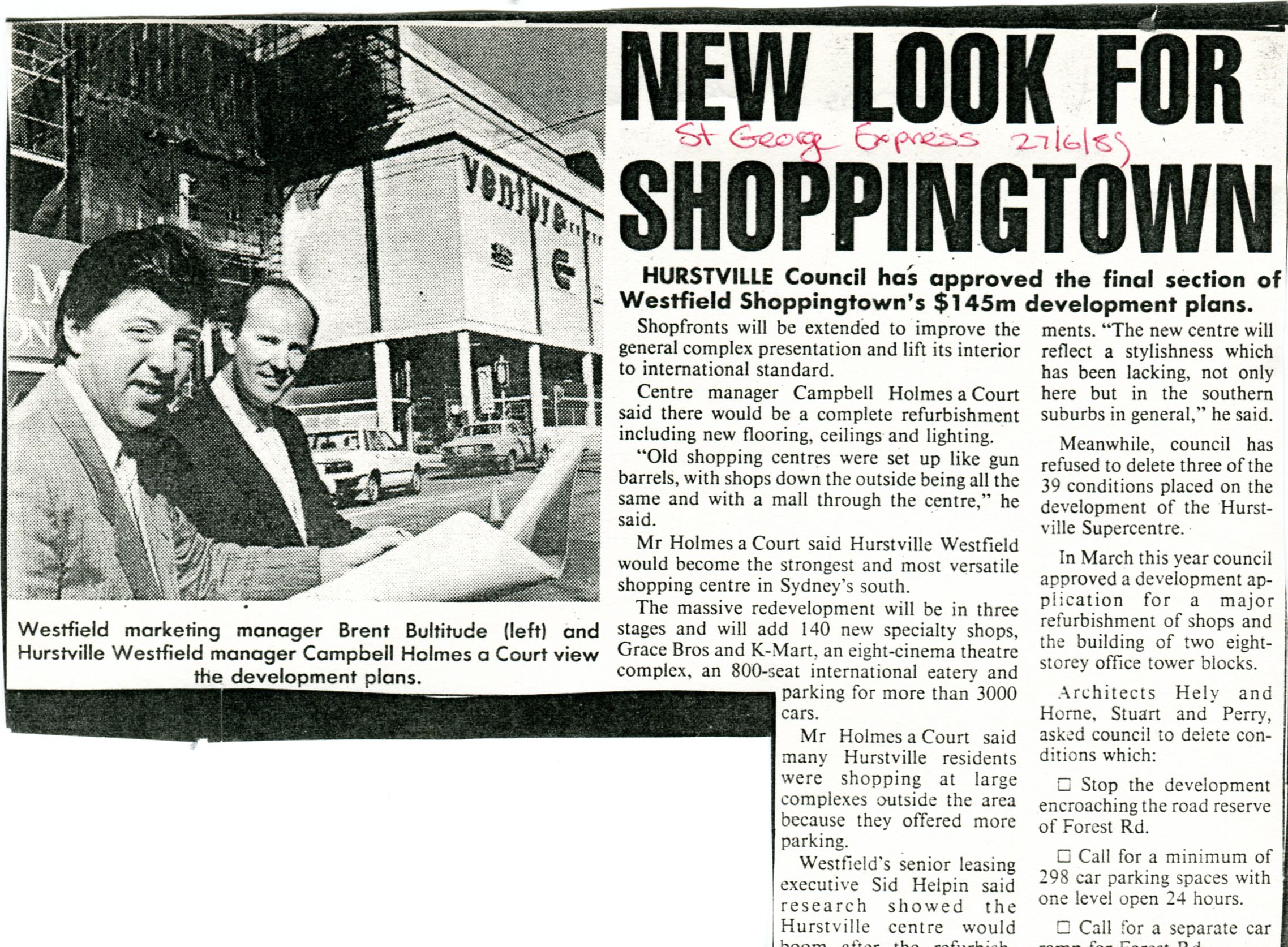
St George Express, June 27 1989
What had met the “international standard” just ten years earlier no longer cut the mustard in the decade of decadence. Of course, this standard was set by Westfield itself, which had opened six centres in the USA since 1980 in its quest to become an international presence. Oh but don’t worry all you xenophobes, they’re still as dinky-di true-blue fair-dinkum mate as a dead dingo’s donger:

Like a weed.
Despite suffering heavy losses in the 1987 stock market crash – bad enough to force the sale of star asset Network Ten (!) in 1989 – the Westfield Group was keen to apply what it had learned in the international market to its legacy outlets.
And let’s face facts: they don’t get much more legacy than Hurstville.

I say we nuke the site from orbit.
Dated 1987, Westfield’s plan for aggressive expansion looks very bold on paper. The centre’s extension was to take up an entire block neighbouring the existing site, a proposal that no doubt delighted Hurstville Council. I know what you’re saying, “It’s lucky they had a spare block of land bereft of residents on hand in order to allow Westfield to expand!”
Well, about that…

When we thought we were moving closer to the shops, this wasn’t what we had in mind.
Just left of the complex in that picture are houses, trees, all that good stuff. But as the caption says, FULL STEAM AHEAD.

Come on, those houses had parking for three cars at best.
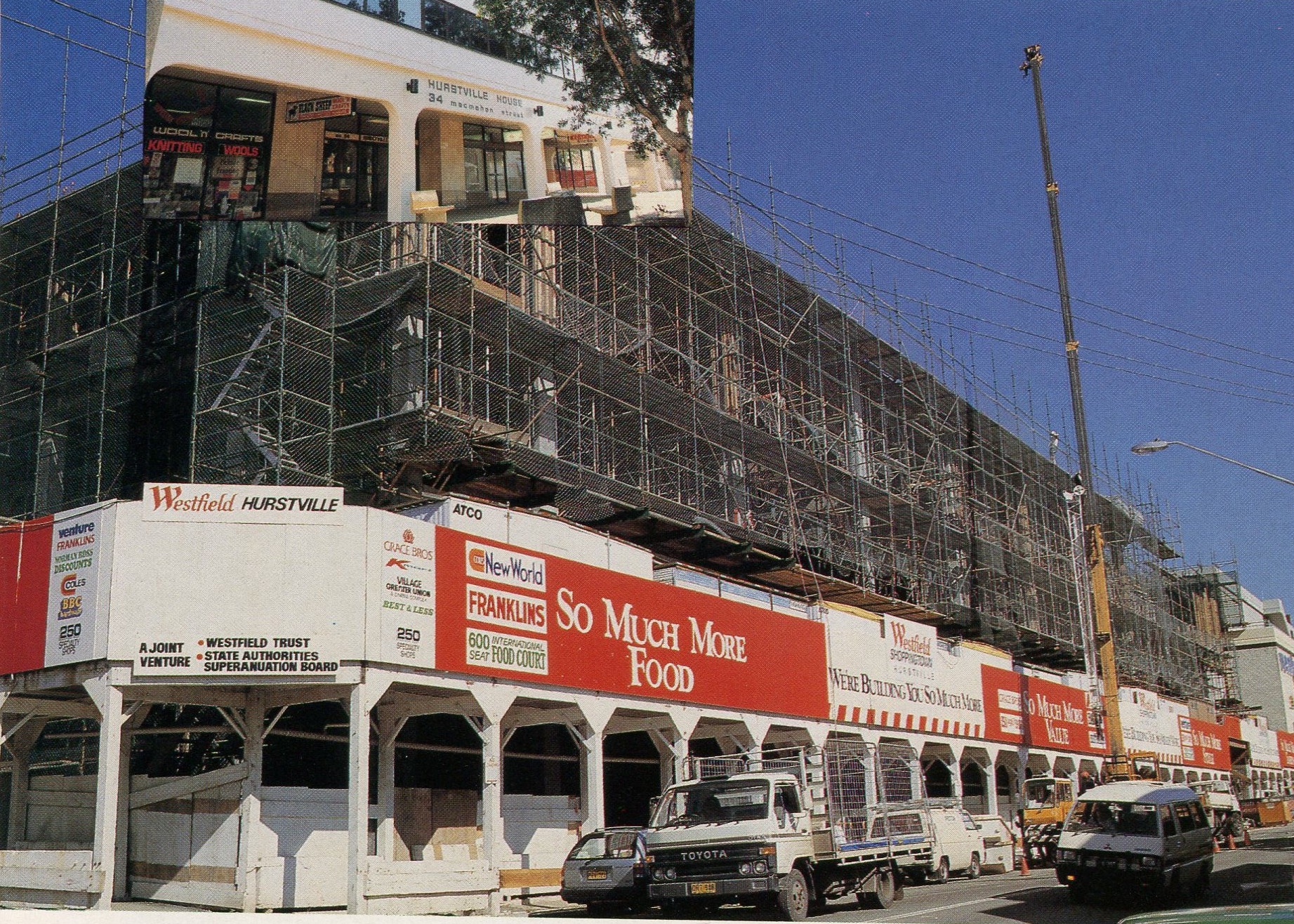
For so fewer people.
Back in their original 1975 proposal, Westfield had been very careful to minimise the impact the centre would have on the community, all in the service of buttering up the Hurstville Council. The pinnacle of this effort was the Snowy Hill Park atop the centre, a nature reserve where people could come and relax away from the hustle and bustle of the retail juggernaut below. In 1988, it was the first to go, razed to make way for a carpark. It says a lot about how the balance of power in the suburb had changed in ten years that this was able to happen. As it stands, this blog entry is now the most public memorial to Snowy. Ouch.
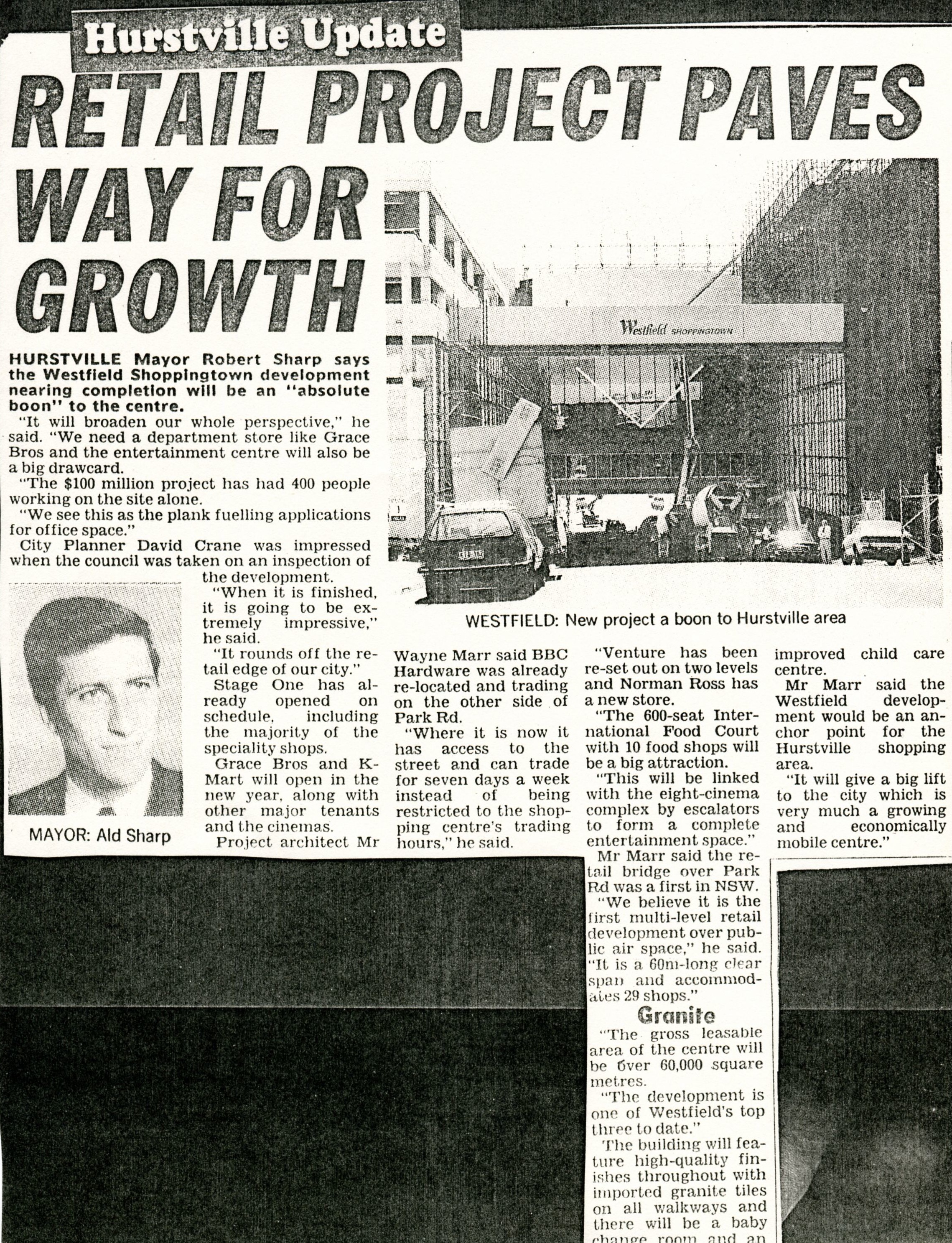
Leader, December 5 1989
All this talk of growth was all well and good, but what exactly was growing? Sure, Westfield’s profits were hulking out, and Hurstville Council’s take-home wouldn’t have been anything to sneeze at, but was Hurstville itself doing much growing? Let’s see…

Leader, March 12 1991

Leader, 1989
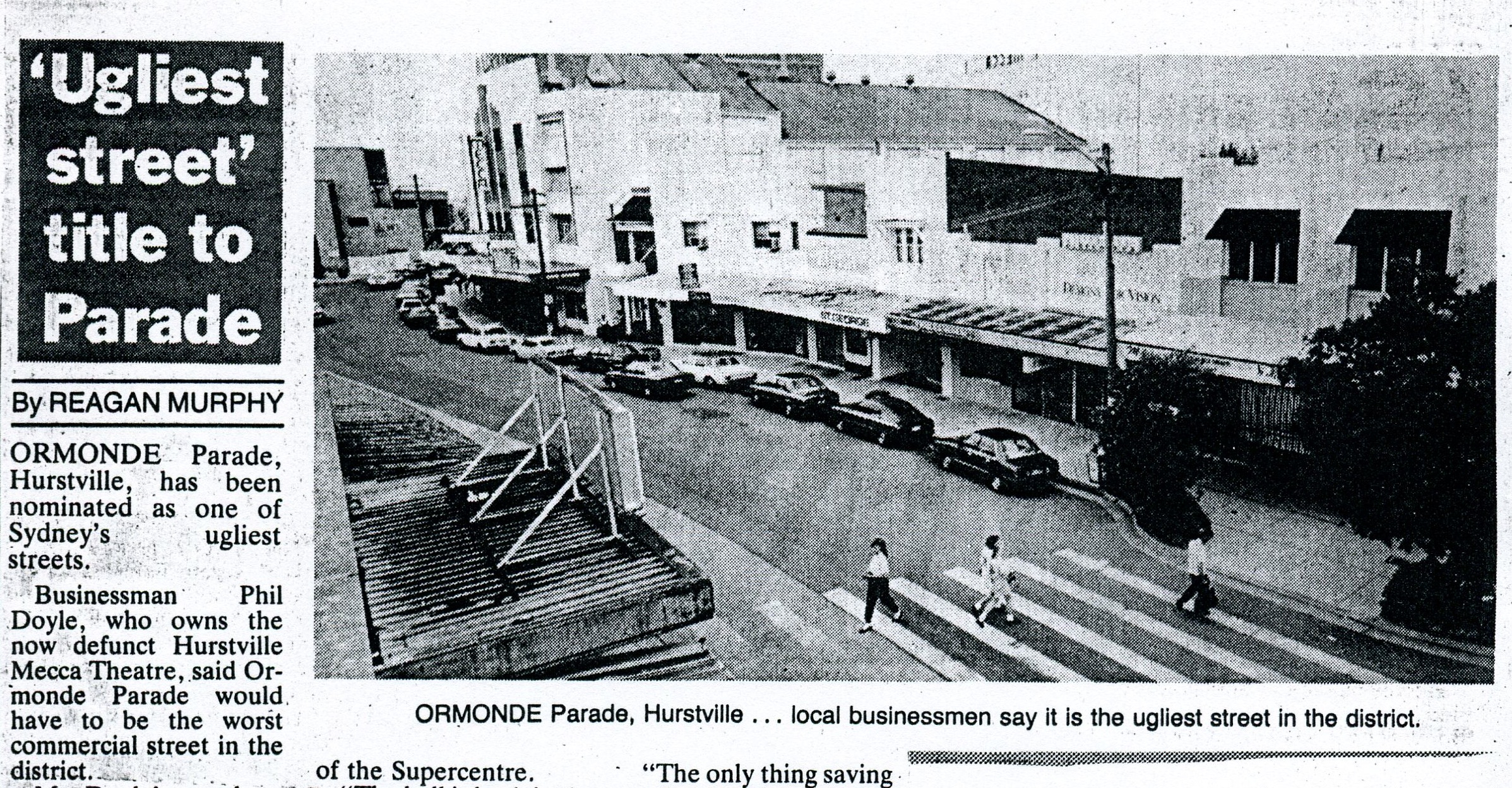
Leader, January 15 1991
So, no.
1990. It was time. The grand opening everyone had been foaming at the mouth for, that people had sacrificed their homes for – that Snowy Hill had been swept under the rug for – was at hand. Did Westfield spare any expense bringing out the big guns for such an occasion?

Maggie T wasn’t good enough for you?
Well, okay. Uh…
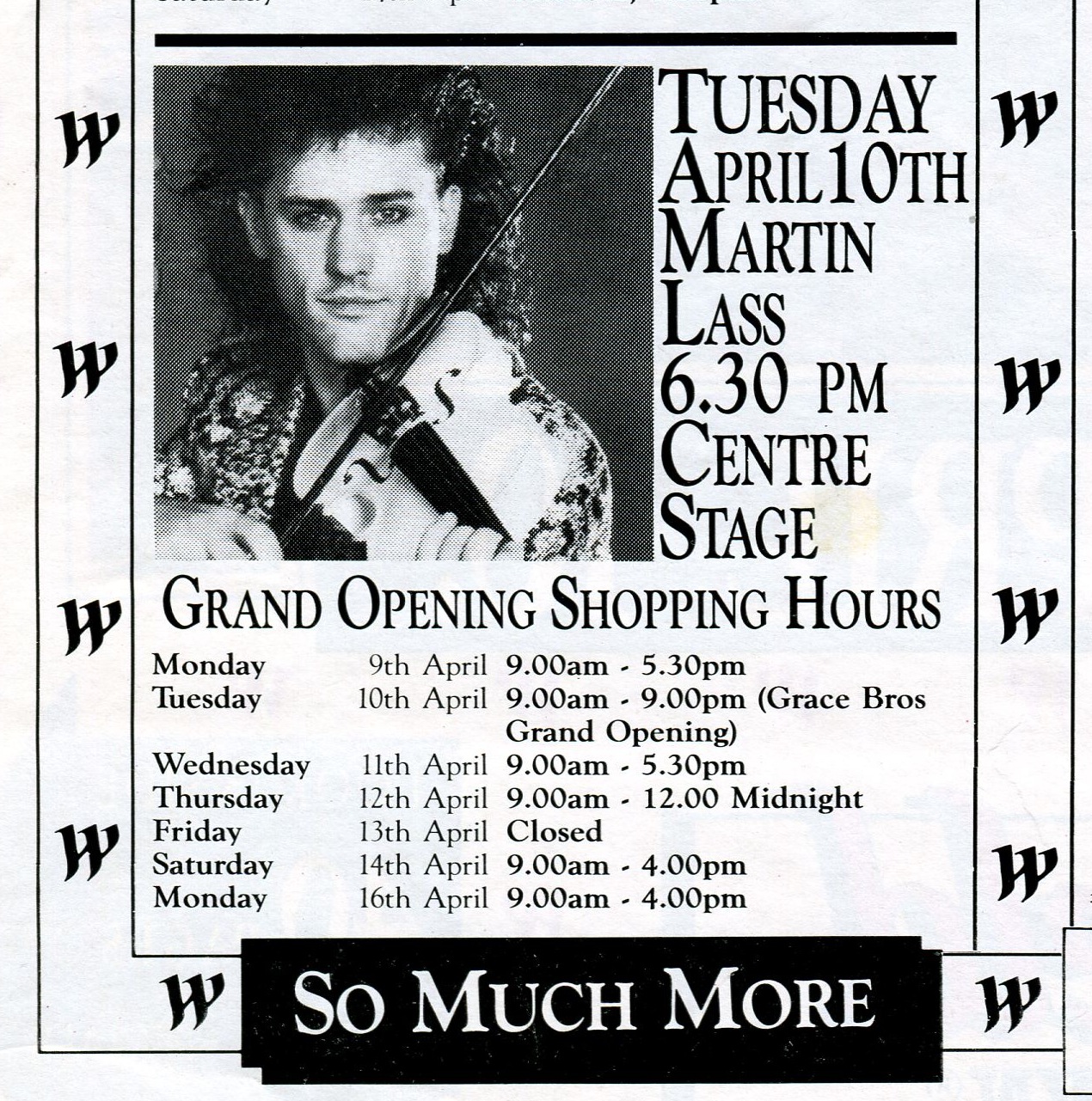
Isn’t he that guy from The Zone?
Hm. So, no.
The biggest jewel in Westfield’s new crown was the addition of Sydney department store mainstay Grace Bros. With Waltons, Westfield had backed the wrong horse, and were determined to make sure that didn’t happen again. The new Grace Bros. also served to steal even more of the floundering Roselands’ thunder, as GB had been that centre’s pride and joy for years at this point. Also new to Hurstville were K-Mart, 125 new specialty shops, as well as some of the biggest and most resilient names in retail:

BIG

HUGE
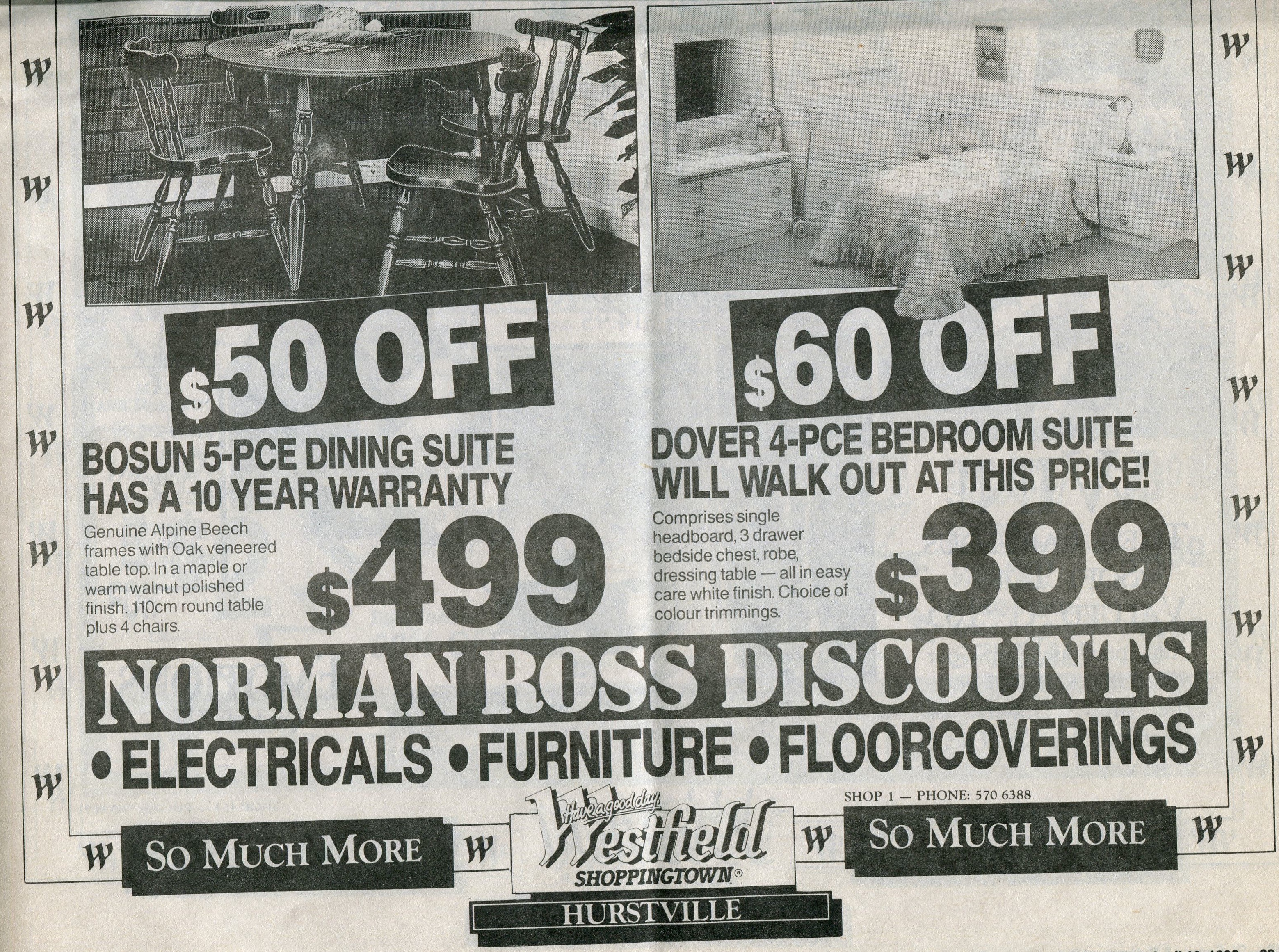
MASSIVE

OOH!

DAMN!
Take a moment to catch your breath and let’s take a look at the whole lineup:
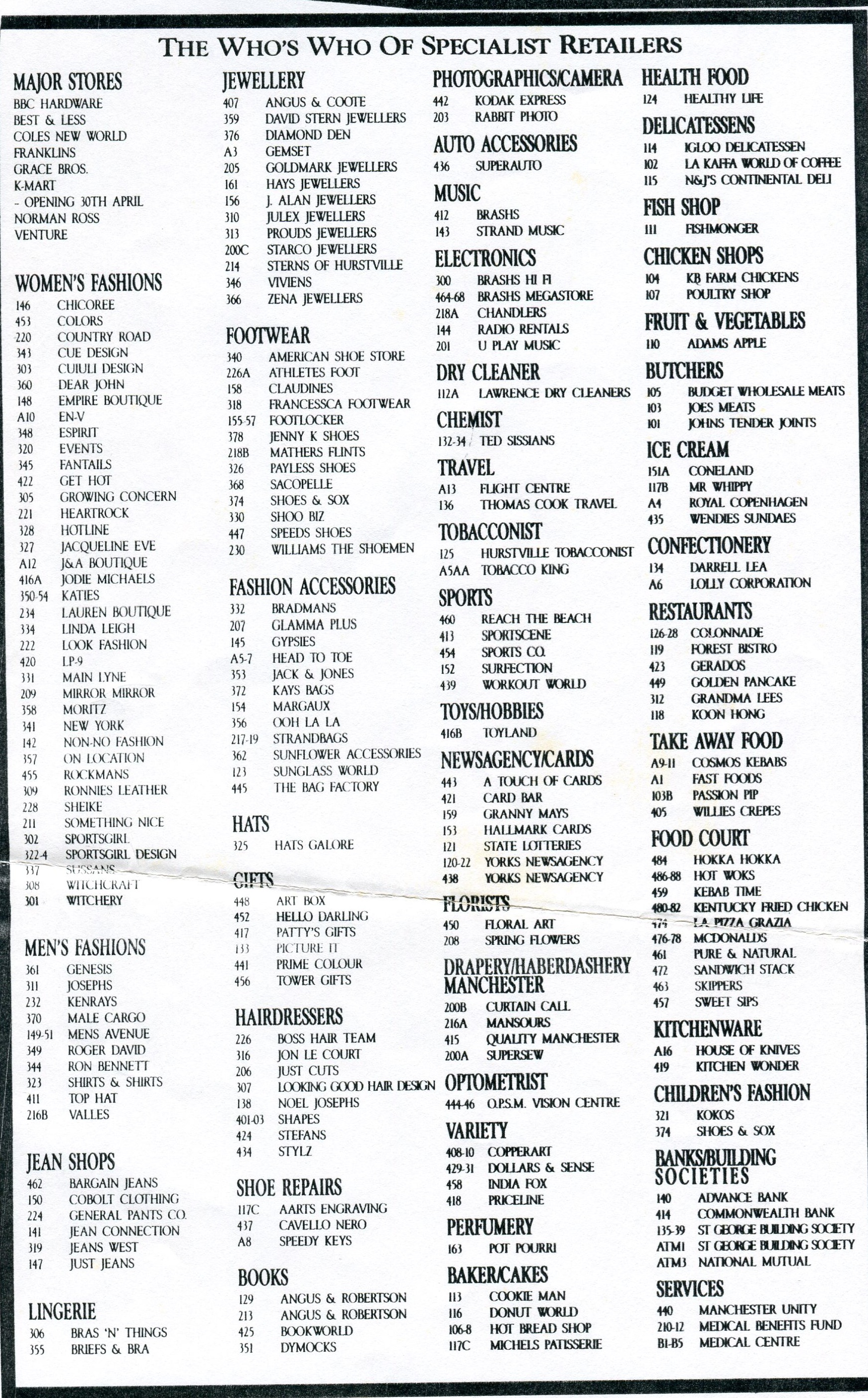
La WHAT’S World of Coffee?! 1990
My award for the best business name ever goes to the hairdresser known as BOSS HAIR TEAM. Untouchable.
Armed with all these new shops and bearing the International Standard ™, Westfield was primed to take the new decade by storm, and for a time it worked. High profile acquisitions and additions peppered the 1990s, but none as exciting as when dying god Venture made way for American toy giant Toys R Us in 1993.
As my contemporaries would concur, the concept of a two storey toy shop was mind-blowing at the time. Compare this to the mere one storey of Bankstown’s World 4 Kids (itself a countermeasure against Toys R Us) and there’s just no competition. Never mind that the bottom level was mainly baby stuff and outdoor junk, that’s not the point. TWO STOREYS.
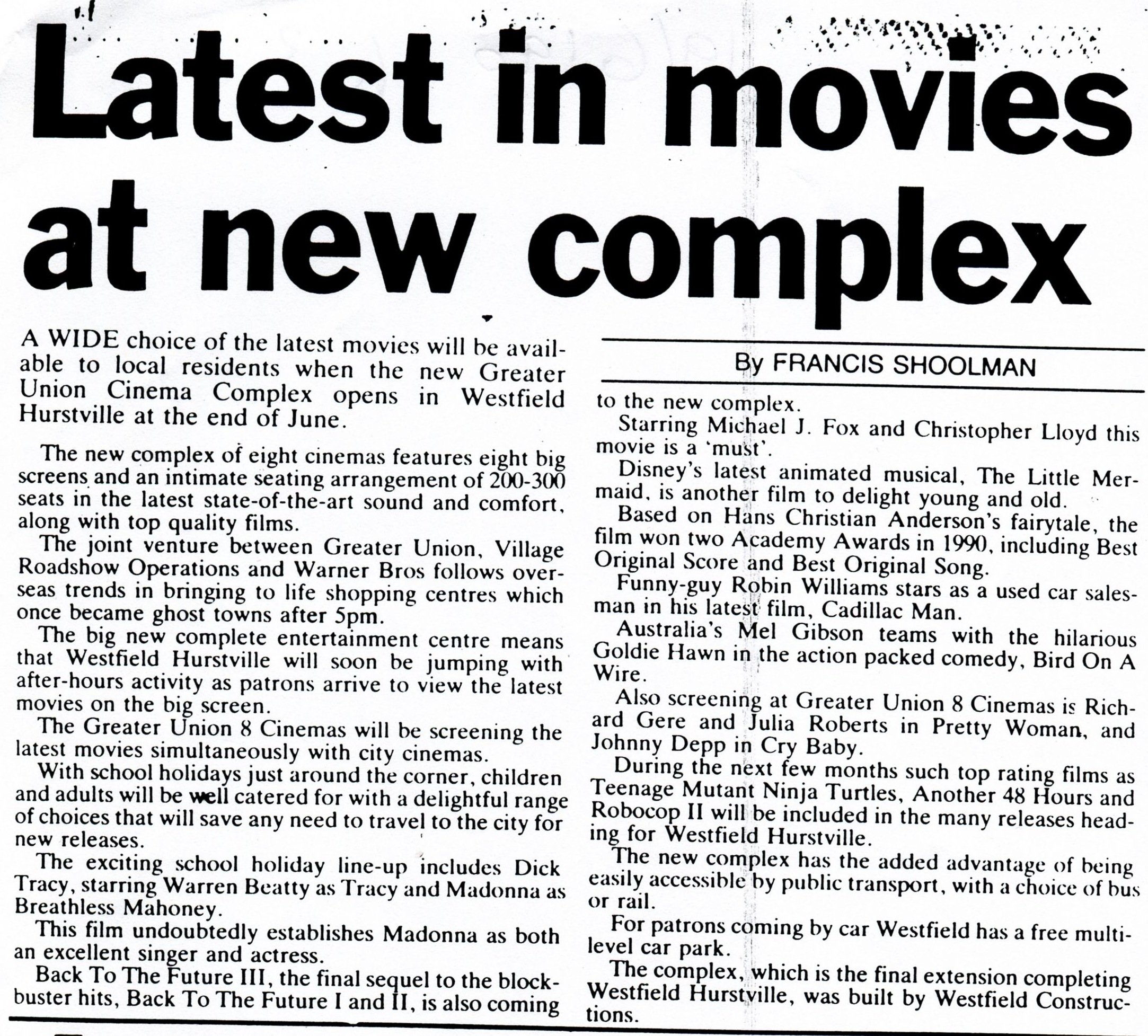
Whoever rated Another 48HRS as a ‘top’ film should be shot.
On the entertainment front, Westfield had topped off its retail sundae with the cherry that was Greater Union. An eight-screen cinema (considered huge at the time, believe me), GU blew away local competition like the Hurstville Savoy, the Kogarah Mecca and the Beverly Hills Cinema. How could those small fry hope to compete with eight screens?
For me though, the high point of Westfield’s desire to innovate during the 1990s was Intencity. Pre-empted by a cool, mysterious ad campaign (below), it seemed as if Intencity was the natural evolution of video game arcades of the past such as Spacetacular and Fun & Games….but that’s another story.
By 1995, the future looked very bright indeed:

No more Boss Hair Team. 1995.
But all the glitz and dazzle was blinding Hurstvillians from what was really going on in the area. For every Toys R Us, there was a story like this. For every K-Mart, there was one of these. And for every Grace Bros., there was a Barter’s.

Rhyming years with years is pretty lazy, Barter’s.
Remember Barter’s (see part one if you don’t)? Living proof that bigger isn’t always better, the three-storey Barter’s had begun its slow decline with the advent of the Westfield itself back in the late ’70s. In January 1985, Barter’s held its last ever sale, and everything had to go:

Barter’s Fire Sale, January 1985. Image courtesy Hurstville Council

Just take it. Barter’s Fire Sale, January 1985. Image courtesy Hurstville Council
Scabs from all over Hurstville picked the place clean. What had once been the example of retail elegance in Hurstville was now…well:

Should have had such a sale every day. Barter’s Fire Sale, January 1985. Image courtesy Hurstville Council

They were even giving the Norms away. Barter’s on the slab, July 1985. Image courtesy Hurstville Council
The oft-ignored side effect of the Westfield was the damage it caused to the Forest Road shopping strip. Although it had originally been intended to complement those shops, Westfield had done everything so much bigger and better that the little guys outside didn’t stand a chance. Throughout the ’90s and ’00s, stories like this were common:

Leader, November 14 1996
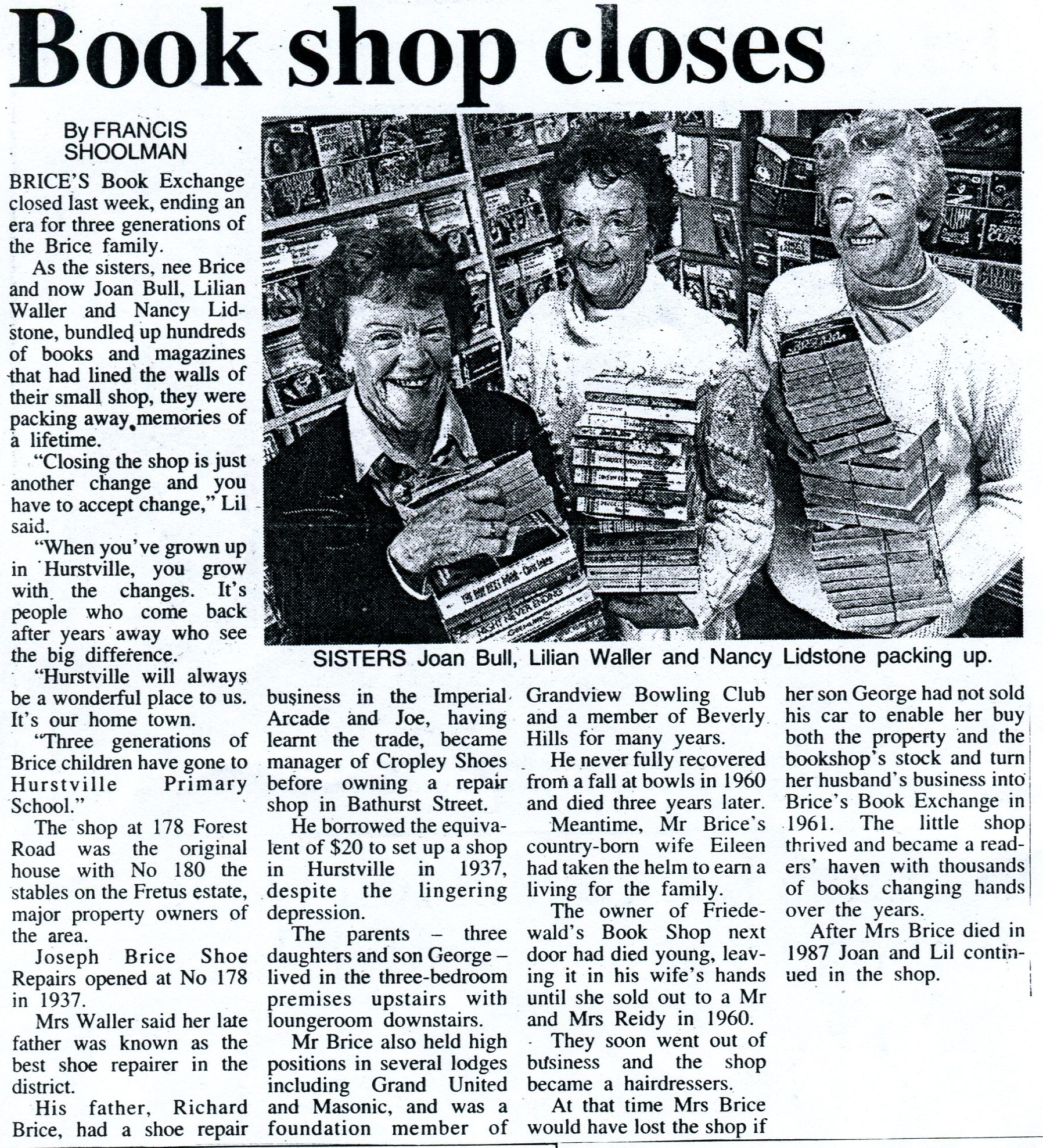
Leader, July 20 1995
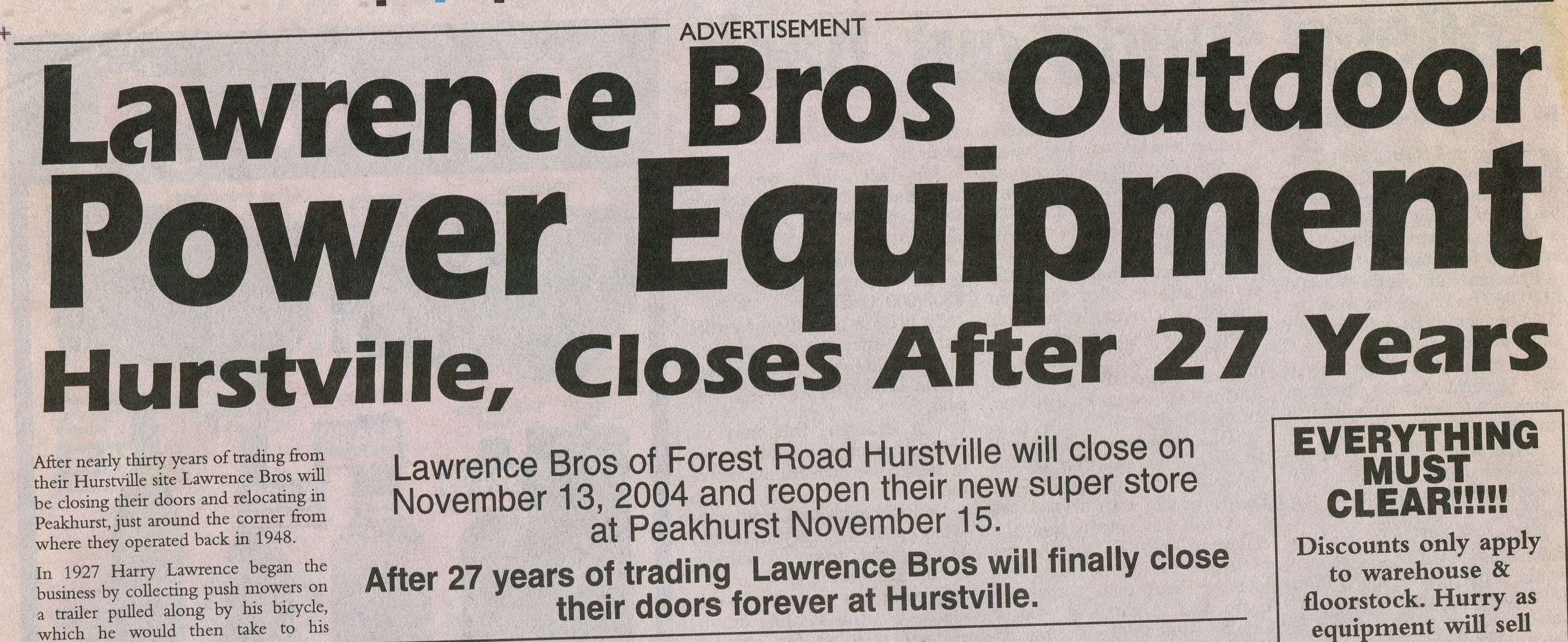
Leader, November 8 2004

Leader, October 5 2000
Not helping matters for local retailers was the debacle that was Forest Road Mall. Proposed in 1988 by council and intended to celebrate Hurstville becoming a city that year, the plan would have seen the two-way Forest Road closed off to private traffic and transformed into a pedestrian mall, ‘Hurstville Boulevard’. It was believed that this mall would combat Westfield’s dominance of the area, although how council thought they could do this and not appear two-faced is beyond me. Needless to say, it wasn’t very popular with retailers:

Leader, January 18 1989

Leader, November 3 1992

Leader, November 10 1992
It may shock you to learn that Hurstville Council went ahead with this plan in 1991, going so far as to hold an opening celebration…
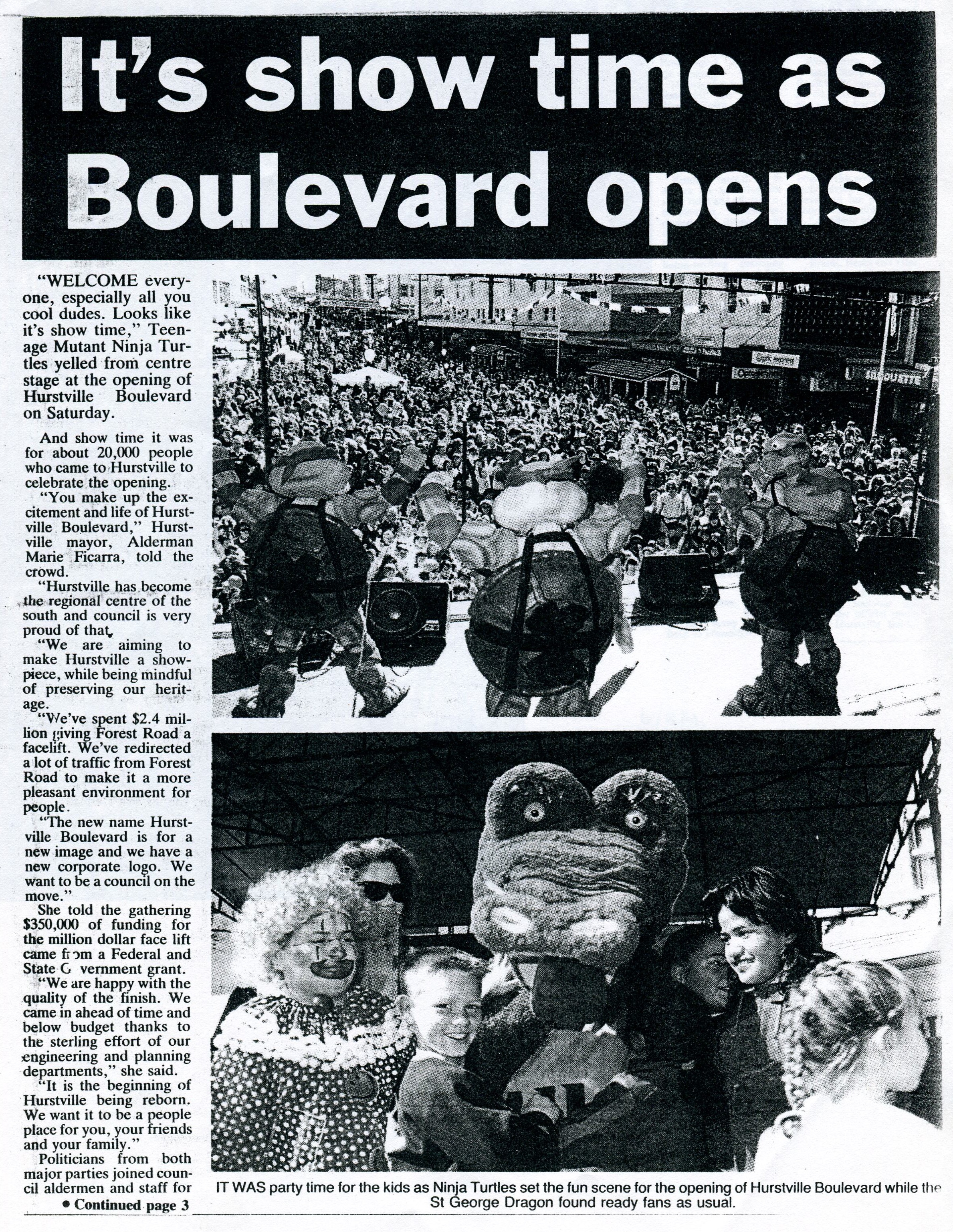
Leader, August 6 1991
…that featured perhaps one of the least appropriate double-billings in entertainment history:
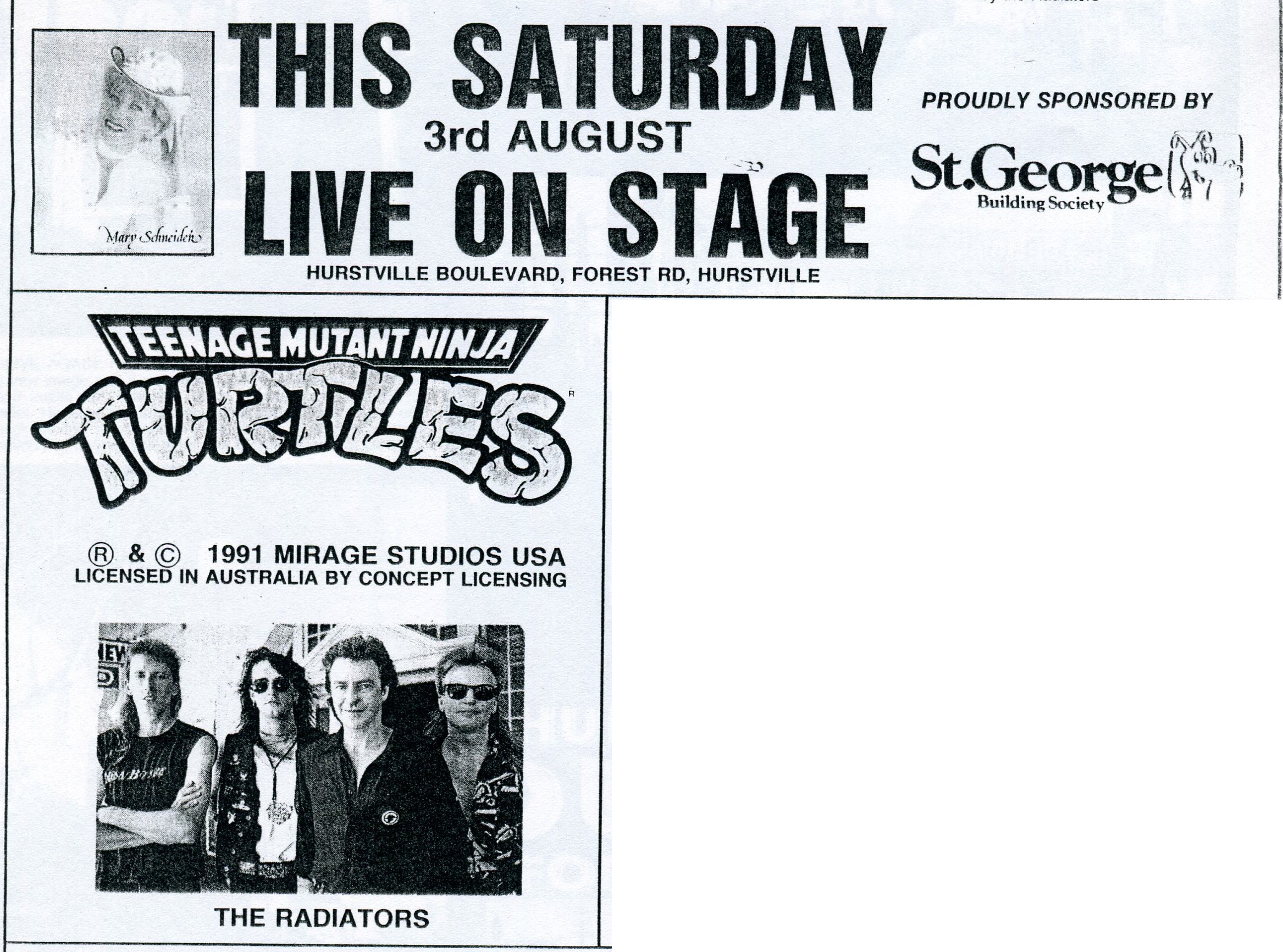
Gimme shred, baby. Leader, August 1 1991
The madness ended in late 1991, as the recession, coupled with increasingly fierce opposition, caused council to rethink their plans. As so much of the construction work to turn Forest Road into the car-free Hurstville Boulevard had been completed, a compromise was met: Forest Road became a one-way street.
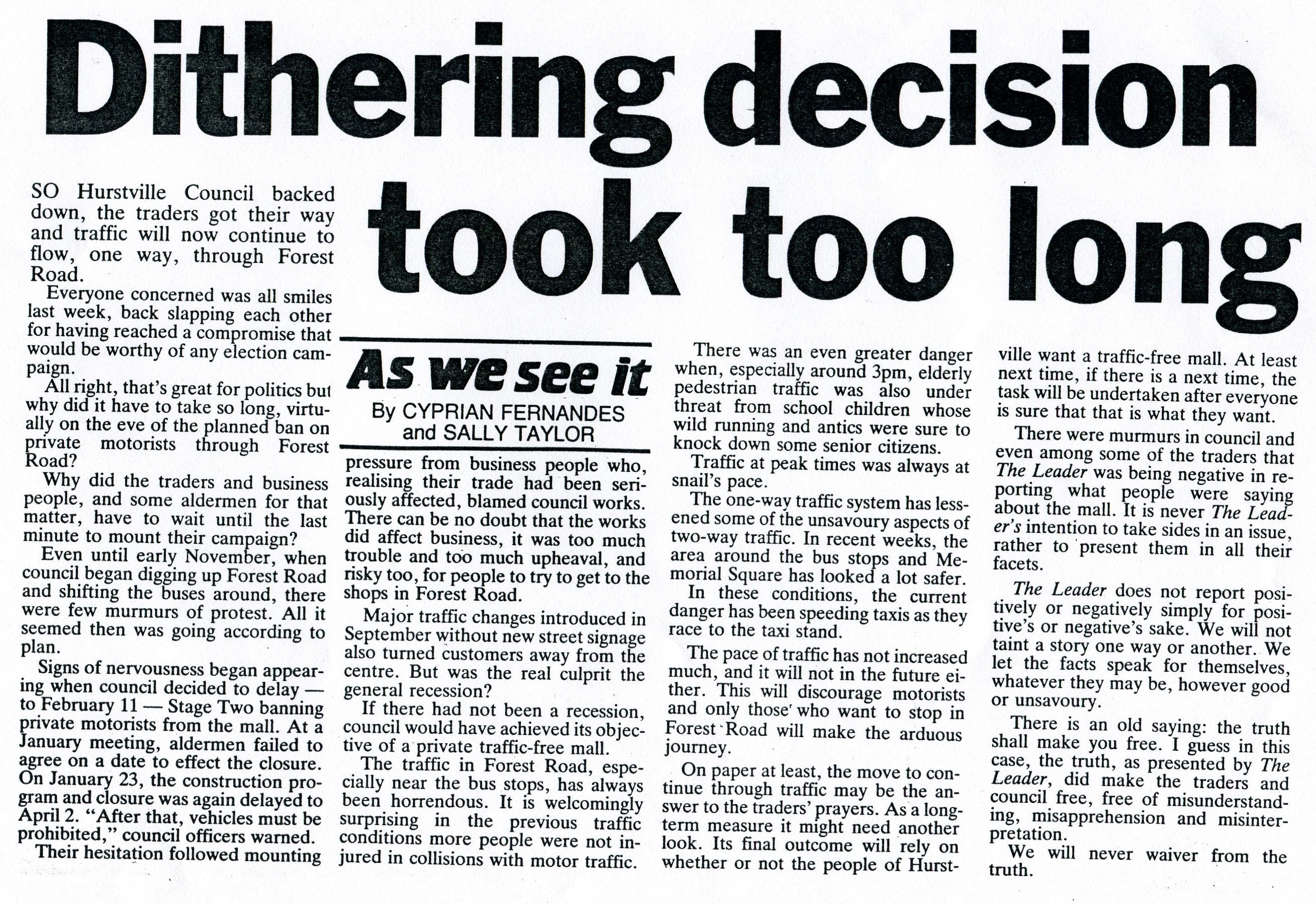
Leader, April 3 1991
You can imagine the big cheeses at Westfield sitting around laughing at this mayhem, which only served to strengthen their position in Hurstville.
But by 1998, Westfield’s gloss was starting to wear off. Another ten years had passed, and in that time international standards had increased again, Westfield Miranda had expanded to become even bigger again, Westfield Burwood was slated for demolition to be replaced by a more modern centre, and many of the heavy hitters of the mid ’90s were winding down. The ever-shifting plates of retail had unsettled giants like Brashs, Toys R Us and *sniff* Intencity, which was replaced by Target in 1997.
Even the cinema was starting to lose its sheen, seen by locals as a hangout for thugs and hoodlums, as was the neighbouring food court. Suddenly, it didn’t feel so good to shop at Hurstville.

Leader, April 14 1992

Leader, April 18 1992

Leader, April 7 1992
The social climate of Hurstville was something that neither council nor Westfield stopped to consider at any time, especially when they were bulldozing houses to expand the shopping centre. That Hurstville was becoming increasingly multicultural didn’t seem to occur to either entity also, only becoming apparent when it was too late to repackage and restructure the complex to suit the suburb’s new needs. I wonder if Westfield ever stopped to wonder why it was suddenly filled with cheap $2 junk shops and mobile phone accessory outlets?
Today, it’s a far cry from the glory days. This year marks Westfield Hurstville’s 35th anniversary, and you can’t half tell. Let’s take a quick tour.

Ugh.
‘Shoppingtown’ no more. Yeah, that was the most dated part of the whole thing, Westfield.

The snow has melted…
Here are the steps that once took those of us craving fresh air and nature up to Snowy Hill Park. Now it’s a place to smoke while you’re waiting for your kid to emerge from the daycare centre. See those bushes to the left? That’s all you’re getting.

Snowy Hill Park in better days, 1978.

Mediocrity and unpleasantness all under one roof.
I don’t understand how only some of the floor tiles are stained. How does that happen?

Not really all that jolly, is it?
Jolley’s Arcade lives on today with this dated entrance to a dungeon filled with a pretty dire selection of shops, with the fashionably incongruous Fevercast a notable exception. I wonder if they still pay less rent?

Is that guy in the trackies taking a selfie?
When even Westfield became too depressing, the threatening youth moved outside to hang around. Not quite the pedestrian mall council envisioned, I’m guessing.

Not pictured: Sul Ponte’s clown mascot. Hey, it worked for the last tenant…
What was once a dedicated McDonalds restaurant was cut in half with the 1990 extension, and today it’s Sul Ponte cafe. McDonalds’ original seating arrangements remain inside, but the burgers themselves have moved up to the food court outside K-Mart.

Don’t put a target on the side of your building, it’ll only encourage them.
Park Road was built over in 1990 to create this shopping overpass. On the left is the original Westfield, although the carpark on top was added in 1990.

A rose by any other dead end…
This is all that remains of Rose Street today. That music lessons shop looks ancient enough to remember when it was a full street.
In the scheme of things, Westfield seems to have moved on and forgotten about Hurstville. They don’t even bother to charge for parking. The corporation has realised that the true profits are to be had in places like Bondi Junction and Pitt Street Mall, and it’s safe to say that ‘Hurstfield’ will not be receiving further extensions.
What was once hailed as Hurstville’s saviour undoubtedly proved its greatest nemesis and ultimately, its assassin. The damage is done, the parasite has sucked the city dry, and the glory days are long behind it. Visiting today is a depressing, colourless experience heightened by the assorted mental patients who frequent the centre. It hasn’t just become a part of the Hurstville experience, it has become Hurstville. Without the centre, the suburb would become nothing.
And given the state of the centre, I’m not so sure that hasn’t already come to pass.
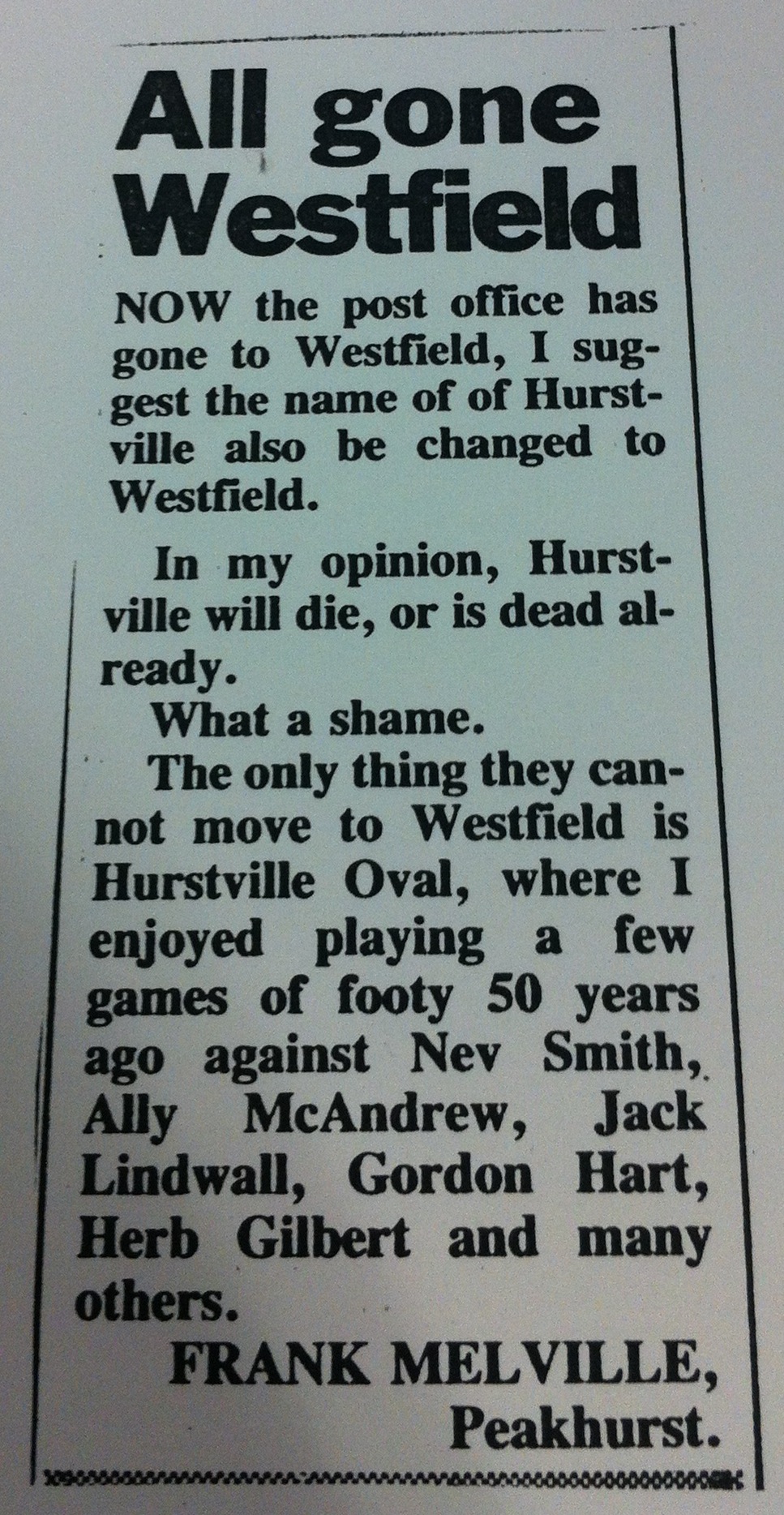
I’d like to wrap this saga up by sharing a letter that I feel is wonderfully succinct, poignant and devastating all at once. This was published in the Leader, November 1 1990, and shows astounding foresight/cynicism. The writer must be dead by now, so RIP Frank, and RIP Hurstville.
Past/Lives Flashback #10: Butchery No. 1 – Hurstville, NSW
As promised, here’s the first in a series of articles taking a look back at the top ten most popular Past/Lives posts of the last year. If I was smart, I would have picked the ten least popular posts so as to boost their views, but there’s a good reason the Belfield denture clinic never found its audience.
With that in mind, it’s to my complete amazement that I present the tenth most popular entry, Hurstville’s No. 1 Butchery.
Original article: Food Fair/ANZ Bank/The Base Store/No1 Butchery – Hurstville, NSW

First things first: there are no obvious changes. Given the building’s colourful history, it’s almost a surprise there’s been no activity over the last 12 months, but there you have it…NO changes whatsoever (perhaps with the exception of the chemist next door having become “Australia’s cheapest chemist”. Yeah, right). It’s as ugly a shopfront as ever, and that demonic pig in the logo is just as disturbing. I’d be willing to bet those people walking past are the same as last year, too.
What’s really interesting to me about this place is that just over the last few weeks, it’s exploded in terms of page views. Why? The whole point of this series was to show you how things have changed over a year, and to find something new to add, so this is a great start. What’s so special about this place? Then again, that’s probably what you were saying when I published the original article a year ago. Wait! Do you feel that? It’s moments like these that bring us closer, dear reader.
Don’t worry, they won’t all be like this.
St. James Theatre/Beverly Hills Cinemas – Beverly Hills, NSW
 Let’s cut to the chase: the Beverly Hills Cinemas are looking a little…porky these days. It’s hard not to notice the expanding waistline anymore, even for the sake of politeness. What I’m saying is, if the Beverly Hills Cinemas were a person, they’d need to take the Kayla Itsines challenge a few times to squeeze back into those trackpants.
But it wasn’t always this way. Back before the cinema was built, the suburb was known as Dumbleton, after a nearby farm. The opening of the Dumbleton train station in 1931 had opened up the suburb to the rest of Sydney in a way the previous public transport option – a coach service from Hurstville station – had not.
Dumbleton’s first shop had only opened in 1908 (on the site of the present day Beverly Hills Hotel), so there wasn’t exactly a major reason to go there. Dumbleton residents hoped to change this in 1910, when a post office was opened within the existing store. It was like the proto-Westfield.
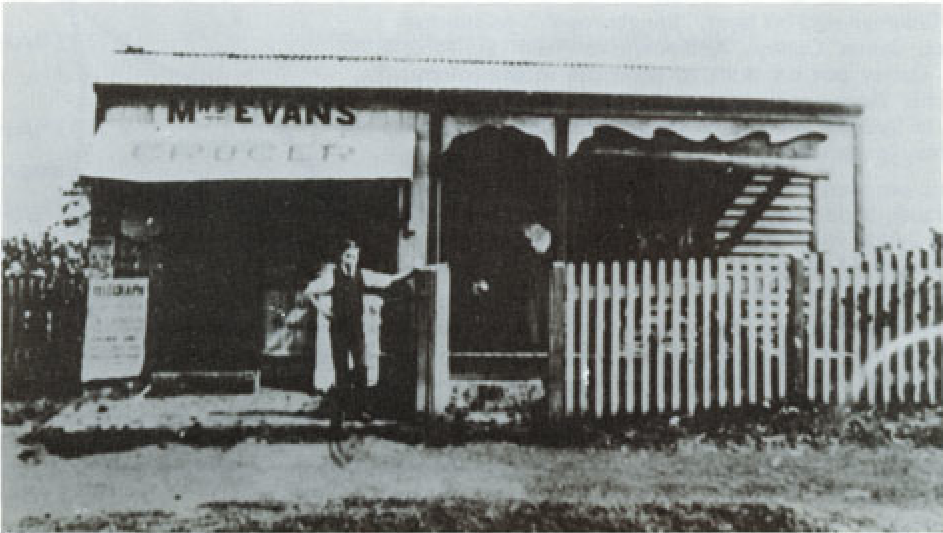
This is that shop, circa 1916. Image courtesy Regina Coeli Parish, Beverly Hills.
The Second World War brought military personnel to Dumbleton, further increasing its population and forcing it to come up with more shops to keep people entertained, but it’s kinda hard to make anything entertaining when your suburb’s name is Dumbleton.
In late 1938, plans began for a picture theatre along King Georges Road with a projected completion date of 1940. I suppose the Dumbletonians were hoping to emulate the success of the Savoy theatre in nearby Hurstville, but they still had the nagging problem of that name.
An American cultural influence had been building in the outskirts of Sydney with the advent of cinema, so with an impending theatre and the belief that the USA would soon be joining the war effort, a move was made in 1940 to change the suburb’s name to the much more glamourous sounding Beverly Hills – Hollywood on the East Hills line. The Californian equivalent was home to famous movie stars, and with the completion of the St. James Theatre later that year, so would Dumbleton.
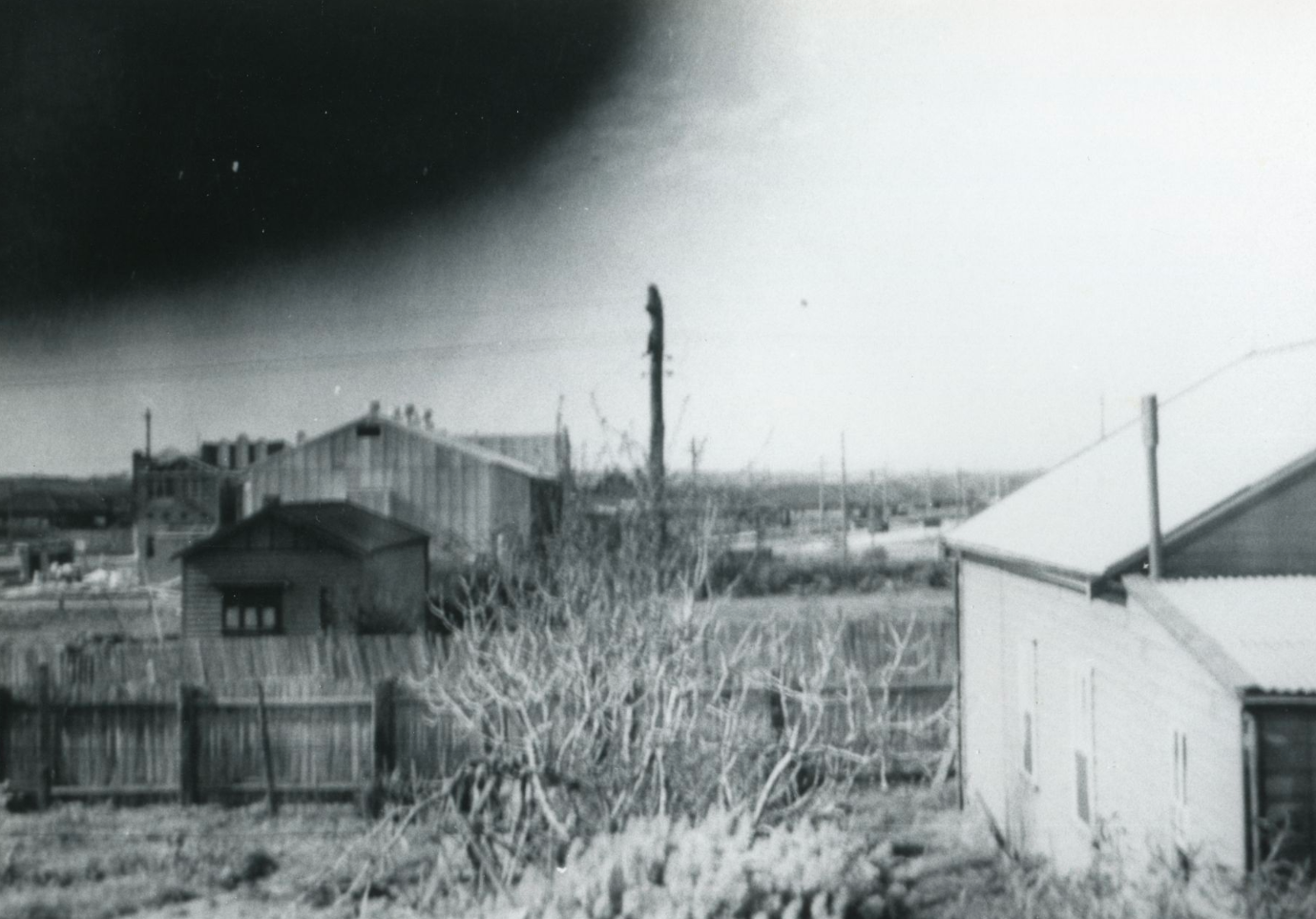
Dumbleton bites the dust as the St. James (centre left) gives rise to Beverly Hills, 1940. Image courtesy Georges River Libraries
A strip of palm trees down the centre of King Georges Road was added to complement the Hollywood theme in a move no one in the 1940s could have predicted would become so tacky by the present day.
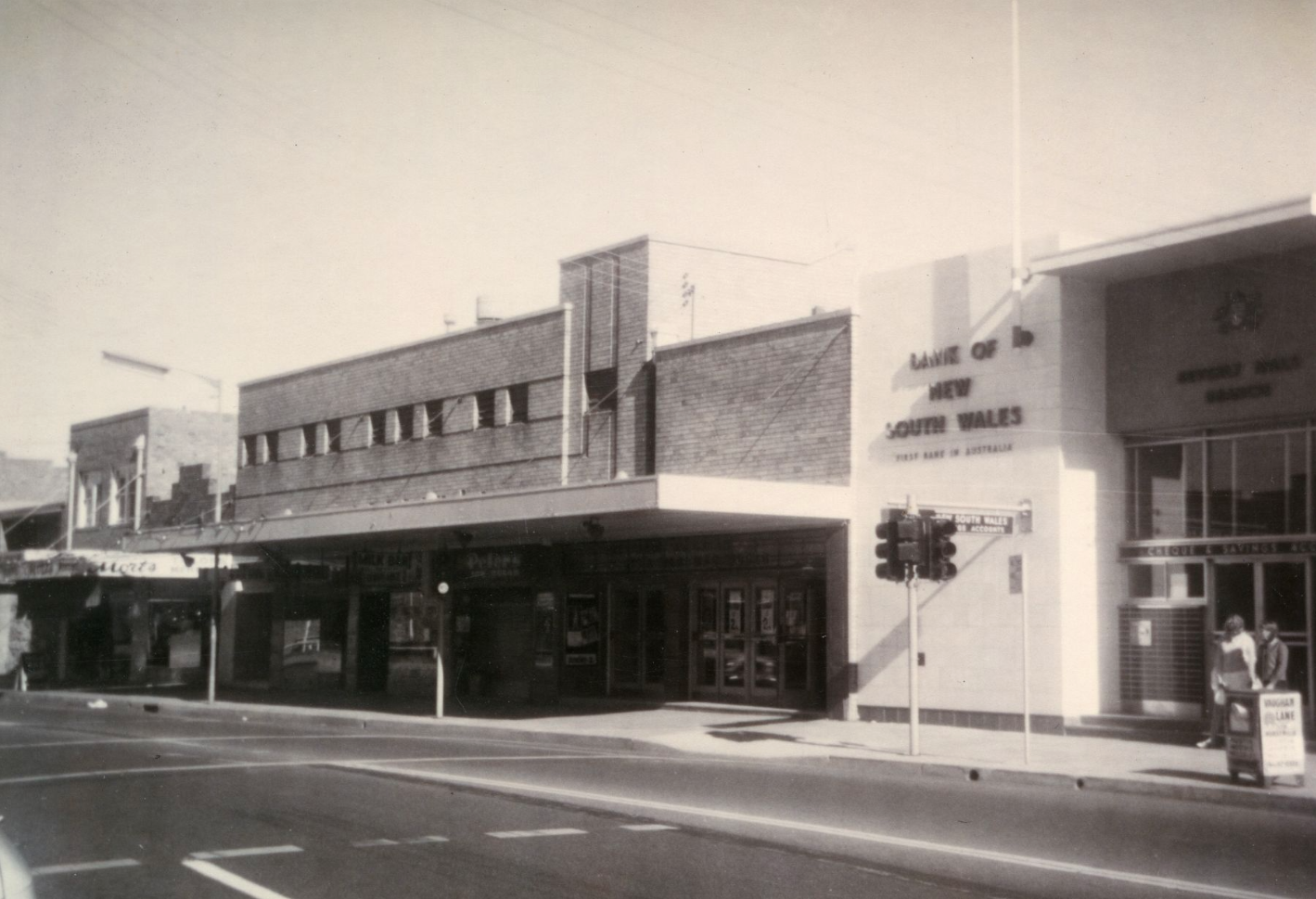
St. James Theatre looking very much like a bank, 1966. Image courtesy Georges River Libraries
The St. James Theatre entertained the residents of the growing suburb (even those older residents who had loudly complained about the name change) for decades until the 1970s, when the voracious Hoyts incorporated it into its suburban chain.
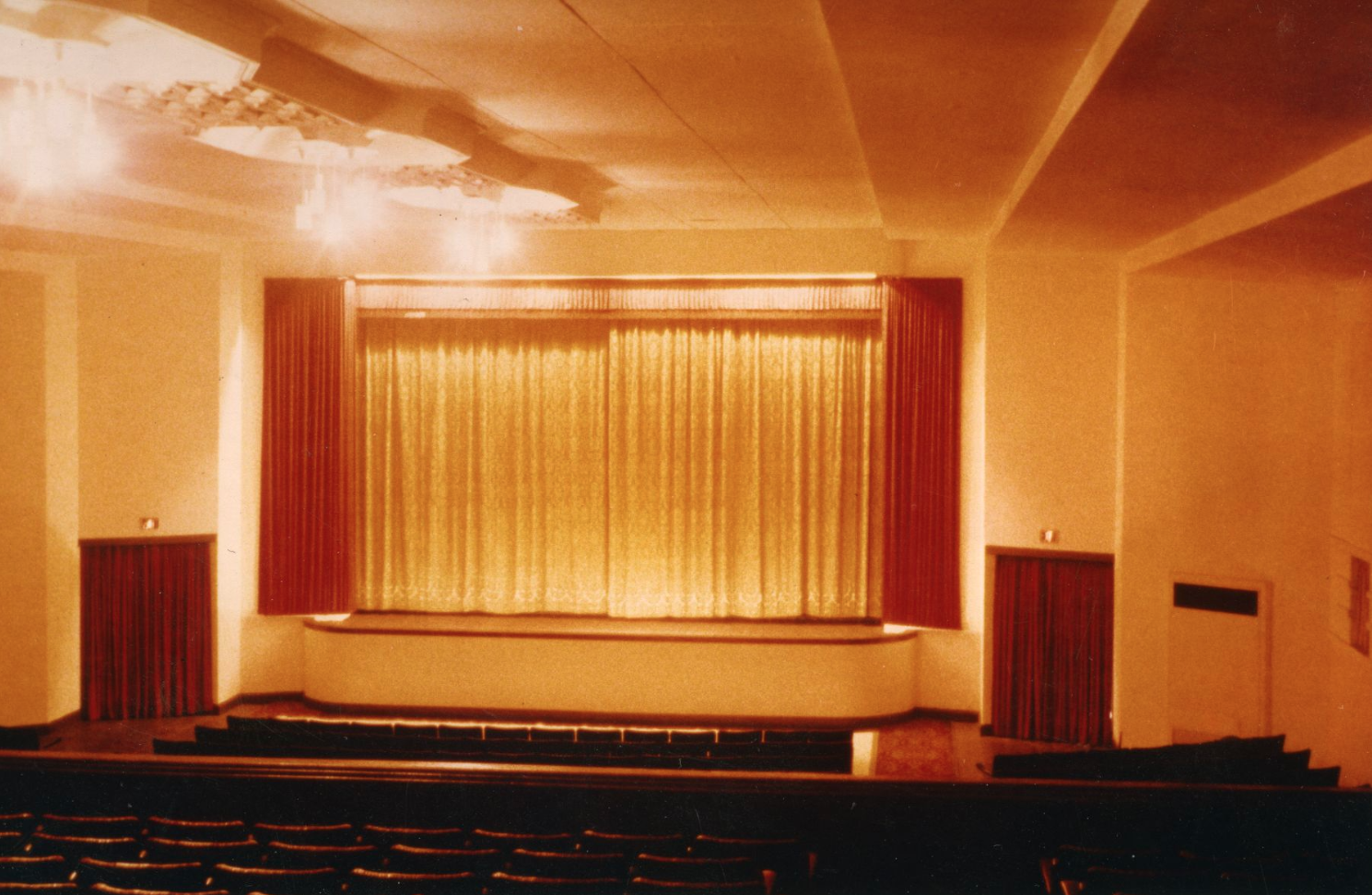
Inside the St. James Theatre, 1981. Image courtesy Georges River Libraries
By 1978, it had fallen into disrepair like many of its suburban cousins that had survived the mass demolition of such cinemas during the progressive 60s, and was showing adult films. Saint James indeed.
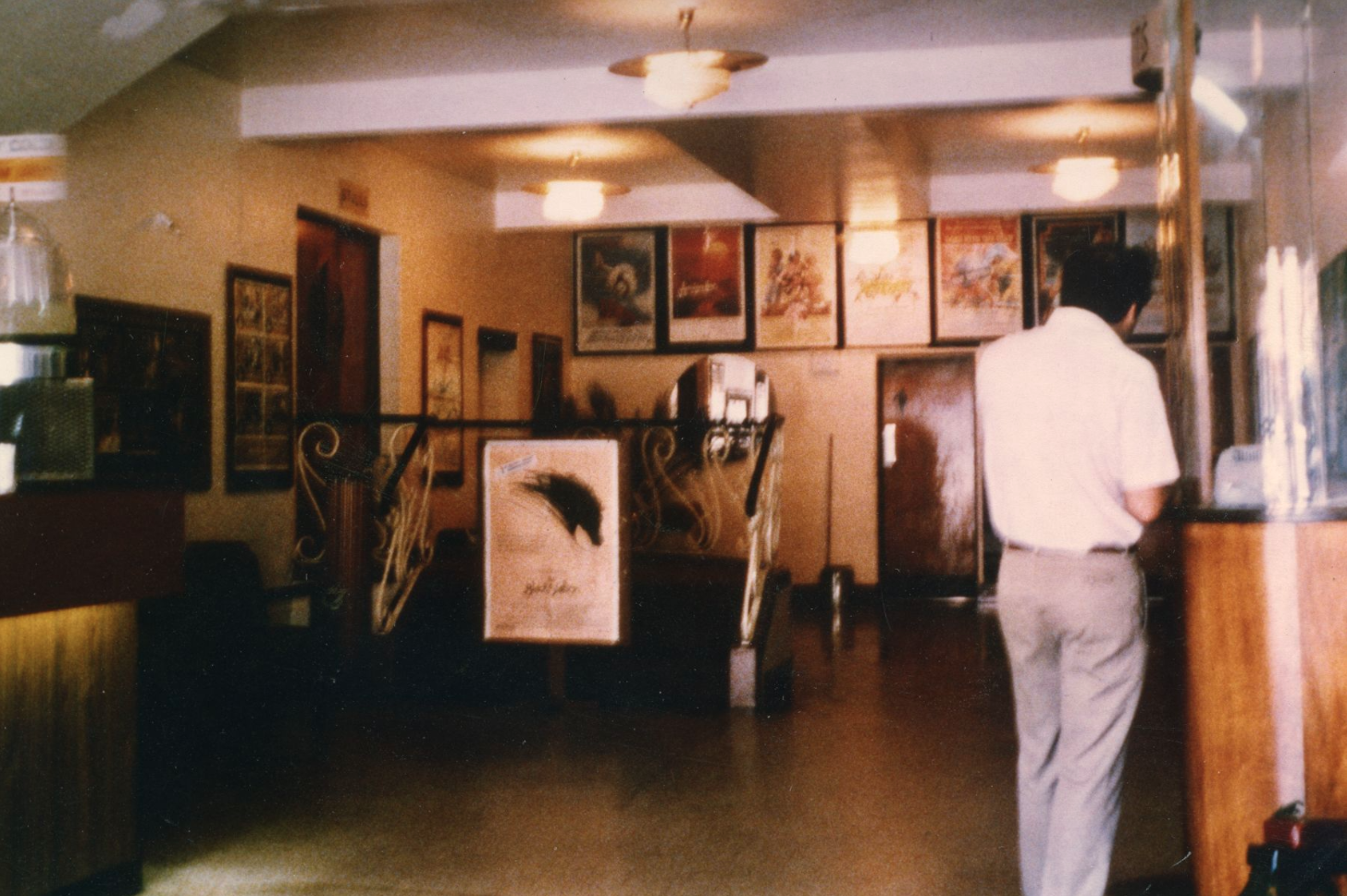
St. James Theatre lobby, 1980. Image courtesy Georges River Libraries
It was that year when developer Jim Tsagias bought the St. James, with plans to transform it into a function centre. Something changed his mind (perhaps the palm trees) and he decided to restore it as a cinema.
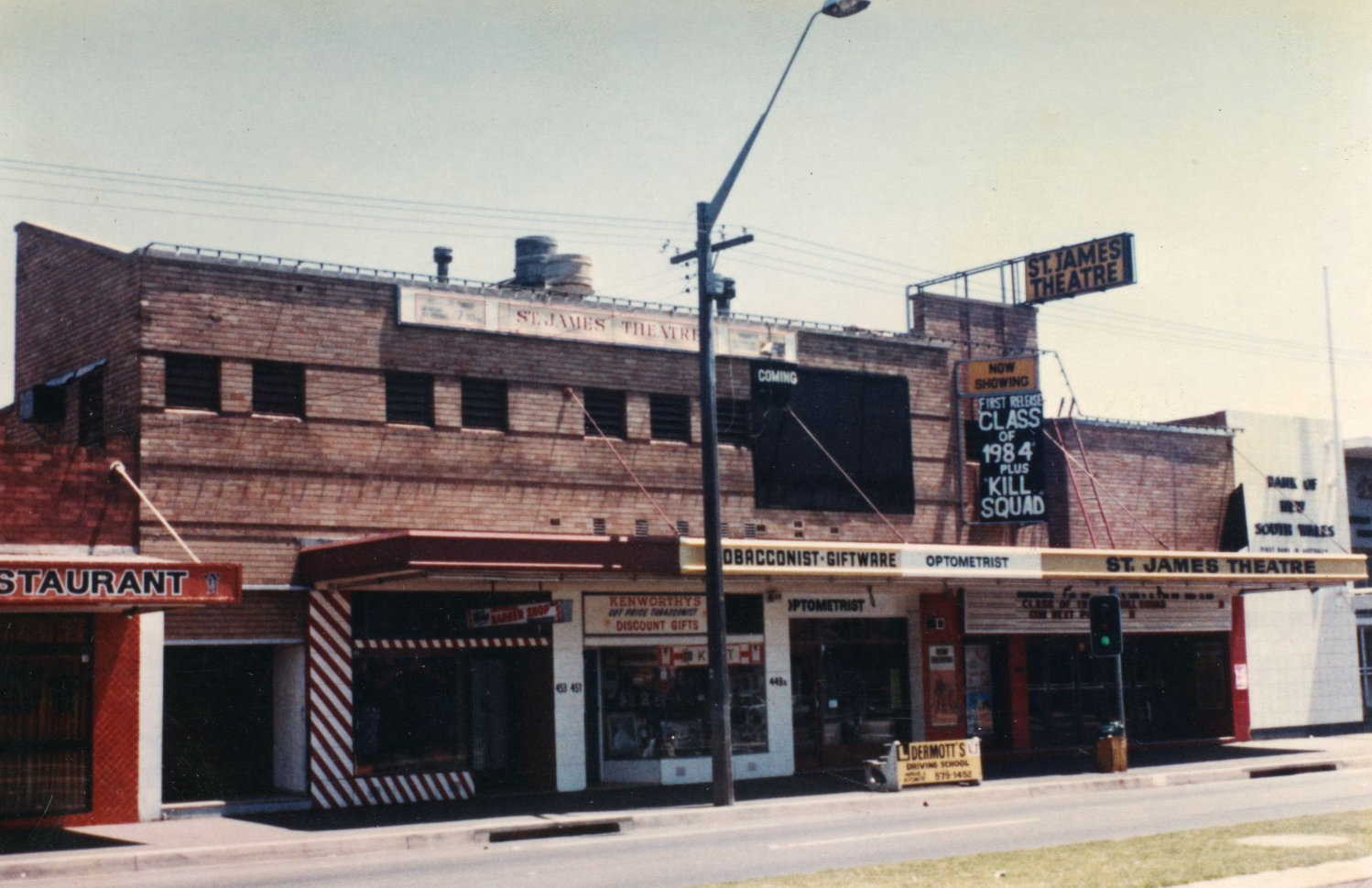
The final reel of St. James Theatre, 1982. Image courtesy Georges River Libraries
In 1982 it was reopened as the one-screen Beverly Hills Cinema, and in 1983 it was converted to a twin.
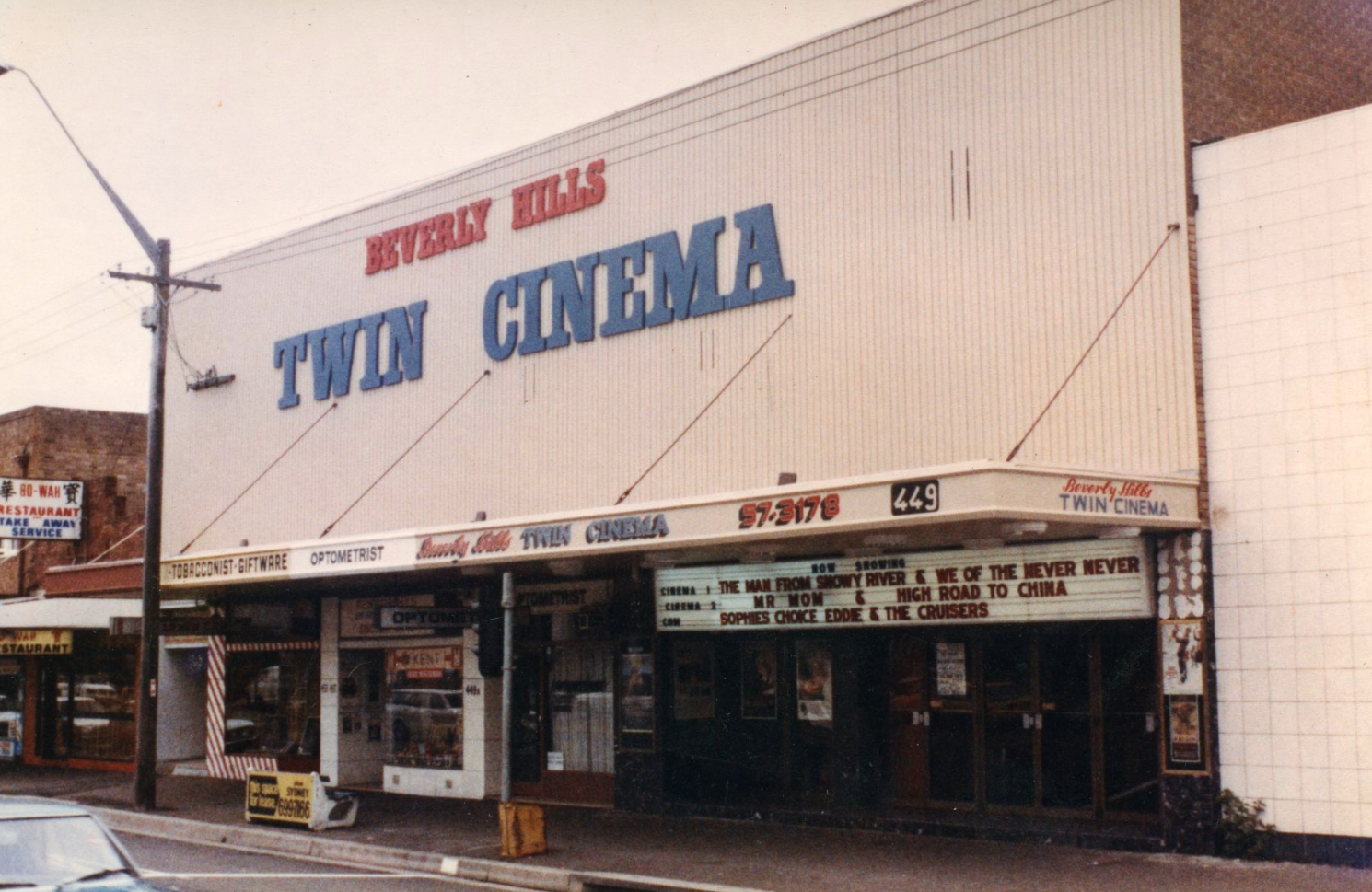
Seeing double at Beverly Hills Twin Cinema, 1983. Image courtesy Georges River Libraries
And couldn’t you tell. For years, the bigger Cinema No. 1 would play host to the big budget blockbusters, while smaller, more intimate pictures or films late in their run were relegated to the tiny Cinema No. 2, which had been shoehorned in above the first. It was an awkward setup, but one that built a reputation as the cheapest cinema in Sydney (based on ticket prices, of course), and became one of the most popular family venues in the south west, especially when coupled with the nearby Beverly Hills Pizza Hut. Movies then all-you-can-eat pizza: it doesn’t get much more 90s than that.
The cinema was looking a bit dated by the early 2000s, but not as bad as the bank next door (originally a Bank of NSW, later a Westpac). Sandwiched between the cinema and the Pizza Hut was one of so many suburban bank branches closed during that time, and it sat dormant for many years just like the Hut.
Perhaps realising it wasn’t a good look, and that there was an opportunity to expand, the Tsagias family bought the bank in 2004 and moved in, creating a video arcade in the new space which greatly relieved pressure from the cramped waiting area.
But this wasn’t enough. In 2008, a complete redevelopment saw the Beverly Hills upgraded to a six-screen cinema. The derelict Pizza Hut was cut in half to make room for more screens and a mini-power station, and the entire facade facing King Georges Road was given the facelift (in true Beverly Hills fashion) that it sports today.
Not quite the case around the back, though.

From the alley behind the cinema, it’s easy to see the layout of the original St James and the bank next door. The structure on the extreme left is new, and sits on the Pizza Hut’s territory. The Pizza Hut recently vanished from existence, perhaps to make way for more parking for the cinema, or a new restaurant (just what BH needs). Whenever you see extensive renovations going on, it’s usually a safe bet that it’s being done to prepare the property for sale. Sure enough, the Tsagias family placed the Beverly Hills Cinema on the market late last year. It seems as if Event Cinemas has taken control, at least of the screening coordination, but it remains to be seen if the Beverly Hills will remain a cinema under a new owner.
If it doesn’t, they may have to change the suburb’s name again.
Food Fair/ANZ Bank/The Base Store/No1 Butchery – Hurstville, NSW
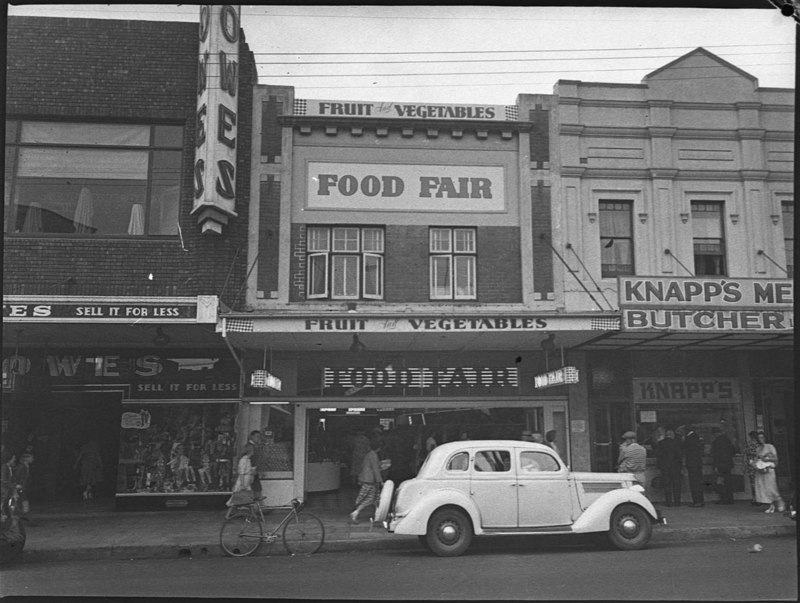
Food Fair, Forest Road, 1951. Image courtesy State Library of NSW.
Sometimes it can be fun to take a look at the evolution of a shop over time. It reveals a lot about the changing face of the suburb, shoppers’ tastes and the sensibilities of the time, among many other things. In this case, we’re looking at 274 Forest Road, Hurstville. In 1951, it was Food Fair, an extremely 50s looking fruit and vegetable shop. Now, take a good look at this picture. You’d never get away with parking a car on Forest Road like that these days, and you certainly wouldn’t ever see your bike again if you just left it unattended and unchained like that. Before the advent of the Westfield, or the Super Centre above the Hurstville train station, these shops were the lifeblood of the suburb that coursed through the vein that is Forest Road.
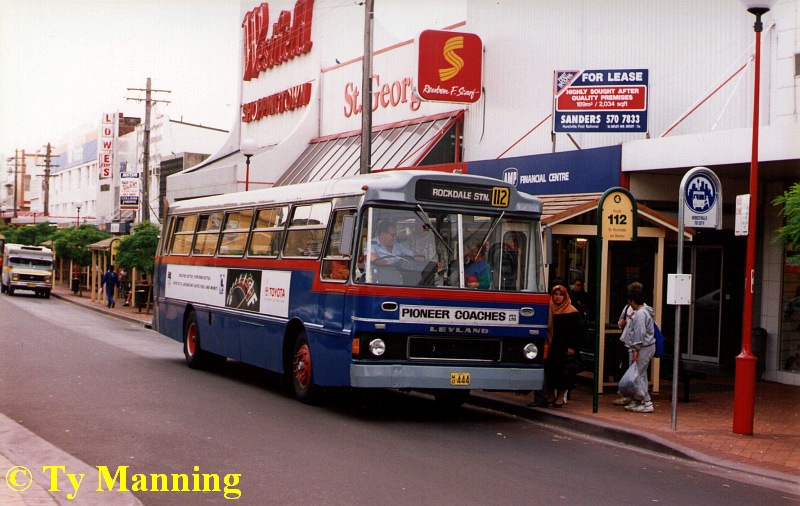
Hurstville, circa 1986. Image courtesy Ty Manning, clearly.
This one’s a stretch, but use your enthusiasm to zero in on the barely visible ANZ logo next to the Lowes, which is still there 30 years later. It makes sense that by the 80s, the banks had staked out territory amongst the little shops along the street. Food Fair would have had nowhere else to go but bust even if it had survived the 1978 opening of Westfield (which I’m guessing it didn’t).

Hurstville, 2002.
Here we are again, in the new millennium. Now the shop is home to The Base Store, a $2 shop/party goods outlet. How shops like these were able to flourish in the 90s/00s is beyond me, but think back – they were everywhere. It all started with the novelty of the Reject Shop, and then things got out of hand. We only have ourselves to blame. By this point the bank is long gone, a victim of the online revolution and branch closures. Firing workers is the best way to save money, you know.
 Which brings us to today. Oh, how things have changed (except Lowes, which appears to be the foundation Hurstville was built around). The former Knapps Butchery has become a Chemist Warehouse, and the party’s over for the Base Store. It’s now Butchery No. 1, or No1 Butchery as Google likes to call it, and fittingly too – it’s anonymous as hell. There’s the Rav 4 parked in the same place as the car in 1951, and they both have the spare tyre on the back. The custom facade of the Food Fair has long since been covered up by the dirty venetian look of ANZ, which itself has left an ugly stain (what a visual metaphor). The ubiquitous-yet-defunct Anata Awning has ensured that Food Fair’s legacy is lost to the world, but I can’t help but think if you tore that facade down, the Food Fair shopfront would be waiting patiently behind it for one more day in the sun. It sounds fair to me.
UPDATE: One year later, No. 1 Butchery is #10 in the Past/Lives Flashback series. Check it out.

 Past/Lives of the Near Future