Cash Converters/Royal Umbrella Asian Supermarket – Burwood, NSW

I bet birds love that sky blue building next door.
When Cash Converters first appeared in Sydney in the early 90s, they were pushing themselves as the legitimate pawnbrokers. You could feel just as comfortable walking in to purchase a ghetto blaster as you could walking in to hock one. In fact, destigmatising the act of hocking was something Cash Converters actively tried to work towards. In the eyes of the Cash Converters you weren’t some junkie whose true intentions were the china white elephant in the room, you were a valued customer. Even the name Cash Converters subliminally worked to suggest ‘Hey, you’re not hocking anything. You’re converting your unwanted goods for cash, and we’re making it happen. Aren’t we great?’
By 1996 the honeymoon was over. The true junkies and dodgy dealers had managed to corrupt the brand, and once again reputable folks were ashamed to be seen there. In the last five years they’ve staged a comeback of sorts (Cash Converters, not reputable folks), and it seems to be working. In fact, there already is a Burwood Cash Converters, but it ain’t this one. This, a little further up the street, is their first aborted attempt at converting Burwood’s cash, and it’s telling that when they went back for a second try, they gave this place a wide berth.

I know that sky looks Photoshopped, but I swear it’s untouched.
The lack of care put in the first time around is evident – the Cash Converters sign is crudely stuck over yet another sign. It even sports the chain’s tagline of the early 90s, which gives me an excuse to post this ad. If I could put it in every post, I would.
Today, the shop is occupied by an Asian supermarket, a proud retailer of globally beloved jasmine rice Royal Umbrella. They’re also clearly very proud of the ‘Trusted Brand’ award they won in 2010, an honour I’m guessing has never been bestowed upon Cash Converters. By the way, if you’ve still got the Cash Converters jingle stuck in your head, head over to the Royal Umbrella site and get a load of theirs. And remember – the whole world loves.
Devonshire Street Cemetery/Central Station – Sydney, NSW
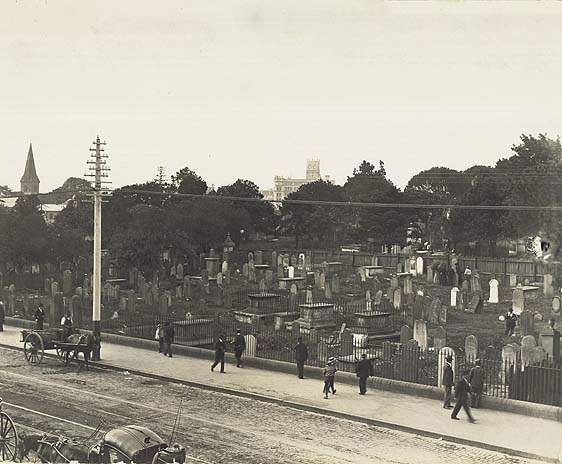
Devonshire Street Cemetery, 1901. Image courtesy State Records NSW
“I once walked through the burial grounds on the Surry Hills, in the commencement of Spring, just as the flowers were beginning to bloom forth in all their beauty…”
Bridget Flood was in the same situation too many of us have found ourselves in all too often: stranded at Sydney’s Central train station, hopelessly late. The big difference is that she was waiting there for over 60 years.
As we’ve previously learned, 1820 was a good year to die in Sydney. Rather than ending up beneath the public piss-pot that was once the colony’s first burial ground, you could find yourself in a brand new plot freshly dug at the just-consecrated Devonshire Street Cemetery.
Yes, that Devonshire Street.

Location, location, location. South Sydney plan, 1842. Image courtesy K Johnson and M Sainty.
Chosen for its abundance of space and central (heh) location, the area bordered by Elizabeth and Devonshire streets was chosen to replace the Old Burial Ground as Sydney’s premier final resting place. Quartermaster Hugh McDonald, 40, was the first lucky stiff to be buried there following his death in 1819. Long waiting lists…so Sydney so chic.
“It was early in the morning when I commenced rambling amongst the tombs, the dew had not yet been dissipated by the genial rays of the invigorating luminary, and the cool fragrance of the atmosphere had not yet given way to the noon-day heat…”
Bridget Flood died in October 1836 at the age of 49 and, like virtually all deaths in Sydney at the time, was interred at the Devonshire Street site. Quoth her headstone:
“Pain was my potion
Physic was my food
Groans were my devotion
Drugs did me no good
Christ was my physician
Knew what way was best
To ease me of my pain
He took my soul to rest.”
They don’t write ’em like that anymore. And rest she did, as did all those buried at Devonshire Street Cemetery well past its 1867 closure.

Go home, we’re full. Devonshire Street Cemetery, 1901. Image courtesy RAHS.
Although steadily employed by the city’s dead between 1820 and 1866, the nail in the coffin (heh heh) for the cemetery was the latter year’s introduction of the Sydney Burial Grounds Act (NSW), which prohibited burials “within the city of Sydney from 1 January 1867, with the exception that persons with exclusive rights of burial at that date could still be buried on application to the Colonial Secretary who needed to be satisfied that ‘the exercise of such right will not be injurious to health’“. Phew. Just tie some rocks to me and throw me in the harbour!

Devonshire Street Cemetery, 1901. Image courtesy Royal Australian Historical Society.
You’d think this act would be in anticipation of some kind of grand plan for the burial ground, but no. With the exception of infrequent additions to family plots as outlined by the overly wordy act (and even these ceased in 1888), Devonshire Street was largely ignored by the growing city while new sites like Waverley Cemetery and the Rookwood Necropolis served the public’s burial needs.

Prince Alfred Park’s Exhibition Building looms large. Devonshire Street Cemetery, 1901. Image courtesy Royal Australian Historical Society.
By 1900, its advanced state of neglect and decay reflected its residents and disturbed the public:

Illustrated Sydney News, 1878.
…although it wasn’t all bad:

SMH, January 26 1878.
“In short, it was exactly such an hour as an imaginative or sensitive being would delight to rove about, and lose himself in the regions of fancy…”
It wasn’t long before some of the more opportunistic voices began to speak out about the the site’s real estate value:
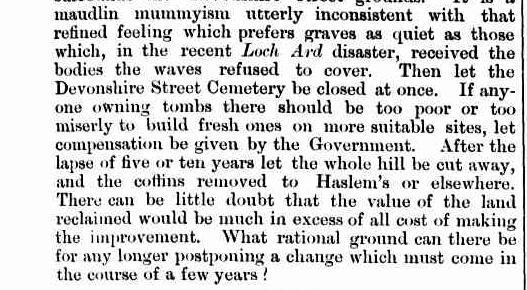
Illustrated Sydney News, 1878.
And as early as 1888 there were rumblings about how best to use the land:
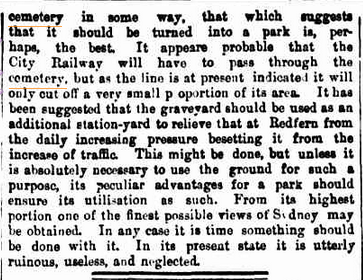
SMH, March 3 1888.
It made sense, given that Central Station’s predecessor, ‘Sydney Station’, lay opposite the cemetery along Devonshire Street.
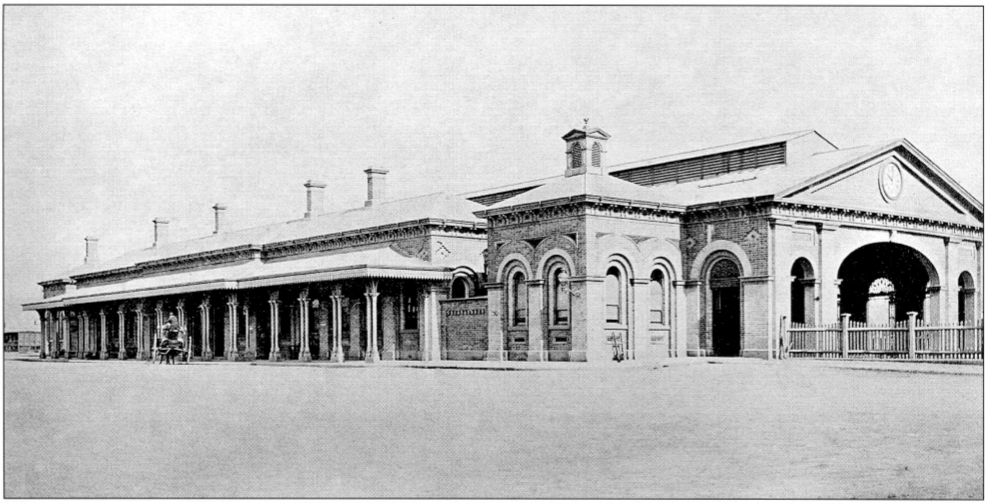
Sydney Station, the forerunner of Central Station, 1874. Image courtesy ARHS Rail Resource Centre.
Since 1884, Sydney’s existing rail network had been under the stress of increasing traffic and a limited reach (sounds familiar, doesn’t it?). Sydney Station was constantly receiving upgrades and additional platforms, culminating in a messy setup of 13 train platforms and numerous tram sheds (sounds familiar, doesn’t it?). The city’s railway commissioners initially struggled to decide upon a plan for the future which would provide Sydney with a central hub expansive enough to extend the rail network to the suburbs (sounds- never mind).

The planned terminus for Hyde Park. Image courtesy RailCorp.
An 1897 royal commission proposed the resumption of Hyde Park for use as the central terminal and, to counter the public outrage over the loss of parkland, the Devonshire Street Cemetery would be converted into a park. For a time this plan seemed to be a go until the unexpected death of Railway Commissioner E M G Eddy (of Eddy Avenue fame) that same year. This forced a literal return to the drawing board, where it was decided that it was probably easier to resume just one giant park instead of two. Nice thinking, guys.

The new plan. Image courtesy Public Works Committee.

The undertakers size up the corpse, December 1900. Image courtesy State Records NSW.
In January 1901, the Department of Public Works served notice that anyone with relatives buried at Devonshire Street were to front up and make known their desire to have the remains reinterred at other cemeteries by train, with the cost to be borne by the NSW Government. These days, they’d just tell you to bring a shovel.

Devonshire Street Cemetery, 1901. Image courtesy RAHS.
Unfortunately, these relatives were given a strict time limit of two months to act, and by the end of that time, only 8,460 bodies had been claimed (not among these was Eddy, who had been buried at Waverley following his death). This left 30,000 remains unclaimed, most of which were transferred to other cemeteries anyway, but due to the rushed nature of construction and given they did such a bang-up job the last time, it’s safe to say there are more than a few commuters at Central waiting for a train that will never come.
With that many bodies to exhume, you can imagine just how many creepy stories must have come out of the venture. Here’s just one:
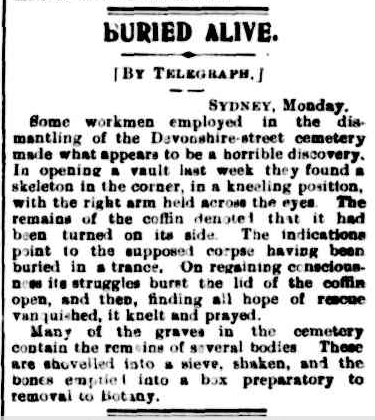
Barrier Miner, July 29 1901.
The reason for the rush was that Melbourne had started work on their Central equivalent, Flinders Street Station, that same year. Sydney was determined to get the drop on Melbourne this time, as Flinders predecessor ‘Melbourne Terminus’ had been Australia’s first city railway station back in 1854, pipping Sydney by a year. The Devonshire Cemetery site had been completely cleared by 1902, and stage one of Central’s construction, which aimed to have the station operational, was completed in 1906. On opening day, the new station featured…13 platforms. Despite being twice the size of its predecessor, this was no improvement, and did nothing to alleviate Sydney’s transport woes (but then again, what ever does?).

Central Station, 1906. Image courtesy State Records NSW.
“I directed my footsteps to a cluster of tombs on an eminence, which was thickly covered with green and blooming geraniums…”
But the unexpected fruit of the Department of Public Works’ labour was the emergence of commercial activity in the areas surrounding the new station. Its proximity to the city made department store shopping for those out in the sticks a treat, with Grace Bros., Marcus Clark, Anthony Hordern, Bon Marche and Mark Foy all within walking distance of Central by 1908. The Tivoli and Capitol theatres became entertainment meccas for those starved of entertainment in the ‘burbs.
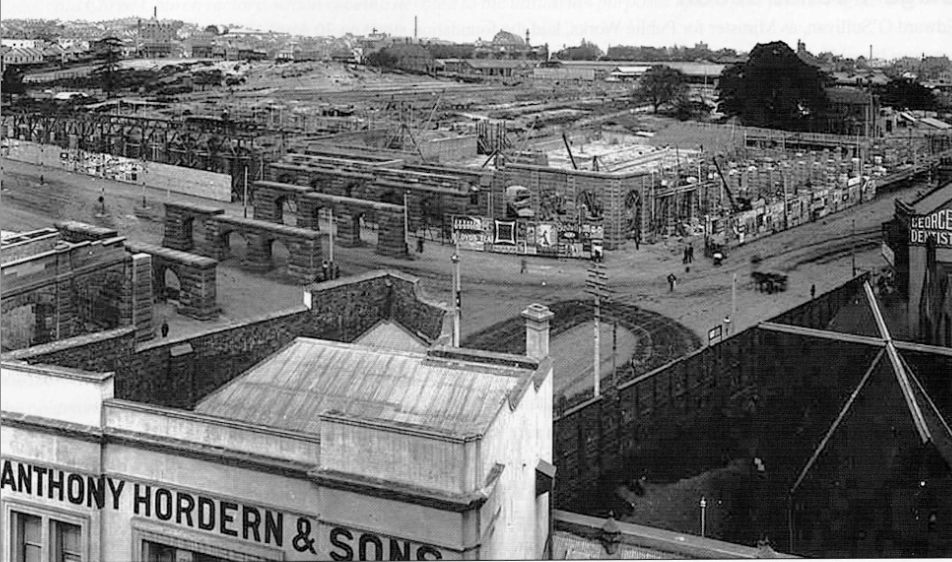
Anthony Hordern awaits new business during Central’s construction, April 1903. Image courtesy ARHS Rail Resource Centre.
The station itself was hardly the thing of beauty its early designs had suggested, with the rushed development cycle omitting many intended features – least of all Central’s iconic clock tower, which wasn’t completed until 1924.

Always on time: Central Station’s clock tower completed, 1924. Image courtesy State Records NSW.
The construction wasn’t just focused on making sure the station would be operational before Flinders Street, though; there was particular care taken to ensure no trace of the Devonshire Street Cemetery remained, going so far as to completely eradicate Devonshire Street west of its intersection with Elizabeth. Other structures that once stood on the land now occupied by Central and its surrounds – the Belmore Police Barracks, the Benevolent Asylum, the womens refuge – have similarly been lost to time.
“I at first almost forgot the ravages of the grave in contemplating the enchanting appearance of the place.” – James Martin, 1838.
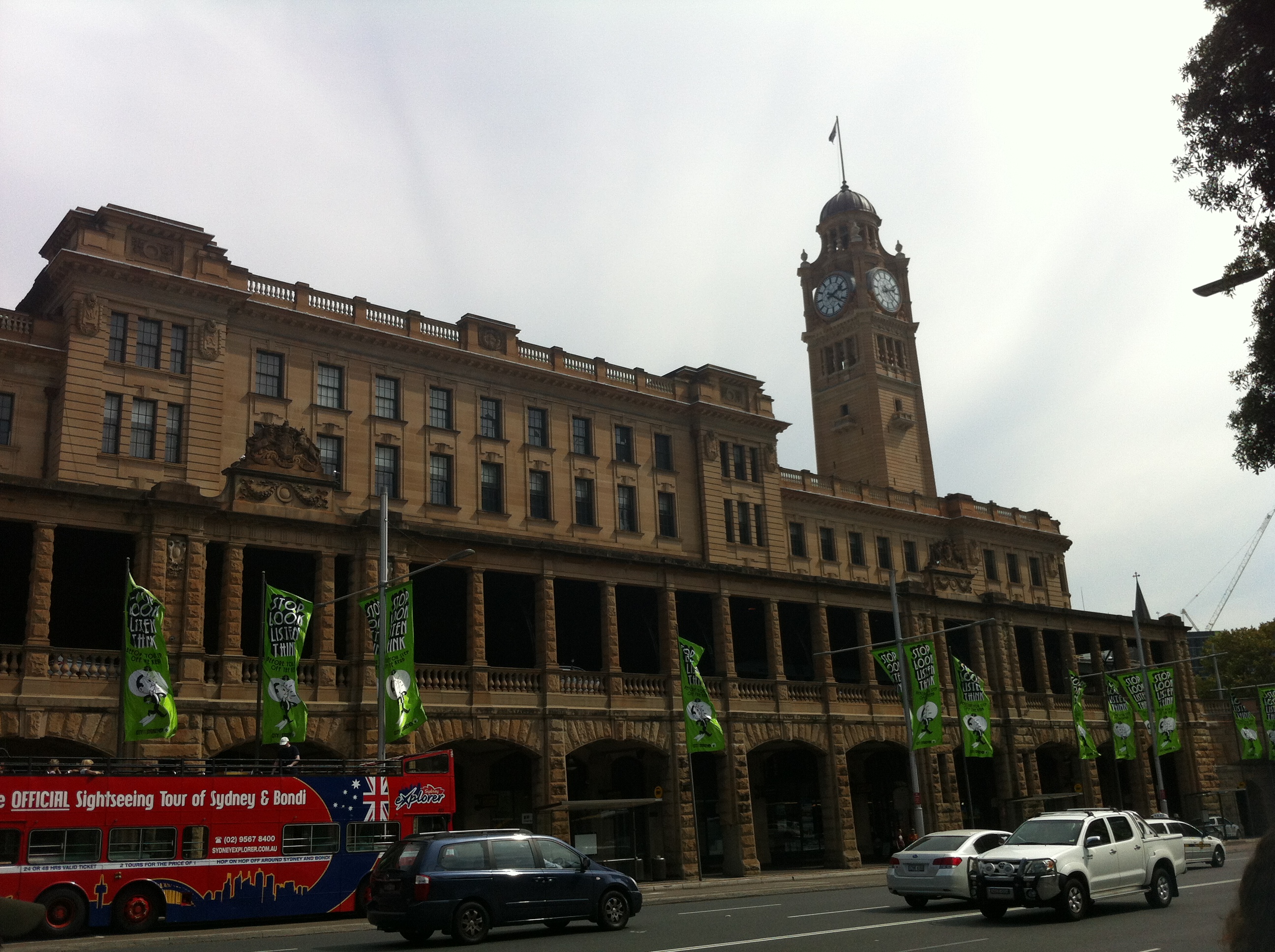
Today, nothing remains to remind commuters of the morbid nature of Central’s past. The cemetery itself was largely situated underneath today’s platforms:

Devonshire Street Tunnel, once Devonshire Street, runs directly underneath the path once carved between the cemetery and Sydney Station, depositing Surry Hills pedestrians into Railway Square amid el-cheapo bargain shops, youth hostels and fast food joints.

Looking east toward Devonshire Street, 2013.

Looking west toward Railway Square, 2013.
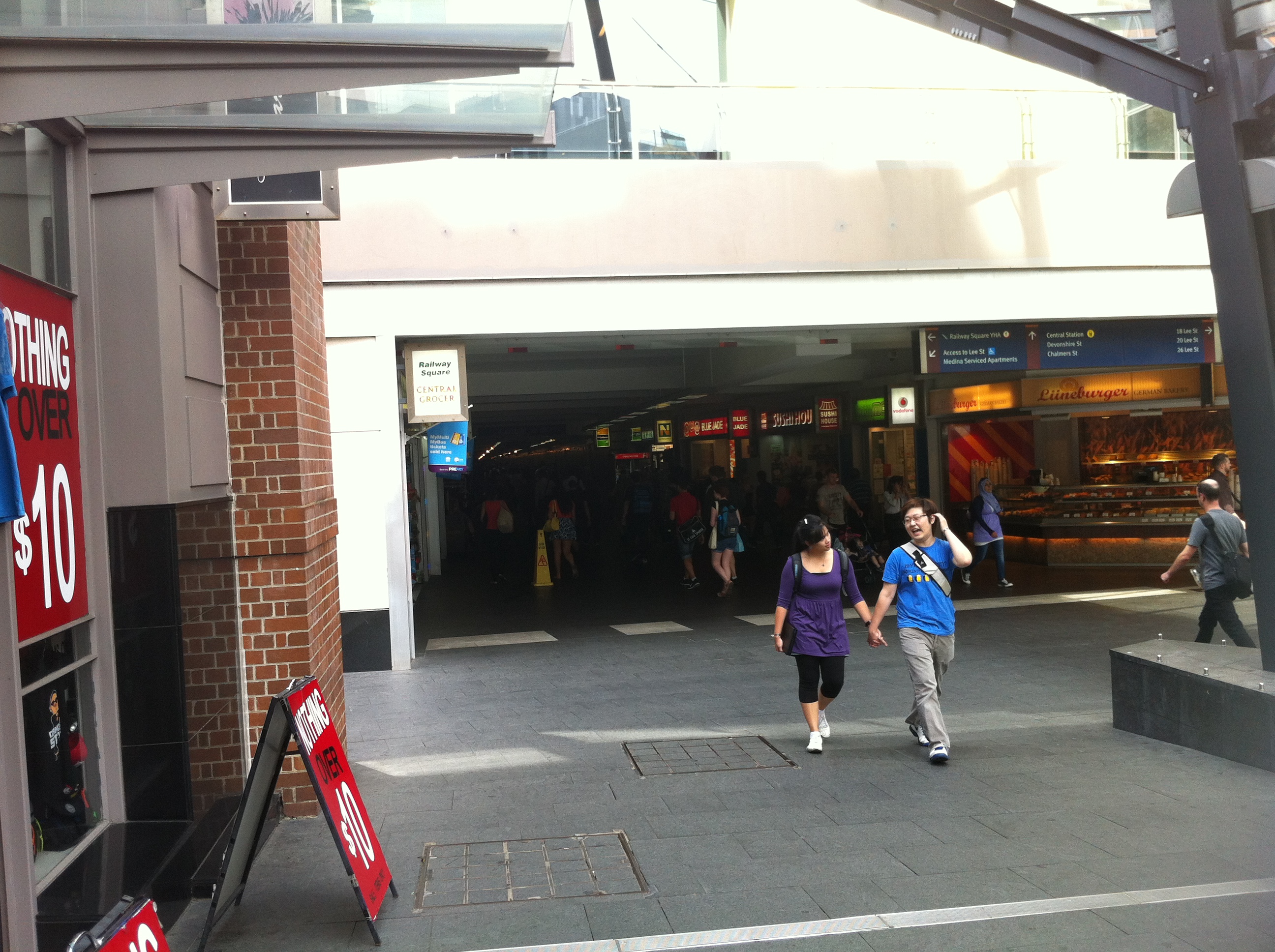
Emerging into Railway Square, 2013.
Also in Railway Square is a series of plaques designed to inform passers-by on the history of Central Station and railway in NSW. The cemetery is mentioned in passing (heh).
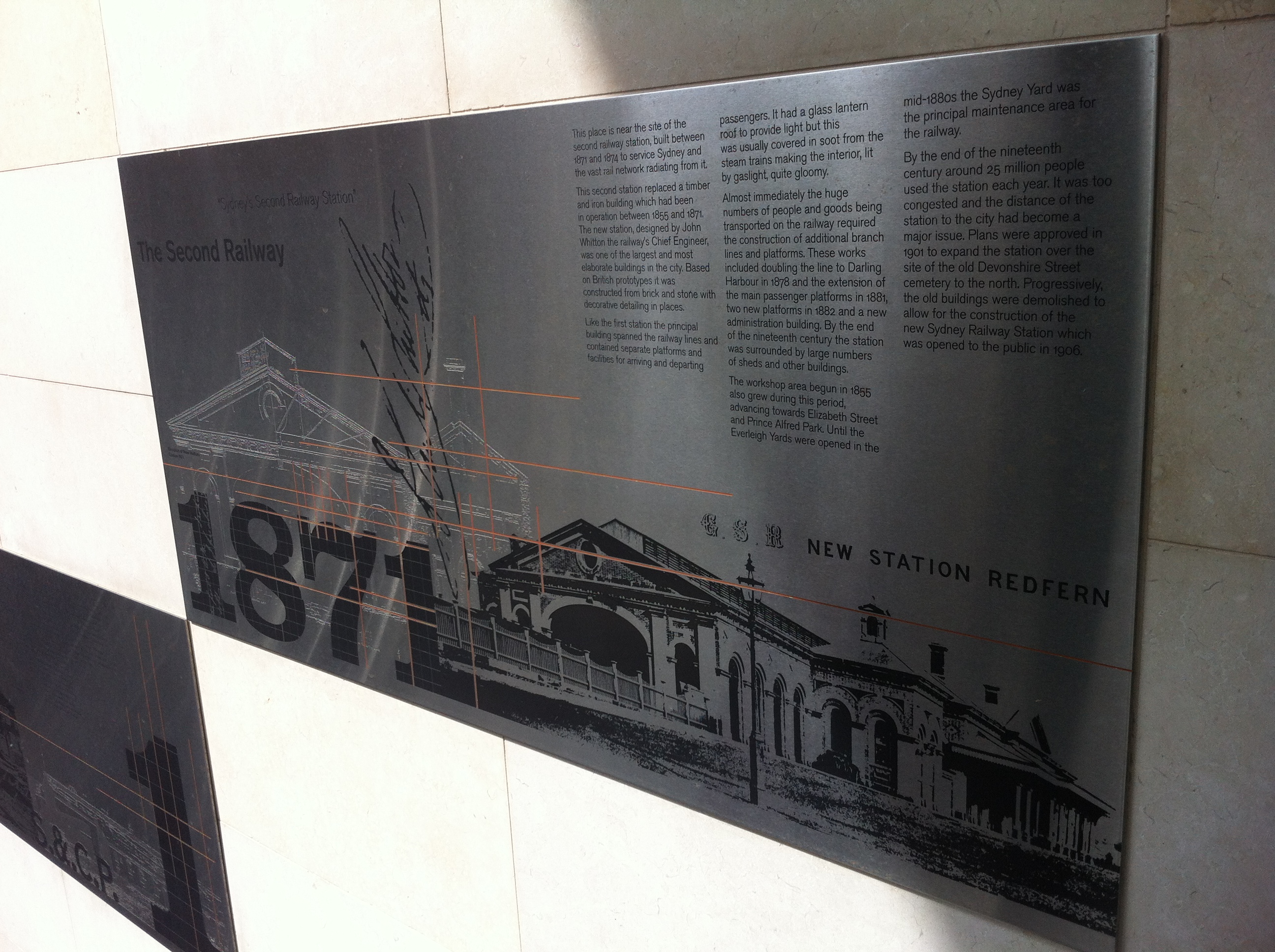
Revisionist history part one, 2013.

Revisionist history part two, 2013.

Revisionist history part three, 2013.
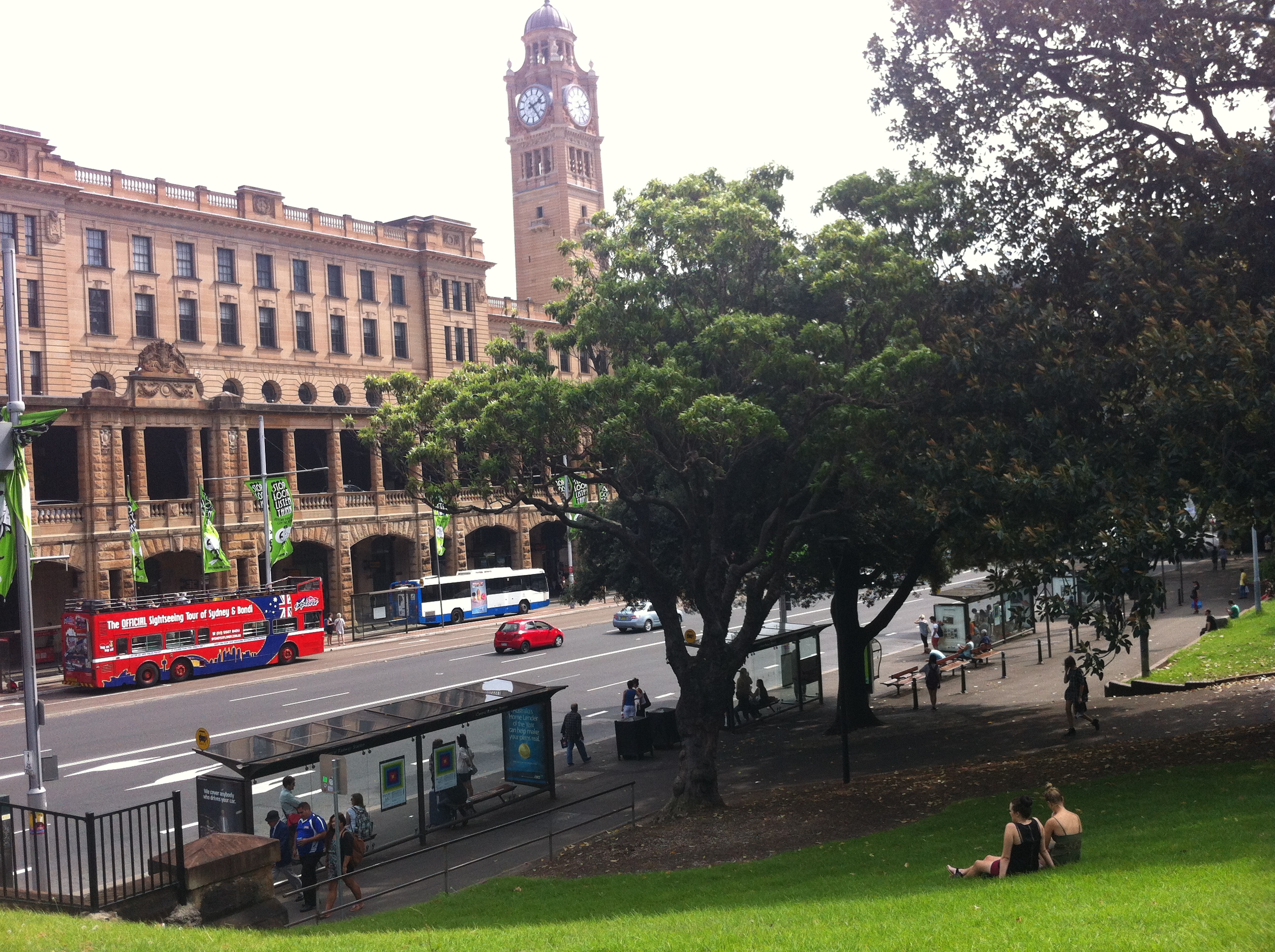
Belmore Park, 2013.
The uneven terrain of Belmore Park perhaps provides us with the nearest idea of what the Devonshire Street Cemetery was like in its natural state as is possible today, although even it has a sordid and ugly past as an open gutter for the refuse of the nearby Belmore Produce Markets and Paddys Markets.

Belmore Park, 2013.

Gateway to limbo. Camperdown Cemetery, 2013.
Rookwood Necropolis, Eastern Suburbs Memorial Park, Woronora Cemetery and many others were the recipients of many of the (not so) permanent residents of Devonshire Street, but none feature as striking and immediate a memorial as the tiny, eerie Camperdown Memorial Rest Park. Here, amongst the sombre atmosphere of tombstones and gloomy, gnarled trees lie what were once the gate posts met by visitors to Devonshire Street. These were removed along with everything else in 1901, and mysteriously disappeared from existence until 1946, when…

SMH, October 9 1946.

It’s kinda graffiti. Camperdown Cemetery, 2012.
It seems almost sacrilegious that thousands of commuters tread all over this once-consecrated ground every day without any kind of marker to signify what was and who mattered, even if it was nearly 200 years ago. C’mon, NSW Government! They’re even in the right electorate! Meanwhile, to the 30,000 Sydneysiders scattered to the four corners by the winds of progress, the term ‘final resting place’ has little meaning.
Finally, here’s a fascinating account of a visit to Devonshire Street Cemetery just as its demolition was beginning. It originally appeared in the Clarence and Richmond Examiner, October 1 1901.


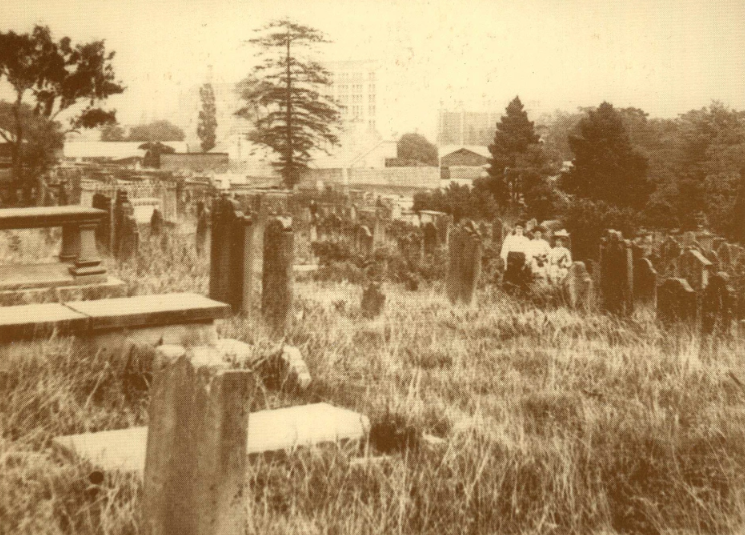
Ghouls, not girls. Devonshire Street Cemetery, 1901. Image courtesy RAHS.
Past/Lives Flashback #2: Platforms 26 & 27, Central Station – Sydney, NSW
Original article: Platforms 26 & 27, Central Station – Sydney, NSW
The mystery of the ghost platforms hidden within Central Station continues to fascinate nearly 35 years after their inception, but since I still haven’t been in there to see them, there’s not much new to add. They’re still not being used for anything important, and there are still no plans to use them in the future.

Platform 27, 1998. Image courtesy David Johnson / Railpage.org.au.
But Central Station’s secrets extend far deeper than just these two platforms, so why don’t we dive into that instead? Bring a shovel.
Past/Lives Flashback #3: Midnight Star Reception Centre – Homebush, NSW
Original article: Homebush Cinema/Niterider Theatre Restaurant/Midnight Star Reception Centre/Derelict – Homebush, NSW

It was only a matter of time before we found ourselves back in front of this beast. As we already know, the Homebush Theatre has experienced a long afterlife as an ice rink, a theatre restaurant, a reception centre and a squat before it was finally allowed to rot alongside the other corpses on Parramatta Road. For more on its years as a squatters paradise, check out this fascinating account and accompanying video.

Shortly after I wrote my original article last year, it came to light that the Midnight Star was to be redeveloped into two towers of high-density living space in the hope of rejuvenating its necropolyptic surroundings. This plan was rightfully met with community outrage, and has since been dropped by the developers without explanation, granting the Niterider another stay of execution.

While attempting to spruce up the area is a good idea, this was not the right way to go about it. Sure, put in your two towers full of people, but consider the lack of amenities or decent infrastructure in the area before you start getting the dollar signs in your eyes, greedy developers! You know, if the M4 was finished, you could transform the stretch of Parramatta Road between Homebush and the city, and smart developers could really clean up… Oh wait, this is Sydney we’re talking about. Carry on.

And so the Midnight Star returns to its seemingly-eternal slumber, waiting for a new set of idealistic developers to take another crack. The Strathfield Council has welcomed attempts to get something happening here, but only if the community at large receives some benefit. Personally, I think the community would benefit from a return of the theatre restaurant format. Come on, who doesn’t like to be entertained while eating, especially by dodgy panto? Get Dirty Dick on the phone! Homebush would learn to laugh again, instead of sinking further into bleak, oppressive hopelessness. It’s not a good look.
UPDATE: Someone has awakened the beast. Come for a tour of the Homebush Theatre before it’s gone forever (or even after it’s gone, these blogs last a long time).
Tandy Electronics/Hair of Istanblue – Gladesville, NSW
Before we launch ourselves into the top three flashbacks, here’s one that’s sure to make the top ten next year. 
If you allow your mind to drift back to the heyday of American-style consumerism this country indulged in between 1970 and 1999, you’ll no doubt remember Tandy Electronics. Born in 1973 as a local subsidiary of an American parent company of the same name, Tandy’s cutting edge product line and futuristic promise found a niche market that didn’t even know it was there. By 1980, Tandy had expanded past its modest Rydalmere headquarters, sprouting up in shopping plazas, arcades and strip malls like this one all around the country.
As a 90s kid, there were no words fit to print with which to express the disappointment of entering a Tandy and expecting video games. It was an electronics shop, wasn’t it? I didn’t want to have to build my own IBM compatible (or CB radio, more likely given Tandy’s field of expertise). They were still kid-friendlier than Radio Shack, but hell, even Dick Smith at least had a SNES game or two.
The paradigm shifted with the arrival of Electronics Boutique in 1997 – an ‘electronics’ shop without the transistors, bulbs and sockets we found so off-putting. At the same time, the limits of home-made technology were becoming apparent as the advances of the tech world left Tandy choking on its dust. In 2001, Woolworths added Tandy to its family, which by then also included Dick Smith.
Sadly for Tandy, it was far too niche to receive a generic relaunching as a consumer electronics and electrical giant as did Dick Smith. By 2009, the Tandy brand was put out to pasture, suddenly the perfect example of an “Oh, where’s that shop gone? I’m sure it was over in this corner…oh well.” moment. The final nail in the coffin was the closure of the tandy.com.au website (it redirects to the Dick Smith site). It’s almost biblical: the final betrayal for Tandy came from the realm of technology itself.
All that remains today are examples like the above. Hair of Istanblue can probably thank Tandy for its awesome homemade security system, or its radio that competes with the permanent-part time apprentice hairdresser for the coveted title of ‘loudest in the room’ on any given business day…but it’s likely these technological legacies go unnoticed.
Not so the old sign outside, the 80s ‘hi tech’ font of which catches the eye much better than the weirdly-incomplete Istanblue awning. But beware its siren call, tech-heads – you won’t find DIY lie detector kits and oscilloscopes here. C’mon, even the defunct Tandy website had to have been better than Hair of Istanblue’s spartan effort.
Also worth mentioning is the integral part Tandy Electronics played in the early 90s Australian childrens TV series Finders Keepers.

Image courtesy ABC
In the show, based on Emily Rodda’s books, a Tandy outlet in Prospect (a northern suburb of Adelaide) acts as a gateway to another world, one separated from ours by a ‘time barrier’. As the Gladesville Tandy has shown us, it wouldn’t be the last time Tandy would act as a time warp.

 Past/Lives of the Near Future