Pizza Hut/Salvation Army – Liverpool, NSW

If there’s one goal that’s proven consistently hard to achieve, it’s covering up an eat-in Pizza Hut. There seem to be two typical approaches: the first is to make a genuine effort to alter the building and hope no one recognises. It doesn’t always work. The second is to just embrace the hallmarks of the former tenant wholeheartedly, and who better to breathe new life into someone’s sloppy seconds than the Salvos?

Inside, if you can look past the piles of instructional golf videos and copious amounts of Fifty Shades of Grey, it isn’t hard to spot the former Hut infrastructure that hasn’t already been sold off. Heck, someone probably walked away with the original oven for a bargain price, and I’m kicking myself right now that it wasn’t me.
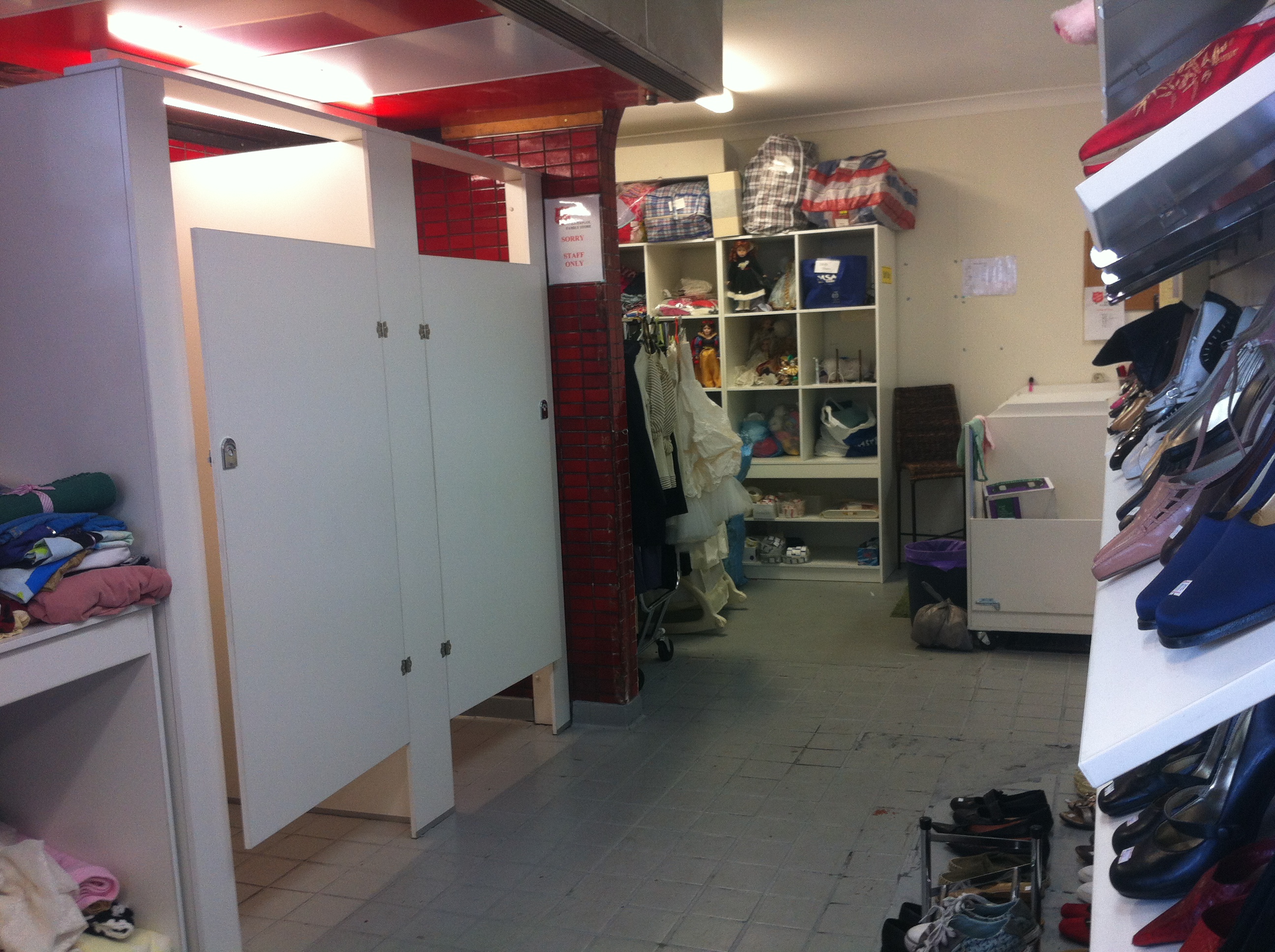
Even the toilets have been put to a more hygienic use (but not by much) as change rooms. And no, I would not count among the highlights of my blogging career standing in the middle of a Salvation Army and taking a photo of its change rooms. It’s all for you, Damien.
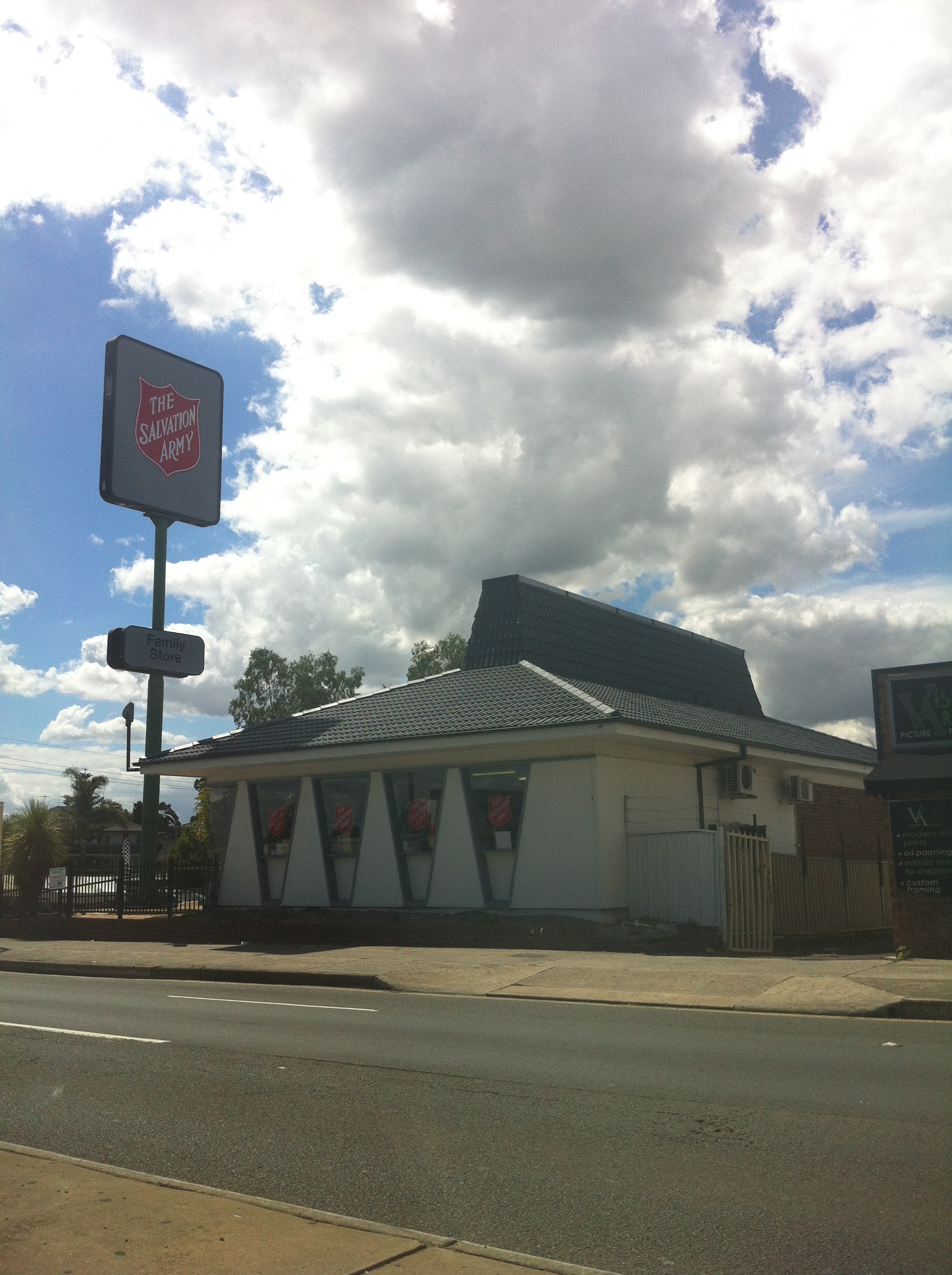
When my generation returns to the earth and Pizza Hut’s eat-in legacy is forgotten, will people wonder why these buildings look so odd? Probably not.
Della Cane/Boomalli & Recollections – Leichhardt, NSW

These days, Leichhardt is home to Recollections, a country-style furniture warehouse, and one door up is Boomalli, an Aboriginal artist cooperative. In this instance, Recollections have wisely chosen to drop their full business name so as not to create a microcosm of colonial Australia right here on Flood Street.

But the earliest settler at this warehouse lives on through this tiny little detail. It’s old, it’s worn, it’s even got a bit snapped off…but it’s still just strange enough to make an observant passer-by take pause. Leichhardt’s hardly a tropical paradise. What’s the story?
The answer lies back in 1991, and this ad for Della Cane. No building that ugly could exist twice, and the interior looks like Fantastic Furniture met Jurassic Park.
Past/Lives Flashback Countdown Repository
Since it took just a little bit longer to get through a seemingly simple top ten than I thought it would, I’ve gathered them all here for the sake of convenience. It was a good chance to go back and flesh out some of the history of these places, and in some cases a great opportunity to continue their stories. Enjoy:
Past/Lives Flashback #10: Butchery No. 1 – Hurstville, NSW
Past/Lives Flashback #9: Hire One – Hurstville, NSW
Past/Lives Flashback #8: Sydney Olympic Park – Homebush, NSW
Past/Lives Flashback #7: Rick Damelian – Leichhardt, NSW
Past/Lives Flashback #6: Regent Street Station – Chippendale, NSW
Past/Lives Flashback #5: The Hartee’s Saga, Part V: Hartee’s Revenge – Manly Vale, NSW
Past/Lives Flashback #4: Videomania – Rosebery, NSW
Past/Lives Flashback #3: Midnight Star Reception Centre – Homebush, NSW
Past/Lives Flashback #2: Platforms 26 & 27, Central Station – Sydney, NSW
Past/Lives Flashback #1: Union Carbide – Rhodes, NSW
In site news, there’s finally a Facebook page for Past/Lives. ‘Like’ it to your right. With it, I’ll be able to update older entries with new photos or newspaper articles or whatever and let you know about it toot sweet, plus there’ll be plenty of other good stuff I’m not able to fit into the main articles, so head on over.
Now that the countdown’s over, there’s plenty of fun NEW material on the way, and I’ll be catching up on some reader suggestions. Stay tuned…
Past/Lives Flashback #1: Union Carbide – Rhodes, NSW
Original article: Timbrol Chemicals/Union Carbide/Residential – Rhodes, NSW
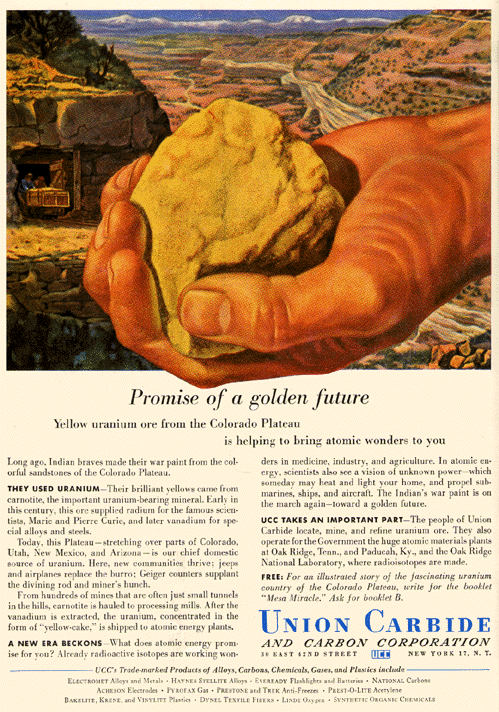
Yes, the time has finally come. The most popular entry on Past/Lives over the last year (and a bit, by this point) by far was the tragic tale of Rhodes and that most toxic tenant, Union Carbide. Rhodes’ decimation at the hands of industrial abuse throughout the 20th century and subsequent resurrection as a residential paradise in the 21st is a long story, and one with repercussions for the whole of Sydney even today. Grab a coffee (although Rhodes residents, maybe don’t use tap water) and get comfortable…we’ll be going back over the whole thing.
THEN

Granny would be proud. Rhodes House, 1875. Image courtesy City of Canada Bay.
Rhodes Hall, near Leeds, was about as far from the eastern shore of the picturesque Homebush Bay as Thomas Walker could imagine. A commissary, Walker had arrived at Port Jackson in 1818, and the following year bought an allotment of land from Frederick Meredith, another early settler. Walker built a house on his bank of the Parramatta River, naming it Rhodes after his grandmother’s estate back in the motherland because even hardened and worldly mercenaries still have soft spots for their grannies. So soft, in fact, that in 1832, Walker moved to Tasmania where he built another estate…also named Rhodes. She must have spoiled that kid rotten.
Wish you were here. Image courtesy City of Canada Bay.
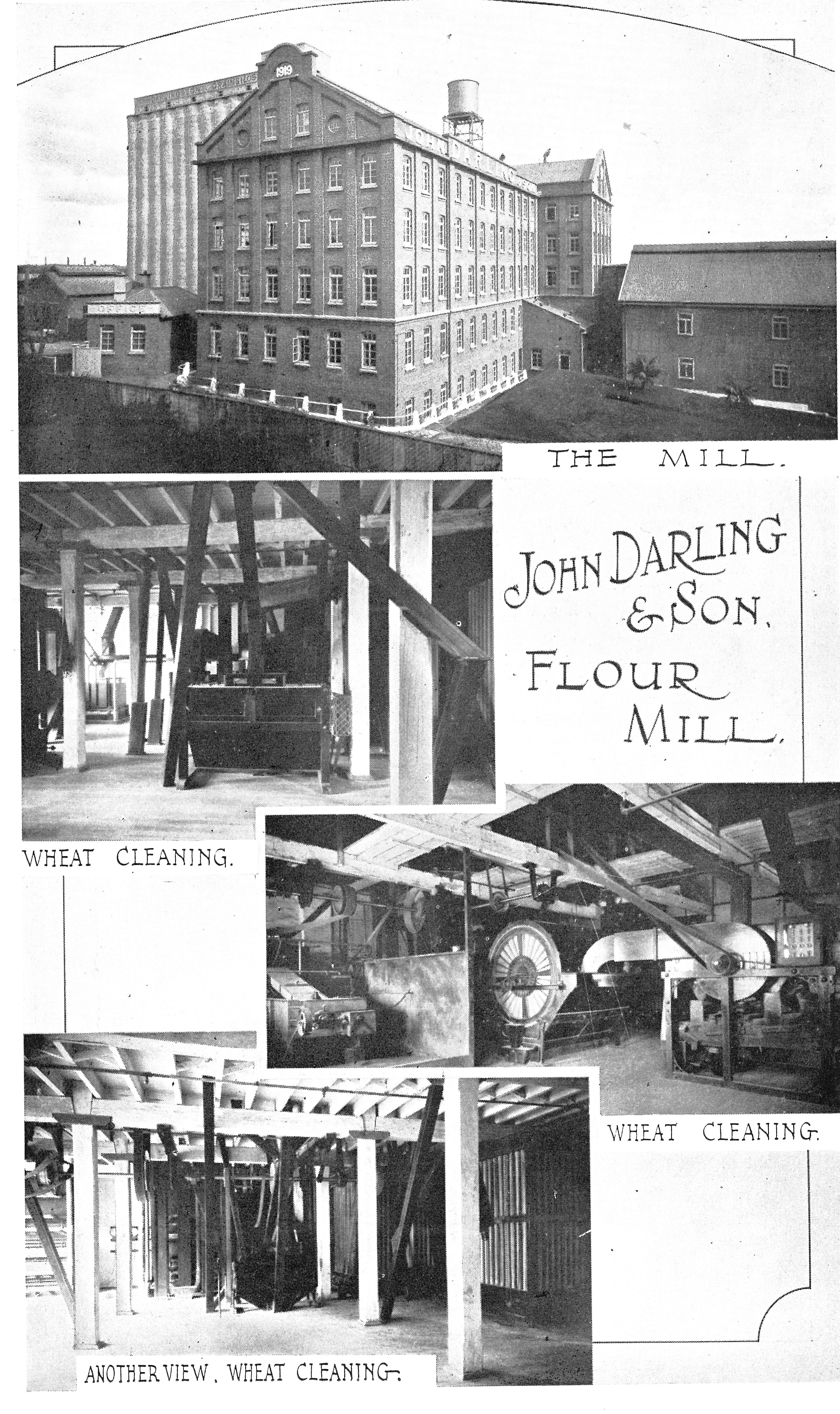
The Walker family relinquished their control over the Rhodes estate in 1919, when they sold up to the John Darling Flour Mill. By this point, Rhodes was no stranger to industry. Eight years earlier, G & C Hoskins had cleared much of the area’s forests to erect a cast iron foundry, and once this had happened, everyone got on board. There was little resistance to this kind of heavy industrialisation, especially in a suburb like Rhodes, which was easily accessible by rail and water.

Kind of looks like the silhouette of a guy with a ponytail, doesn’t it? Image courtesy City of Canada Bay.
At this point in time, Rhodes and the neighbouring Homebush were the outer limits, truly the Western Suburbs, with only Parramatta and the Blue Mountains more forbidding. Sydneysiders were keen to get the blossoming industrial sector as far away from their own backyards as possible (understandably), and Rhodes, bordered by the new abattoir and the Parramatta River, was out of sight, out of mind.
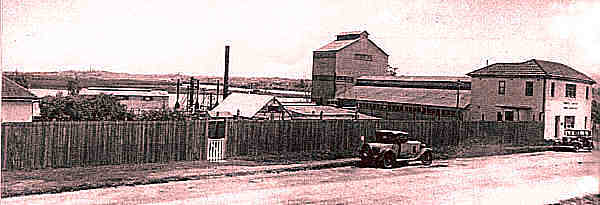
The root of our evil. Timbrol Chemicals, 1934. Image courtesy Chemlink.
Flour mills and cast iron foundries weren’t exactly environmentally friendly (a phrase not yet in use in 1928), but the true damage to Rhodes didn’t begin until the arrival of Timbrol Ltd in 1928. Timbrol had been established in 1925 by three Sydney University researchers keen to manufacture their own brand of timber preservative, so at least it was all for a good cause.

Rhodes, 1930. Image courtesy City of Canada Bay.
In 1933, Timbrol had a breakthrough! It was able to produce the first Australian made xanthates, which is used in the mining sector for extracting particular kinds of ores. With the advent of the Second World War, xanthate exports boomed, and expansion of the Timbrol site was required. But where to go? Sandwiched between the train line and the foreshore, and with John Darling to the north and CSR (another booming wartime chemical company) to the south, Timbrol was apparently out of options.

1942. Image courtesy City of Canada Bay.
Just joking. Of course there was an option – the only option: reclaim land from Homebush Bay by filling in the river with contaminated by-products and building over it. Out of sight, out of mind.

1949. Image courtesy City of Canada Bay.
The post-war housing boom brought about various new challenges in the domestic domain, most of which could be easily solved with chemicals. Thus, demand for chlorine, herbicides and insecticides, particularly DDT, skyrocketed, and Timbrol was right there to capitalise. And by right there, I mean jutting out over Homebush Bay on new, hastily constructed ground.
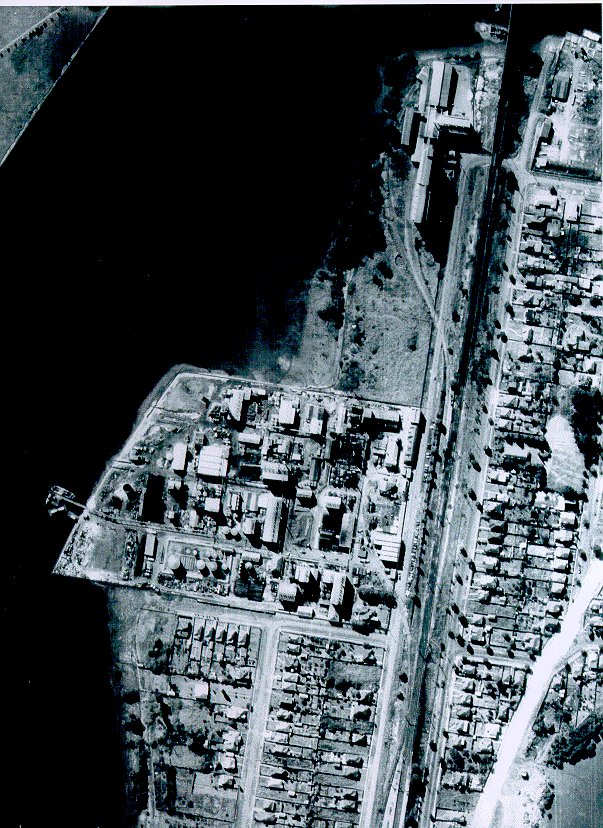
1951. Image courtesy City of Canada Bay.
Spurring the chemical company’s efforts on even further were their competitors CSR, ICI and Monsanto, most of whom were a stone’s throw away from the Timbrol site. The close proximity of these companies meant that the output of potentially dangerous by-product seemed minimised in the eyes of the era’s governments; it was better for all the companies to be dumping together rather than dumping apart at wider intervals. This also meant that the neighbouring sites could ‘borrow’ Timbrol’s approach to expansion – good news for Homebush Bay.
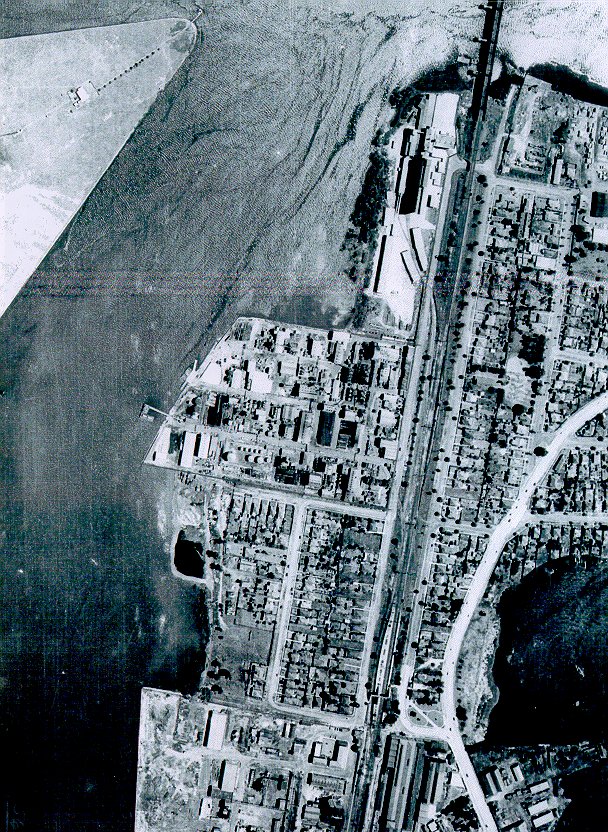
1956. Image courtesy City of Canada Bay.
Timbrol’s success had attracted another element: the American chemical giant Union Carbide, which saw Timbrol as a great place to start an Australian subsidiary. Union Carbide dated back to 1898, and had built its wealth through aluminium production and its zinc chloride battery arm – both of which seem like the perfect thing to manufacture on the bank of a serene body of water.
At this point I’d like to pose a question: when did it ever seem like a good idea to produce chemicals like herbicides, zinc chloride and xanthates beside a healthy bay full of wildlife? Who signed off on this? How were the guys in charge of these companies able to look at this beautiful place and think “Hmm, needs more poison.”? I’m aware that without these chemicals we wouldn’t be able to live the way we do today, but some of these decisions were bordering on just straight up evil.

An honest day’s work. Union Carbide HQ, Rhodes, 1970. Image courtesy City of Canada Bay.
The arrival of Union Carbide frightened Timbrol’s competitors. The might of the American parent company meant near-unlimited resources, so local campaigns were stepped up.

1961. Image courtesy City of Canada Bay.
CSR and even old John Darling began to encroach upon the bay, re-sculpting the landscape as they saw fit.

Axis. Allied Feeds, ca 1970. Image courtesy City of Canada Bay.
The initial success of Union Carbide Australia didn’t go unnoticed overseas, either. Associated British Foods bought John Darling’s Flour Mill for its Australian subsidiary Allied Mills in 1960, rebranding it Allied Feeds. Most of the product manufactured at the Allied Feeds site would end up in the stomachs of livestock sent to Homebush Abattoir, where said stomachs would then be carved up to be fed back to the populace. And for that, you need MORE ROOM.

1965. Image courtesy City of Canada Bay.
But back to Union Carbide. The early 1960s weren’t kind to UC. Competitors and waning demand had teamed up to diminish the brand, but that didn’t stop the near endless flow of poisons into the bay. By now, nearly all of Union Carbide’s output produced an unfortunate and extremely unpleasant by-product: dioxins. Highly toxic and capable of, at the very least, causing cancer and damaging reproductive and immune systems, dioxins are usually exposed to humans via food particularly meat and fish. What a great idea then to produce extremely unsafe levels of dioxins right beside a manufacturer of animal feed. What a great idea to produce that animal feed on top of land infused with dioxins. What a great idea to expel those unwanted dioxins into Homebush Bay, a waterway directly linked to Sydney Harbour and full of fish.
Let’s take a moment to hear from the World Health Organisation about dioxins:
Short-term exposure of humans to high levels of dioxins may result in skin lesions, such as chloracne and patchy darkening of the skin, and altered liver function. Long-term exposure is linked to impairment of the immune system, the developing nervous system, the endocrine system and reproductive functions. Chronic exposure of animals to dioxins has resulted in several types of cancer. Due to the omnipresence of dioxins, all people have background exposure and a certain level of dioxins in the body, leading to the so-called body burden. Current normal background exposure is not expected to affect human health on average. However, due to the high toxic potential of this class of compounds, efforts need to be undertaken to reduce current background exposure.
So…don’t do what Union Carbide did next, then?
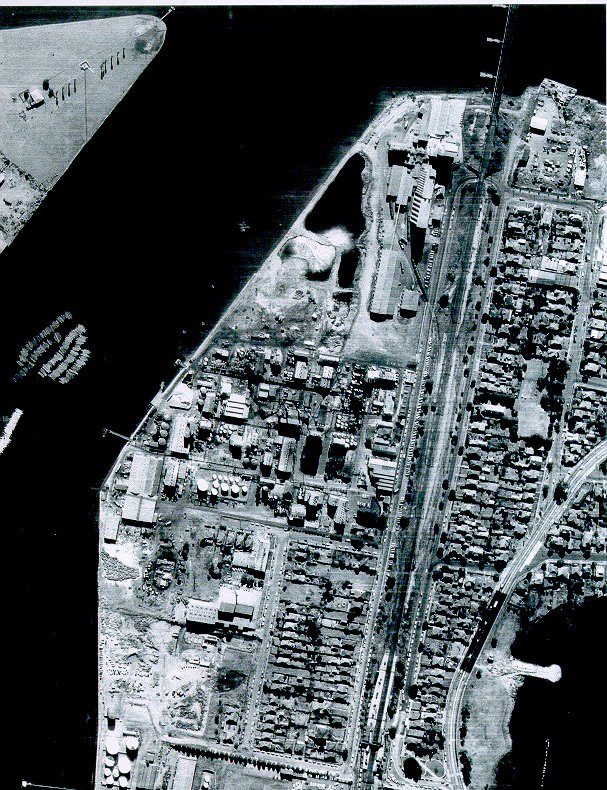
1970. Image courtesy City of Canada Bay.
The fortunes of Union Carbide Australia were reversed by the Vietnam War. See, Vietnam has a lot of jungles, and those pesky Vietcong kept hiding in those jungles, so what better way to flush them out than by removing their hiding spot? Union Carbide was contracted by the US military to produce Agent Orange, a dioxide-heavy defoliant. Even when it was discovered that Agent Orange’s components contained a particularly toxic strain of dioxin, it continued to be sprayed indiscriminately throughout the war, during which dioxins continued to be dumped into Homebush Bay.
In the midst of all this, Union Carbide research scientist Douglas Lyons Ford invented Glad Wrap at the Rhodes plant. It was introduced to the Australian market in 1966, the first such product in the country. Well, that kind of balances out that other thing, doesn’t it?
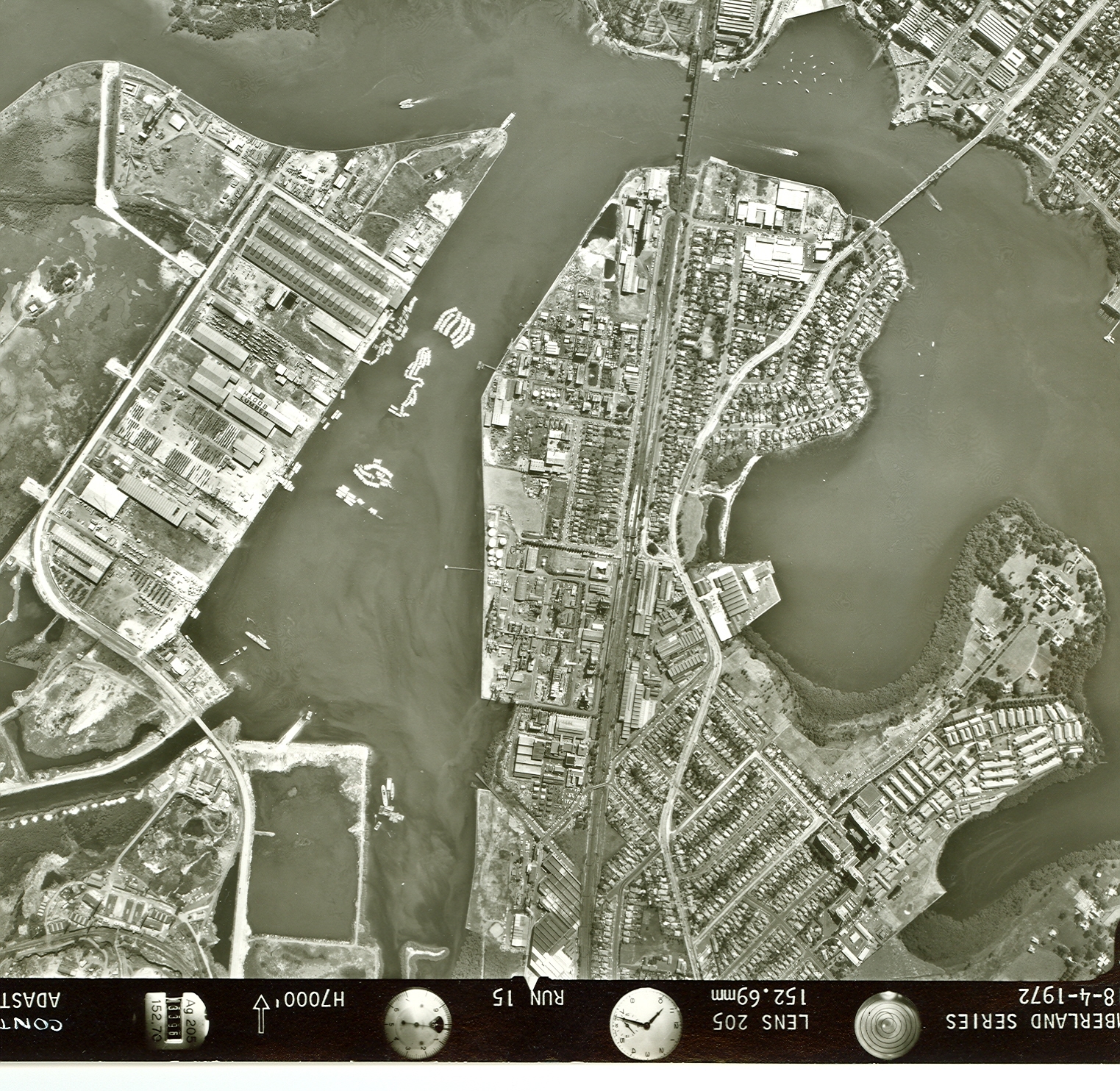
It’s easy to spot the pollution. 1972. Image courtesy City of Canada Bay.
By the 70s, environmental action against companies like these was stepping up, and the population of Sydney had exploded westward. Rhodes’ train line was now a sharp divider between the industrial zone and a booming residential sector.
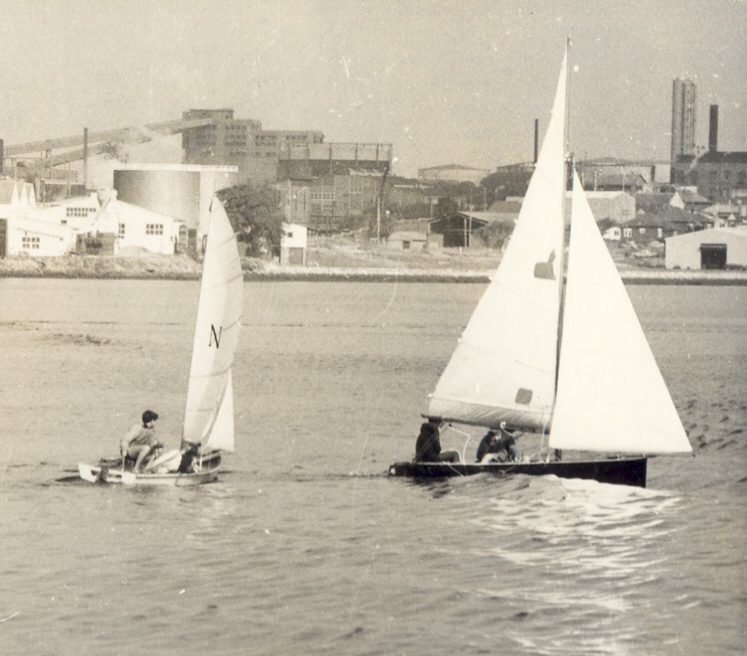
A day on the water, 1970. Image courtesy City of Canada Bay.
Further north and across the river, Meadowbank and Ryde were both beginning to cast aside their industrial legacies and welcoming more and more families, while to the south, the Homebush Abattoir was winding down operations. Forward-thinking residential developers were eyeing these areas with great interest, and keeping government wheels greased to ensure their availability in the future. In typical lightning fast Sydney reaction time, this movement was accommodated in the mid-80s by the construction of Homebush Bay Drive, a highway that bypassed the nearby suburb of Concord and tracked through Rhodes’ industrial zone. Out of sight, out of mind.

Is it still water? 1985. Image courtesy City of Canada Bay.
By the early 1980s, Rhodes was known throughout the land for its toxicity and odour above all else.

Poking fun at the cripple, 1946. Image courtesy City of Canada Bay.
Its rich legacy of achievements in the field of chemistry long forgotten, Union Carbide was looking increasingly sick and tired; a relic of another age. But one major incident in 1984 made it look downright villainous.
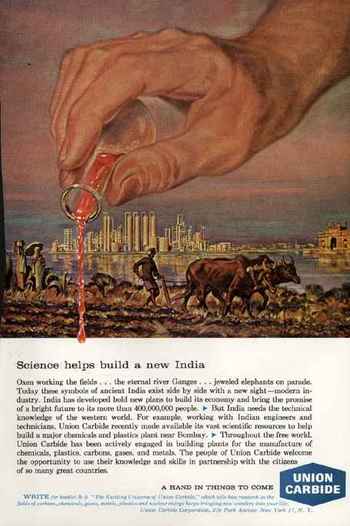
In December of that year, an explosion at the Union Carbide plant in Bhopal, India exposed half a million people to toxic gases, killing thousands. PR disaster for UC, and the final straw for the parent company. Most of its international subsidiaries were wound up in the years following Bhopal, including the Rhodes plant, which ceased operations in 1985. Allowed to leave without any kind of cleanup effort, Union Carbide left behind a toxic legacy that remains detrimental to Sydney today.
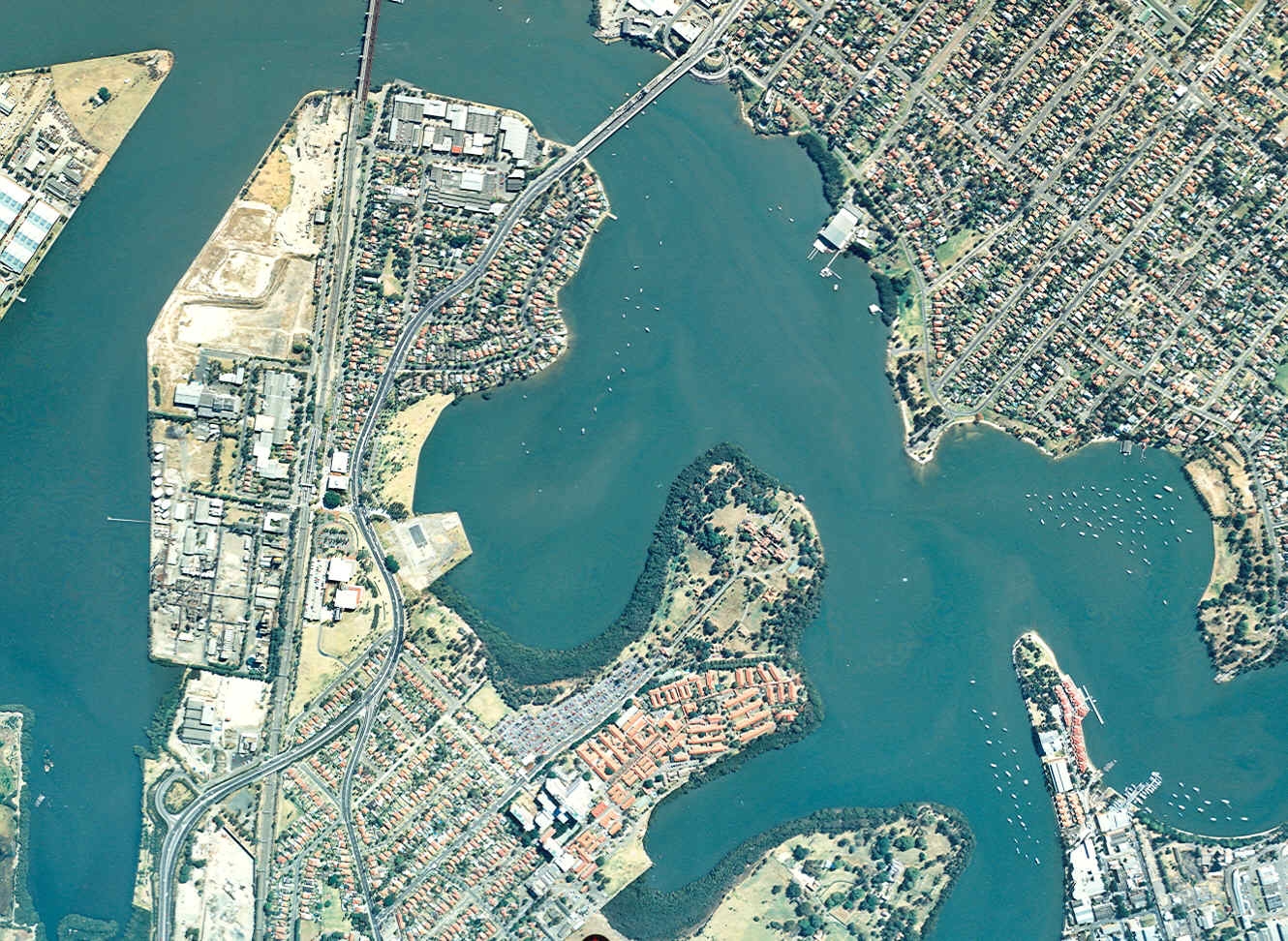
Without a trace? 1995. Image courtesy City of Canada Bay.
The NSW Government and the Australian Olympic Committee had hoped to transform Rhodes into an Olympic athlete village by the 2000 Sydney games, but they had underestimated just how poisoned the land was.

Resuming the Union Carbide site, 1993. Image courtesy Rhodes Remediation.
Government remediation efforts tried in vain between 1988 and 1993 to heal the land, but it wasn’t until 2005, long after the end of the Olympics, that private enterprise intervene with the necessary money and technology to properly clean the land. Why this sudden burst of effective effort so long after the fact?
NOW

Aptly named apts.
Today, if you turn off Homebush Bay Drive at the IKEA, you’ll descend into valleys of glass and steel. Rhodes’ rebirth as a gauntlet of residential and commercial towers, a process which began in 2005, is nearly complete. Sensing an opportunity to make money, Mirvac and other developers pounced on the toxic wasteland at the end of the 90s, saving it from a future of causing people to hold their breath as they drove past.
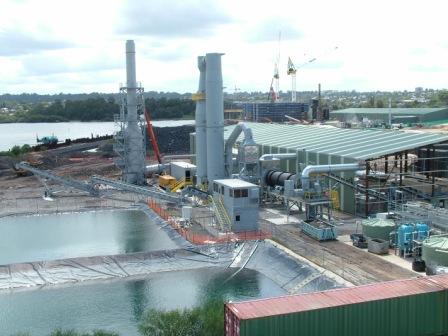
Scrub harder! The remediation process, 2006. Image courtesy Rhodes Remediation.
With a steady flow of money and the promise of even more at the end of the remediation rainbow, Thiess and the NSW Government got to work turning the poisonous dirt into the foundations of the futuristic castles that line the foreshore today.

I think I can see the duck.
But while the reclaimed land has been mostly made harmless, the bay has not. In fact, the NSW Department of Health has prohibited fishing west of Sydney Harbour Bridge due to an abundance of dioxins. And swimming? Forget it.

Don’t jump! You have your whole life ahead of you.
The remediation efforts have been effective in more ways than one. I don’t think that Mirvac and friends really cared about anything other than making the land safe enough to pass re-zoning as residential, but despite this, wetland wildlife has begun to return to the bay. Studies on the sea life are ongoing with hopes that one day the bay will once again be safe, but I don’t think we’ll see it in our lifetime. To my infant readers: this means you too.

Canary yellow?
To the developers’ credit, the project seems to have largely been a great success. There’s the popular shopping centre, complete with cinema and IKEA (a huge coup in its day, since superseded by Tempe), and Liberty Grove to the east. Care has been taken to eradicate most traces of the industrial nightmare of the past. The new units look good enough to stop you from wondering why the grass is always yellow, and they’re certainly filling up fast. And yet…
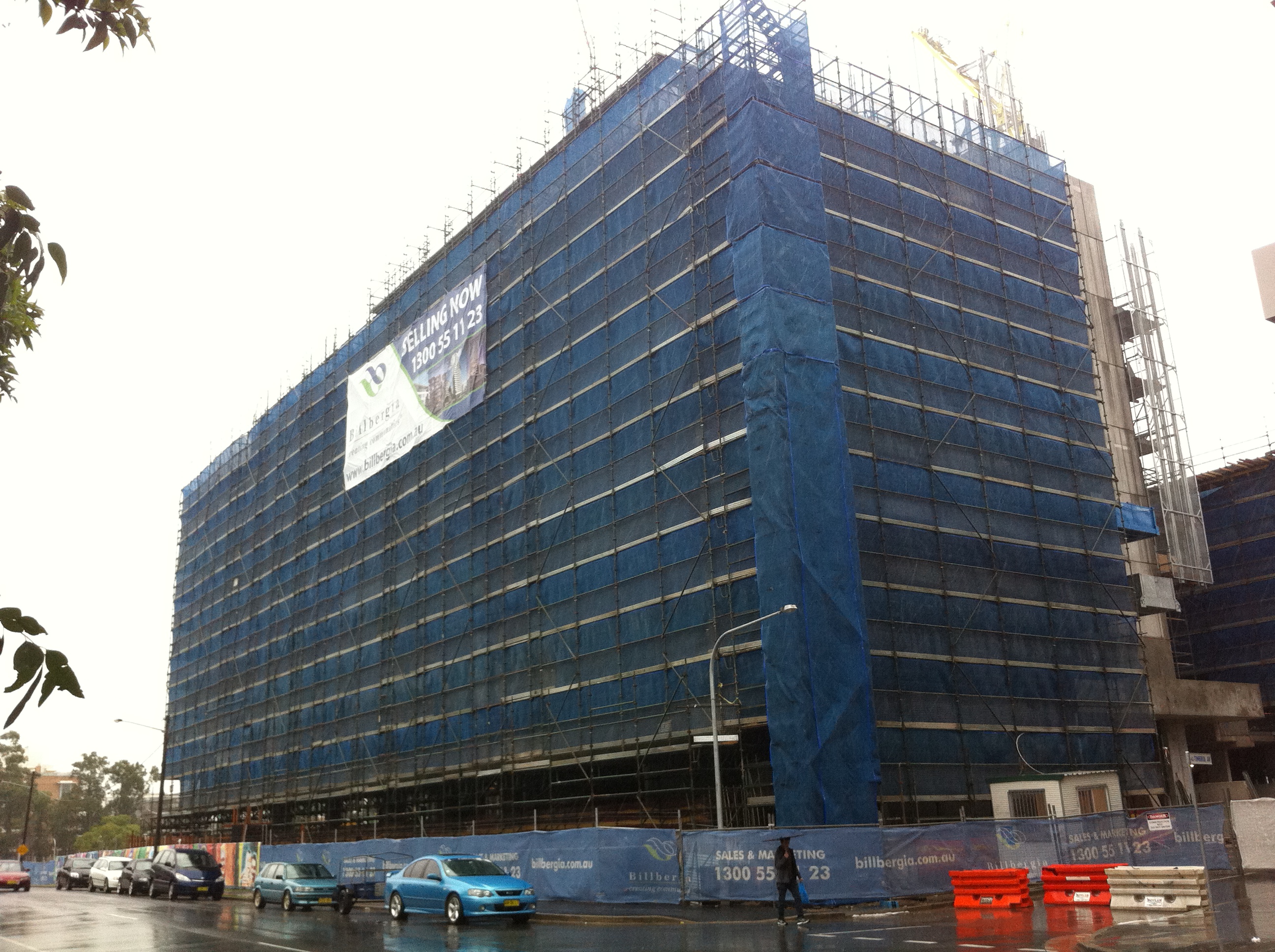
The bad seed.
If you plant a seed in bad soil, it won’t grow very well. Case in point: this is the unit tower being constructed directly upon the former Union Carbide site. Every other tower in Rhodes is either completed or is only weeks away, but not Union Carbide. In fact, the entire site seems to have been plagued with construction delays or other issues. Sure, this stage of the Rhodes project started later than the others, but that too is down to the sheer toxicity of the Union Carbide land.
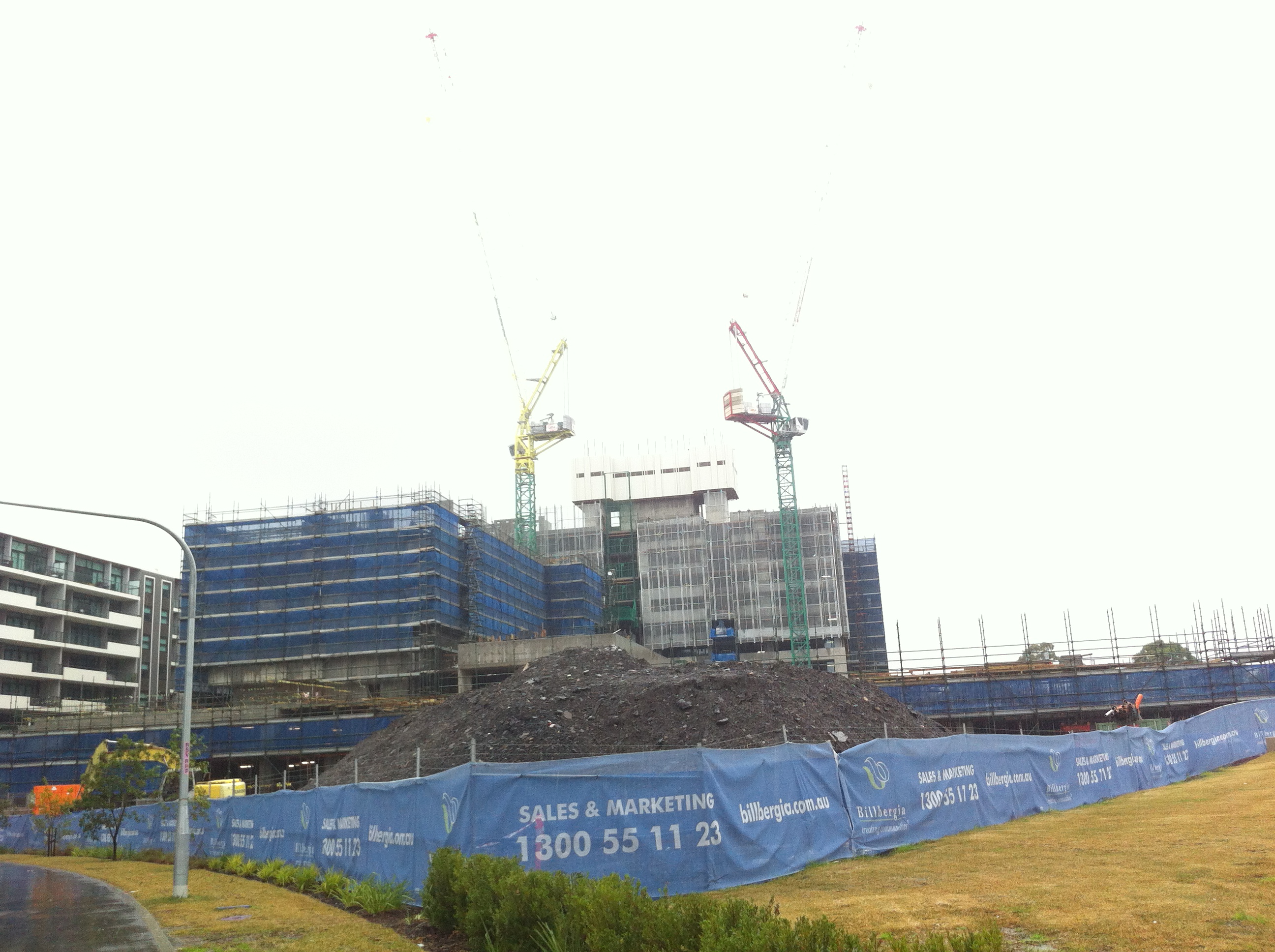
That dirt looks like a job for your sales and marketing guys.
At the rear, things look even worse. Piles of dirt sit around, uglifying the scenery. Cranes hover above the unfinished structure like buzzards.
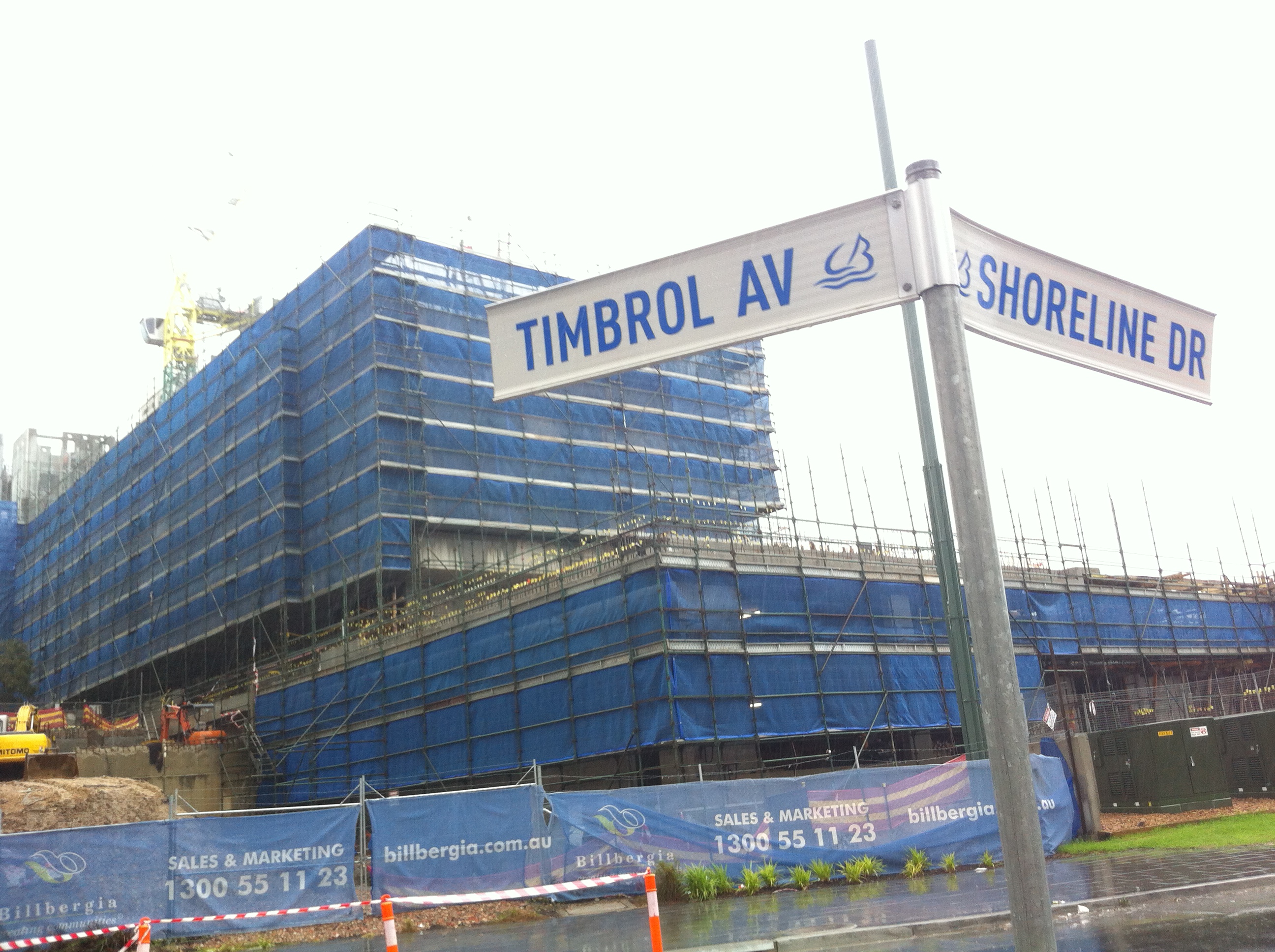
Another Timbrol shoreline.
On the corner of Shoreline and Timbrol, construction equipment is a mainstay. It’s as if they just can’t make this one happen, despite their money and intentions.
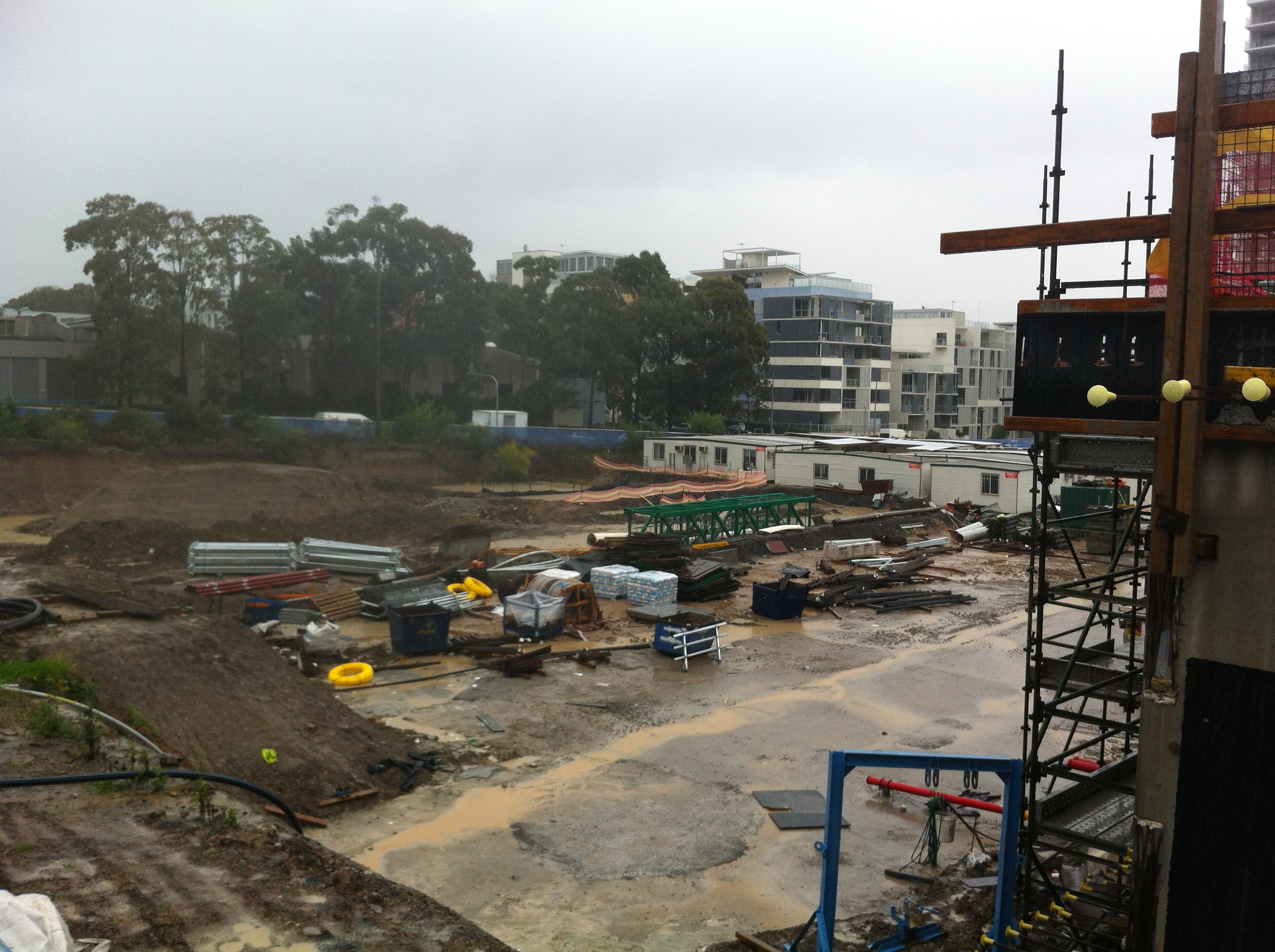
Solid foundation.
Tower number two hasn’t even started yet, acting as a base of operations for the workers completing tower number one. In 1997, Greenpeace discovered 36 sealed drums of toxic waste underneath the Union Carbide site, so there’s no telling what these guys are digging up as they go. Does your underground carpark glow in the dark?

No pets allowed, though.
Down at the Union Carbide foreshore, an even eerier sight: completed units, completely empty.

Your nearest neighbours are miles away.
These seem to be ready to go, but either due to environmental concerns or the noise of construction, residents aren’t allowed to move in yet. I’d be leaning toward the former reason, seeing as plenty of other people here have to put up with the noise.
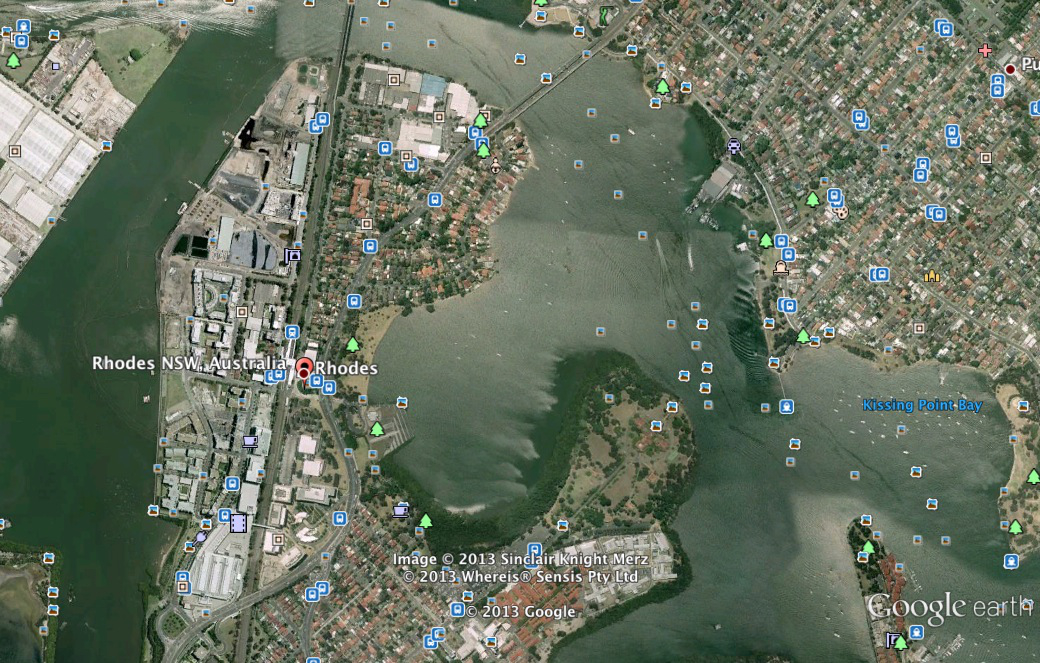
2013. Image courtesy Google Earth.
The Rhodes experiment has proven to be an environmental triumph, arguably even greater than Sydney Olympic Park, but it’s an even greater financial triumph. The corporations behind the remediation weren’t doing this for the sake of the environment or because they felt like doing something nice, they were doing it for the exact same reason the land was stained in the first place. Rhodes may have gotten the second chance Bhopal never did, but they’re equally valid testaments to that reason.
The Auburn Emporium – Auburn, NSW

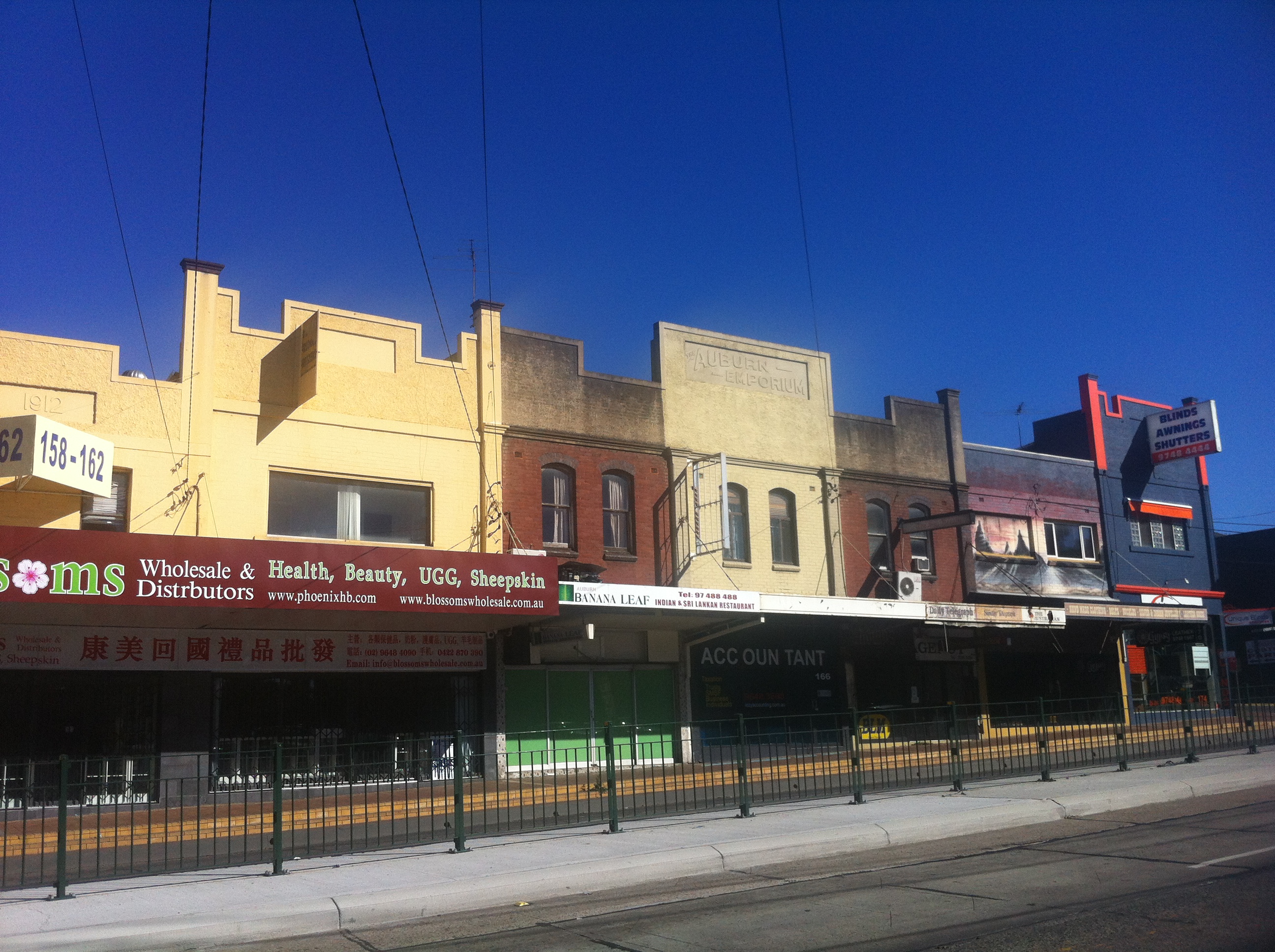
Let’s take another trip to that seemingly bottomless well of source material, Parramatta Road. If this Australian Women’s Weekly logo looks ancient to you, that’s because it is. In fact, I’d say there’s a good chance the magazine itself sported this logo the last time it was on sale at this location, which was most recently known as Danny’s Newsagency. But what’s happened to the sign there?
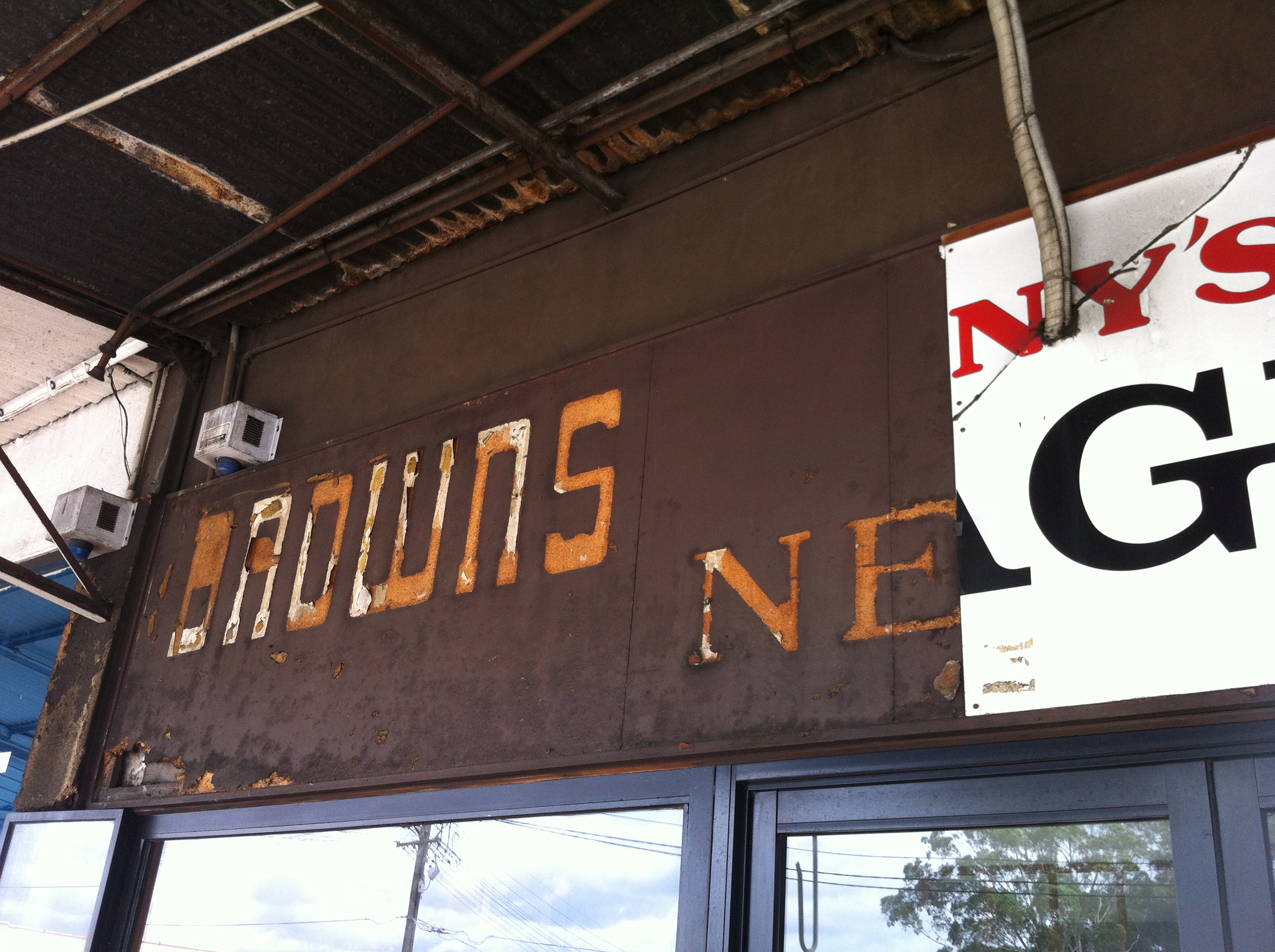
Oh, well this changes everything. Before Danny moved in, the newsagency was Brown’s domain. Perhaps the AWW sign belonged to Brown in the first place. Case closed, unless the awning offers us any more clues…
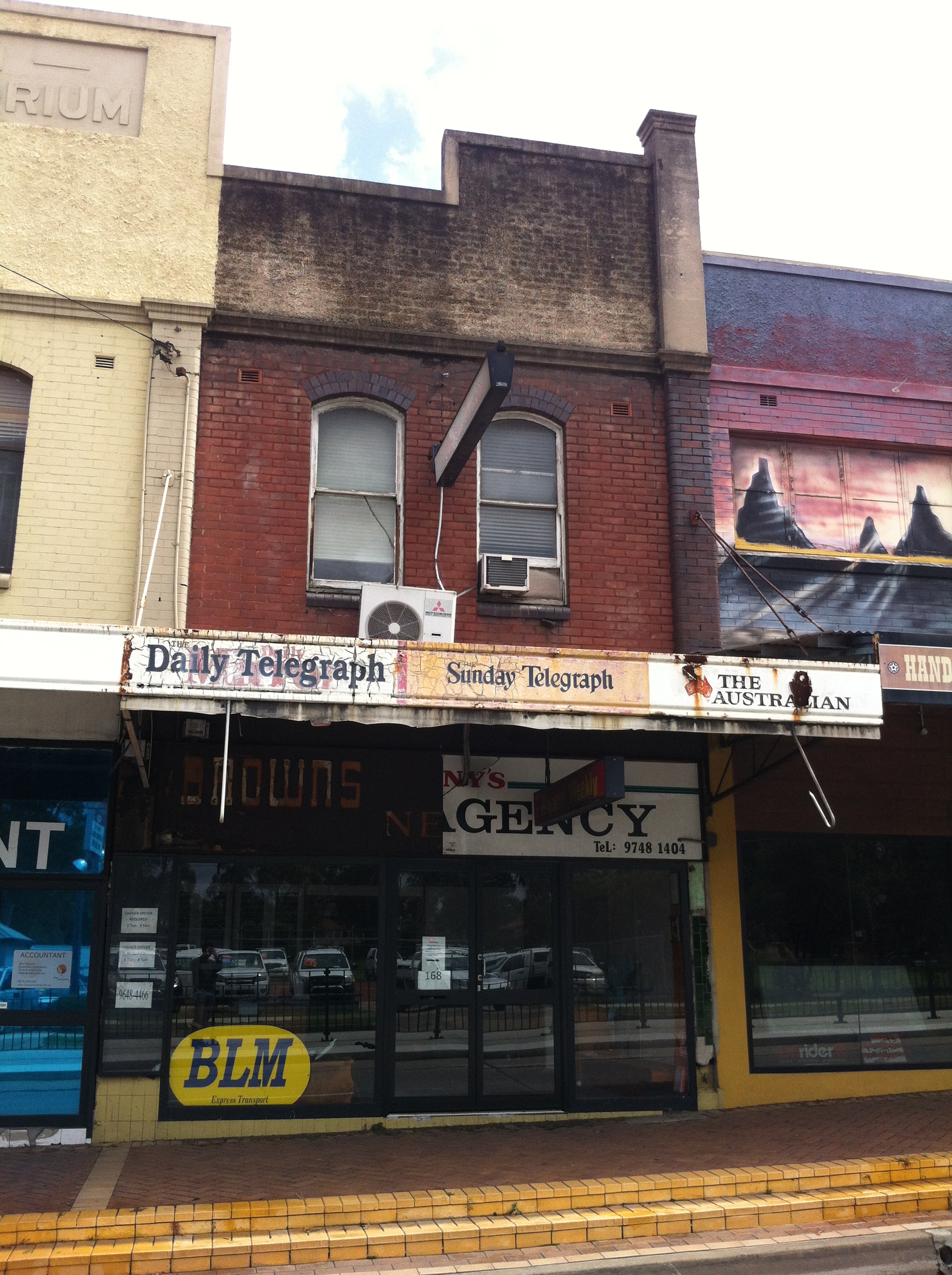 No. It was Brown’s Newsagency, then Danny’s, and now it’s a freight company called BLM, which is apparently just too busy to take down some old, misleading signs. Mission accomplished, what a great story, we can all go home. Was it good for you too? Seriously, why can’t these shops just present a decent front? If BLM wanted more business, why wouldn’t they dust themselves off a bit (unless they don’t want more business ON PURPOSE)? Does the rest of this row of shops have the same issue?
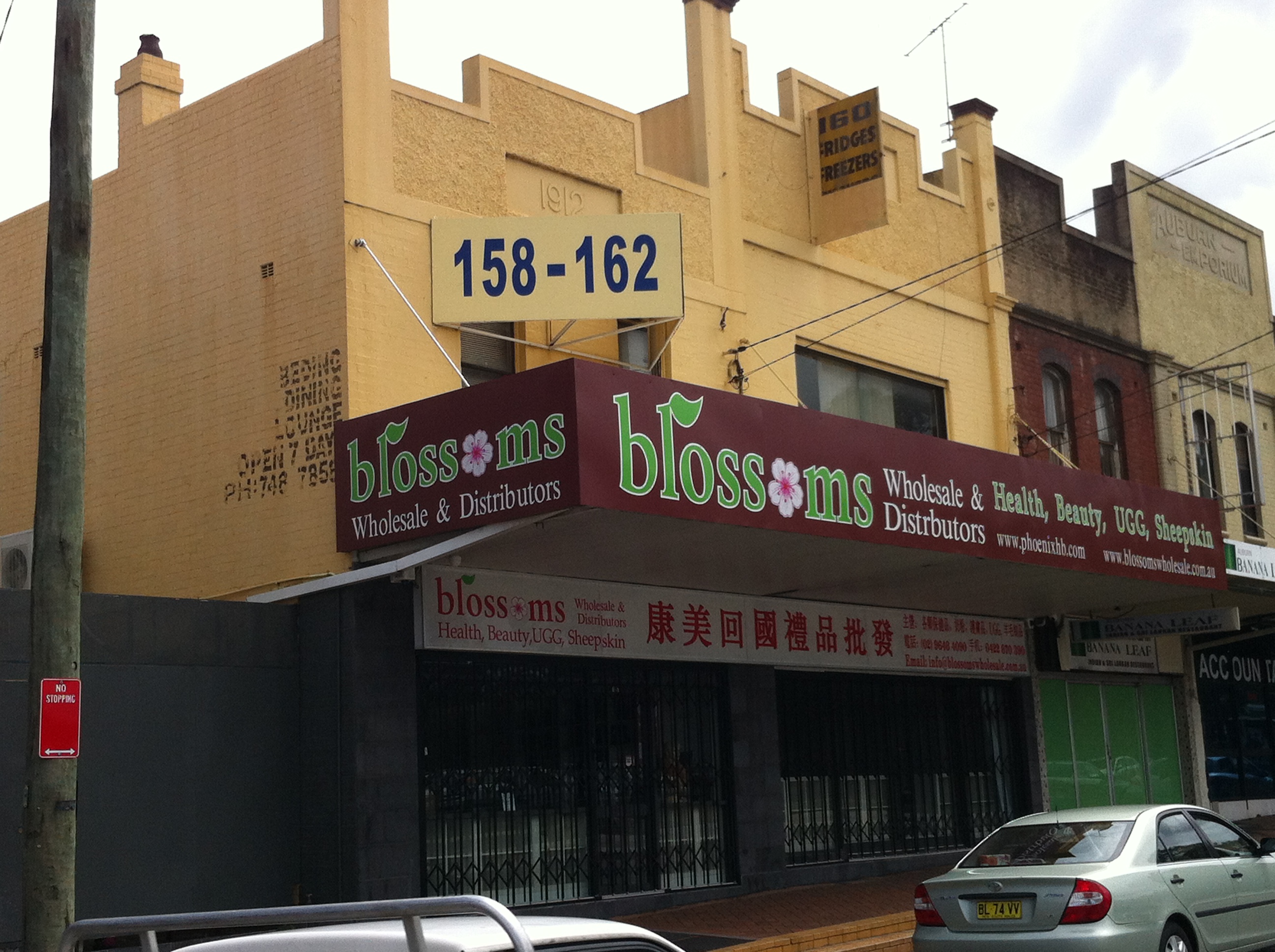
On the east corner we’ve got Blossoms wholesalers of health, beauty and ugg. Great combo. Looks like they ran out of yellow paint before they could disguise the fact the place used to sell:

..’beding’, among other things. Great. What’s that up there?

You can’t have freezers without fridges. Oh look, the building was finished in 1912. I bet they weren’t this lazy or negligent back then. Next…
 The next door down offers no such insights – it’s a boring restaurant. Beside that, it’s this accountant. And a pretty busy one right now I’m sure, given what time of the year it is. Yawn…I’d imagine this place wasn’t so pedestrian in 1912, a time when Parramatta Road wasn’t a huge embarrassment to the city and a great place to park your car on weekends. It would have had a purpose, it would have been the product of some dude’s life’s work. It would have stood out from the crowd and meant something rather than just taken up space with its ugliness.

Yeah, I’d like to think this was something really special…back in the day…
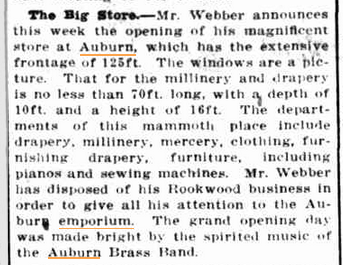
Cumberland Argus, November 23 1912.
Mr. Webber had sold his other business at nearby Rookwood, presumably the one on which he had built his name, because he had such faith in this place. Wow. “The windows are a picture.” Wow! They sold pianos and had the Auburn Brass Band on site to celebrate the opening. It’s hard to believe that such an event could once have gone on at this place we’ve seen today, but there you go.
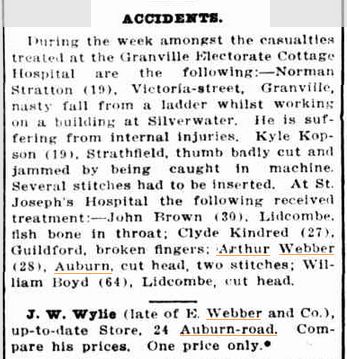
Cumberland Argus, June 10 1916.
Don’t let anyone tell you department stores aren’t a cut-throat (or cut-head, in this case) industry, just like I won’t let anyone tell me that Wylie’s departure from Webber’s empire and Arthur Webber’s injury are just a coincidence. In fact, let’s concentrate on Wylie’s little advertisement for a moment. First, he’s taken it out in the accidents section of the paper, which doesn’t bode well. Second, he’s done it directly below an account of his former employer’s misfortune. Third, he’s included the snide ‘up-to-date Store’ dig, as well as imploring thrifty shoppers to ‘compare his prices’ (to whom, I wonder?)…and yet the very next line tells you there’s one one price to compare. In case you’re interested, his address is a Westpac bank today, which means this paragraph is his legacy. Suck it down, Wylie.

Cumberland Argus, April 30 1921.
Gee, the Webbers seem a little…accident-prone, don’t they? In 1921 young Ernest Webber (son of Arthur) cut his finger. And it made the paper. Slow news year, perhaps?
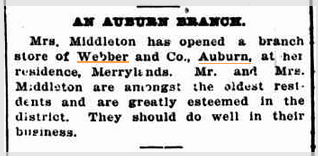
Cumberland Argus, February 22 1922.
So successful was the Webber store that a Mrs. Middleton took the fight to Merrylands. I wonder how it turned out?

SMH, April 19 1922.
Ernest E. Webber (who I’m assuming isn’t the seven-year-old with a bandaid on his finger) copped a heavy fine of four pounds for not paying two of his employees the minimum wage. No wonder Wylie left. Shoulda just paid ’em, Ernie.

SMH, November 11 1922.
Just don’t expect minimum wage. Hey, what a deal there at the top: a set of teeth from one guinea. Yuck.

Cumberland Argus, April 12 1924.
The Webbers, still in PR crisis mode, provide the furnishings to a local recital. We haven’t forgotten about the third world wages, Ern.

Northern Star, December 31 1924.
And neither has Desire La Court (what a name). Read that thrilling tale of escape in the third paragraph, and tell me it wouldn’t make a great white-knuckle thriller starring Channing Tatum.

Cumberland Argus, February 18 1927.
Here’s Webber’s castle, paid for by the unpaid wages of his workers.

Cumberland Argus, October 3 1929.
I can’t decide whether my favourite part of this story is the thief begging Webber not to call the cops and then offering to drive Webber to the police station, or him playing the ‘my wife and kids’ card for sympathy and later denying having done so. It’s just a quilt, Webber. Even if he did nick it, let him have it. The Depression’s coming.
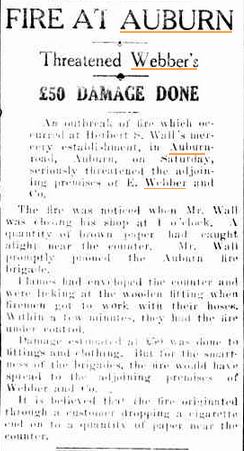
Cumberland Argus, July 31 1930.
And now they know: don’t throw a lit cigarette onto piles of paper.
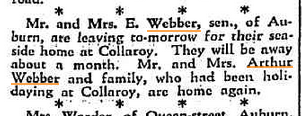
Cumberland Argus, February 8 1934.
Good thing they advertised this, now all the thieves out there with a copy of the 1927 paper and a map will know his house is empty.
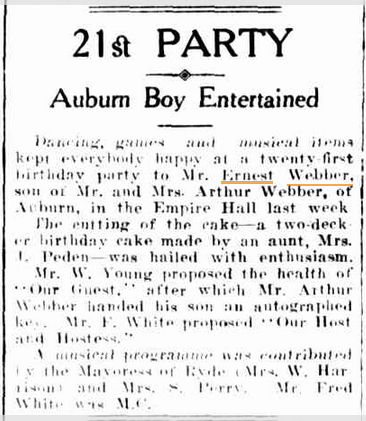
Cumberland Argus, June 10 1935.
Young Ernest Webber, last seen blubbering like a baby over a cut finger, has turned 21. Lock up your daughters! Nice cheapskate present, Dad – an autographed key. “My signature will be worth a lot of money in a few years, son…”

Cumberland Argus, June 28 1937.
Do you think Mark Foy was this plagued by thievery?

Northern Star, July 7 1937.
This plagued? This seems just a little suss, don’t you think?

Barrier Miner, 7 July 1937.
The plot thickens. I like the use of quotation marks around “square”, as if to square this divorce meant some drastic action.

Cumberland Argus, October 21 1937.
And finally the truth comes out! Picture the headlines: “Webber of Deceit”. I wonder if Webber’s trip to Jervis Bay was advertised in the paper? Maybe all those other times Webber was thieved from was the result of some cuckolding. I can only imagine how his wife must have felt…

Cumberland Argus, January 27 1938.
Oh.

Cumberland Argus, January 14 1942.
From philandery to philanthropy. Wisely replacing the adulterous E. Webber as media spokesperson, Arthur Webber sets off on his quest to repair the Webber reputation, 150 shoppers at a time. I’m guessing they had a sign, “Toilet and air-raid shelter for customers only.”
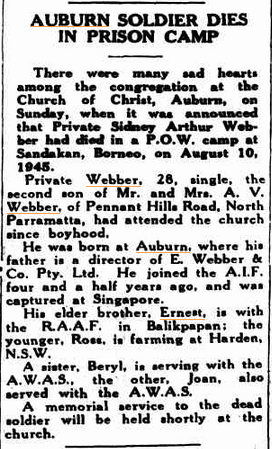
Cumberland Argus, November 28 1945.

Cumberland Argus, August 14, 1946.
With the war over, the Webbers put some distance between the scandals and tragedies of the past by backing the Auburn ‘Popular Girl’ Competition. Really rolls off the tongue, doesn’t it? You’re pretty much asking for trouble inviting someone named ‘Mrs. Crooks’ to your fancy ball, especially given your history, Webbers.
Sadly, this grand event is where the Webber story comes to an end. The trail went cold, and nothing more hit the papers. But despite the abrupt and mysterious ending it kind of feels like we were right there with them…almost like we were one of them. Do we need to know what happens next? Do we need the sad details of the day the Webbers signed their pride and joy over to Brown of Brown’s Newsagency? Of the day one of the shops was demolished to make room for Gypsy Leather, ruining the established style? Probably not. The best years are behind us at this point, and we’ve only the advent of Danny’s Newsagency to look forward to. We can use our imaginations to fill in the blanks.
Plus it’s been an adventure. We’ve laughed, we’ve cried, we’ve been scandalised and burglarised, but above all, we’ll never look at this innocuous little row of shops with the same eyes again. Right? Here it is again, just to be sure:

 Past/Lives of the Near Future