Lone Star Steakhouse & Saloon/Derelict – Parramatta, NSW
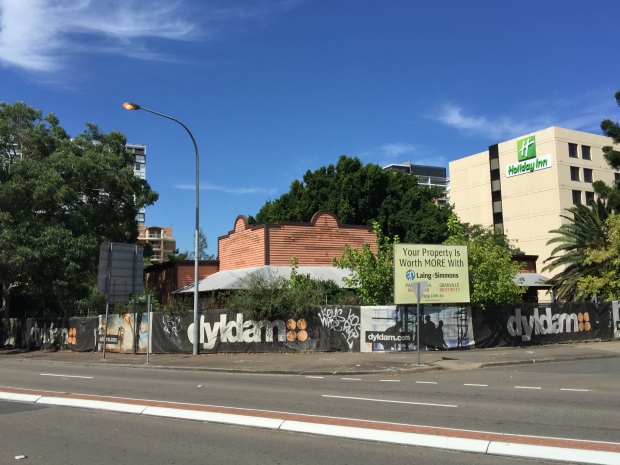
Say it to yourself just one time: themed restaurants. Takes you back, doesn’t it? Right back to oh, say…the long, hot summer of 1993, when Australia’s first Lone Star Steakhouse & Saloon opened at this very location in Parramatta. Here’s a terrible photo:
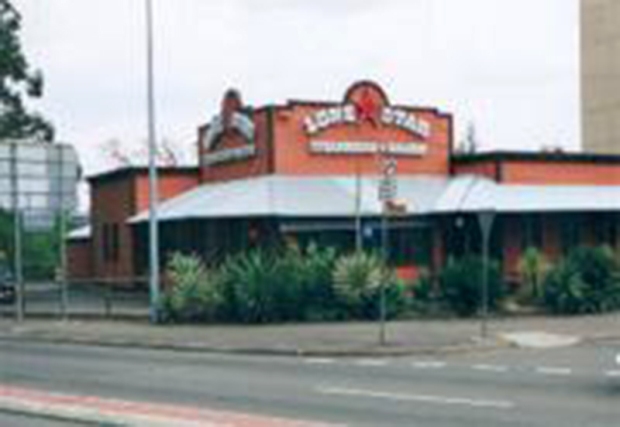
Lone Star Steakhouse in the glory years, 1997. Image courtesy australianexplorer.com
Dirty Dicks, Xerts, Hooters, Choys, Planet Hollywood… anachronisms all, and all either relegated to the central coast or the western suburbs, or simply wiped off the face of the earth. For some reason, the concept of the themed restaurant never quite took off in Australia the way it was hoped, and I suppose that’s one more thing separating us from Americans.
And speaking of…

Lone Star as a brand began in 1989, in North Carolina of all places. In its 26 year history, there’s never been a Lone Star outlet in Texas. I wonder how a Parramatta-themed restaurant would fare there? Texans, would you enjoy being screamed at by mental patients while trying to hold down a cold Whopper (RIP Hungry Jack’s)? Leave a comment below.

Apparently Parramartians (c’mon, pay it!) seemed like a more receptive audience for steak and ribs slathered in sugary sauces, and I dunno, vittles, or whatever else a Lone Star would provide.
Time for a confession: I never went there. And it seems I wasn’t the only one: in 2000, the already illusory relationship between Lone Star and Australian diners began to collapse entirely. In three years, 21 Lone Star outlets around the country were either closed or sold off, joining so many others in themed restaurant hell (where there are napkins, dress codes, and entrees instead of starters).
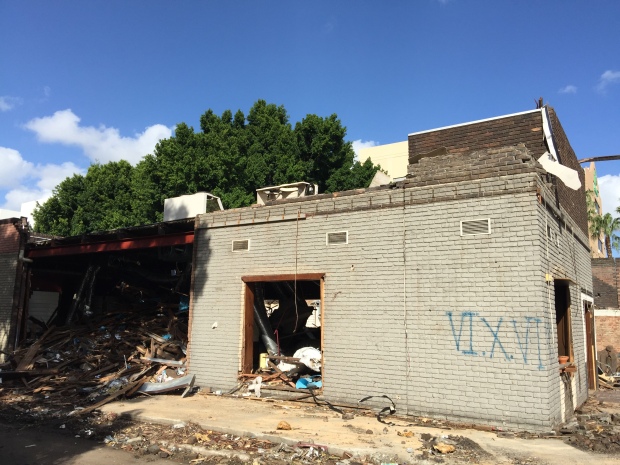
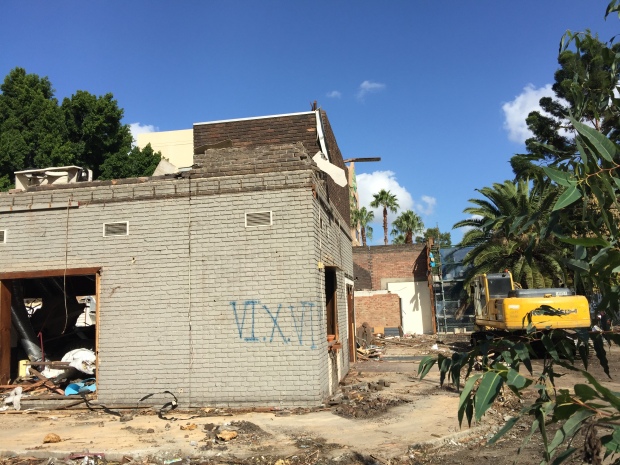
If you looked toward Parramatta in October 2011, you might have spotted a falling Star. It’s been sitting waiting for demolition ever since.
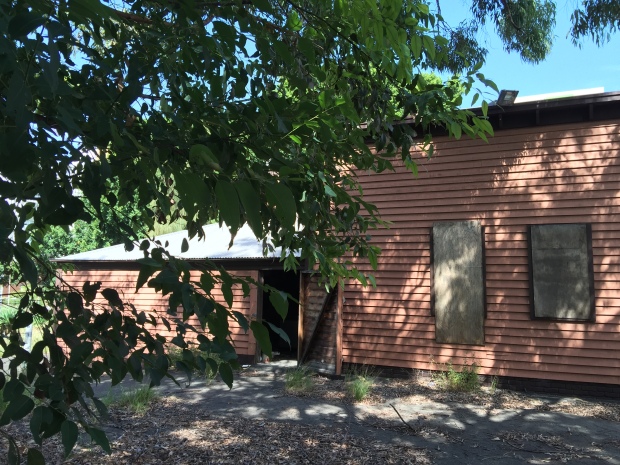
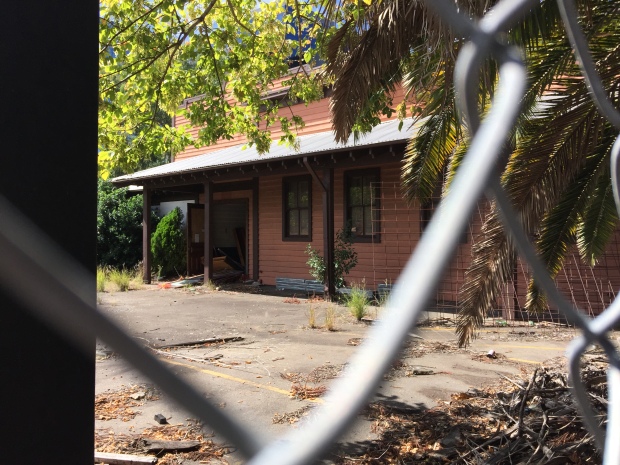
The side doors yawn open at passers-by, singing a siren song to urban explorers, graffiti artists and those in need of a quiet place to shoot up.
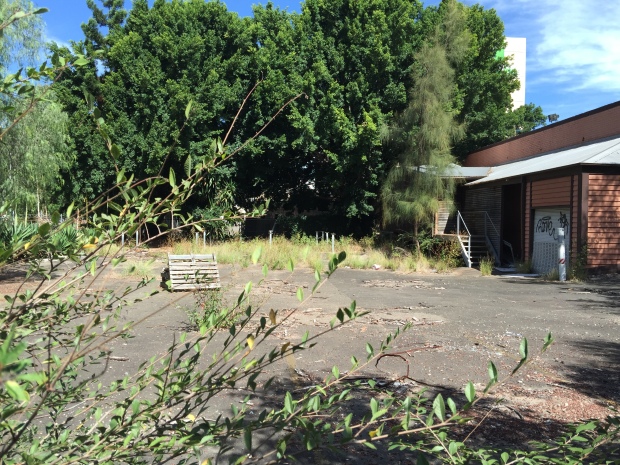
Around the back, metal struts sprout from the ground like steel weeds. Perhaps they were once for outdoor dining. Doubtless it still happens there.

Message to developers Dyldam (you don’t wanna know what that autocorrected to): when your derelict site has been broken into and abused this badly, you’re taking too long.
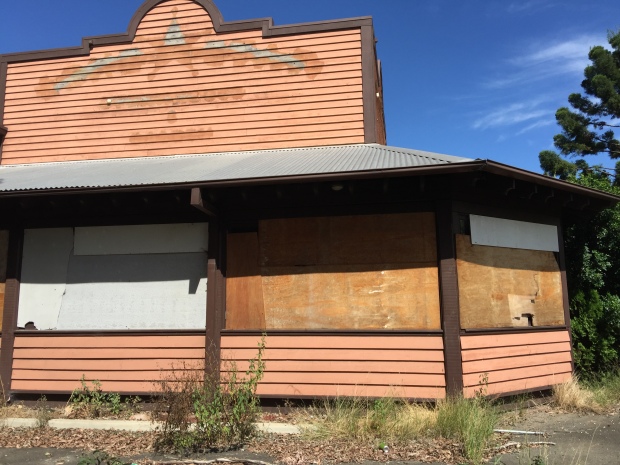
The Parramatta chapter of the Lone Star story may have ended, but the saga continues. Today, the brand sort of carries on under the name Lone Star Rib House. I…I don’t know how lone that star would really be. I’m no expert, but I think the steak and rib galaxies are pretty close.
Also, here’s a fun game to play: go to the Lone Star Rib House ‘About Us’ page and try to decipher the alien language used there. If you can work out what the hell they’re on about, you’ve done better than I.
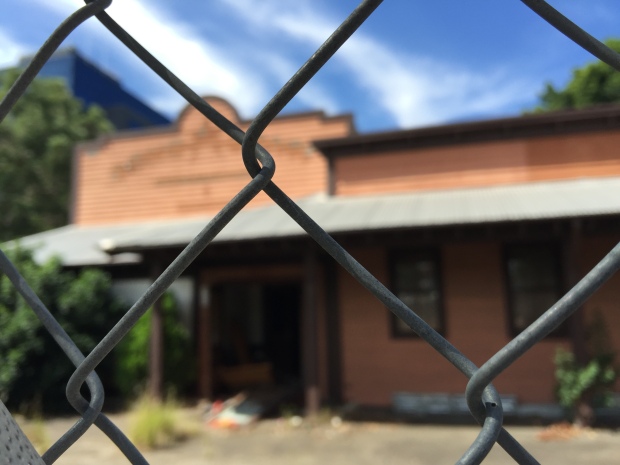
By resisting the bulldozers for so long, Australia’s first Lone Star has become an anomaly in this part of Parra, a lone star if you will (clean out your desk – ed). Soon it’ll be just another block of units, but until then it’ll remain…remarkable.
DESTRUCTIVE UPDATE: Or will it? No sooner had this post gone up did the bulldozers awaken and make short work of the Lone Star. Look everyone, a falling star…
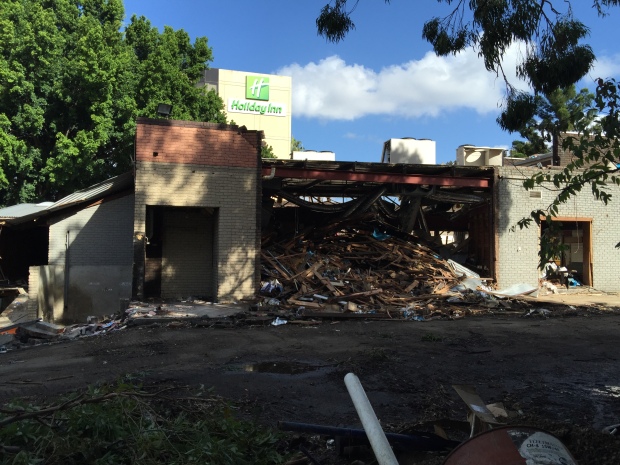
Fred’s Video Shop/East Hills Takeaway – East Hills, NSW
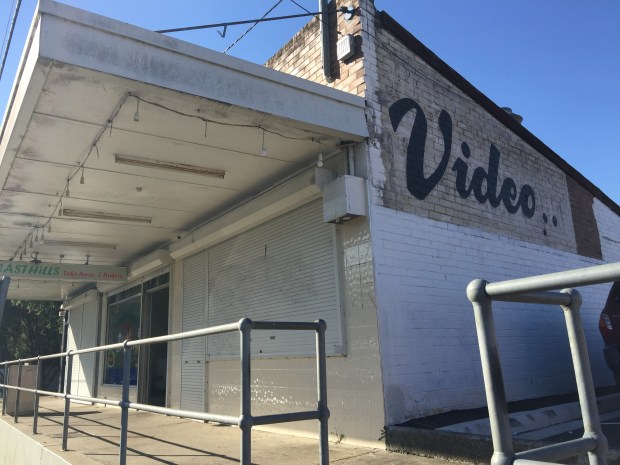
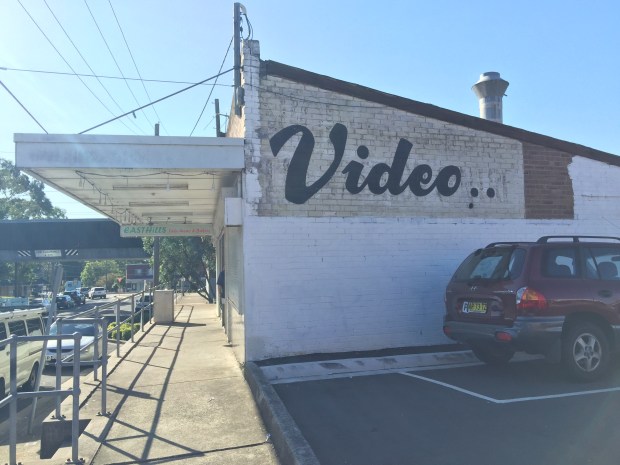
In East Hills, an unfinished unfinished thought drifts across the side of an otherwise unremarkable little building. If you wanted to nitpick (and if you don’t, why are you here), you could argue that today’s East Hills Take Away & Bakery doesn’t actually offer any videos, and the sort-of mural outside is nothing but elegantly inscribed false advertising.
You’d be right.
But ask yourself this: do you actually want a video? Because if you do, go across the road.

This shop, or Fred’s, as it’s known to the locals, is the video headquarters of East Hills. If you want 1988’s Black Eagle, 1989’s The Experts, or the double cassette Malcolm X from 1992, and you only want them for up to three nights, you come here.
I can’t help but ask. “So…does anyone actually still rent these videos?” I did it for you.
Fred doesn’t miss a beat.
“Mate, all the time! I had a few come in ‘ere this week even.” He gestures to the videos lining the walls. “They come in, they borrow them, and they bring ‘em back.”
But do they rewind them, Fred?
Fred is 79, and fresh out of hospital. I’d come by the week before and found a sign on the locked door: ‘Closed Tuesday, maybe Wednesday’. It was Thursday.
But now it’s Saturday, and here but for the grace of the video gods is Fred, ready to vend Mr. Bean Volume 1 to whoever hasn’t upgraded to DVD yet. Behind the counter is a menagerie of ancient video posters and promo items, and most startling of all, a dedicated rewinding machine. Be kind, eh?
“But they’re not as popular as the games,” Fred continues with a hint of pride. I think he might be referring to the arcade games in the room next door, standing like terracotta warriors amid piles of random junk, but no. He’s talking about the Sega games.
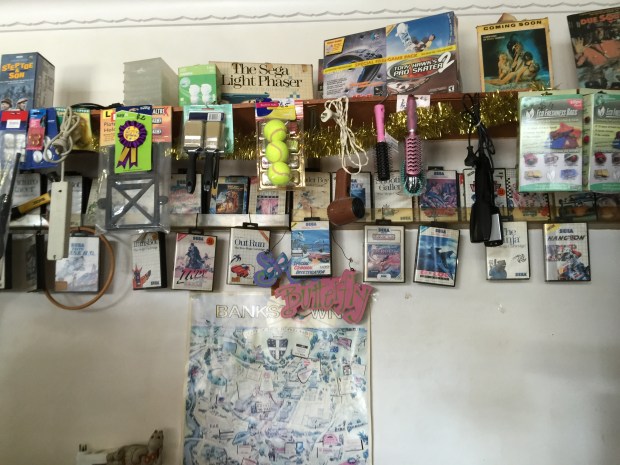
On the wall are dozens of games for Sega’s Master System console. For those of you unfamiliar, the Master System was released in 1987. Sega exited the home video game console business entirely in 2001. Fred could be the only one in the country still renting these games out, and he seems to know it. When I ask if the games are for sale, he snorts.
“Gotta be joking, mate.”
Uh, which one of us?
Inevitably, I ask about the shop across the road, hoping for a story of bitter rivalry between two video shops during the golden years of the format, something in the vein of Used Cars (available at Fred’s for $3 a night). Not for the first time in his life, Fred disappoints.
“That other shop used to be mine, I moved here about 25 years ago.”
Oh. So what had this been?
“It was a hardware shop, and next door was a newsagent. I got that not long after, and painted it up with me murals…”

He sure had. I’m not sure if decorating is the right word, but his tributes to the Sydney 2000 Olympics…stained the walls of the arcade next door. The piles of junk did their best to cover them, but the damage was done.
Why had he left the neat, compact comforts of the shop across the road?
“The video business just got too big,”
Stifling laughter, I nodded.
“What I don’t get,” he started. Oh, this ought to be good. “is why they left the sign up. Let me tell you, mate, I put the word out at the local school that I wanted a sign painted. A little girl offered to do it and I said righto, she done it, and after she goes, ‘I want three shillings,’.”
Hold on. Shillings? VHS became a viable home entertainment format in 1976, ten years after shillings got the heave-ho. Suddenly, Fred had become an unreliable narrator. Nothing could be trusted. Even my eyes could be deceiving me, I thought, as I eyed the can of creaming soda I’d bought. What had the expiry date been?
I left the shop, knowing there was nothing more to glean from old Fred. I probably couldn’t even get an article out of it. I squinted in the afternoon sun as my eyes adjusted from the dark of the shop, and that’s when I saw it. Just up there, on the pub side of Fred’s building. The remains of a painted sign.
It said ‘HARDWARE SHOP’.

Across the road, the undeniably handsome three shilling work of the little girl caught the sun. I’d been pondering the ellipses following the word. Had it been Fred’s direction, or the girl’s own flourish? Had she even known what a video was?
In the time of shillings, this word brought the promise of a high-tech future to the backwater East Hills, and Fred delivered it. And now, in that very future, he still does.
The American Way, Part 1: Happenstance – Monterey, NSW
Goldfinger said, “Mr Bond, they have a saying in Chicago: ‘Once is happenstance, twice is coincidence, the third time it’s enemy action.'”
– Ian Fleming, Goldfinger (1959)
Sydney is a multicultural city. From Bondi in the east to Blacktown in the west, from Narrabeen in the north to Cronulla in the south (well, maybe not Cronulla), it’s not hard to argue that the city has come a long, colourful way since the White Australia of the 1950s.
But long before even that decade, influences of another culture were finding their way into what was a very British way of life at the time, influences that have come to be embraced as the preferred way over time.
Prior to 1788, the British used its North American colonies as a penal dumping ground, auctioning off convicts to plantation owners and other slavery enthusiasts. But when the American Revolution brought that to a halt, the former colony quickly established its own identity as the Empire scrambled to find another outlet for their unwanted lawbreakers.
By the early 20th Century, the American style as we know it today was pretty firmly established, particularly through the film industry blossoming in Hollywood. The extent of the influence of American films around the world is so massive as to be unknowable, but we’re certainly going to know a little part of it today.
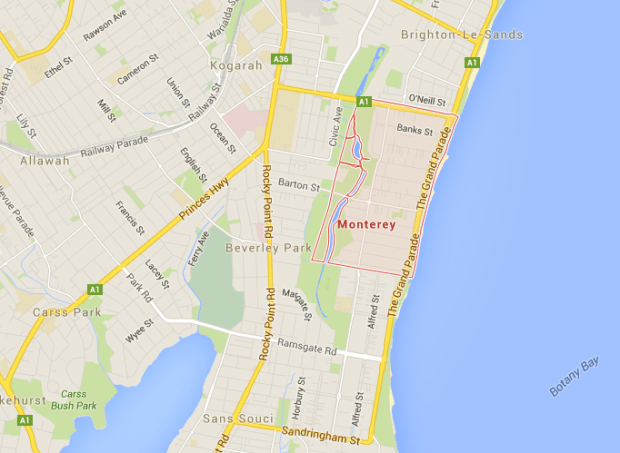
Monterey, 2016. Image courtesy Google Maps
Smack-bang in the middle of the Grand Parade that marches through Ramsgate and Brighton-Le-Sands along the shores of Botany Bay is the broad cleft that is President Avenue.

Along the aptly named President Avenue, everything is presidential. From this palatial block of units reminiscent of Goldfinger‘s Miami…
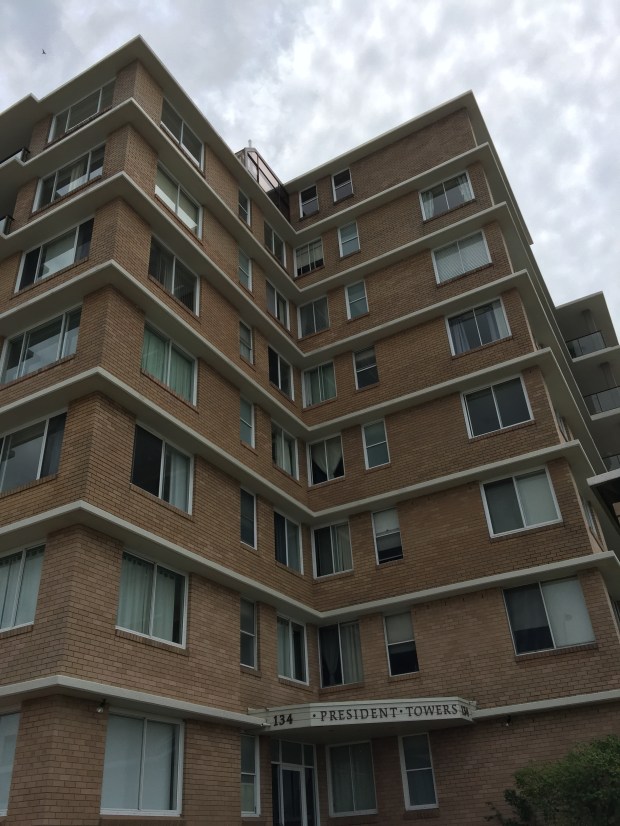
…to this capital lodge…

I think I can see the president up the top there.
…everything on the avenue fits the bill.
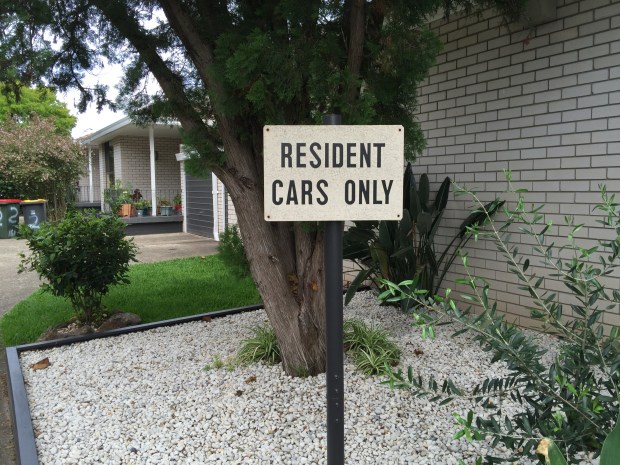
Clearly the ‘P’ has become the victim of vandals.
It’s the suburban equivalent of the kind of aged, staid, rich white guy we generally associate with the US presidency, so perhaps it’s no surprise that it borders today’s subject: Monterey, a young, small suburb that’s essentially comprised of four major streets.

Monterey’s insecure, slightly murky, and largely unofficial history finds its origins in 1877, when it was a piece of Scarborough Park. Jacob Marks, a prominent Jewish property developer, bought a parcel of land in the area, which was beginning to boom thanks to the popularity of the nearby Lady Robinsons Beach and Sandringham Baths. Marks had 13 kids (!), one of whom lived (and died) in California, so when it came time to name the streets in his property, things got red, white and blue pretty quickly.
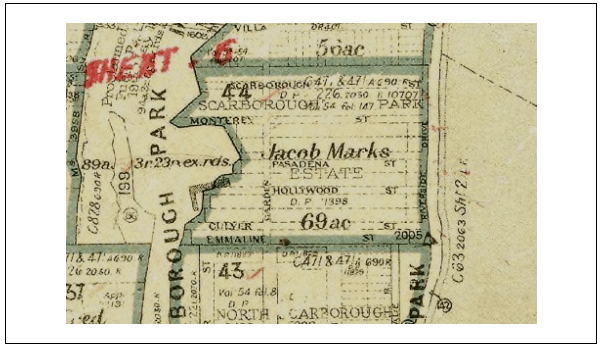
The Marks lot, 1903. Image courtesy Rockdale Library
Here’s where things get a bit cloudy – the street names were carved into stone by 1903, but it’s unclear who named them, and then it wasn’t until the early 1920s when the subdivision went up for sale.
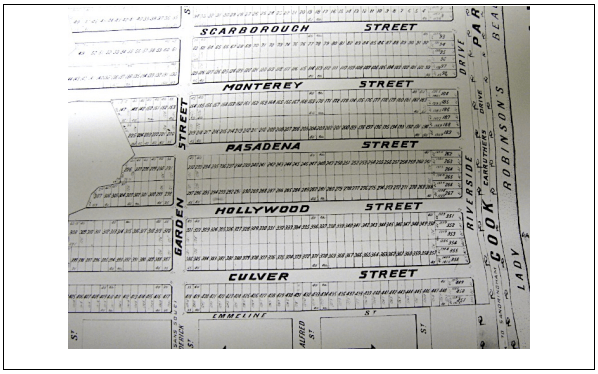
Up for grabs. From the Lance Giddings pitch, 1921. Image courtesy Rockdale Library
The sale was orchestrated by a WWI veteran/motor racing enthusiast/socialite named Lance Giddings, who injected a healthy dose of American panache into the sale. Unfortunately, things didn’t quite take off.
“The enthusiastic advertising copy and promotion produced considerable sales over the next six years but these sales did not result in building. While Council records list and identify considerable lot ownership after 1921, the Sands Directory of 1924 could only find a single Monterey resident, Mr Hugh Macan in Pasadena Street, for its listing.” – Fibro Moderne: Mid-20th Century Fibro Housing in Monterey NSW (Bogle, Pickett 2013)
Even by 1930, the suburb only had five residents. Imagine the parties! Fat bass gramophones uninhibitedly pumping out block-rocking beats of Whispering Jack Smith with the nearest neighbour at least 15 minutes walk away!
Inevitably, the post-WWII housing boom took hold in Monterey, and by the 1950s it was a bustling suburb; although not so bustling that it wasn’t partially gazetted in 1951 for a potential Southern Freeway extension from Waterfall to St Peters. Interestingly, it remains gazetted so today, so if you’re a resident, don’t get too comfortable.
Now, let’s take a look at those street names. When you’re heading south from President Avenue, the first one you come to is Banks Street.

And that’s American! Because banks are…American and…uh, evil, and…how does the rest of that go? Big banks? Big oil…
No, the real Monterey gets started further down, with Monterey Street.

The name Monterey has its origins in Monterrei, Spain. So revered was Gaspar de Zuniga Acevedo y Fonseca, 5th Count of Monterrey (as Monterrei had become known by the 1590s), that Monterrey, Mexico was named in his honour by the conquistadors. Subsequently, in 1602, when it came time to name a newly discovered bay in what is now California, the Spaniards went with Bahia de Monterrey, which eventually evolved into Monterey Bay, which itself lends its name to the nearby city of Monterey, which then became the capital of Alta California. When the United States won the Mexican-American War of 1846-47, California was annexed by the USA right there in Monterey. The city went on to be the site of the first theatre in California (a state now synonymous with show business), and is famous for its cheese. Whew!

Not that kind of cheese…
Now look at Monterey Street, Monterey, with all the trappings of Australian suburbia. Does it bear the weight of all that history? Hell no.
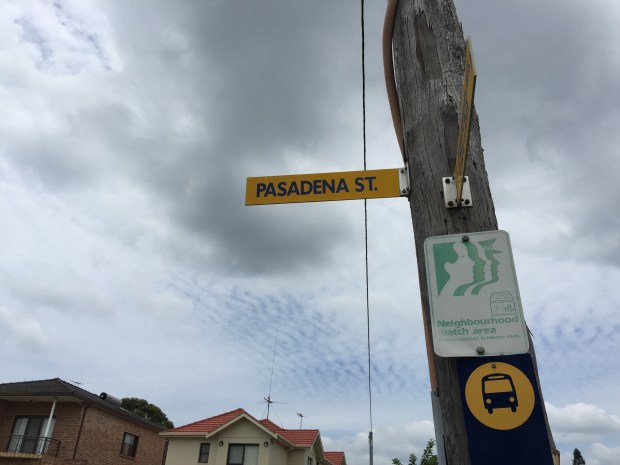
Next up is Pasadena Street, and you’d better believe it’s full of little old ladies. Pasadena gets its name from the city in Los Angeles County, a city that dates back to 1886 and is named for a Chippewa Native American term meaning ‘of the valley’. I’m starting to feel that not a lot of thought went into these street names…

In fact, the most interesting thing I can say about Pasadena Street is that it comes out directly across from Botany Bay. Look at that picture above. That gap in the land is the mouth that flows out to the Tasman Sea, from whence the Endeavour, for better or worse, arrived in 1770.

Again, too much history comes down, crushing the street’s thin veneer of banality, exposing nothing beneath.

Inevitably, there’s Hollywood Street. At the time of its christening, 1903, Hollywood, California had only just been incorporated as a municipality. It wouldn’t get its first movie studio until 1912, so whomever named was showing some astonishing foresight.

Also astonishing is this house on the corner of O’Connell and Hollywood. Just look at it.

Look at it!

Finally, we have Culver Street. Culver City, back in Cali, is another one that didn’t really come to prominence until the years after this street was named. In Culver City’s case, it wasn’t incorporated until late 1917. Weirder still is that Harry H. Culver, after whom Culver City is named, didn’t even arrive in California until 1910! Who named this street?!

Sadly, the psychic who gave Culver Street its name didn’t foresee just how pedestrian it would become in later years.
Mystery still surrounds the naming of these streets. There’s no definitive record of anyone in particular having bestowed the names, and sources have varied throughout histories both official and unofficial over the decades. Even Rockdale Council has no idea, and it’s, like, their ‘hood. What gives?
In 1941, an attempt was made by council to name the suburb ‘Werribah’ for postal reasons. Rolls right off the tongue, don’t it? It didn’t take, and ‘Monterey Park’ was also rejected before settling on plain old Monterey. I mentioned postal reasons…that appears to be its own story, and we’ll come back to that another day. It’ll be worth the wait, I swear!
All the bickering over the name meant that the suburb’s designation Monterey remained unofficial until 1972, when the Geographic Names Board stepped in and shit got real. A local poll of residents of the four American-flavoured streets showed that Monterey was the preferred name for the area, and so it’s remained ever since. Now that was all quite interesting, wasn’t it?
Again, for better or worse, this isn’t the only instance of major American influence in the early days of Sydney. The origins of Monterey are an inauspicious start, but nevertheless interesting given how the whole Brighton area embraced the very Goldfingerian image of the USA from the 1960s onwards.
Shifting tastes, a tipping of the global power balance, and a propensity to bend over for Uncle Sam meant that quite a few changes – from the minor to the irreparable – were on their way.

That means you, Chelsea.
For more reading on Monterey and the fibro houses within, check out Fibro Moderne. Early to Mid-20th century vernacular housing in Monterey NSW, without which I could not have completed this article. So blame them.
Burger joint/Under construction – Lilyfield, NSW
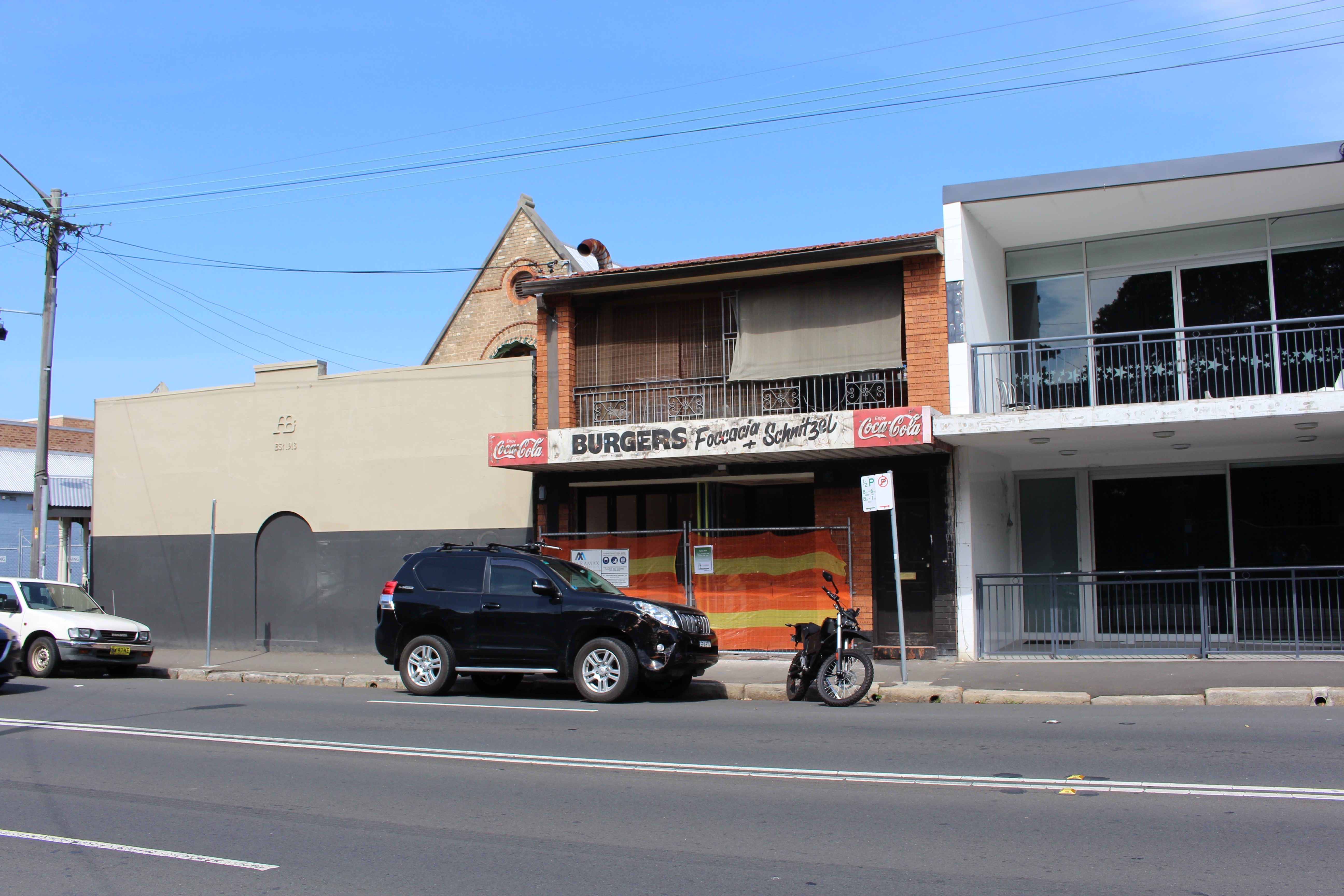
Image courtesy Andrea Cook
How common a sight is this? Even if we’re not living in the golden age of the take-away shop (and we really aren’t), you still can’t seem to swing a dead focaccia in Sydney’s suburbs without hitting one of these, or an ex-one of these.
For those readers too young (pfft, yeah right) to remember, let me take you back for a moment. In my day, you could go to these places called milk bars or take-aways, which were usually plastered in Coca-Cola advertising. Not Pepsi…never Pepsi.
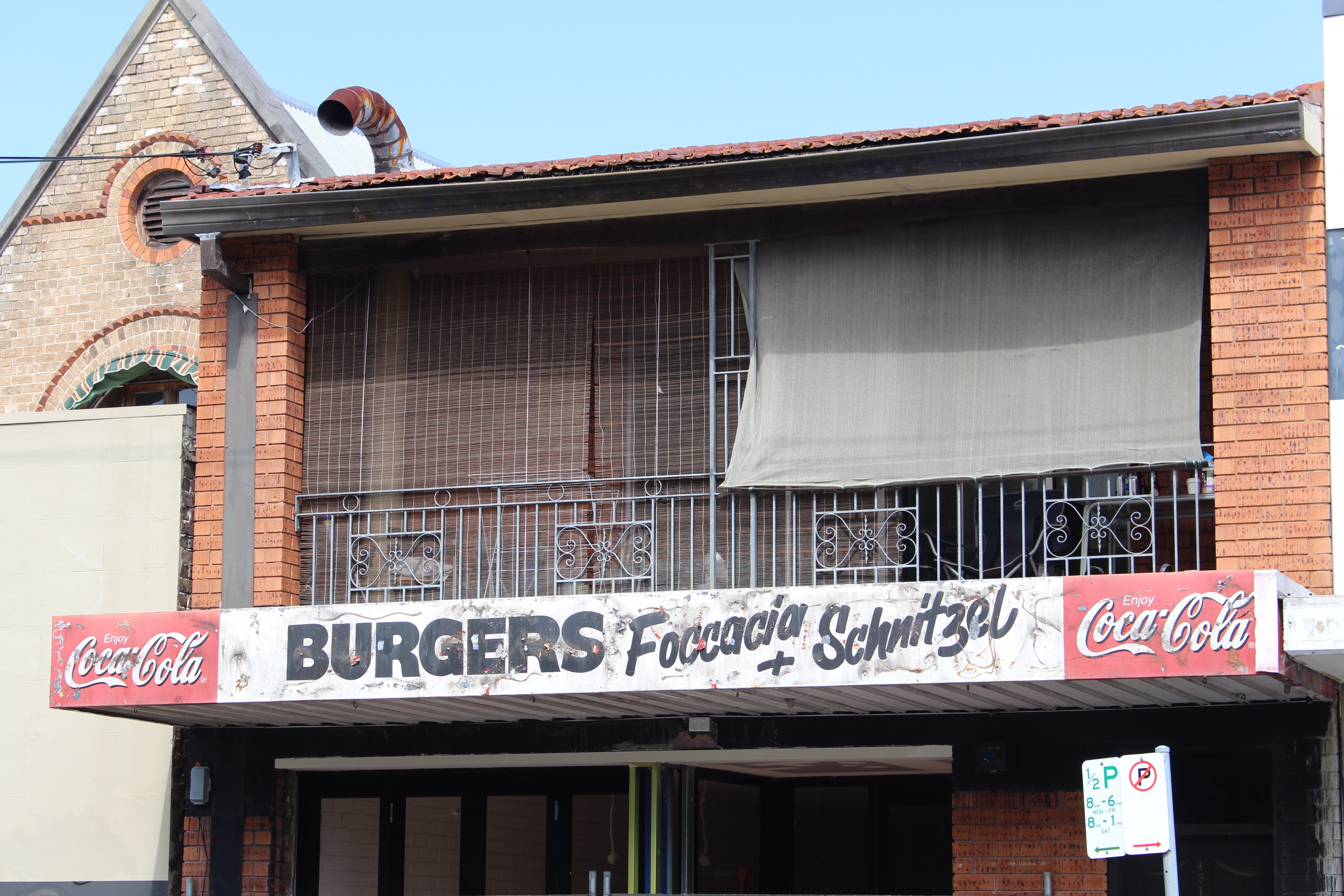
Image courtesy Andrea Cook
They’d make hot food and keep it in these giant contraptions called bain maries, which made it impossible to tell how long it’d been there. Crucially, they were also trojan horses into the then-fledgeling world of ethnic food: Australians not open minded enough to actually go to a Greek restaurant might still have a souvlaki at their local take-away. Ingenious, really.
This particular take-away seems to have spent most of its early years as a residential property before taking the plunge into the deep-fry. The kind of fatty junk sold here probably filled the stomachs of the blue-collar workers who once populated the area, or the staff and patients of Callan Park Mental Hospital which is just across the road, but as times and tastes changed it was out with the milkshakes and schnitzels (mmm, together at last), and in with the coffee and rolls.
But let’s go back even earlier, shall we, to a time before deep fried food clogged Australia’s arteries…

Dubbo Liberal and Macquarie Advocate, 11 February 1939
You’d better believe Mrs. Cutting wasn’t serving up dim sims and Chiko rolls to her 50 guests. I wonder if Dubbo’s local papers still herald the homecoming of any travelling Dubbogan (Dubsider? Dubbocastrian?)
The celebrations didn’t last long, because by 1943 the Cuttings had cut loose, and the jocks were in.
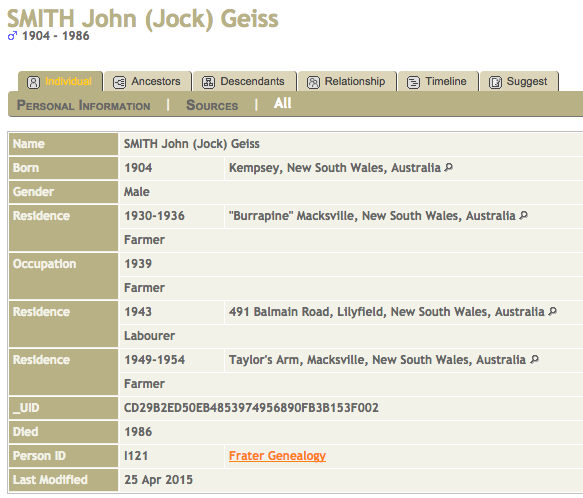
As you can see, Mr. John Smith (dynamic name, no wonder he became Jock) lived right here in the mid-1940s while working as a labourer. SEE? I WASN’T MAKING ALL THAT UP ABOUT IT BEING BLUE COLLAR!
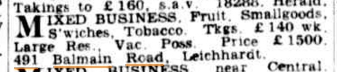
SMH 13 July 1949
Ahem. But once Jock’s labours were over, business became a little…mixed. A dynasty that would last over six decades began here for a measly 1500 pounds. I wonder if the take-away was making 140 pounds a week?

Google Street View, July 2014
As recently as last year, the newly minted Rozelle Coffee Lounge was still feeding the locals, but in a much harsher, more competitive environment. Go to Rozelle today and there are gourmet cafes on every corner, so the more meat-and-potatoes establishments face an uphill battle, and that’s probably why the Coffee Lounge isn’t around today.
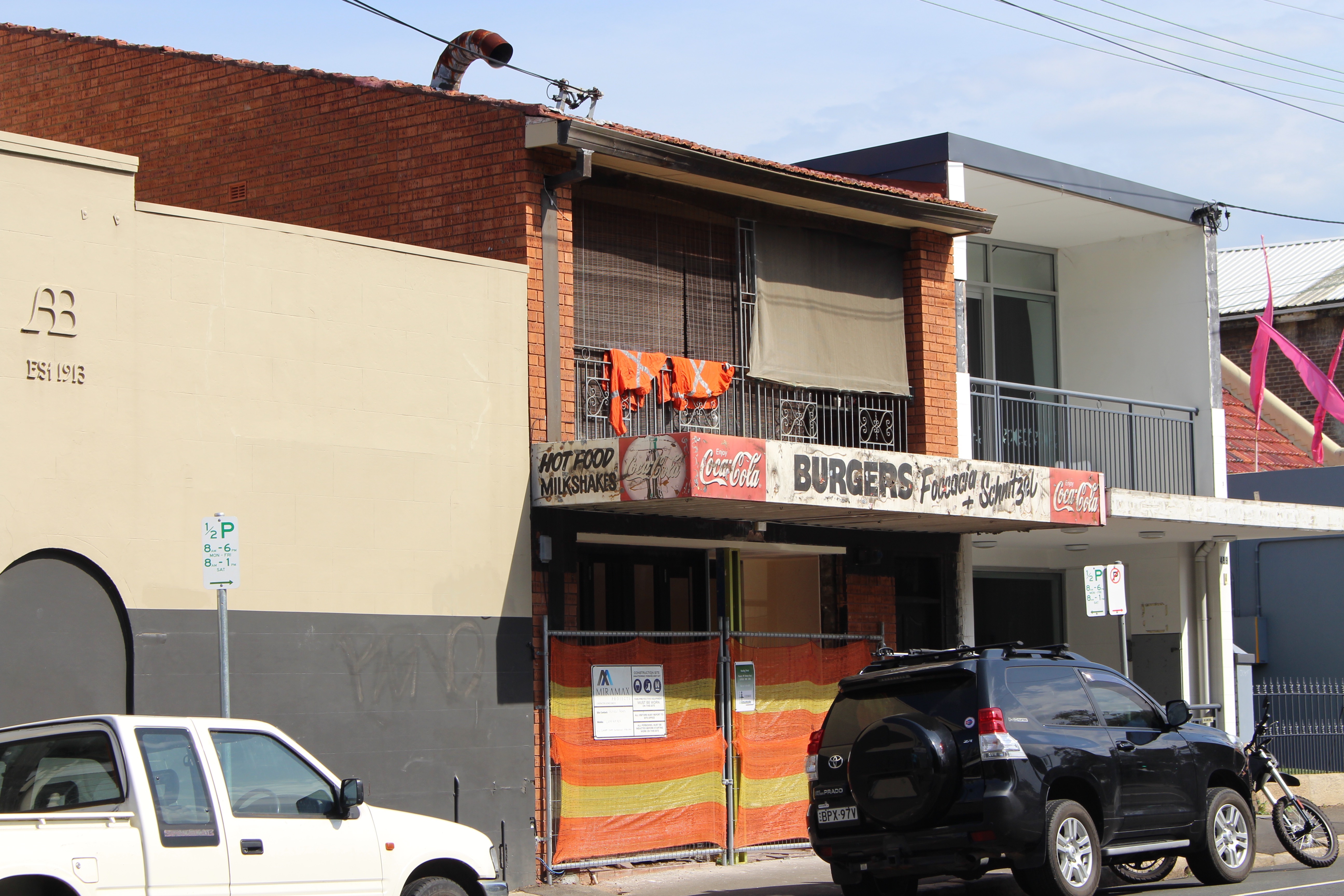
Image courtesy Andrea Cook
As the suburb has become gentrified and all the blue collars have turned to ironic skivvies, there’s no longer any call for a place like this. The Coffee Lounge knew it, as it’s currently under construction, presumably transforming into something more suitable to today’s clientele.
I don’t know about you, but I’ll always find those Coca-Cola takeaways suitable. There’s something really…comforting about them. If you drive into a country town and things are looking unfamiliar and unsettling in a Deliverance kind of way, a place like this is all you need to soften the sound of the banjos.
Old Book & Comic Emporium/First Choice Family Lawyers – Beverly Hills, NSW

We specialize in selling American, British and Australian Comics and Pocket Libraries, Story Papers, Science Fiction/Fantasy Books and Pulp Magazines, First Edition and Out of Print Books, Vintage Paperbacks, Vintage Magazines, Records, Children’s Books
“Tell me this,” says Tony as he reclines in a chair that’s more like a throne. Fittingly, he’s surrounded by plastic subjects that dedicate all five points of articulation to the whims of their king. Tony is the proprietor of the Old Book & Comic Emporium in Beverly Hills, which specialises in books, toys…and comics.
“In the first one, you had Lex Luthor running a real estate scheme. In this new one, you’ve got Lex Luthor running a real estate scheme. You’re telling me that there wasn’t another plot they could have used from the nearly 70 years’ worth of stories?” He snorts as he dismissively turns the page of the newspaper he’s absently reading. “For that reason alone, I’m not going to bother.”
On the subject of dodgy Superman movies he is, of course, completely right. And he should know; he must have well over a third of those stories in his collection.
At the counter, familiar faces from decades of pop culture stare back. On the far wall, Freddy Krueger dares you to go to sleep. The Joker laughs eternally from behind Tony’s desk, while perched atop his cash register (no EFTPOS) is the withered visage of Emperor Palpatine. They feel as much a part of the place as gruff old Tony. He’s made this shop his own.
I first became aware of Tony’s Old Book & Comic Emporium in about 1999, when I was on a serious nostalgia trip. It’s a familiar story: disposable income, an age that’s at once responsible and irresponsible, a firm grip on the past and a tenuous one on the present. In the shop window was a factory sealed box of Topps trading cards (with gum) from 1989’s Batman, a movie I’d originally seen just down the road. I’d never gotten the whole set as a kid, so I had to have them.
But the cards were the gateway drug. Once inside, I marvelled at just how many blasts from my past the owner had accrued. Monsters in My Pocket. Fangoria. The Inspector Gadget doll with the telescoping Go-Go-Gadget neck. Among these, the past-blaster was set to stun: Hardy Boys books. Monkees lunchboxes. Old Playboys below a sign marked ‘Adults ONLY’. Nice try, Tony.
During the short time I lived in the area, I became a regular. I’d hang out in the shop on Saturday afternoons shooting the shit with Tony about movies, his new arrivals and our favourite topic, the past. Never the future. Tony liked my writing style, and one afternoon wrote down the contact details of the editor of a pulp sci-fi magazine called Andromeda Spaceways for which he thought my work would be a perfect fit. I didn’t see it myself, so I never followed it up.
Thinking back now, it’s gobsmacking to imagine a two-storey modern-age antiques shop in a suburb like Beverly Hills.

Fate must have noticed the oversight. Long after I’d moved away, I swung by one afternoon only to find the shop empty. All that remained was the sign on the side of the awning and the piece of paper with the Andromeda Spaceways details still sitting in my wallet.
If you’re reading this, Tony, I hope your bold and much appreciated experiment didn’t meet too painful an end. You added a bit of colour to an otherwise boring area, and no-one’s ever going to fill your shoes. I mean, I’m sure the world needed another family law centre (especially the long-awaited first choice), but I’m sorry: you ain’t no Tony.

 Past/Lives of the Near Future