Tattoo Parlour/Strathfield Laundry – Homebush, NSW
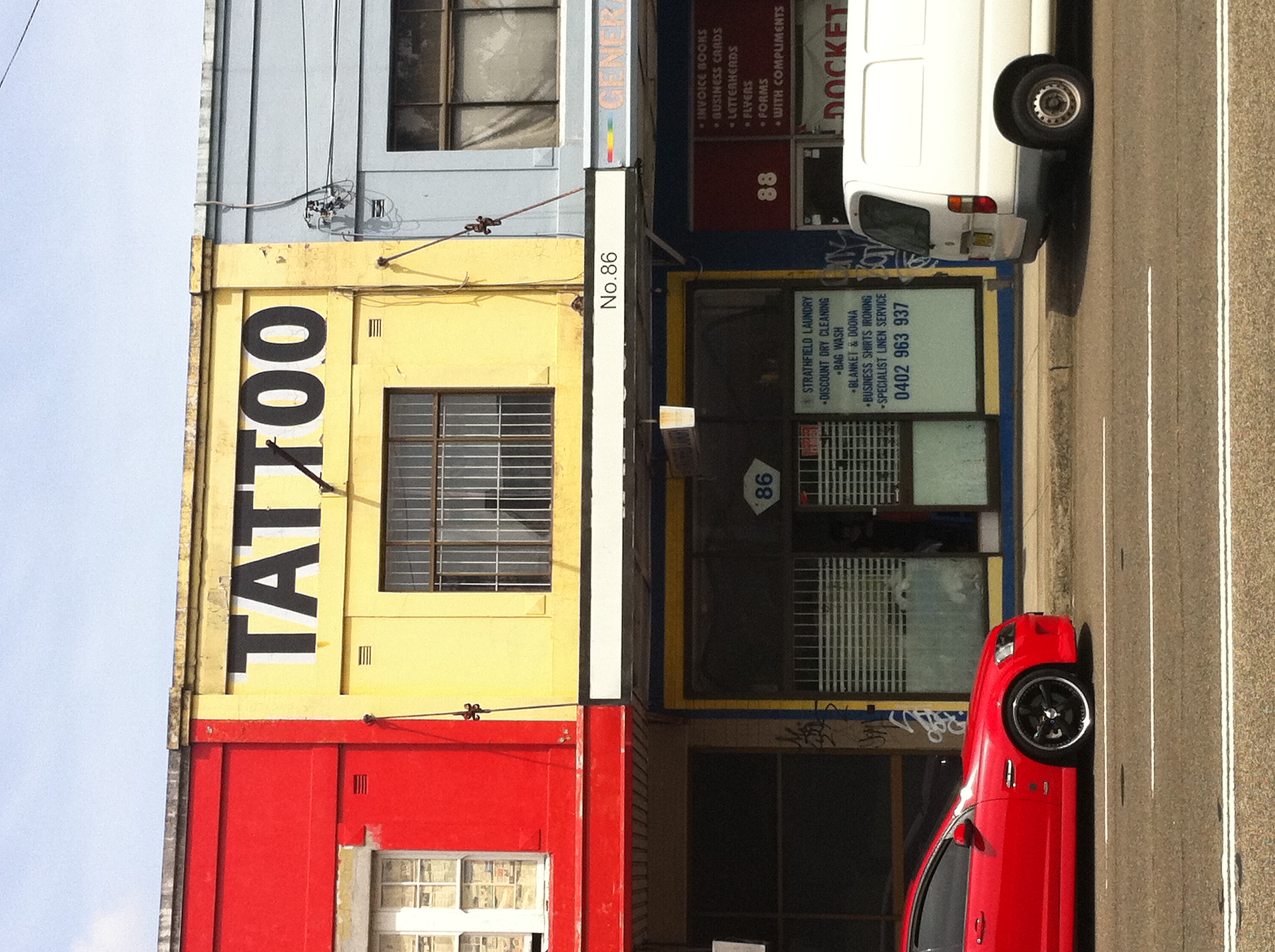
Back in the day, this stretch of Parramatta Road (opposite Underwood Road) used to be a hotspot for hoons and revheads to congregate ahead of drag races through the old abattoir and brickpit. The most popular meeting spot was Big Chief’s, a burger joint a bit further west of here. Presumably, this tattoo parlour (imaginatively titled ‘TATTOO’, leading one to suspect they only had one design) was a by-product of that era. In an effort to quell bikie activity, it has been rebranded Strathfield Laundry, but there’s no guarantee it’ll work. Bikies need their clothes washed, too.
The Plaza Theatre/Maxy’s Roller City/Planet Hollywood/McDonald’s – Sydney, NSW

Image courtesy Simon Fieldhouse.
Sydney’s Plaza Theatre was once one of many elegant cinemas and theatres lining George Street’s entertainment strip. Like many cinemas, its business was damaged by the advent of television, and today it has the distinction of being arguably the world’s fanciest McDonald’s.

McDonald’s George Street interior, 2012.
Built for Hoyts in 1930, the Plaza sat alongside venues such as the Century Theatre (which became an indoor BMX track in what could only have been the 80s) and the Crystal Palace Arcade.

Erecting the neon sign, The Plaza Theatre, 1935. Image courtesy State Library of NSW.

Hoyts Plaza Theatre, 1966. Image courtesy City of Sydney Archives.
Despite many of its contemporaries being bulldozed around it, the Plaza stood firm until 1977, when it was closed as a cinema and reopened as Maxy’s, a disco skating rink. The changing face of entertainment.

The Plaza as Maxy’s, 1983. Image courtesy Helen Grant/Sydney Cinema Flashbacks.
Surprisingly, the idea of a disco roller rink wasn’t fashionable for long, and the Plaza played host to Mickey D’s and video arcades for most of the 1980s.
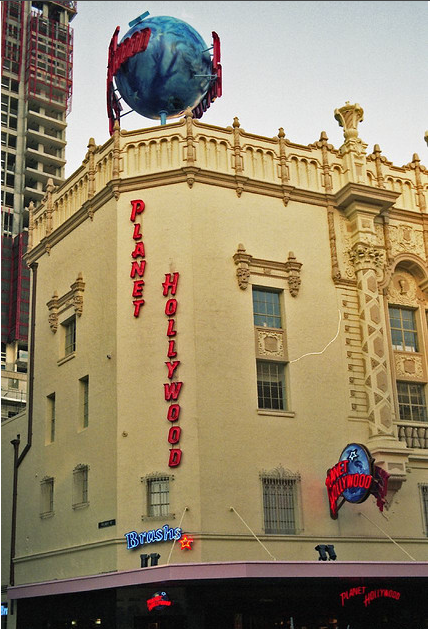
Planet Hollywood Sydney, 1996. Image courtesy Steve Newbury.
The Plaza’s northern end was once again immersed in the world of cinema in 1995 when the Stallone-Schwarzenegger-Willis-Moore joint Planet Hollywood came to Sydney, establishing itself in the former arcade. According to this photo taken in 1996, PH shared its space with Brashs, another 90s success story. By 1999, both ventures would be out of business.

Today, some lazy entrepreneur has taken the already-tacky Planet Hollywood aesthetic and adapted it into the Star Bar, another of modern George Street’s entertainment offerings. Not sure how many stars you’d see here these days. The Plaza in its present state is yet another example of Sydney trying to disguise the brazen pimping of itself to the lowest bidder by hiding behind facades of the past. If it looks vintage, it seems that much more respectable. What isn’t considered is that drunken eyes can’t appreciate all the lovingly preserved heritage fronts, and as George Street continues to slide into the gutter, the death grip it has on these buildings only serves to drag their illustrious reputations and history down with it.
STAR STUDDED UPDATE: Reader Cameron says: “Star Bar was originally created by Planet Hollywood to replace Brashs when it failed which had the same owner, Star Bar was created so Planet Hollywood could profit from gambling without tarnishing its family image. The two coexisted for a while. A bizarre fact, this restaurant was a real cash cow and extremely profitable when it closed, a case of embezzlement I believe. The real crime there was the removal of the original cinemas Spanish themed ceiling for the extra headroom and replaced with a high blue ceiling. The Star Bar is now run by the same group that has the even tackier Shark Bar! now with no sharks……”
Sounds like the sharks haven’t left at all, actually. It’s almost inconceivable that shady types would be running places like this (especially the Shark Bar), but there you go. Thanks, Cameron!
Bristol & Co Real Estate/Map World/Citymart – Sydney, NSW

The idea of a small real estate agent such as Bristol & Co. sitting in the middle of the city seems strange now. It’s hard to imagine that a small fry like Bristol could ever compete in an environment full of franchises and big name firms. Likewise, the current incarnation of the building, Citymart, seems ill-equipped to compete with the 7-Elevens and City Conveniences of downtown Sydney, primarily because it’s closed and near empty.
Map World is another instance of a shop too small for its ambitions. It probably did alright in 2000, but in an age where everybody’s phone knows the city better than your average taxi driver, Map World’s pretty much fallen off the map. With a track record of three duds, maybe it’s just an unlucky shop.
Liquor Legends/China Jingdezhen Art Porcelain Fair/Demolished – Hurstville, NSW

A liquor shop for many years, this Hurstville location has recently become a bottle shop of a different kind. We all know that all booze eventually ends up hitting the porcelain in one form or another, but this is rather literal.
BARREN UPDATE:
I certainly hope you weren’t planning on getting that special someone some porcelain for Christmas…

Western Distributor On-Ramp/Road Hammock – Sydney, NSW

Here’s something completely stupid: this carriageway is the Western Distributor passing over Kent, Day and Margaret Streets near Wynyard. Below it is…a bit of road that…goes nowhere, and does nothing.
The Western Distributor began life in the early 1960s as a way to relieve traffic on the Harbour Bridge. Sydney’s extensive underground rail system meant that the Distributor couldn’t be built as a series of tunnels, so viaducts were the sensible alternative. That’s where the sense stopped.
The only reason the Western Distributor existed was because the designers of the Harbour Bridge and existing road system didn’t use enough foresight. You’d think that planners of the WD would employ twice as much foresight to make sure that further modifications weren’t necessary. Well, two times nothing is still nothing.
The original plan for the Western Distributor had westbound traffic exiting the city via the Glebe Island Bridge. For those who aren’t familiar with the bridge in question, here’s a picture:
That’s it there, below that huge, multi-lane bridge. If you can’t see it, squint. The two-lane Glebe Island Bridge had been built in 1903 to provide access to the Glebe Abattoir, and it includes a swing bridge to allow boats through. Surprisingly, this bridge proved to be unable to handle the traffic spewing forth from the Western Distributor, and in 1984 the NSW Government proposed another bridge. Good thinking! The Anzac Bridge was completed by 1995 (!), and opened in December of that year. It features a great height to allow boats through.
Of course, when the Distributor had been designed, it was flowing towards a small bridge. Now that it had a giant, capable bridge to lead into, the one-lane road itself suddenly seemed a bit lacklustre. In 2002 (!!), work commenced to widen the Western Distributor throughout the city, which brings us back to our original ridiculousness.

Here’s the other end, just in case you were thinking it went somewhere.
This bit of suspended road was originally an on-ramp for the Western Distributor, with access from Margaret Street. When the road above our piece here was widened, it claimed the on-ramp’s space and ended Margaret Street’s usefulness in the scheme of things. For a time it was used as a parking bay (illustrating the lengths the City of Sydney Council is willing to go to to make a buck out of parking). The ramp was then severed at both ends, and now sits hanging above the street, useless and surreal.
The happy ending to this story is that after the implementation of each of these emergency patches to the highways of Sydney, traffic in the city was never a problem ever again.

 Past/Lives of the Near Future