Devonshire Street Cemetery/Central Station – Sydney, NSW
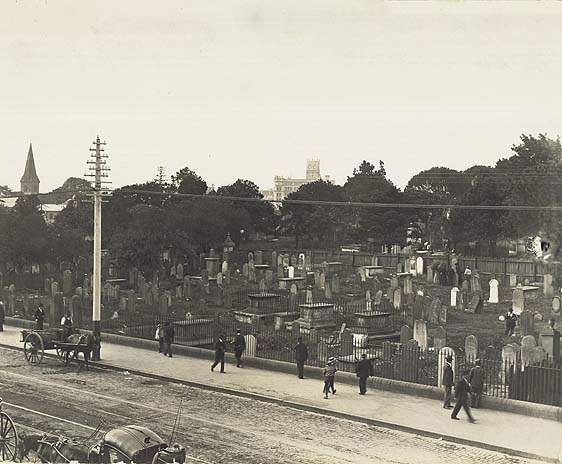
Devonshire Street Cemetery, 1901. Image courtesy State Records NSW
“I once walked through the burial grounds on the Surry Hills, in the commencement of Spring, just as the flowers were beginning to bloom forth in all their beauty…”
Bridget Flood was in the same situation too many of us have found ourselves in all too often: stranded at Sydney’s Central train station, hopelessly late. The big difference is that she was waiting there for over 60 years.
As we’ve previously learned, 1820 was a good year to die in Sydney. Rather than ending up beneath the public piss-pot that was once the colony’s first burial ground, you could find yourself in a brand new plot freshly dug at the just-consecrated Devonshire Street Cemetery.
Yes, that Devonshire Street.

Location, location, location. South Sydney plan, 1842. Image courtesy K Johnson and M Sainty.
Chosen for its abundance of space and central (heh) location, the area bordered by Elizabeth and Devonshire streets was chosen to replace the Old Burial Ground as Sydney’s premier final resting place. Quartermaster Hugh McDonald, 40, was the first lucky stiff to be buried there following his death in 1819. Long waiting lists…so Sydney so chic.
“It was early in the morning when I commenced rambling amongst the tombs, the dew had not yet been dissipated by the genial rays of the invigorating luminary, and the cool fragrance of the atmosphere had not yet given way to the noon-day heat…”
Bridget Flood died in October 1836 at the age of 49 and, like virtually all deaths in Sydney at the time, was interred at the Devonshire Street site. Quoth her headstone:
“Pain was my potion
Physic was my food
Groans were my devotion
Drugs did me no good
Christ was my physician
Knew what way was best
To ease me of my pain
He took my soul to rest.”
They don’t write ’em like that anymore. And rest she did, as did all those buried at Devonshire Street Cemetery well past its 1867 closure.

Go home, we’re full. Devonshire Street Cemetery, 1901. Image courtesy RAHS.
Although steadily employed by the city’s dead between 1820 and 1866, the nail in the coffin (heh heh) for the cemetery was the latter year’s introduction of the Sydney Burial Grounds Act (NSW), which prohibited burials “within the city of Sydney from 1 January 1867, with the exception that persons with exclusive rights of burial at that date could still be buried on application to the Colonial Secretary who needed to be satisfied that ‘the exercise of such right will not be injurious to health’“. Phew. Just tie some rocks to me and throw me in the harbour!

Devonshire Street Cemetery, 1901. Image courtesy Royal Australian Historical Society.
You’d think this act would be in anticipation of some kind of grand plan for the burial ground, but no. With the exception of infrequent additions to family plots as outlined by the overly wordy act (and even these ceased in 1888), Devonshire Street was largely ignored by the growing city while new sites like Waverley Cemetery and the Rookwood Necropolis served the public’s burial needs.

Prince Alfred Park’s Exhibition Building looms large. Devonshire Street Cemetery, 1901. Image courtesy Royal Australian Historical Society.
By 1900, its advanced state of neglect and decay reflected its residents and disturbed the public:

Illustrated Sydney News, 1878.
…although it wasn’t all bad:

SMH, January 26 1878.
“In short, it was exactly such an hour as an imaginative or sensitive being would delight to rove about, and lose himself in the regions of fancy…”
It wasn’t long before some of the more opportunistic voices began to speak out about the the site’s real estate value:
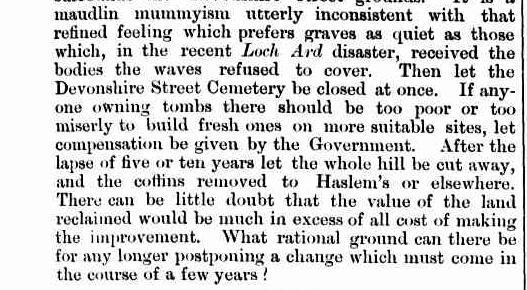
Illustrated Sydney News, 1878.
And as early as 1888 there were rumblings about how best to use the land:
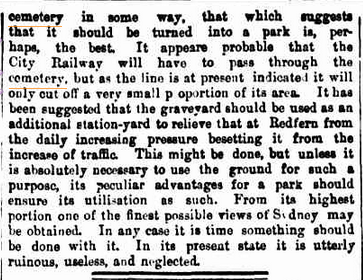
SMH, March 3 1888.
It made sense, given that Central Station’s predecessor, ‘Sydney Station’, lay opposite the cemetery along Devonshire Street.
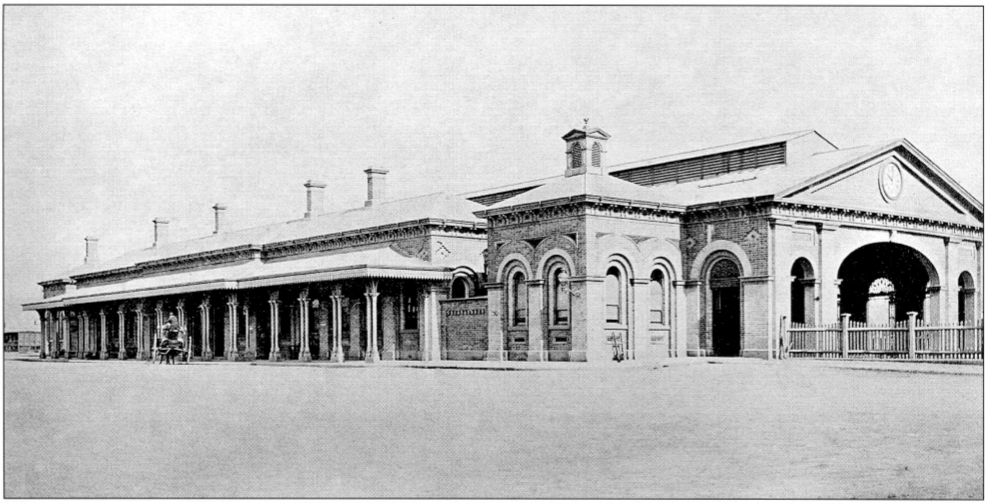
Sydney Station, the forerunner of Central Station, 1874. Image courtesy ARHS Rail Resource Centre.
Since 1884, Sydney’s existing rail network had been under the stress of increasing traffic and a limited reach (sounds familiar, doesn’t it?). Sydney Station was constantly receiving upgrades and additional platforms, culminating in a messy setup of 13 train platforms and numerous tram sheds (sounds familiar, doesn’t it?). The city’s railway commissioners initially struggled to decide upon a plan for the future which would provide Sydney with a central hub expansive enough to extend the rail network to the suburbs (sounds- never mind).

The planned terminus for Hyde Park. Image courtesy RailCorp.
An 1897 royal commission proposed the resumption of Hyde Park for use as the central terminal and, to counter the public outrage over the loss of parkland, the Devonshire Street Cemetery would be converted into a park. For a time this plan seemed to be a go until the unexpected death of Railway Commissioner E M G Eddy (of Eddy Avenue fame) that same year. This forced a literal return to the drawing board, where it was decided that it was probably easier to resume just one giant park instead of two. Nice thinking, guys.

The new plan. Image courtesy Public Works Committee.

The undertakers size up the corpse, December 1900. Image courtesy State Records NSW.
In January 1901, the Department of Public Works served notice that anyone with relatives buried at Devonshire Street were to front up and make known their desire to have the remains reinterred at other cemeteries by train, with the cost to be borne by the NSW Government. These days, they’d just tell you to bring a shovel.

Devonshire Street Cemetery, 1901. Image courtesy RAHS.
Unfortunately, these relatives were given a strict time limit of two months to act, and by the end of that time, only 8,460 bodies had been claimed (not among these was Eddy, who had been buried at Waverley following his death). This left 30,000 remains unclaimed, most of which were transferred to other cemeteries anyway, but due to the rushed nature of construction and given they did such a bang-up job the last time, it’s safe to say there are more than a few commuters at Central waiting for a train that will never come.
With that many bodies to exhume, you can imagine just how many creepy stories must have come out of the venture. Here’s just one:
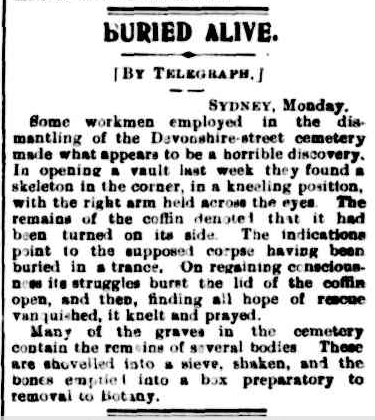
Barrier Miner, July 29 1901.
The reason for the rush was that Melbourne had started work on their Central equivalent, Flinders Street Station, that same year. Sydney was determined to get the drop on Melbourne this time, as Flinders predecessor ‘Melbourne Terminus’ had been Australia’s first city railway station back in 1854, pipping Sydney by a year. The Devonshire Cemetery site had been completely cleared by 1902, and stage one of Central’s construction, which aimed to have the station operational, was completed in 1906. On opening day, the new station featured…13 platforms. Despite being twice the size of its predecessor, this was no improvement, and did nothing to alleviate Sydney’s transport woes (but then again, what ever does?).

Central Station, 1906. Image courtesy State Records NSW.
“I directed my footsteps to a cluster of tombs on an eminence, which was thickly covered with green and blooming geraniums…”
But the unexpected fruit of the Department of Public Works’ labour was the emergence of commercial activity in the areas surrounding the new station. Its proximity to the city made department store shopping for those out in the sticks a treat, with Grace Bros., Marcus Clark, Anthony Hordern, Bon Marche and Mark Foy all within walking distance of Central by 1908. The Tivoli and Capitol theatres became entertainment meccas for those starved of entertainment in the ‘burbs.
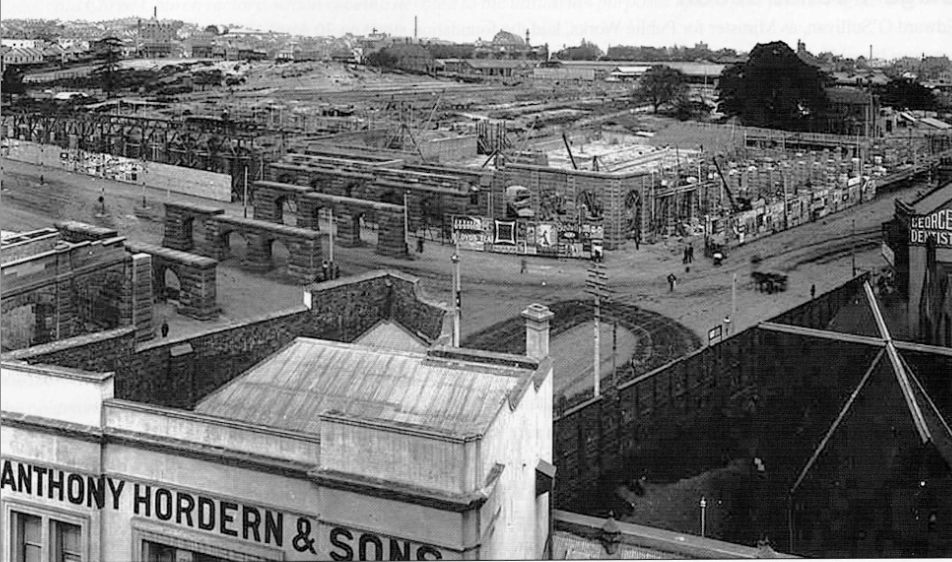
Anthony Hordern awaits new business during Central’s construction, April 1903. Image courtesy ARHS Rail Resource Centre.
The station itself was hardly the thing of beauty its early designs had suggested, with the rushed development cycle omitting many intended features – least of all Central’s iconic clock tower, which wasn’t completed until 1924.

Always on time: Central Station’s clock tower completed, 1924. Image courtesy State Records NSW.
The construction wasn’t just focused on making sure the station would be operational before Flinders Street, though; there was particular care taken to ensure no trace of the Devonshire Street Cemetery remained, going so far as to completely eradicate Devonshire Street west of its intersection with Elizabeth. Other structures that once stood on the land now occupied by Central and its surrounds – the Belmore Police Barracks, the Benevolent Asylum, the womens refuge – have similarly been lost to time.
“I at first almost forgot the ravages of the grave in contemplating the enchanting appearance of the place.” – James Martin, 1838.
Today, nothing remains to remind commuters of the morbid nature of Central’s past. The cemetery itself was largely situated underneath today’s platforms:

Devonshire Street Tunnel, once Devonshire Street, runs directly underneath the path once carved between the cemetery and Sydney Station, depositing Surry Hills pedestrians into Railway Square amid el-cheapo bargain shops, youth hostels and fast food joints.

Looking east toward Devonshire Street, 2013.

Looking west toward Railway Square, 2013.
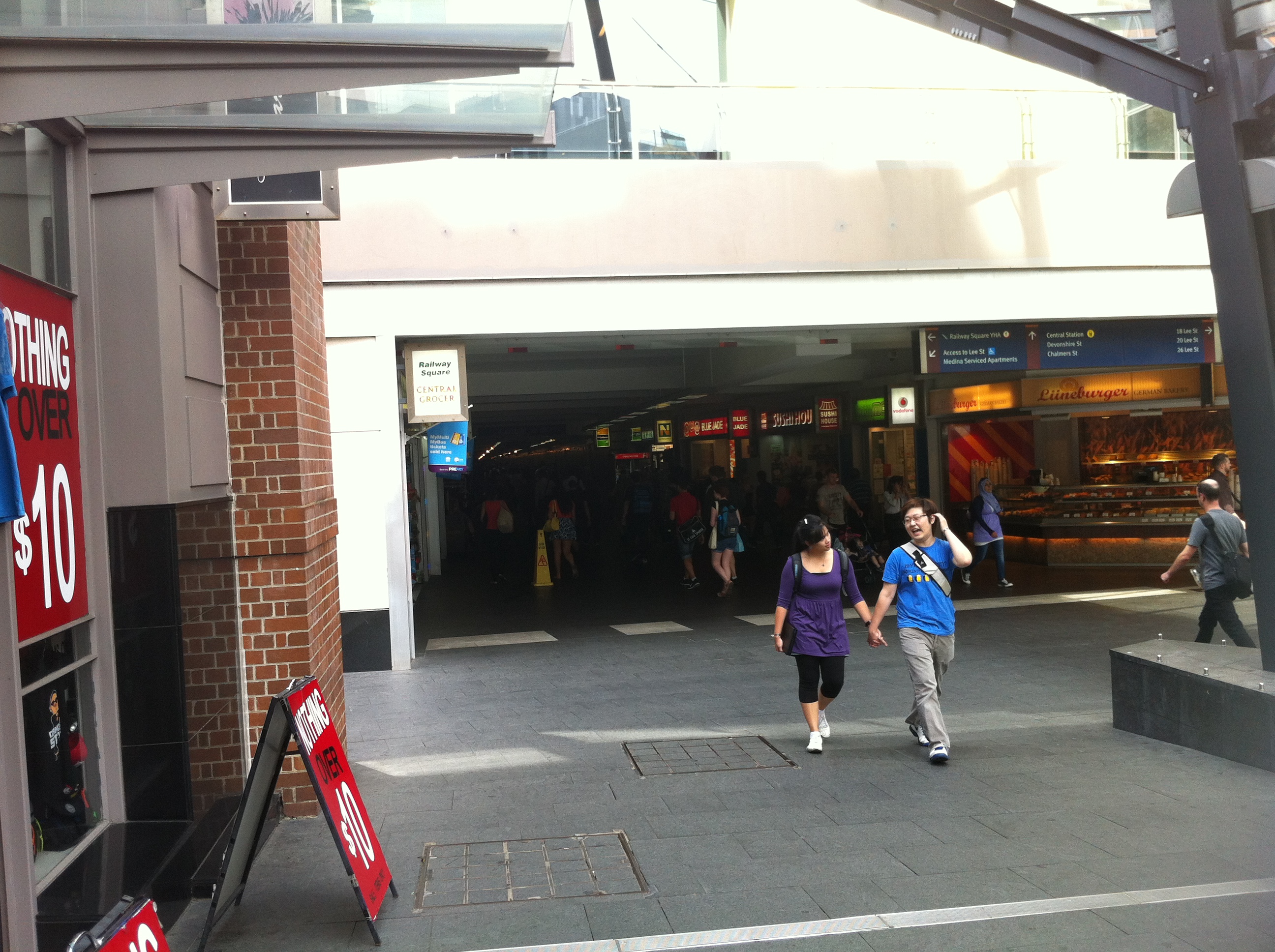
Emerging into Railway Square, 2013.
Also in Railway Square is a series of plaques designed to inform passers-by on the history of Central Station and railway in NSW. The cemetery is mentioned in passing (heh).
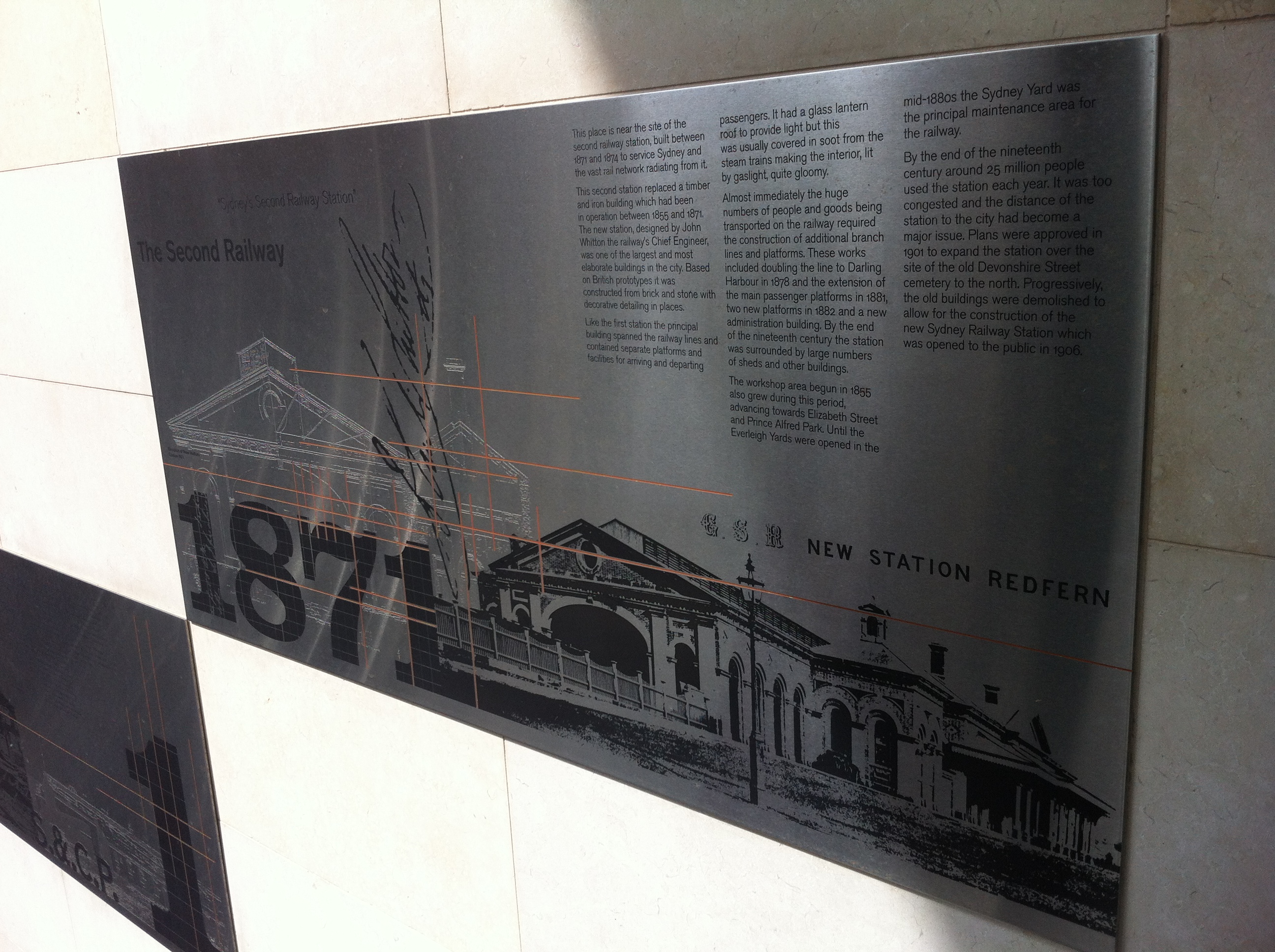
Revisionist history part one, 2013.

Revisionist history part two, 2013.

Revisionist history part three, 2013.
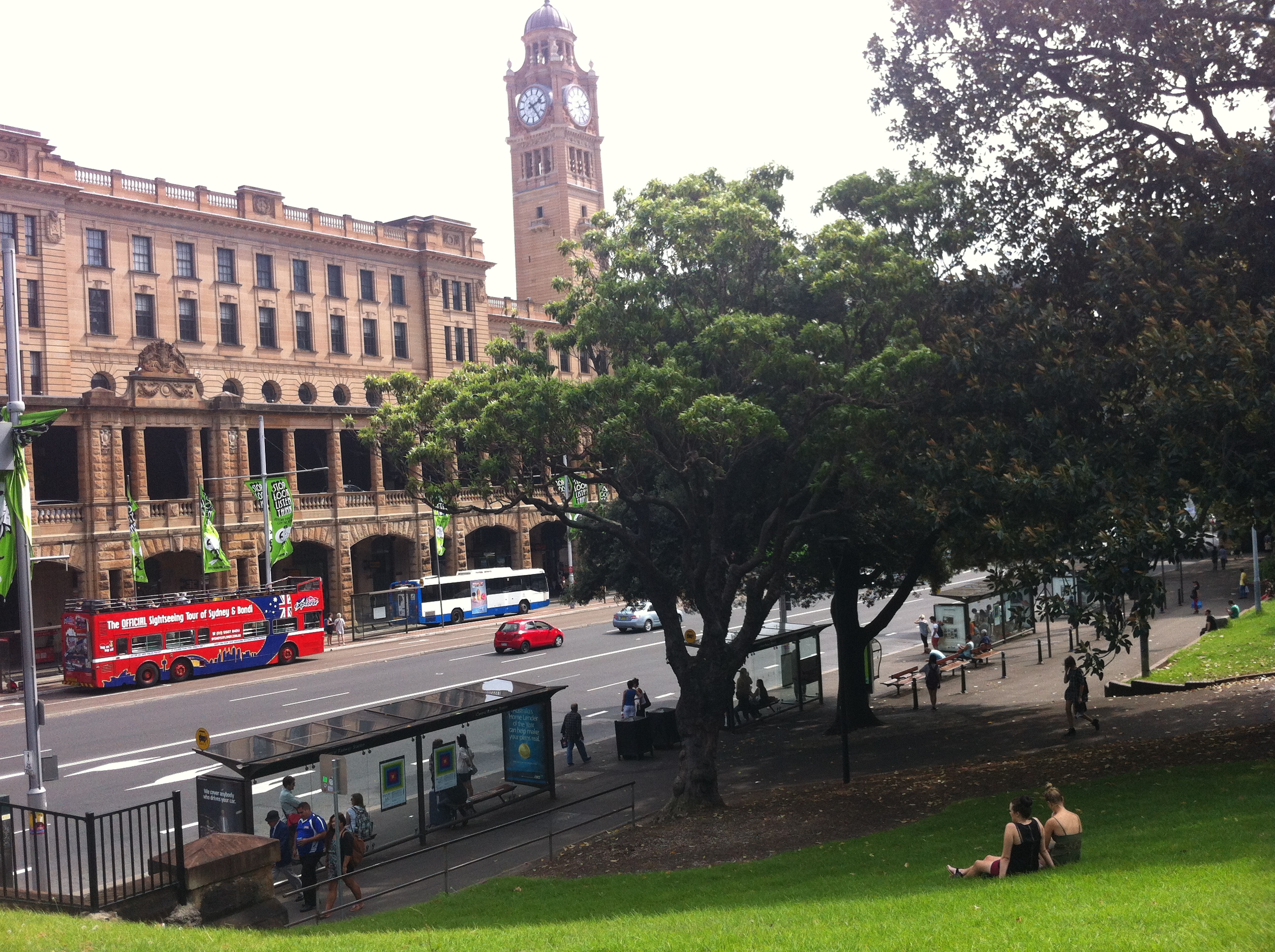
Belmore Park, 2013.
The uneven terrain of Belmore Park perhaps provides us with the nearest idea of what the Devonshire Street Cemetery was like in its natural state as is possible today, although even it has a sordid and ugly past as an open gutter for the refuse of the nearby Belmore Produce Markets and Paddys Markets.

Belmore Park, 2013.

Gateway to limbo. Camperdown Cemetery, 2013.
Rookwood Necropolis, Eastern Suburbs Memorial Park, Woronora Cemetery and many others were the recipients of many of the (not so) permanent residents of Devonshire Street, but none feature as striking and immediate a memorial as the tiny, eerie Camperdown Memorial Rest Park. Here, amongst the sombre atmosphere of tombstones and gloomy, gnarled trees lie what were once the gate posts met by visitors to Devonshire Street. These were removed along with everything else in 1901, and mysteriously disappeared from existence until 1946, when…

SMH, October 9 1946.

It’s kinda graffiti. Camperdown Cemetery, 2012.
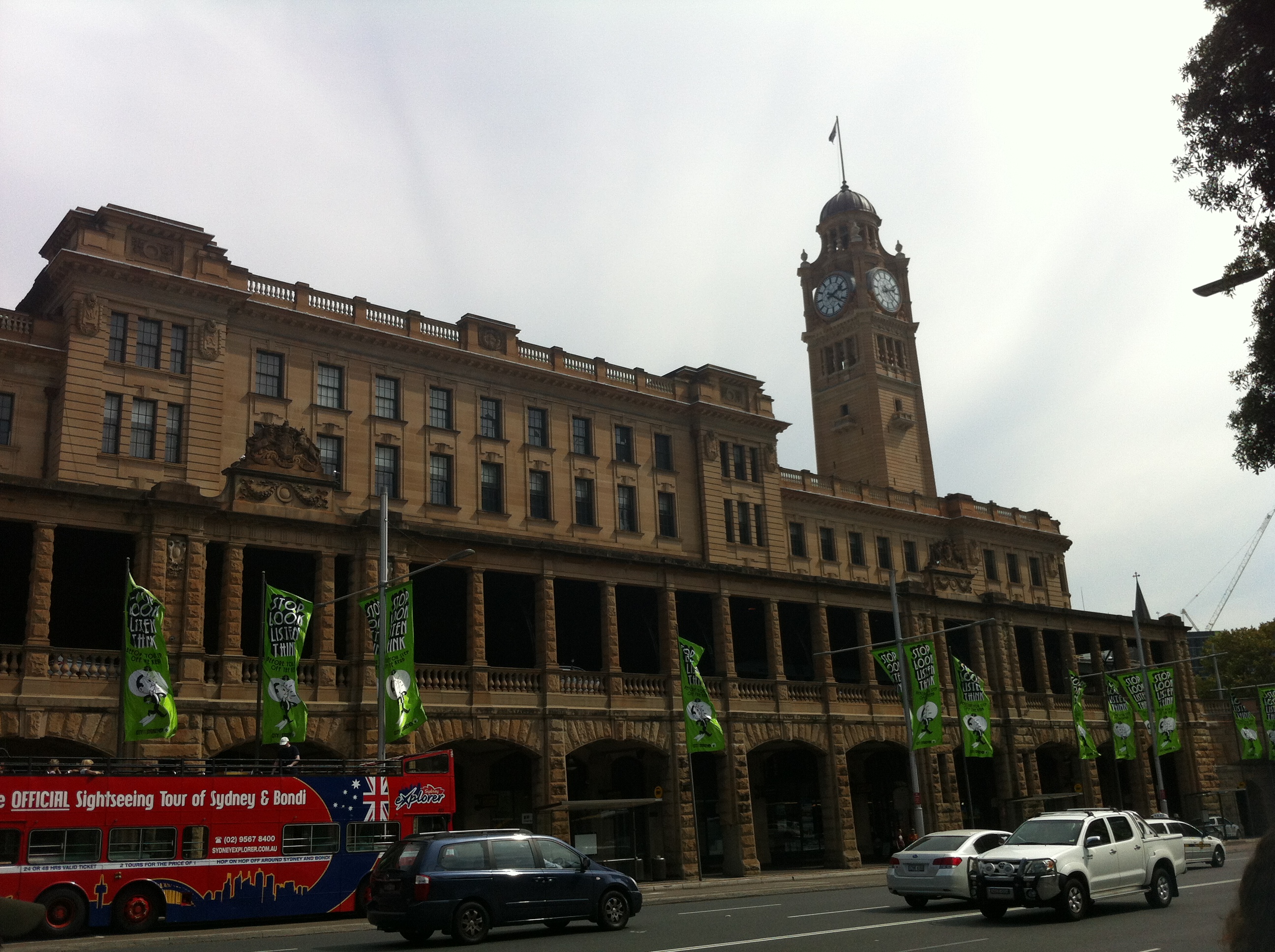
It seems almost sacrilegious that thousands of commuters tread all over this once-consecrated ground every day without any kind of marker to signify what was and who mattered, even if it was nearly 200 years ago. C’mon, NSW Government! They’re even in the right electorate! Meanwhile, to the 30,000 Sydneysiders scattered to the four corners by the winds of progress, the term ‘final resting place’ has little meaning.
Finally, here’s a fascinating account of a visit to Devonshire Street Cemetery just as its demolition was beginning. It originally appeared in the Clarence and Richmond Examiner, October 1 1901.


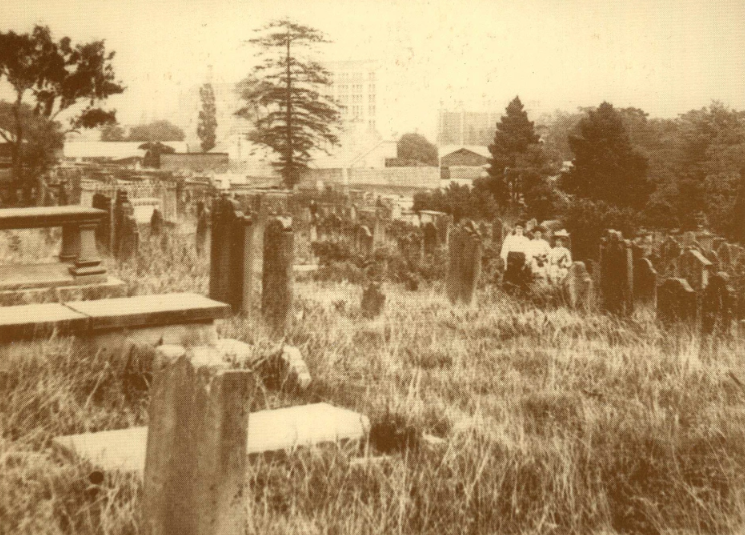
Ghouls, not girls. Devonshire Street Cemetery, 1901. Image courtesy RAHS.
Dianetics Volcano/Video Billboard – George Street, Sydney NSW

On a stormy night in 1996, the Church of Scientology made its mark on the George Street entertainment strip in the form of Sydney’s most bizarre advertising initiative. The site, on the east side of George Street, was formerly the Roma Complex; a row of shops including the Roma cinema torn down in the early 1990s to make way for the current setup. Now comprised of a variety of smaller shops, the address is most notable for including the Metro Theatre, a popular music venue, and as the former home of Galaxy World, a video arcade.
Someone in the Church of Scientology saw an opportunity to educate the people of George Street in the ways of Xenu et. al., and in mid-1996 a giant illuminated volcano facade was erected above Galaxy World, with a giant video screen at the peak. The screen played commercials for Scientology founder L. Ron Hubbard’s 1950 book Dianetics over and over and over as smoke burst from the volcano, while testing centre was established nearby so that anyone interested in the ad could have their situation evaluated by the experts. What had been originally intended was that the screen would be directly used by the Church of Scientology to advertise the religion/cult, but after that proposal was denied by the Sydney City Council, a compromise was reached in the form of the Dianetics ads. Celebrity Scientologists Kate Ceberano and Nancy Cartwright appeared at the unveiling, which was forced inside due to the thunderstorm.

George Street Volcano, 1996. Image courtesy suburbia.net.
After just a few months, the brightly coloured volcano had faded, and so had the public’s compulsion to humour the Church of Scientology. Then-Sydney Lord Mayor Frank Sartor offered to pull the volcano down as early as November 1996. At some time in 2000, long after the advertisements had stopped erupting, the facade caught fire, and remained in its burnt state for nearly a year afterward. When the volcano screen was first erected, it was agreed that it would only be up for six years, but here we are in 2012 and although the volcano is gone, the screen and an ugly facade remain. It’s a surprise it’s still there, given Sydney City Council’s tendency to overhaul all things George Street every couple of years.

Turn around, you fools. George Street, 1998. Image courtesy Edmund Cheng.
Speaking of erections and eruptions, a few enterprising young scallywags took the obvious opportunity to broadcast porn through the screen for a prank at some point in the late 1990s, and given that’s the least creepy thing the setup was ever used for, that’s a good place to end this article.
PS. Oh, the 24hr Bar Ace advertised alongside the volcano isn’t there anymore either. It’s two Japanese restaurants now.
Alan Williams Karate Centre/nothing – Penshurst, NSW

More like PensHURTS
Right now you’re feeling as excited as I was to stumble upon this sign. B-B-B-B-BAM! Damn! It’s like a FIVE HIT COMBO to your GROIN!
WHACK – Alan Williams!
SOCK – Alan Williams’ name in its original katakana!
BIFF – He has a KARATE centre!
THWACK – Tae Kwon Do too!
OOF – the official Alan Williams dojo logo featuring the official fist of ALAN WILLIAMS.
Now you’re stumbling around, numb from the waist down, and all you can think about is HOW DO I GET DOWN THOSE STAIRS AND SIGN UP?
Well sadly, there are no stairs. At all. There is no dojo, nor is there an Alan Williams. Maybe there never was. The only people who would ever see this sign are those heading to the TAB at the end of this bizarre corridor, so maybe downstairs is some kind of veiled reference to hell.
The Sandwich Shop/nothing – Enfield, NSW
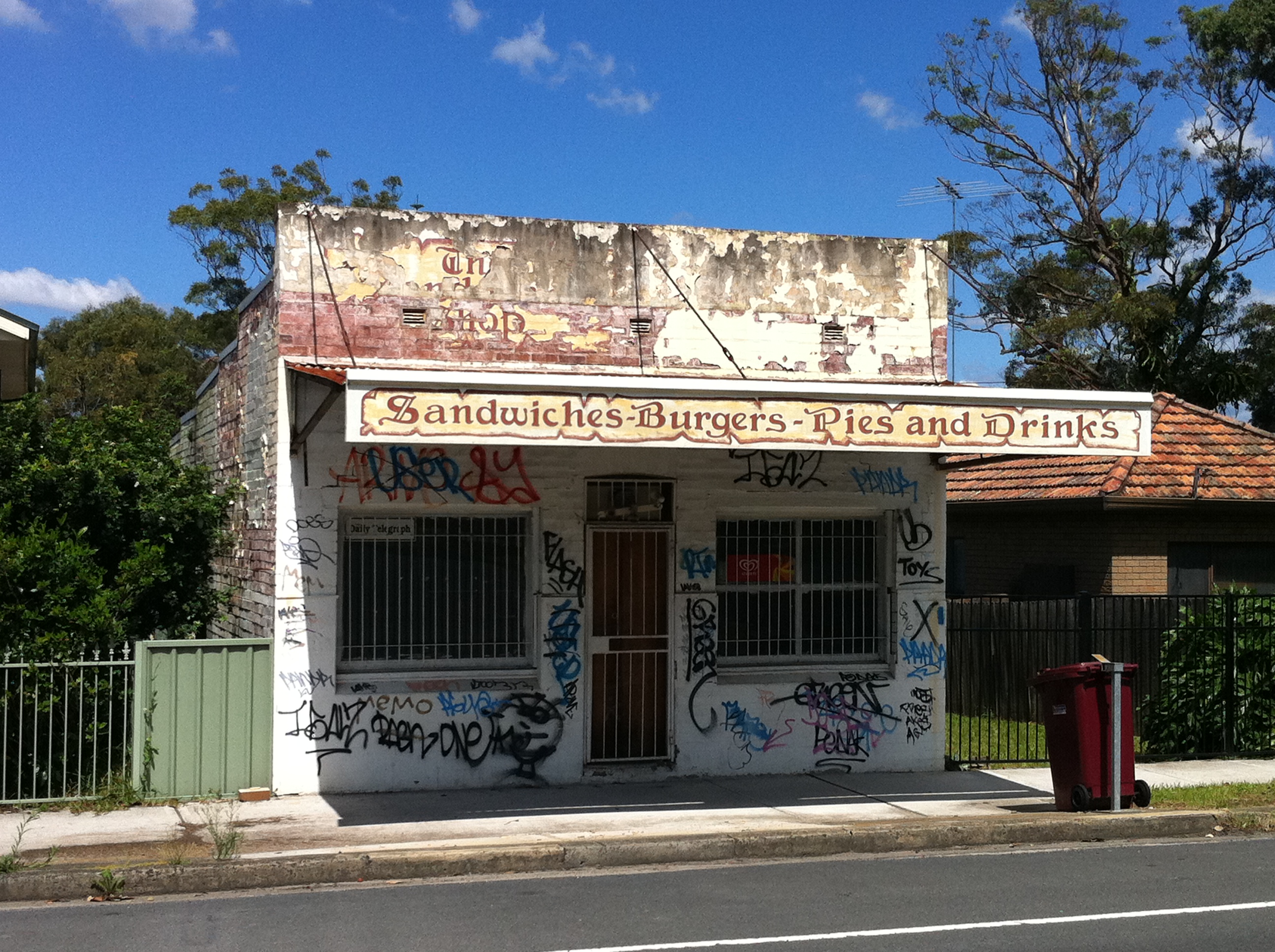
This shop is straight up creepy. The ye-olde Englishe font, the extreme dilapidation, the offputting warning of ‘NO TOYS’ graffiti’d on the shopfront…
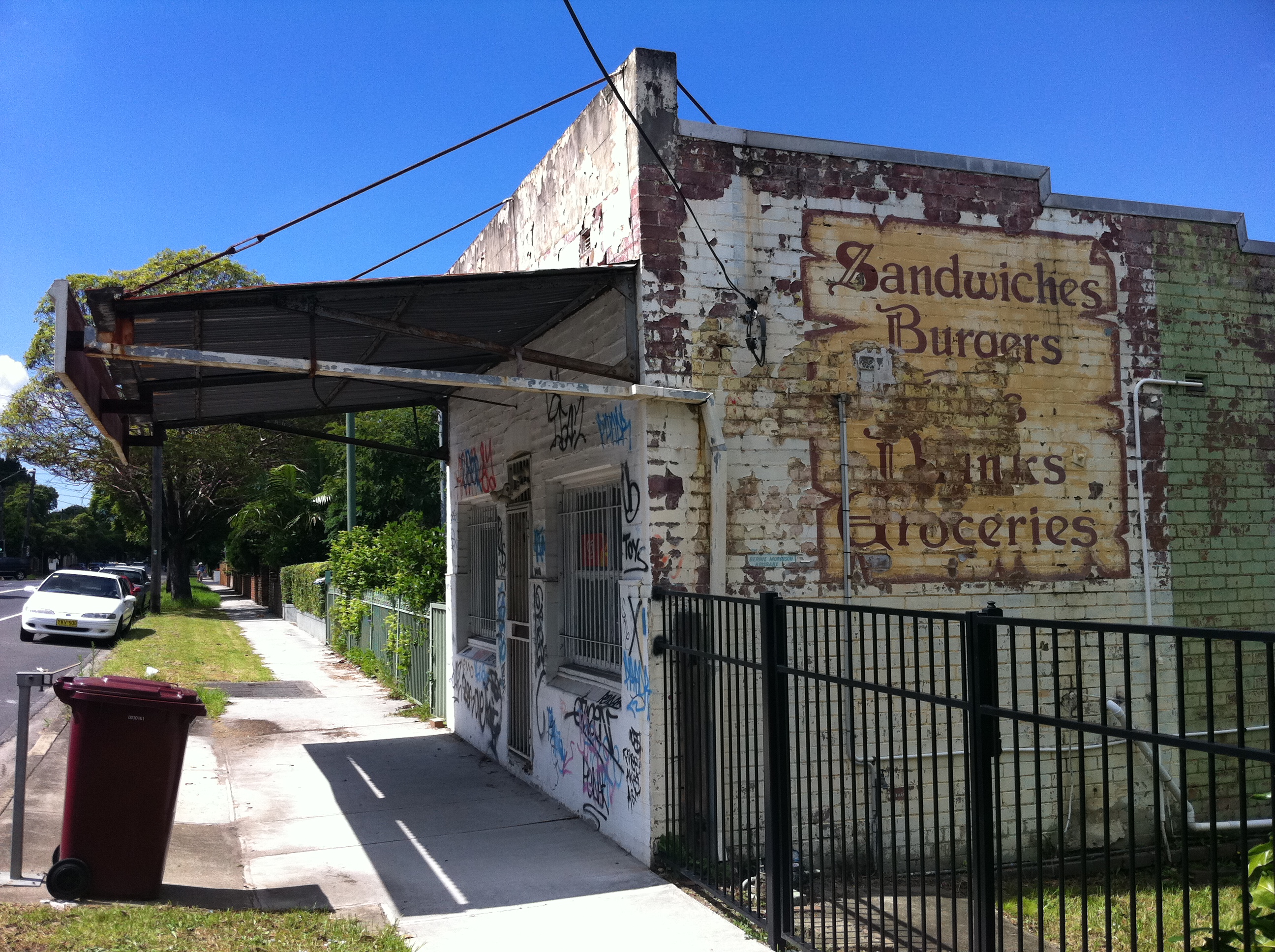
I’ve not seen this place open once in 20 years. Creepy. It has that weird grassy patch next to it. Creepy. That chilling dull red bin? CREEPY. This guy:

"SAMMIDGES, BURGERS, PIES AND DRIIIIIINKS"
Mildly unsettling.

 Past/Lives of the Near Future