Western Distributor On-Ramp/Road Hammock – Sydney, NSW

Here’s something completely stupid: this carriageway is the Western Distributor passing over Kent, Day and Margaret Streets near Wynyard. Below it is…a bit of road that…goes nowhere, and does nothing.
The Western Distributor began life in the early 1960s as a way to relieve traffic on the Harbour Bridge. Sydney’s extensive underground rail system meant that the Distributor couldn’t be built as a series of tunnels, so viaducts were the sensible alternative. That’s where the sense stopped.
The only reason the Western Distributor existed was because the designers of the Harbour Bridge and existing road system didn’t use enough foresight. You’d think that planners of the WD would employ twice as much foresight to make sure that further modifications weren’t necessary. Well, two times nothing is still nothing.
The original plan for the Western Distributor had westbound traffic exiting the city via the Glebe Island Bridge. For those who aren’t familiar with the bridge in question, here’s a picture:
That’s it there, below that huge, multi-lane bridge. If you can’t see it, squint. The two-lane Glebe Island Bridge had been built in 1903 to provide access to the Glebe Abattoir, and it includes a swing bridge to allow boats through. Surprisingly, this bridge proved to be unable to handle the traffic spewing forth from the Western Distributor, and in 1984 the NSW Government proposed another bridge. Good thinking! The Anzac Bridge was completed by 1995 (!), and opened in December of that year. It features a great height to allow boats through.
Of course, when the Distributor had been designed, it was flowing towards a small bridge. Now that it had a giant, capable bridge to lead into, the one-lane road itself suddenly seemed a bit lacklustre. In 2002 (!!), work commenced to widen the Western Distributor throughout the city, which brings us back to our original ridiculousness.

Here’s the other end, just in case you were thinking it went somewhere.
This bit of suspended road was originally an on-ramp for the Western Distributor, with access from Margaret Street. When the road above our piece here was widened, it claimed the on-ramp’s space and ended Margaret Street’s usefulness in the scheme of things. For a time it was used as a parking bay (illustrating the lengths the City of Sydney Council is willing to go to to make a buck out of parking). The ramp was then severed at both ends, and now sits hanging above the street, useless and surreal.
The happy ending to this story is that after the implementation of each of these emergency patches to the highways of Sydney, traffic in the city was never a problem ever again.
Epping Theatre/Fashions Galore/Video Ezy/Network Video & Gloria Jean’s & Jackie’s Hair and Beauty – Epping, NSW
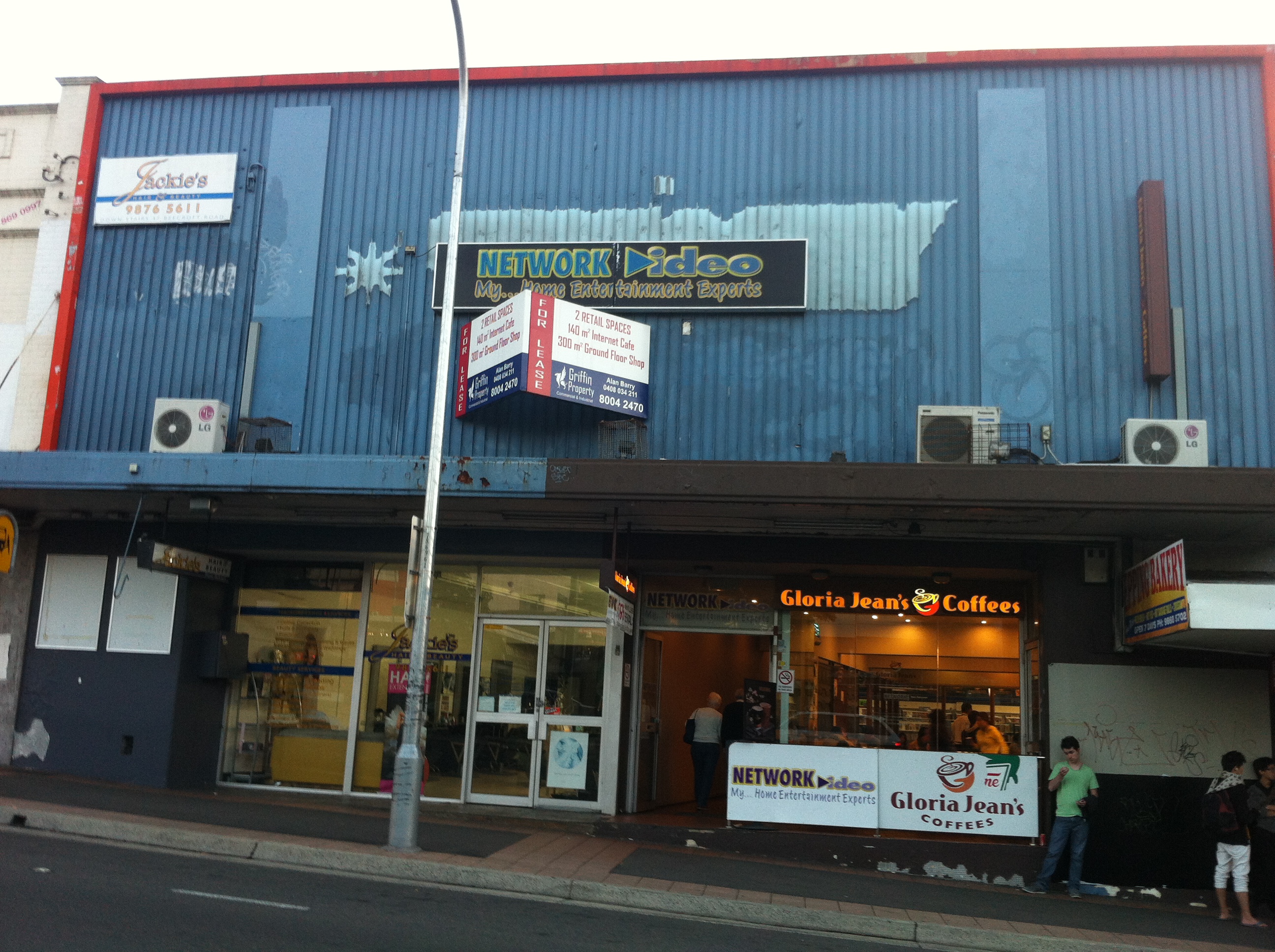
Another testament to the power and influence of video shops in the old days – it took three shops to replace one giant Video Ezy. You can see on the left the space where new release posters would have hung, luring potential new members inside and forcing them to think of a password of the easily forgettable variety in order to get a video card just to be able to hire Maverick for the night. Sadly for the former king of weekly entertainment, Ezy Street is a long way away these days.
Meanwhile, if you paired up locations of the ubiquitous Gloria Jean’s with Thai restaurants, you might find the number is a perfect match. Even Mickey D’s doesn’t cover this kind of territory.
THEATRICAL UPDATE: After digging a bit deeper (read: having a look around the back), it’s become apparent that this location has a bit more to it than it would seem. From the 1930s to at least the 1950s, this was the site of Epping Theatre, which is laughably obvious when you check out the rear:

If it looks like a theatre etc… The discovery of the ‘Fashions Galore’ sign means that this is now probably the longest titled entry on this blog – quite an achievement given the competition. Epping Theatre is a bit of a mystery; apart from some old ‘staff wanted’ ads and its listing in several State Library photo archives (currently unseen), there’s not much out there. Or is there? Readers, if you can help, you know what to do.
HELPFUL UPDATE: Reader Carmen was kind enough to send in a picture of Epping Theatre in its prime. Judging by the films on show – Johnny Belinda, The Gallant Blade and Red Canyon – this was taken in 1949. Check it out:

Epping Theatre, 1949. Thanks to reader Carmen for the image!
PS. Just in case you didn’t believe this was at any stage a Video Ezy, check out this solid gold proof that awaits those brave enough to wander up the back alley:
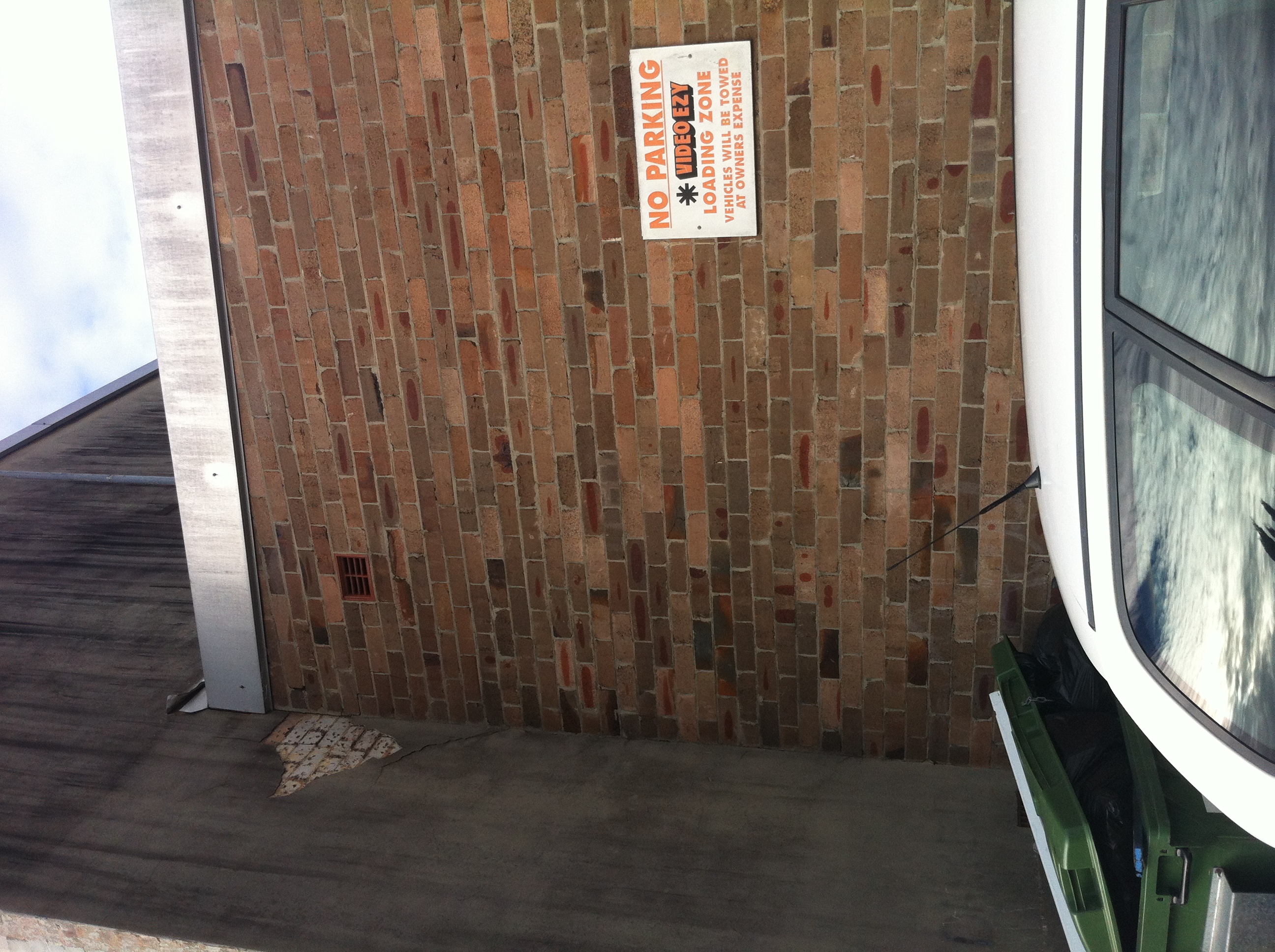
It says a lot about the current state of Video Ezy that this guy’s chosen to park there despite the sign. Ballsy.
KFC/For Sale – Mosman, NSW

Mosman KFC – it’s been closed since 2004, presumably because it was on Military Road and wasn’t a boutique fashion outlet. I think Mosman Council must have some kind of cull every now and then of shops that aren’t conforming to the Mosman style; prior to the 1950s, this site was a grand old house belonging to Mosman G.P. Dr. Geoffrey Mutton, complete with tennis court out the back. The tennis court is now the block of units at the top right of the picture, and here on Military Road we have the Colonel, now awaiting oblivion/development.
You can tell this outlet is old because it doesn’t feature or allow for a drive-thru system, and apparently it also acted as a car dealership at some point. It’s notable in the illustrious history of KFC as being the recipient of a visit from Colonel Sanders himself in 1976:

Colonel Sanders visits KFC Mosman, 1976. Image courtesy Gary Graham / Archive News Ltd.
Put some gloves on, Colonel.
Dianetics Volcano/Video Billboard – George Street, Sydney NSW

On a stormy night in 1996, the Church of Scientology made its mark on the George Street entertainment strip in the form of Sydney’s most bizarre advertising initiative. The site, on the east side of George Street, was formerly the Roma Complex; a row of shops including the Roma cinema torn down in the early 1990s to make way for the current setup. Now comprised of a variety of smaller shops, the address is most notable for including the Metro Theatre, a popular music venue, and as the former home of Galaxy World, a video arcade.
Someone in the Church of Scientology saw an opportunity to educate the people of George Street in the ways of Xenu et. al., and in mid-1996 a giant illuminated volcano facade was erected above Galaxy World, with a giant video screen at the peak. The screen played commercials for Scientology founder L. Ron Hubbard’s 1950 book Dianetics over and over and over as smoke burst from the volcano, while testing centre was established nearby so that anyone interested in the ad could have their situation evaluated by the experts. What had been originally intended was that the screen would be directly used by the Church of Scientology to advertise the religion/cult, but after that proposal was denied by the Sydney City Council, a compromise was reached in the form of the Dianetics ads. Celebrity Scientologists Kate Ceberano and Nancy Cartwright appeared at the unveiling, which was forced inside due to the thunderstorm.

George Street Volcano, 1996. Image courtesy suburbia.net.
After just a few months, the brightly coloured volcano had faded, and so had the public’s compulsion to humour the Church of Scientology. Then-Sydney Lord Mayor Frank Sartor offered to pull the volcano down as early as November 1996. At some time in 2000, long after the advertisements had stopped erupting, the facade caught fire, and remained in its burnt state for nearly a year afterward. When the volcano screen was first erected, it was agreed that it would only be up for six years, but here we are in 2012 and although the volcano is gone, the screen and an ugly facade remain. It’s a surprise it’s still there, given Sydney City Council’s tendency to overhaul all things George Street every couple of years.

Turn around, you fools. George Street, 1998. Image courtesy Edmund Cheng.
Speaking of erections and eruptions, a few enterprising young scallywags took the obvious opportunity to broadcast porn through the screen for a prank at some point in the late 1990s, and given that’s the least creepy thing the setup was ever used for, that’s a good place to end this article.
PS. Oh, the 24hr Bar Ace advertised alongside the volcano isn’t there anymore either. It’s two Japanese restaurants now.
AWA Tower/E. G. Collections – Wynyard, NSW
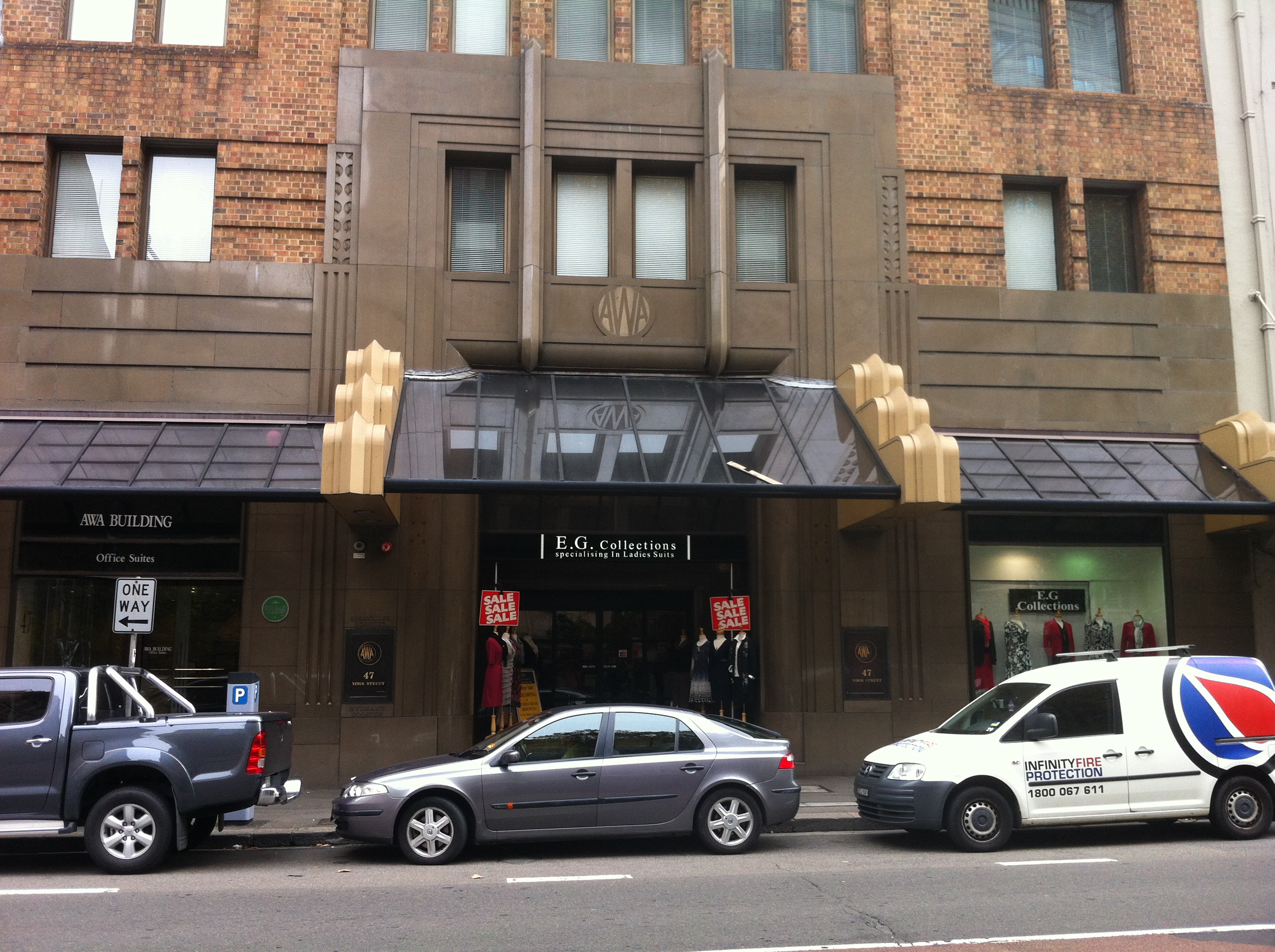
Amalgamated Wireless Australasia Ltd. started life at our old friend Homebush West in 1909, and over the next few years became the Federation-era’s answer to Sony. In 1918, AWA received the first radio broadcast from the UK to Australia – an address to troops by then-Prime Minister Billy Hughes. AWA then transmitted the first newsreel pictures from Sydney to London in 1930.
Not content to just broadcast and receive the radio signals, AWA entered the consumer radio market after the Second World War. AWA became the leading manufacturer of consumer radios in Australia, and subsequently branched out into other areas. Fans of commercial radio (I know you’re out there) may care to thank AWA for owning and operating 2GB sister station 2CH for many years.
Of course, an Australian company couldn’t do this well without at some point having their own building, and in 1939, that dream was realised in York Street, Wynyard. The AWA Building was the tallest building in Australia until 1958, and remained AWA’s head office until the late 1990s, when AWA backed out of the broadcasting race because it’s kinda hard to get a decent signal amongst all those skyscrapers in Wynyard. Today, the tower is E. G. Collections, “specialising in Ladies Suits”, with office suites above, and doubtlessly the friends of all of the building’s employees are sick of hearing about how you can see the office in that one bit in The Matrix.
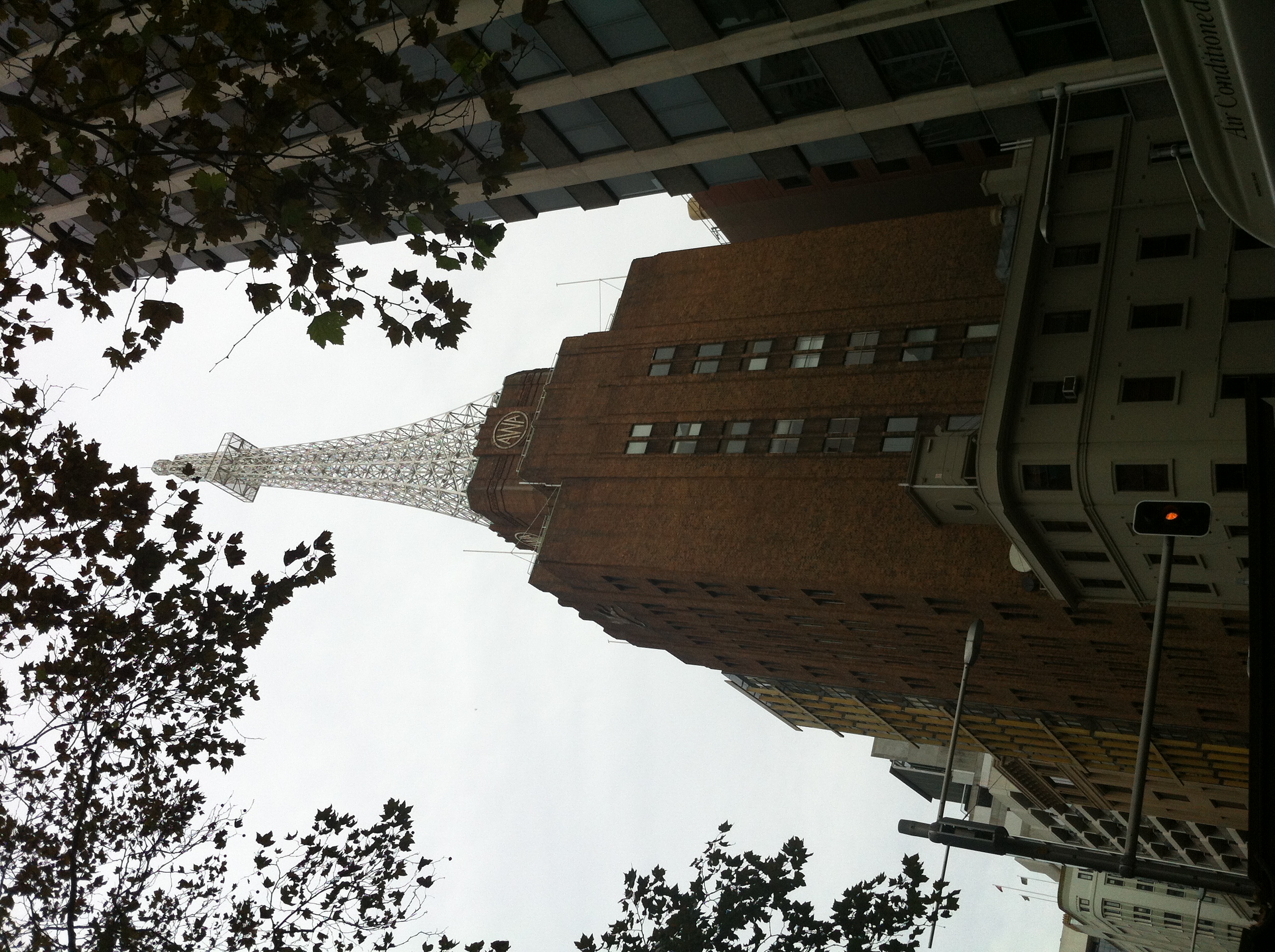
Perhaps seeing the writing on the wall for the kind of olde-tyme radio business they were so deeply involved in, 1991 saw AWA acquire Smorgon Technologies. Although it sounds like a Captain Planet villain, it was a world leader in totalisator systems, and this purchase led to AWA’s own acquisition by Tabcorp in the 2000s. Wow.
AWA regained its independence from Tabcorp’s clutches in 2004, and these days focuses on IT and commutation services, which is a newfangled way of saying it’s doing what it always did, but NEW. Strangely, AWA has licenced its brand name to Woolworths, Big W and Dick Smith Electronics for use in generic consumer electronic devices. You know, just in case anyone out there is 150 years old and remembers how good the sound was from their AWA car radio.

 Past/Lives of the Near Future