Sharpie’s Golf House/Harmex Golf/Derelict – Sydney, NSW

I see you back there, Edwards & Co. Ltd. You’ll get your turn…
Yes, the kitschy neon sign is what Sharpie’s Golf House is best known for, but there’s a bit more to it than that. For starters, the sign has been gone for years, having been taken down by the City of Sydney in 2007 for ‘refurbishment’. How long does it take to replace a few tubes?
The origins of Sharpie’s Golf House lie in the shop next door. It’s currently the empty shell of the former Gold Sun Supermarket, but in 1918, when Russian immigrant Harry Landis bought it, it was the Railway Loan Office, named for its proximity to Central Station. Landis moved into the current Sharpie’s address in 1923, and proceeded to divide the pawn shop into two sections: musical instruments and sporting goods, with an emphasis on golf.

After the Second World War, the sporting side was renamed The Golf House, and in 1964 the animated neon sign featuring the world’s best golfer (he always gets a hole-in-one) was erected after six years of construction. Until its removal, it was Australia’s second oldest neon sign (Melbourne features the oldest. You gonna take that lying down, Sydney?). The music business moved to Park Street in 1977, and the Golf House became Sydney’s premier golf store. This prestige attracted pro golfer Lindsay Sharp, who bought the shop in 1985 and renamed it after himself, forcing a change to the neon sign. That’s why the red ‘Sharpie’s’ part looks so out of place.

Sharp himself sold the ever-declining business in 1999, and in 2004 it became Korean-owned Harmex Golf, which limped on for a few years before closing its doors for good in 2007. Looking around the area it’s not a surprise – what was once a thriving business zone has become a wasteland with a bad reputation, filled with backpacker hostels and husks of businesses long gone. I’m not complaining; it’s great for what I’m doing. But it’s a sad look for the city, especially so close to the train line. Besides, it’s not like there are any golf courses in the immediate vicinity, so it’s not hard to imagine the golfing community getting fed up with making the trek out here every time they wanted a decent 5-iron. At least they made for good weapons when they stepped back out into the street.

The building today is a mess. Sharpie’s has been dulled. It’s dirty, covered in posters and falling apart. Even by Elizabeth Street standards it’s an eyesore. The part I’m having a hard time getting over is the indoor driving range. It had an indoor driving range! For how long? How did it work? I’ve played those virtual golf simulators indoors before, but surely this was set up long before those were around. It’s not even that long a building, how did Sharpie have room to get his drive on?

Do all those hole-in-ones count if he’s been playing the 19th hole all these years? Image courtesy SMH, 25 Aug 2003
It’s alleged that the sign sits inside, heritage listed, waiting for a spit and polish that’ll likely never come. There have been a few proposals submitted to the Sydney City Council to demolish the current site and reincorporate the sign into whatever is built in its place, but all have been declined. It’s not like they’re going to build another Golf House, so why not just leave it in the past? Why not take the opportunity to breathe some life back into this part of town, and create tomorrow’s heritage listed signs? For all the talk of preservation, Sharpie was quick to flush a 20-year-old sign down the toilet to remake it in his image. It’ll likely go the way of the Regent Theatre on George Street, and we’ll be able to live in Sharpie Tower in 20 years time. There’s something to look forward to.
Stunning Flowers/Dog and Cat Beauty Salon – Kogarah, NSW
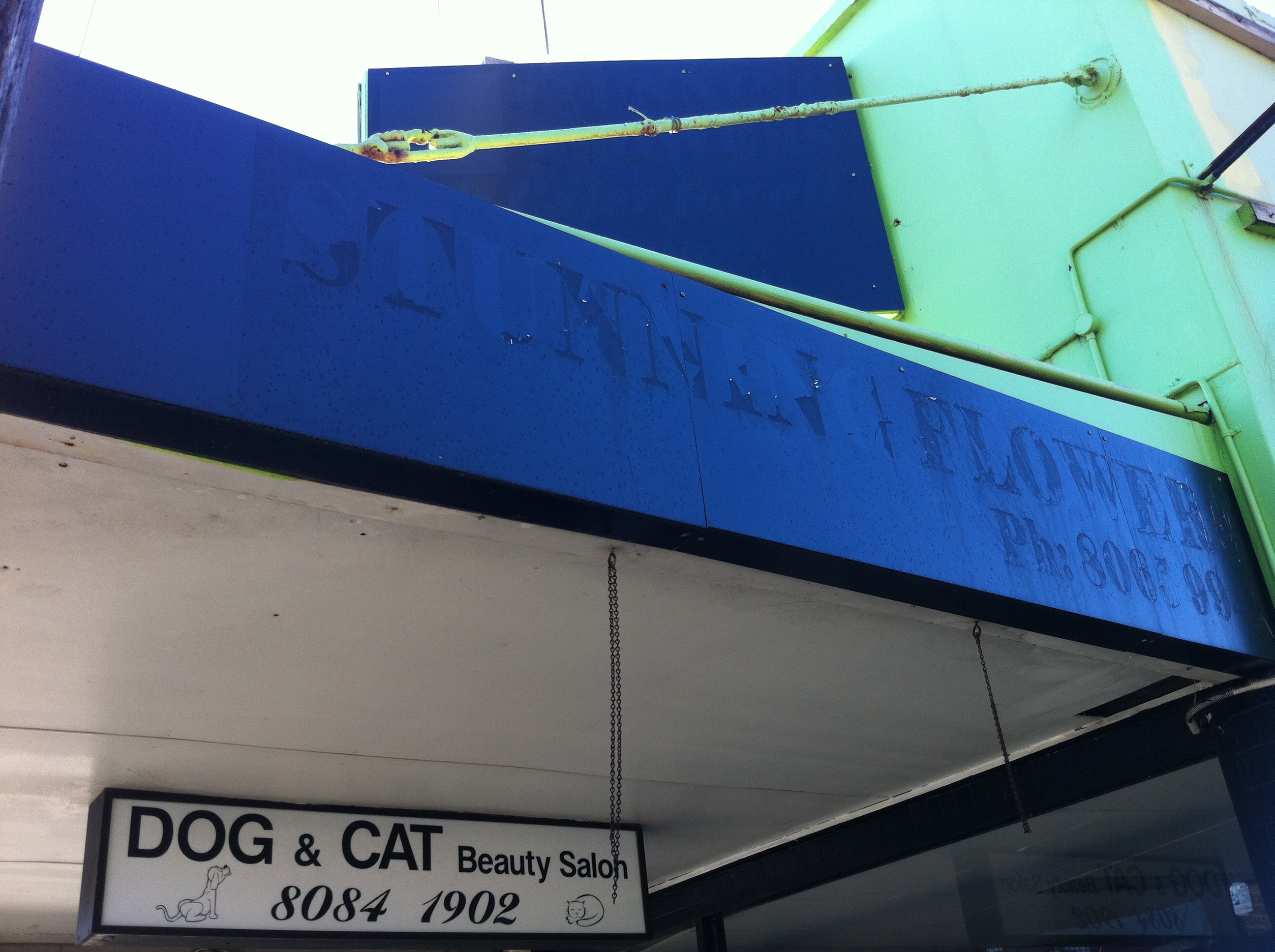
Kogarah’s dogs and cats are that much more beautiful thanks to the offputting hubris of Stunning Flowers. No one likes a braggart, least of all flower customers.
Chinese Restaurant/Hyang Won Korean Restaurant/For Lease – Strathfield, NSW
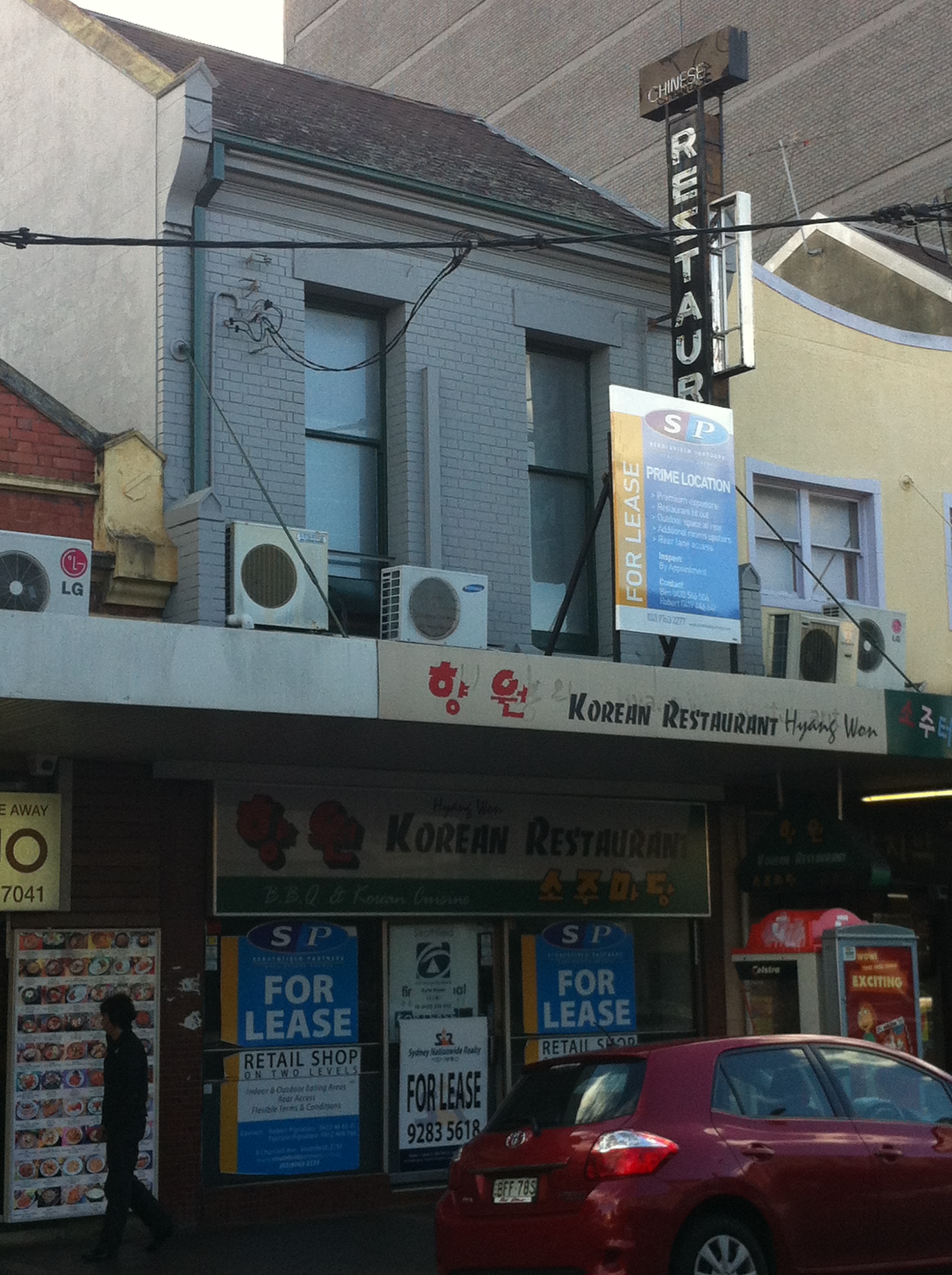
By leaving the previous tenant’s neon ‘Chinese Restaurant’ sign up, this Korean restaurant hoped to bank on an underlying current of the ‘they all look alike’ mentality to put bums on seats. Perhaps it’s a good thing then that they’re no longer in business? In reality it looks like this restaurant was part of the ‘by the people, for the people’ trend that saw Chinese restaurants originally established to appeal to the more adventurous members of white Australian communities replaced with Korean restaurants designed to cater to the area’s blossoming Korean community…and it closed because apparently, the food sucked. Japanese next time?
Botany Water Pumping Station/Botany Rockdale Sewage Farm/SWSOOS – Mascot, NSW

Cooks River, Kyeemagh. Courtesy Sydney – City and Suburbs Photo Blog.
When Sydney began to run out of fresh water in 1850, having abused both the Tank Stream and Busby’s Bore in Centennial Park, consideration was given to where a new supply would come from. It took four thirsty years to decide upon a plan to build a series of dams leading to a pumping station out near Botany (beside the site of Sydney Airport). Water was pumped from the Botany site to two city reservoirs: one in Crown Street and one in Paddington.

Ruins of the Botany Water Pumping Station, 1996. Courtesy City of Botany Bay.
The scheme didn’t really work out, and water again ran dry by 1862. This new crisis led to the creation of the Upper Nepean Scheme, which is still providing us with fresh water today. The Botany Station kept pumping, topping up shortages until 1893.

The great minds at the top weren’t finished with the Botany site, however. In the 1870s it became ground zero for the Botany-Rockdale Sewage Farm, Sydney’s earliest attempt at purifying human waste products in the hope of beating the repulsive sounding sanitary problems of the era. A farm was created using human waste as fertiliser, and while the crops were successful, there just weren’t enough of them to sustain operating costs. That, and this monstrosity was right next to a fresh water supply. The farm was closed in 1916 and deemed a failure, but as they say, shit happens.

Botany Rockdale Sewage Farm, circa 1900. Courtesy Water Board Archives.
All physical evidence of the farm was destroyed or removed. Unbelievably, it was decided that a better solution was to just pump all the sewage out into the ocean near Long Bay, and the current buildings here were built for that purpose. Even more unbelievable is that in this day and age, this system (known as SWSOOS, or Southern and Western Suburbs Ocean Outfall Sewer System) is still deemed the best way, because it’s still happening. This one in particular services the Cooks River Estuary and the Ascot Racecourse (now Mascot Airport). So much cement was required for this project that Australia’s first steam powered concrete mixer was imported for the job. Wow.
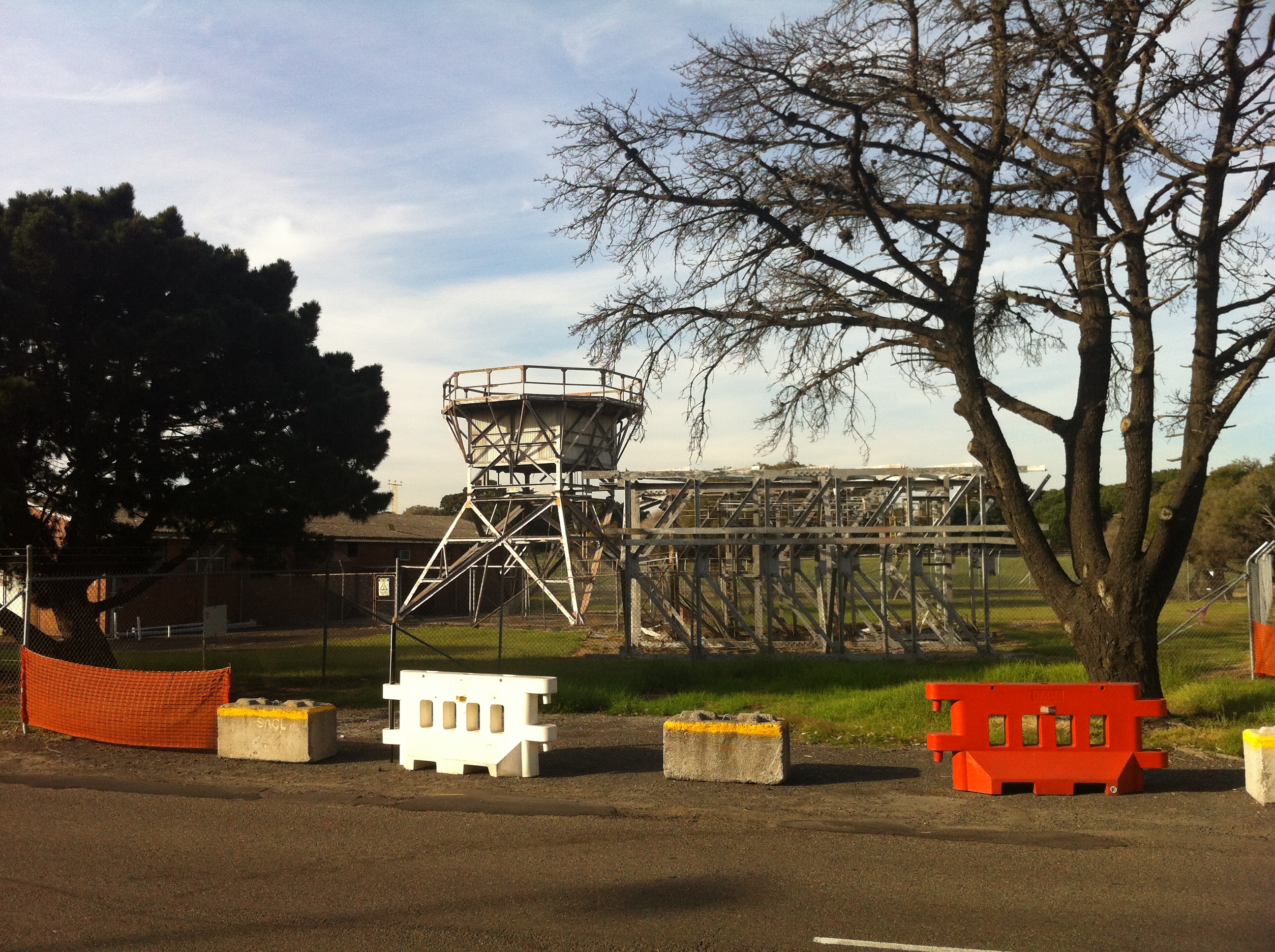
It’s a quick yet perilous walk from the McDonald’s (a sewage farm of another kind) on General Holmes Drive to the scene of the action, and your first port of call is this. I had the eerie feeling I was being watched as I approached, and not by the Federal Police.

When I reached the site I was greeted by some friendly bunny rabbits, who have taken up residence in this…that. Whatever that is. The bunnies appeared to be doing their best to make sure the site was still well fertilised. Some things never change.
Maritime Services Board/Museum of Contemporary Art – The Rocks, NSW

Since 1991, the Museum of Contemporary Art has enthralled, inspired and confused Sydneysiders and tourists of all kinds. Established through a bequeathment of money from Australian artist John Power (who died in 1943, making it one very long inheritance battle), the MCA has recently undergone a much publicised redevelopment during which ruins of a colonial dockyard were discovered underground. But contrary to what you might think, their art deco building wasn’t just an attempt by the MCA itself to be trendy – they weren’t in there first.

It’s funny that despite the expensive and lengthy redevelopment process, they missed this little clue. In fact it appears it was covered up by another sign for years and only recently disturbed. As you can see, it reveals that the MCA’s building was once the site of the MSB. This is apparently common knowledge, but what was the MSB?
It makes sense that the Maritime Services Board was established in and housed at the Rocks. 90 years of confusing yet important Sydney port control laws and services were consolidated into one administrative entity, the MSB, in 1936. In 1949 construction began on the building, which was completed in 1952, so even by art deco standards it was late to the party. The MSB itself relocated in 1989, leaving behind the building for the art world to work its magic on and in. It’s just that you missed this spot, guys. Then again, knowing the MCA, maybe it’s actually one of the exhibits and I just don’t get it.

 Past/Lives of the Near Future