The Melton Hotel – Auburn, NSW
Get comfy, this’ll be a long one.
 Sometimes, it’s not so much about what a place has become as it is about how it got that way. This is certainly true in the case of Auburn’s Melton Hotel. Ordinarily I, like any passer-by, would take one look at the Melton and think ‘I value my life too much to go in there,’ subsequent to the instinctual thought of ‘Just another pub.’ Situated along Parramatta Road at the corner of Station Street, there’s just nothing that sticks out about the hotel in any way; not even the jovially named ‘Hey Hey Kebab’ adjoining gives cause for anything more than a mild double-take.
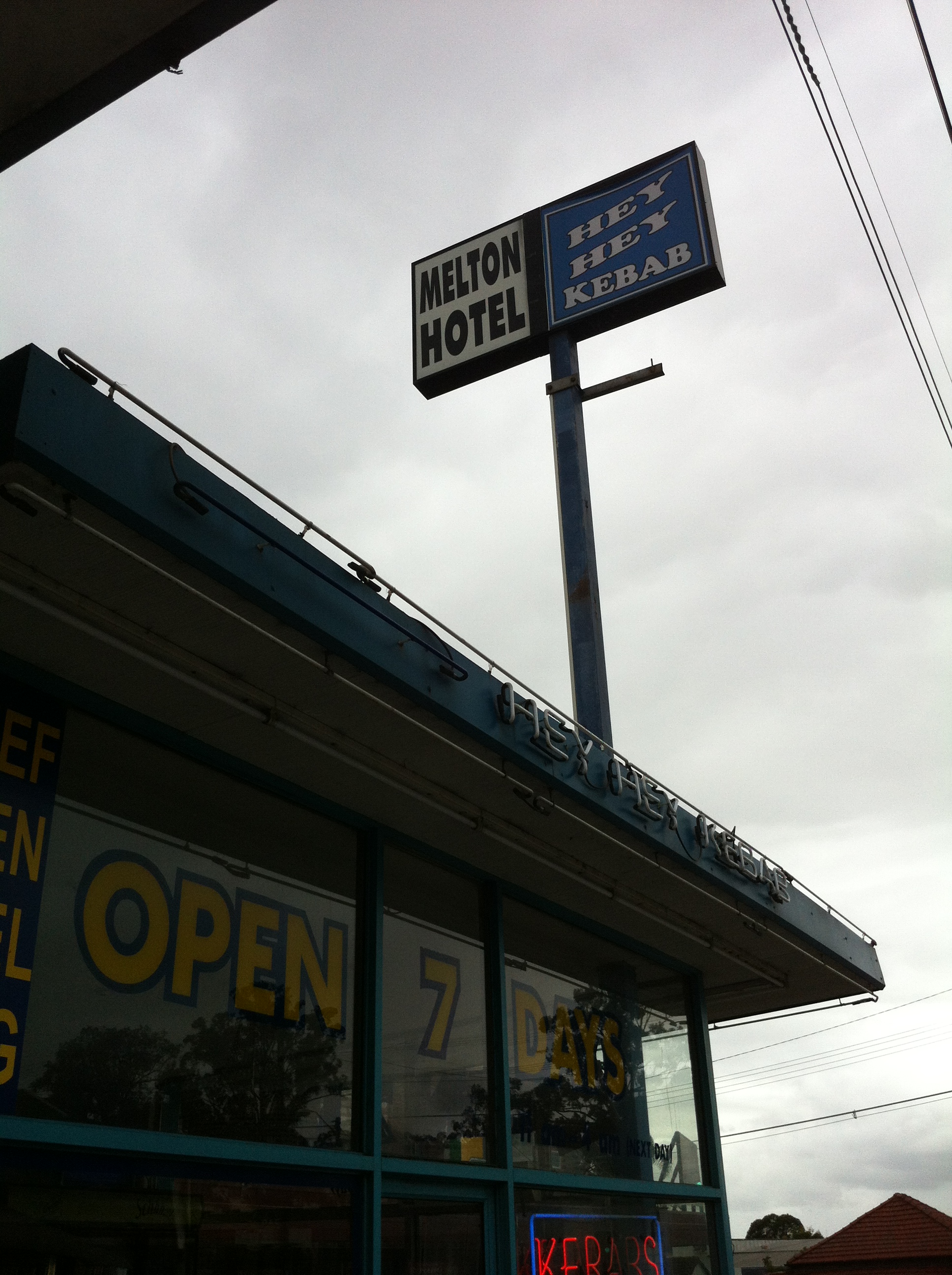 So why, dear reader, am I subjecting you to this dry account of a seemingly humdrum pub? Well, what piqued my interest (as I’m sure it will yours) was the simple fact that the street running parallel to the hotel’s side of the block is called Melton Street South.

Not pictured: Melton Street North
This got me thinking: why was the pub named the Melton Hotel if it wasn’t actually on Melton Street? Clearly it was time for some field detective work, because I knew if I didn’t solve the mystery it would bother me all day. I couldn’t find anything about anyone named Melton in the area’s history (it’s not even clear to historians why the area itself is named Silverwater), but I had a feeling if they were honouring some local hero, they wouldn’t just name a pub and a street after them. First port of call: the Atlas of the Suburbs of Sydney, ca 1885-1890.

Courtesy the Atlas of the Suburbs of Sydney, ca. 1885-1890
This map of Auburn shows that neither Station Street nor Melton Street South existed at the time. Today, they’re located between the map’s Stubbs Street and Sutherland Street (now Silverwater Road).
Next: time to research the pub itself. Thankfully, the pub in question has an illustrious history; according to the hoteliers, its license dates back to 1811 (when it was owned by Samuel Haslem, of Haslem’s Creek fame), attached to an inn located not too far from the current site. In 1877 a former jockey, Fred Martineer, became the licensee of the Melton Hotel and held that position for over 30 years, firmly establishing the pub as a favourite of the area’s myriad meat workers.
Tragedy struck in 1914 when, after too many cases like this…
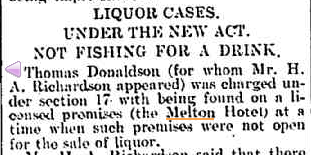
The Cumberland Argus and Fruitgrowers Advocate, 21 February 1906
…the public was swept up by a need to reinstill a sense of public decency via a series of local option acts. The acts enforced a six o’clock closing time for pubs and resulted in 293 hoteliers losing their licenses, including Martineer. Despite the pub’s closure and with flagrant disregard to the after hours prohibition, he continued to live in what became known as the ‘old Melton Hotel’ until his death in 1918:
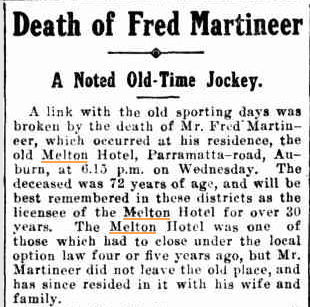
The Cumberland Argus and Fruitgrowers Advocate, 16 March 1918
The Old Melton had been named sometime prior to 1895, when it appeared on that year’s list of Hotel Licensees. It’s this hotel that sat on the corner of Melton Street South (then Melton Road), so from this we can assume the street was named after the pub. But, like me, the Martineers couldn’t let it go. In 1929, the Martineers built the NEW Melton Hotel at its current location, which at the time seemed to take up the entire section of Parramatta Road between Melton Street and Station Street.
That’s all well and good, but today it’s a very different story. Nothing remains of the Old Melton, the New Melton is nowhere near the corner of Melton Street, and there’s a string of dingy shops between it and its namesake street. What happened?
 Discounting the obvious greed associated with subletting the Melton Street side of the block to said dingy shops, the true answer seems to lie in the Melton Hotel’s parking lot. The hyperbolic claim of “stacks & stacks of parking” is betrayed by the truncated nature of the car park itself. Here it is, seen from Station Street:
 Further encroachment into the lot reveals a flimsily constructed wall on the Melton Street side. Hmm…
 And a gap in the northern end of that wall. HMM…
 The gap leads out to Melton Street, whereupon you’re immediately facing a school. This sign:
 …is all that remains of this side’s former life as an entrance/exit to the Melton’s car park, and indeed of the Melton’s connection to the street it inspired. A closer look at the other side of the fence backs this deep bit of insight up.
 The kerb is clearly a lighter shade of cement, indicating the spot where the driveway used to be. The two bushes are doing a laughable job of hiding the wooden fencing that blocks off those driveways.
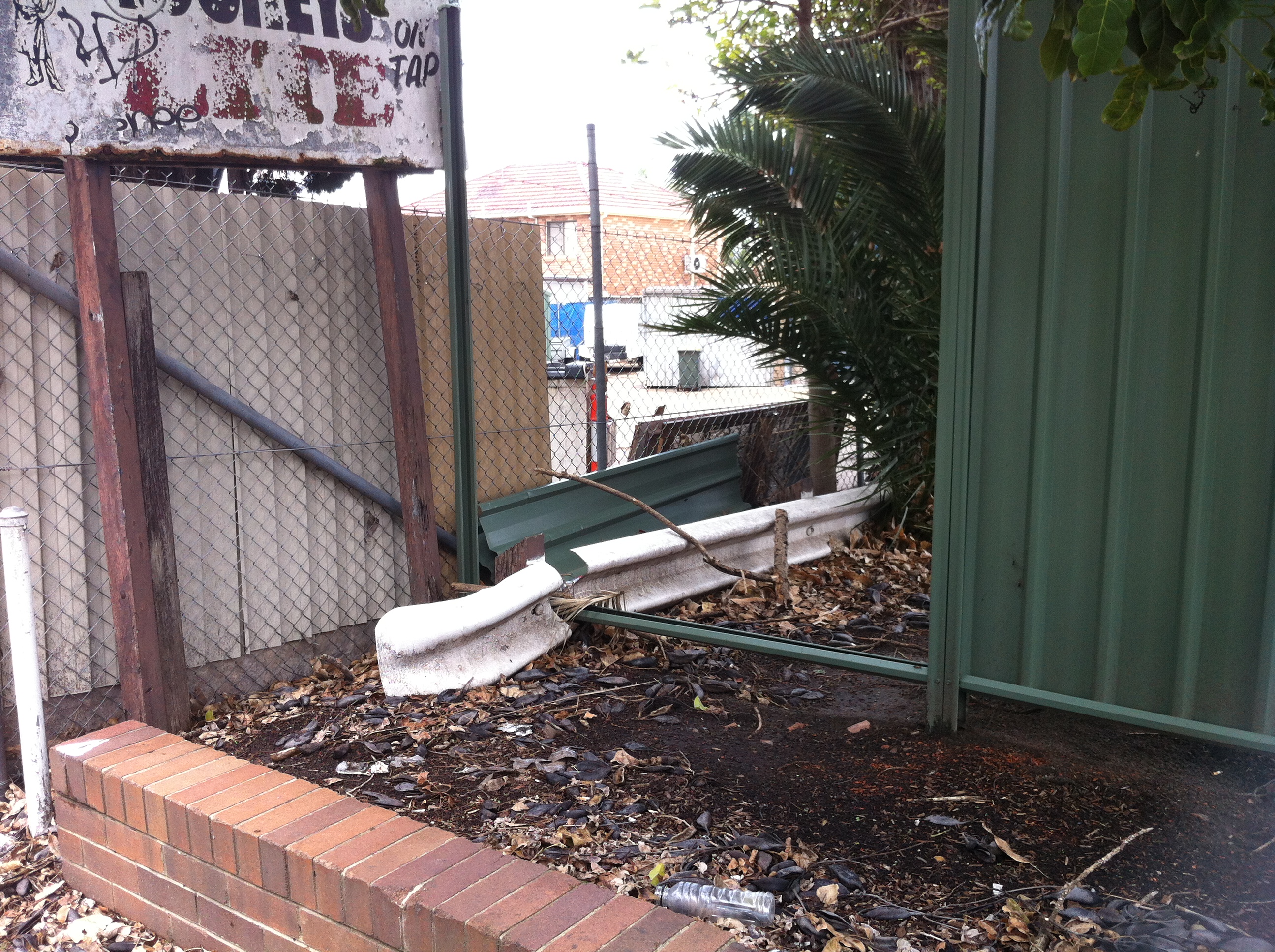 Even stranger is the choice to keep these former barriers, and simply cut them where the new fence intersects.
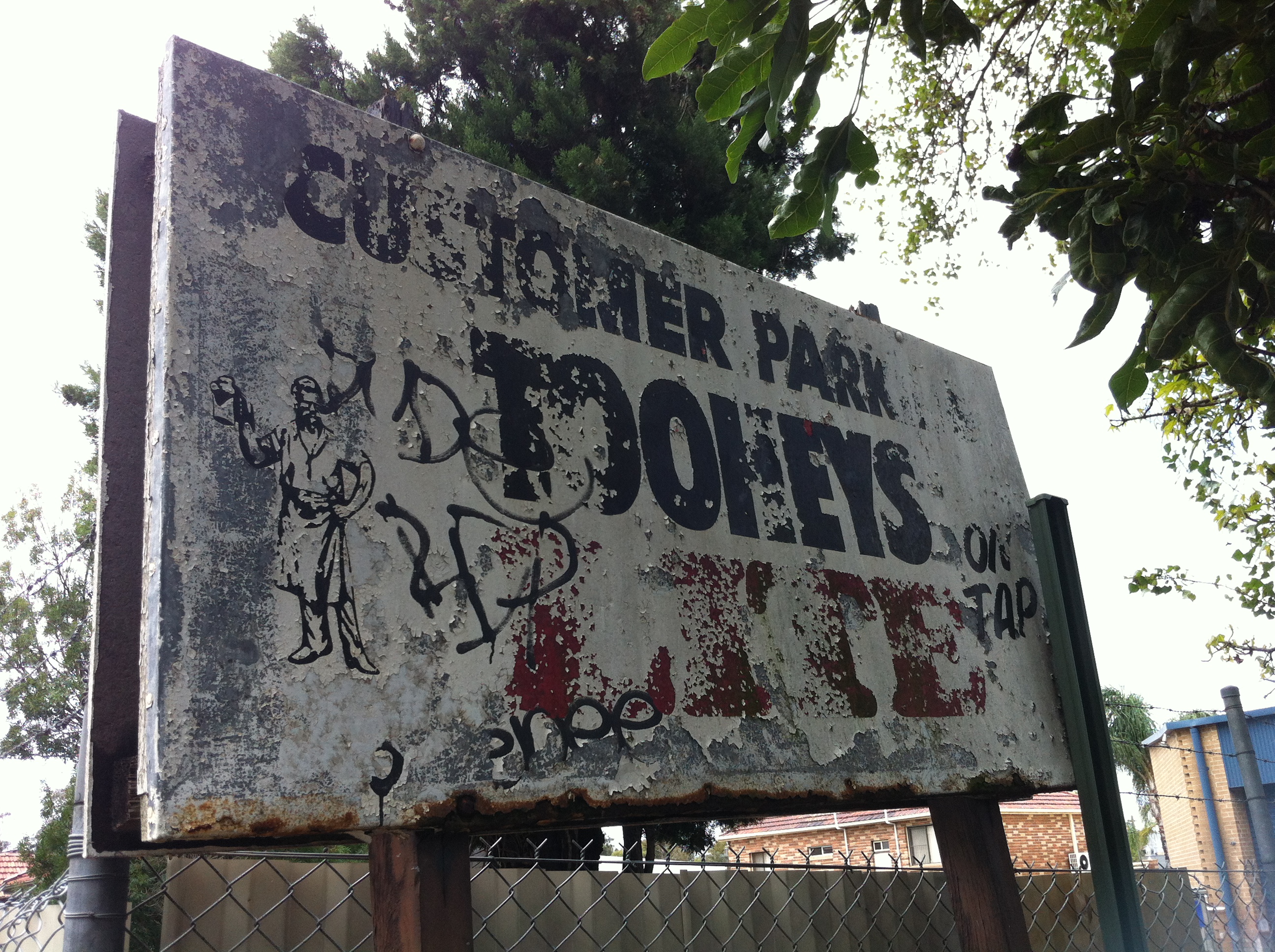 One of the more interesting aspects of all of this is the sign that once guided thirsty drivers into the parking lot. Hidden by overgrown branches and worn away by years of neglect, there’s no real reason for the hoteliers to have left it there – least of all what it’s advertising. After all, if it hadn’t been for the sign, I never would have stumbled upon this madness in the first place. No, for me, the real gold is the sign’s reverse side:
 Remarkably well-preserved, the sign advertises Tooheys 2.2, which was an attempt by Tooheys to introduce a light beer to their otherwise heavy range in the late 1980s.
While it would be nice to think that this was Tooheys doing its part to avoid another 1914 Local Option fiasco, the way the ad puts a jokey spin on drunken violence and employs a disturbing tagline clearly aimed at the breathalyser crowd suggests a more cynical set of motives. For better or worse, this didn’t take, and by 1995, 40 years after the Local Option acts were repealed, 2.2 was 6.0 feet under. It’s worth pointing out that 2.2 was supplanted in 1998 by Hahn Premium Light, which is now Australia’s top selling light beer…and owned by Tooheys. A fascinating trail of the significant episodes of 2.2’s short life can be found here (WORTH READING). I think the lesson here is don’t give your beer a name that invites terrible Richie Benaud impressions.
But back to the Melton. Also of note are the apparent remains of either a garbage can or a phone box (remember those?) located between the two driveways.
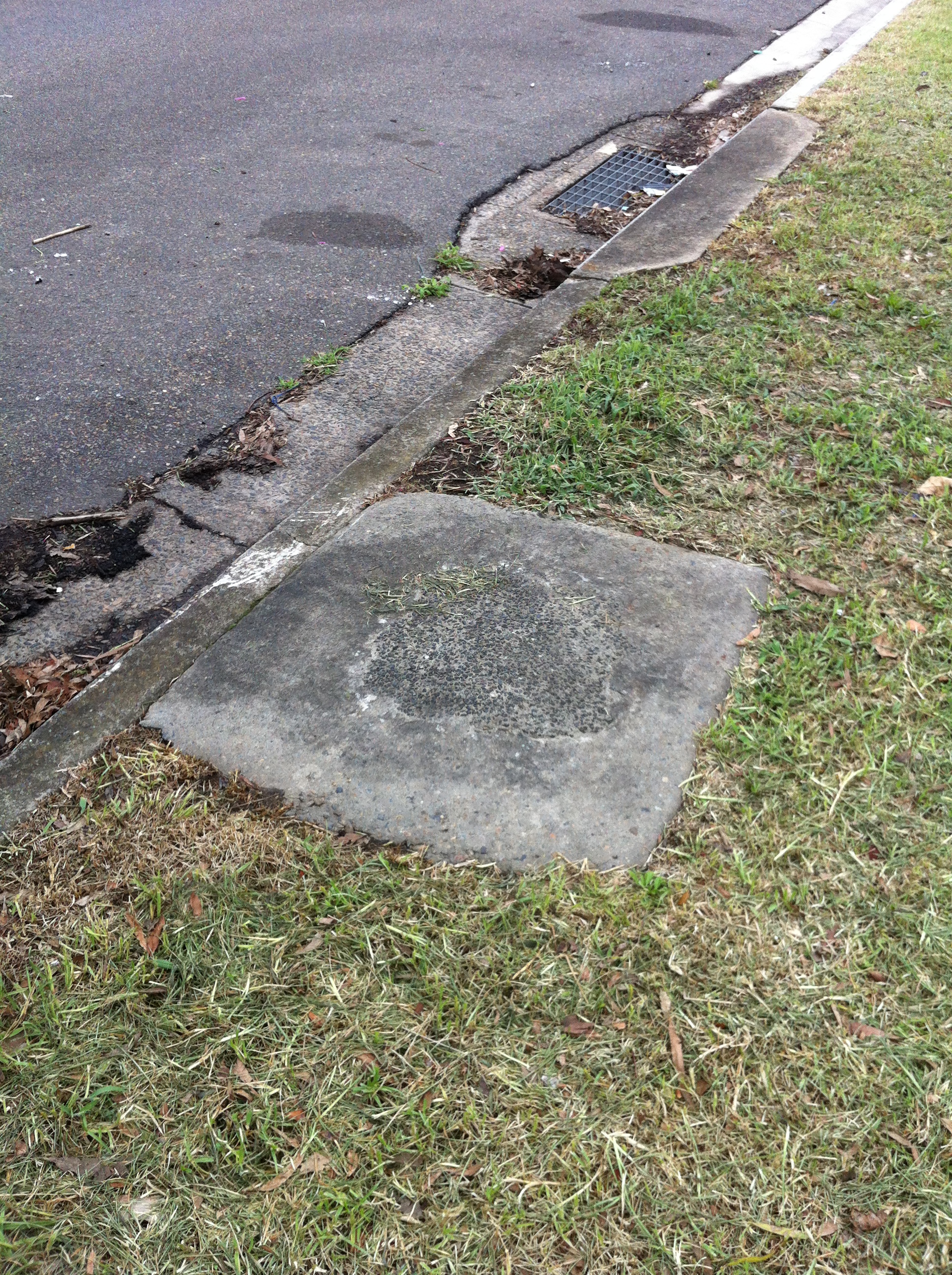 Let’s stop for just a second to process this. Regardless of whether this was in fact a garbage can which spent countless nights being chundered into by melting Meltonians, or a phone booth which spent its Friday and Saturday nights listening to endless pleas by hopelessly pissed pub patrons for their wives, girlfriends, parents or less drunk mates to come and pick them up, and then being chundered into, the fact remains that it was located BETWEEN the two driveways. How is this a spot for either of those objects which both appear as bright flames to drunken moths? The line for the phone alone would have been both long and drunkenly ignorant enough to queue across the nearest driveway. You can’t tell me this didn’t cause at least one clipped wing.
Even worse is the pub’s proximity to Auburn North Public School. Anyone foolish and drunk enough to ‘breathe easy’ and attempt to drive home via the Melton Street exit (or entrance, depending on the level of drunkenness) on a weekday afternoon ran the risk of knocking over a kid on their way home. If it didn’t happen or nearly happen, I’d be surprised.
With these reasons in mind, it’s easy to imagine just how and why the Melton would have had these driveways sealed up, thereby severing its ties to its own history. It’s also easy (and funny) to imagine particularly OCD and DUI pub patrons attempting to drive out of their usual exit and smashing the fence, otherwise why the need for the bushes and the potplants? Sure, the Melton could have chosen to seal up the Station Road driveways, which face the old Joyce Mayne complex, but it turns out that a child’s life is worth more than that of a shopper looking for bargain whitegoods. Who knew?
And all because some public spirited men didn’t know their limits and couldn’t hold their beer.
Of course, I could be wrong about everything, and I might owe both the Melton and overdrinkers everywhere an apology, but have a look at this:

The Cumberland Argus and Fruitgrowers Advocate, 10 July 1915
EPILOGUE
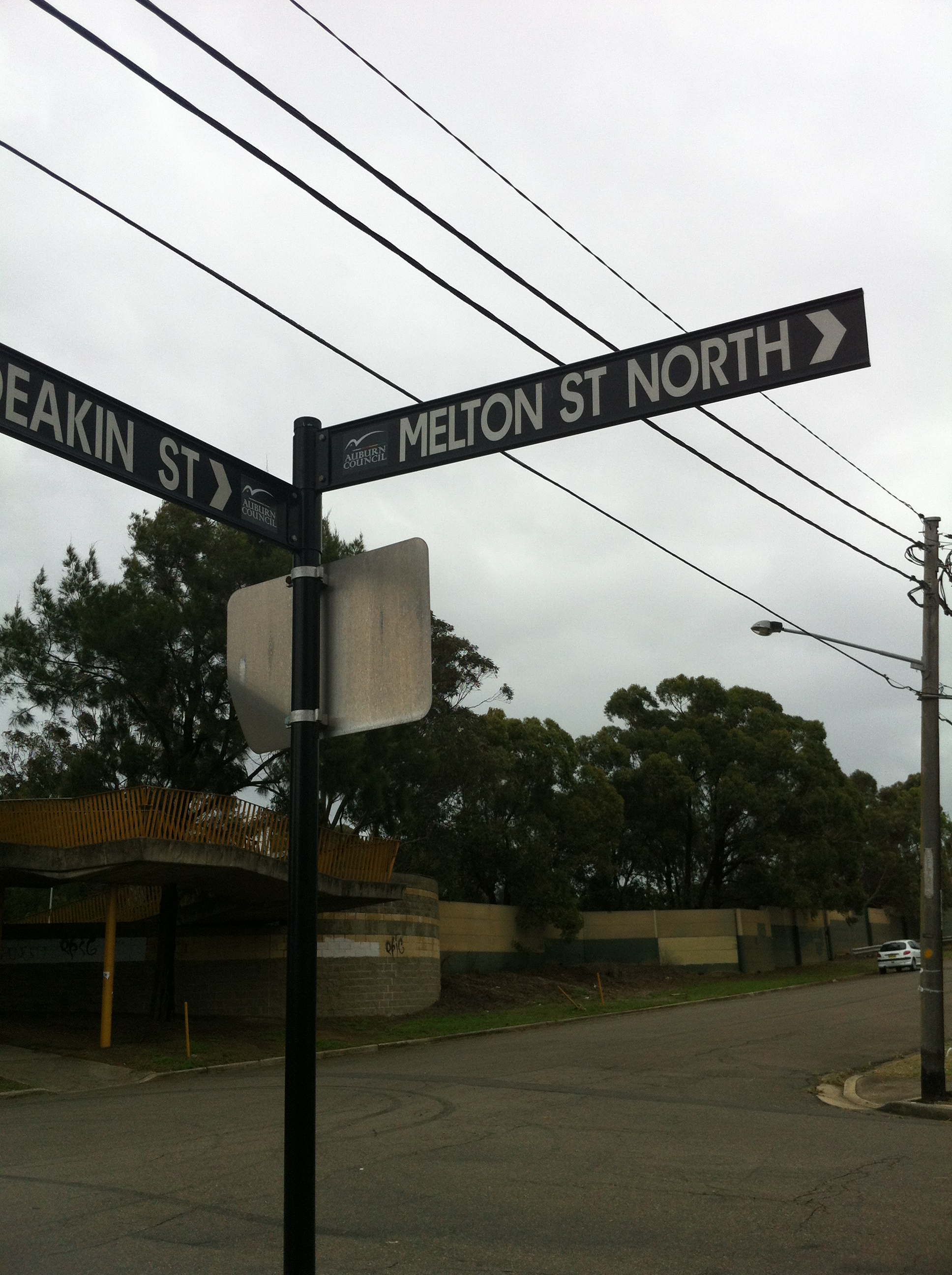
Not pictured: Melton Street South
You may have just read all that and be wondering ‘what was the point?’ or ‘where’s the remove bookmark button?’, but more inquisitive (or less demanding) readers may be wondering ‘What was so drastic that happened to Melton Road to cause it to be split into Melton Road South and Melton Road North?’
Next time, baby.

Vend-A-Card/Pez Dispenser – Strathfield, NSW
This one’s a bit different to the usual stuff, but if you’re my age and demographic (and I’ll bet you’re not) this’ll appeal to a long-forgotten part of your brain. Prepare your past life for a future shock.
When I was a kid, if a big budget movie was coming out to appeal to all six of my senses (you know you have more when you’re a kid), chances are one of its avenues of assault would be a series of trading cards. On me, it worked like a charm. I had a tonne of them, and they made sure that each set was an OCD’s delight. You had to order them correctly in the official collector albums, you had to get all the inserts, you could even collect the wrapper variants. Nothing was more boastworthy at school than the rarest inserts or a complete set, but completing a set wasn’t as easy as you’d think. Trade negotiations between jealous and selfish five-year-olds were more heated than that era’s US-Soviet peace talks, and eventually you’d reach the point where you only needed one or two cards to be done with the whole business. A pack would typically contain seven cards or more. How to solve this dilemma?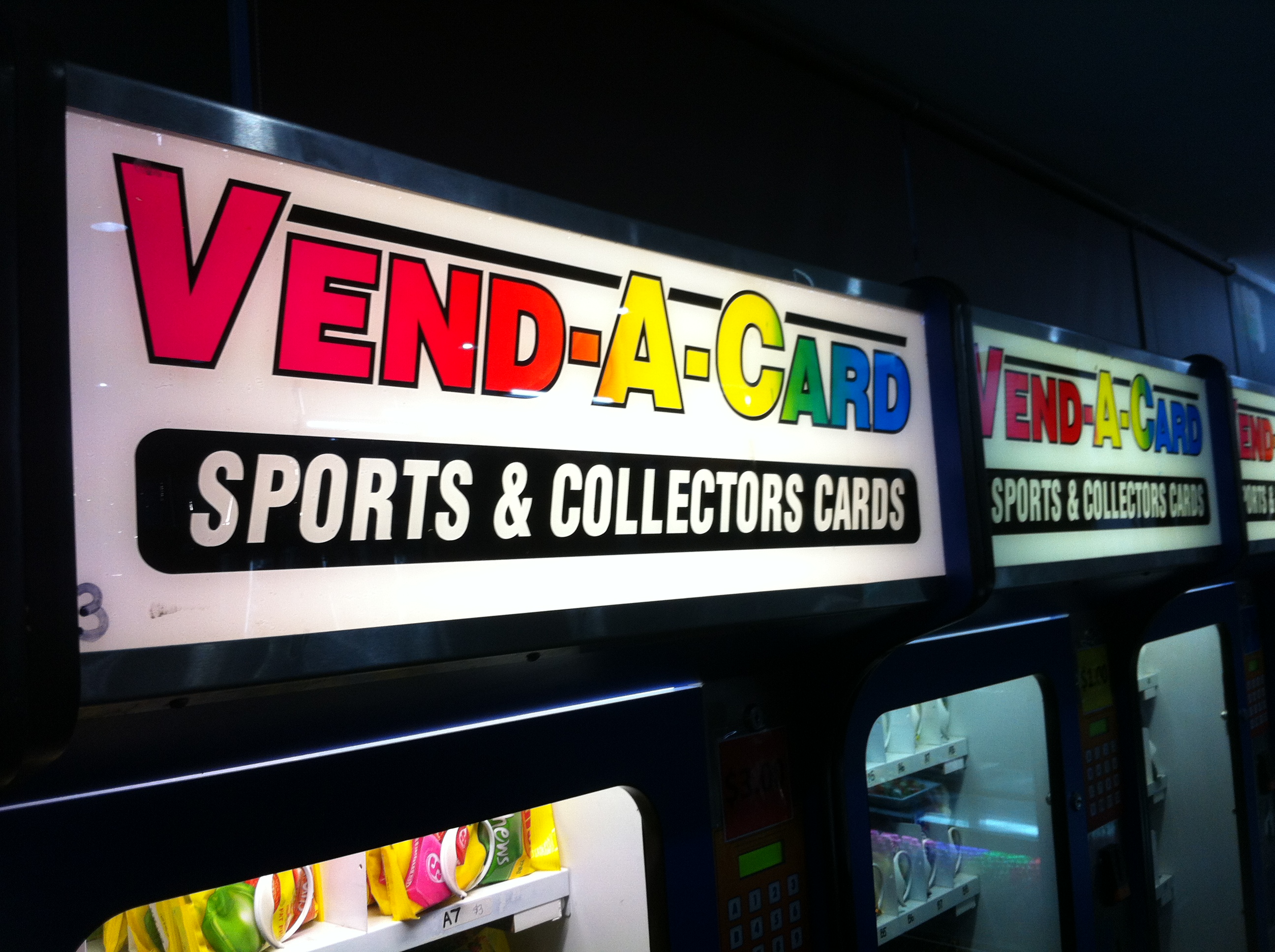 That’s where Vend-A-Card came into the picture. A vending machine for cards. The only thing better for a kid my age would have been a vending machine for action figure accessories you’d managed to lose. The machines would typically play host to single cards (at inflated prices), and sometimes packs as well, presumably because newsagents had gotten sick of snotty kids coming in and chewing them out for picking the wrong pack off the shelf (if I’d wanted Spiderman 94s, I wouldn’t have asked for Spiderman 95s, would I?). It should say something about the popularity of trading cards at the time that these beasts could even exist. Many a set was completed through the luck of spotting that last elusive #33 staring out at you through the Vend-A-Card, and for a time they were heroes.
Then 1997 happened. Topps and Skybox execs were jumping from the 40th floor windows of their buildings and hitting the streets below among scores of pedestrians too busy playing with their Tamagotchis to notice. The videogame industry had inflicted a Dim Mak upon trading cards, and things would never be the same. The Vend-A-Card machines were destined to become landfill, and they, once my eternal saviours, exited my consciousness…until about two weeks ago.
Strathfield bowling alley’s arcade isn’t huge, and certainly isn’t huge enough to contain THREE Vend-A-Card machines, but they made it happen. Even back in the day you wouldn’t have seen a Vend-A-Card at a bowling alley despite their ubiquitousness, but Strathfield quietly installed these three to provide for the needs of the masses once more. But, I hear you say, cards are an anachronism. Surely they wouldn’t be vending cards these days.
You’d be right.
 The sight of a relic from 1995 reborn as a dispenser dispenser made me extremely thankful for the Nurofen.
Hamburger Joint/Residential – Eastwood, NSW
 Once upon a time, this shop would have served the hamburger and hot chip needs of as many residents of Eastwood as could be bothered walking to it. These days, it’s easier to just go to the Macquarie Centre.
Situated along Balaclava Road (bal-A-KLAAAAR-VA, or buh-LACK-luvuh for our SA readers), it’s clear that this was one of those corner shops of yore, the kind that would require a visit every few days to stock up on such olden days essentials like sugar, lard and chicken feed. But as times changed, so did the shop’s offerings.

Above the roller-door of the former loading dock is a telltale sign boasting of hamburgers and hot chips, cunningly repurposed as…some kind of reverse sign. You can bet that when it opened, hamburgers and hot chips were probably just gleams in Fred Hamburger and Glenn ‘Hot’ Chipps’ eyes, but to stay alive in the corner shop game, you’ve gotta diversify.

By what looks like the late 90s or, at a stretch, early 2000s, the place was even supplementing its bread-and-butter milk supply with Ski yoghurt. With a Woolworths within 5km in every direction by this point, it was a desperate time calling for desperate measures. But even the combined deliciousness of Fruits of the Forest weren’t enough to reverse the fortunes of this store.
In the end, the big boys won, and this dangerous threat to their dominance and manhood was eliminated. Do you think Coles and Woolworths shared a beer over this death? Do you think they even noticed? Undeniably aware of the building’s deep-fried past, the current owners have decided to take it in a different direction – residential. Won’t Coles and Woolworths be pleased?
Noel Shipp Motorcycles/Derelict – Wollongong, NSW

Another sad tale from the coast today, this time down south. In 1923, mechanic and motorcycle enthusiast Jim Shipp started a sales and repair business in Wollongong, and in 1949, his son Noel took over as owner. In these early days, dealerships were a huge part of the Shipp motorcycle empire, and Noel sponsored all sorts of club motorbike events and competitions. At some point there was probably a local TV ad featuring the man himself.
But as the years wore on, Shipp’s motorcyclery went the way of all enthusiast business ventures in the modern age. The customers dried up, the big dealers moved in, the internet made sourcing parts easier than ever. What was once a cutting edge mecca for all things motorbikes became that crusty, decaying hulk on Keira Street, itself reforged as a cul-de-sac to prevent noisy motorcycle traffic. Enthusiasm becomes eccentricity. Much like Gould’s or Comic Kingdom, when a business reaches the brink of obsolescence, all it can rely on as a drawcard is the individual experience and know-how of its staff. In Noel Shipp’s case, this was a pretty major asset.
Even after a spell of ill health and admittance to a nursing home later in life, Noel would still make his way into the shop to tinker around with the bikes brought in solely by enthusiasts. A much-loved and well regarded member of the community, Shipp passed away last September, and the shop has been boarded up ever since. Once the name finally rots away and the motorcycle signs are claimed by souvenir hunters, Noel Shipp will join Jim in the annals of the forgotten, and the shop will just be another brick box in the warehouse that Wollongong has become.
UPDATE: Or worse. The old Shipp place has met its end, making way for a new attempt to breathe life into this end of the ‘gong.

Electrical Outlet/Davally Beauty – Enfield, NSW
You know how it can be.
You work hard all your life, bringing your strong, old-world work ethic to whatever task you’re assigned. Sometimes you sell produce, sometimes you sell furniture. It doesn’t matter to you, you were built for this. You can sell anything, it’s your purpose. It makes you feel good. You shack up, maybe you get an idea that you’re going to settle. ‘This could work,’ you think to yourself. ‘I could see myself here in five years, just cruising.’
You hit that point where you’re salivating at the thought of retirement, a handsome payoff for all the hard work you’ve ever done. Sure enough, the day comes. There’s a small celebration, a cake. Gary from next door has a bit too much champagne and ruins your carpet. You laugh and shrug; you’ll have nothing but time to clean it up.
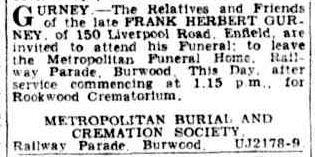
But then the unthinkable happens. Something so commonplace you kick yourself for not having seen it coming, but you never thought it would happen to you. One of your dependents passes away.
SMH, May 4, 1949
Suddenly, things aren’t looking so simple. Easy Street has taken a sharp left onto Struggle Street…which is now a five lane highway. You’ve got to go back to work if you want to make ends meet.
The first day back on the job, and everything has changed. New owners, new workers. New work ethic. As the new upstarts proceed to do all the things you never could, the taste of that cake comes back to you, suddenly very bitter. The owner can see the way things are going, and decides to get out. Just like that. Here one day, gone the next, and not even a goodbye. You know in the back of your mind it’s all your fault. How did that make you feel?

SMH, April 2, 1953
Another decade, another set of owners. The rent won’t pay itself, after all. These hip new owners watch you work, barely masking the disappointment. They paid how much for this? You’re from another time; you just can’t cut it. So out comes the new coat of paint, the new accoutrements designed to help a dinosaur compete in a modern world. It works…for awhile.
And then the 80s. You cut a break – suddenly it doesn’t matter who you are, only what you’re selling. And you’ve lucked out, my friend. Fully stocked with the latest in washers, colour TVs and video recorders. Inwardly, you can’t even begin to understand how it all works. You’re of a bricks-and-mortar mindset, these newfangled electronics baffle you. But you were built to sell, and sell you do. The money – you’ve never seen so much money! – comes thick and fast, and suddenly you find yourself with a hefty bonus here and there. It goes to your head. You’ve forgotten that no one is bigger than the business.

Which brings us to today. Colour TVs lost their novelty. VHS is barely a memory in the mind of the public. ‘People still have to wash,’ you argue. True. But there are laundromats for that. Massive department stores just up the road. While you were sitting here, the world changed, and if you ever left your comfort zone, you’d know that.
These days, you’re a sight. You cling embarrassingly to your heyday, desperate to remind prospective owners what you can do.
Could do.
Did.
But no one’s buying what you’re selling. You were never the best salesperson, merely capable. Today, even that’s negligible. All you do is remind people of a past they’re happy to forget. Despite your best efforts, you’ve landed yourself a beauty salon gig, the kind that’s all too common in these strips. Well done. The saddest part is, you think it’s going to last forever.
I pity you.

 Past/Lives of the Near Future