Vend-A-Card/Pez Dispenser – Strathfield, NSW
This one’s a bit different to the usual stuff, but if you’re my age and demographic (and I’ll bet you’re not) this’ll appeal to a long-forgotten part of your brain. Prepare your past life for a future shock.
When I was a kid, if a big budget movie was coming out to appeal to all six of my senses (you know you have more when you’re a kid), chances are one of its avenues of assault would be a series of trading cards. On me, it worked like a charm. I had a tonne of them, and they made sure that each set was an OCD’s delight. You had to order them correctly in the official collector albums, you had to get all the inserts, you could even collect the wrapper variants. Nothing was more boastworthy at school than the rarest inserts or a complete set, but completing a set wasn’t as easy as you’d think. Trade negotiations between jealous and selfish five-year-olds were more heated than that era’s US-Soviet peace talks, and eventually you’d reach the point where you only needed one or two cards to be done with the whole business. A pack would typically contain seven cards or more. How to solve this dilemma?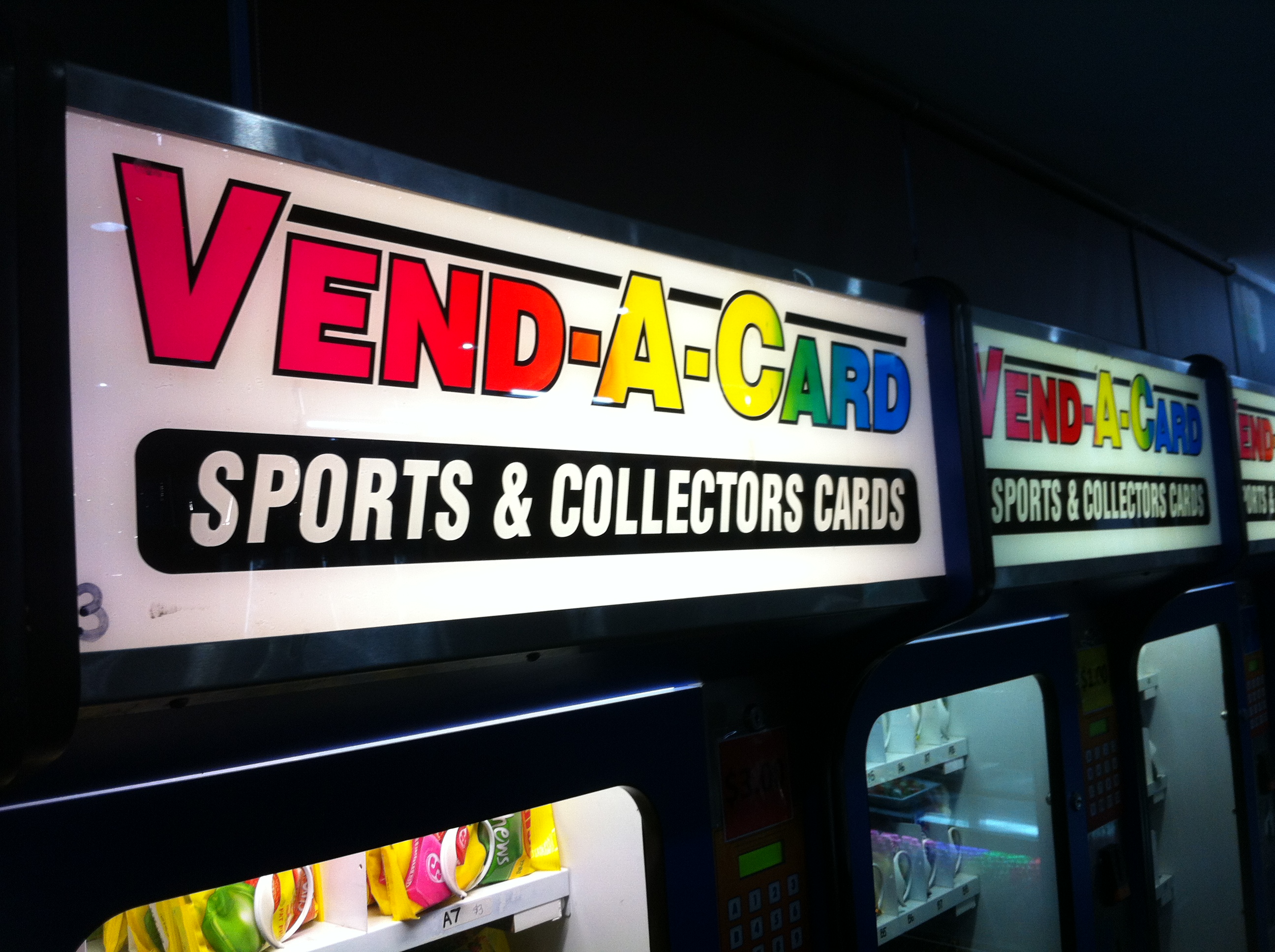 That’s where Vend-A-Card came into the picture. A vending machine for cards. The only thing better for a kid my age would have been a vending machine for action figure accessories you’d managed to lose. The machines would typically play host to single cards (at inflated prices), and sometimes packs as well, presumably because newsagents had gotten sick of snotty kids coming in and chewing them out for picking the wrong pack off the shelf (if I’d wanted Spiderman 94s, I wouldn’t have asked for Spiderman 95s, would I?). It should say something about the popularity of trading cards at the time that these beasts could even exist. Many a set was completed through the luck of spotting that last elusive #33 staring out at you through the Vend-A-Card, and for a time they were heroes.
Then 1997 happened. Topps and Skybox execs were jumping from the 40th floor windows of their buildings and hitting the streets below among scores of pedestrians too busy playing with their Tamagotchis to notice. The videogame industry had inflicted a Dim Mak upon trading cards, and things would never be the same. The Vend-A-Card machines were destined to become landfill, and they, once my eternal saviours, exited my consciousness…until about two weeks ago.
Strathfield bowling alley’s arcade isn’t huge, and certainly isn’t huge enough to contain THREE Vend-A-Card machines, but they made it happen. Even back in the day you wouldn’t have seen a Vend-A-Card at a bowling alley despite their ubiquitousness, but Strathfield quietly installed these three to provide for the needs of the masses once more. But, I hear you say, cards are an anachronism. Surely they wouldn’t be vending cards these days.
You’d be right.
 The sight of a relic from 1995 reborn as a dispenser dispenser made me extremely thankful for the Nurofen.
Noel Shipp Motorcycles/Derelict – Wollongong, NSW

Another sad tale from the coast today, this time down south. In 1923, mechanic and motorcycle enthusiast Jim Shipp started a sales and repair business in Wollongong, and in 1949, his son Noel took over as owner. In these early days, dealerships were a huge part of the Shipp motorcycle empire, and Noel sponsored all sorts of club motorbike events and competitions. At some point there was probably a local TV ad featuring the man himself.
But as the years wore on, Shipp’s motorcyclery went the way of all enthusiast business ventures in the modern age. The customers dried up, the big dealers moved in, the internet made sourcing parts easier than ever. What was once a cutting edge mecca for all things motorbikes became that crusty, decaying hulk on Keira Street, itself reforged as a cul-de-sac to prevent noisy motorcycle traffic. Enthusiasm becomes eccentricity. Much like Gould’s or Comic Kingdom, when a business reaches the brink of obsolescence, all it can rely on as a drawcard is the individual experience and know-how of its staff. In Noel Shipp’s case, this was a pretty major asset.
Even after a spell of ill health and admittance to a nursing home later in life, Noel would still make his way into the shop to tinker around with the bikes brought in solely by enthusiasts. A much-loved and well regarded member of the community, Shipp passed away last September, and the shop has been boarded up ever since. Once the name finally rots away and the motorcycle signs are claimed by souvenir hunters, Noel Shipp will join Jim in the annals of the forgotten, and the shop will just be another brick box in the warehouse that Wollongong has become.
UPDATE: Or worse. The old Shipp place has met its end, making way for a new attempt to breathe life into this end of the ‘gong.

Darrell Lea Chocolates/Newsagent – Roselands, NSW
No doubt you’ve heard about the financial struggles faced by Darrell Lea over the past few months, and if you haven’t, you might want to rethink buying Mum and Dad a Rocklea Road for Christmas. It’s a sad thing when suddenly chocolate isn’t financially viable enough. What, did everyone just decide it was terrible after 85 years? Enough terrible puns were made by the papers at the time of Darrell Lea’s collapse, so I’ll spare us all that nightmare as today we look at the Roselands outlet of the chocolate maker.
Roselands Shopping Centre is up for an entry itself in the future, so watch this space (at the rate I’ve been going lately, it should only take another six years), but the part of Roselands Darrell Lea ended up in is one of its older areas. Located almost at the bottom of a downward escalator, you’d think maximum exposure + delicious chocolate would = maximum delicious profits. Well…
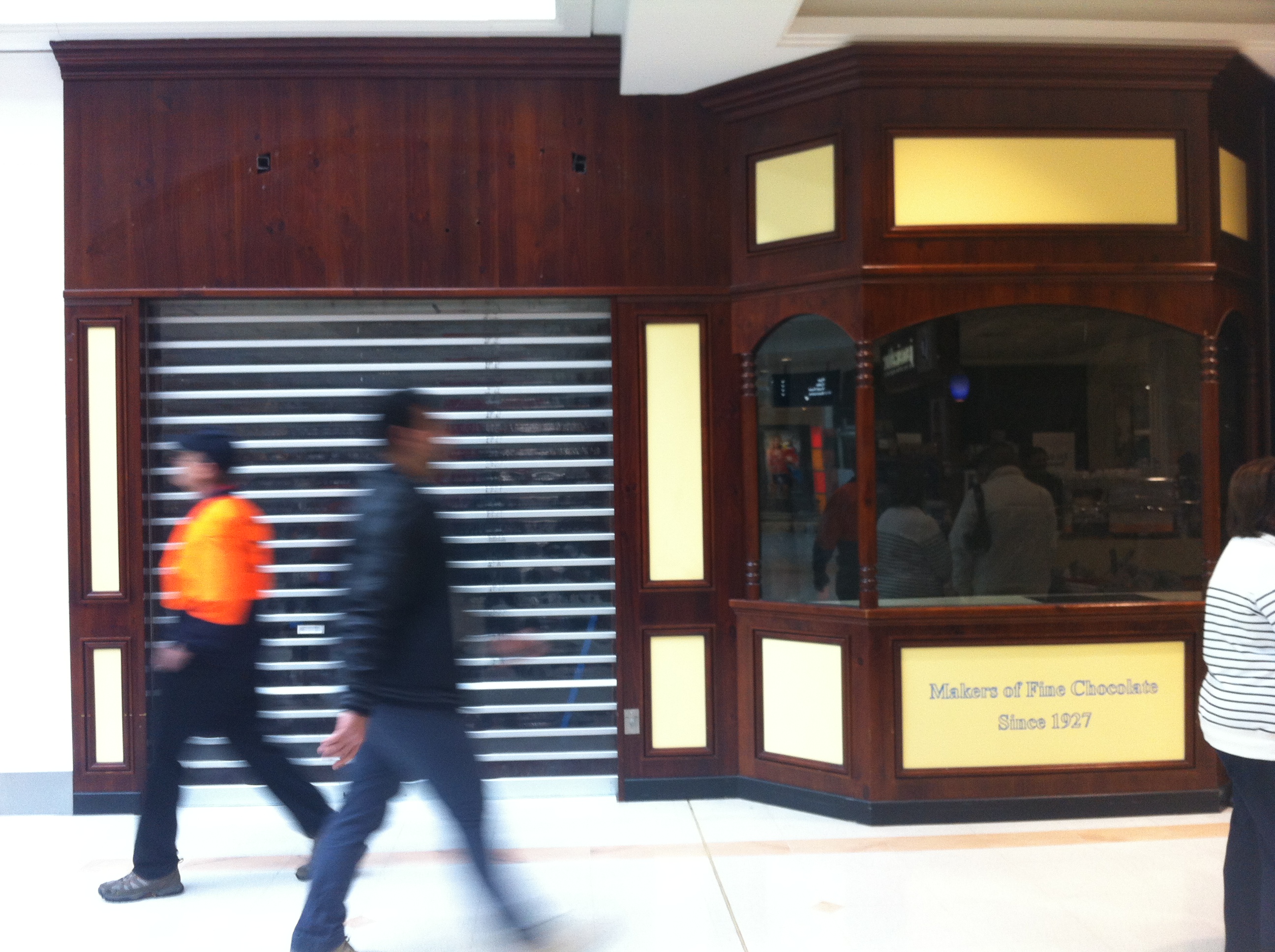
Plans for the empty shop involve an expansion by the neighbouring newsagent, which is so cramped and old it wouldn’t surprise me if they’d built the entire shopping centre around it. Hopefully, the doubling of their floorspace will allow much more room for their diligent army of plain-clothed guards to continue their campaign of death-staring at anyone they think might be shoplifting.
According to this article on the store’s closure, Darrell Lea admin chose to close Roselands (looks like I’ve met my assonance quota for the day), yet kept the Bankstown Centro store open. But commenter Brad Edwards reveals the truth:
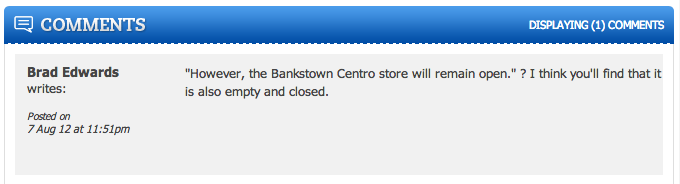 More like…Darrell LIE! Oh, sorry.
Griffiths Teas/Derelict – Surry Hills, NSW

In 1873, English grocer James Griffiths migrated to Melbourne with his wife and cousin (one and the same) in order to start a tea business. By 1875 Griffiths Brothers Teas had become a sensation, providing tea, coffee, cocoa and chocolate to caffeine junkies all over Australia. The Sydney outlet of the Melbourne-based company, built in 1915 as a Budden and Greenwell joint, banked heavily on thirsty train travellers staggering out of nearby Central Station looking for a cuppa.

Image courtesy AusPostalHistory.com
In a memorable ad campaign, a series of these signs were situated at varying intervals along the train trip into Central, designed to gee up incoming arrivals by counting down the miles until they could drink up. It’s hard to imagine anyone being so excited about tea in this day and age, although I wonder if any of the signs are still out there, amping people up for phantom tea?
 But we’re not here to talk about the glory days, are we? In 1925, James Griffiths was killed by a train (apparently the train driver missed the ‘1 mile to Griffiths’ signs), and the tea company was sold to Robur Tea, which itself lasted until 1974. Griffiths’ death meant downsizing within the company (maybe today isn’t so different after all), and the Sydney building was transferred to the Sydney City Council, who then leased it back to Griffiths Teas. Talk about keeping up appearances!
 The tea fad was over by 1965, and Griffiths relinquished control of the building to a variety of tenants, some of which have left their mark on the exterior. For example:
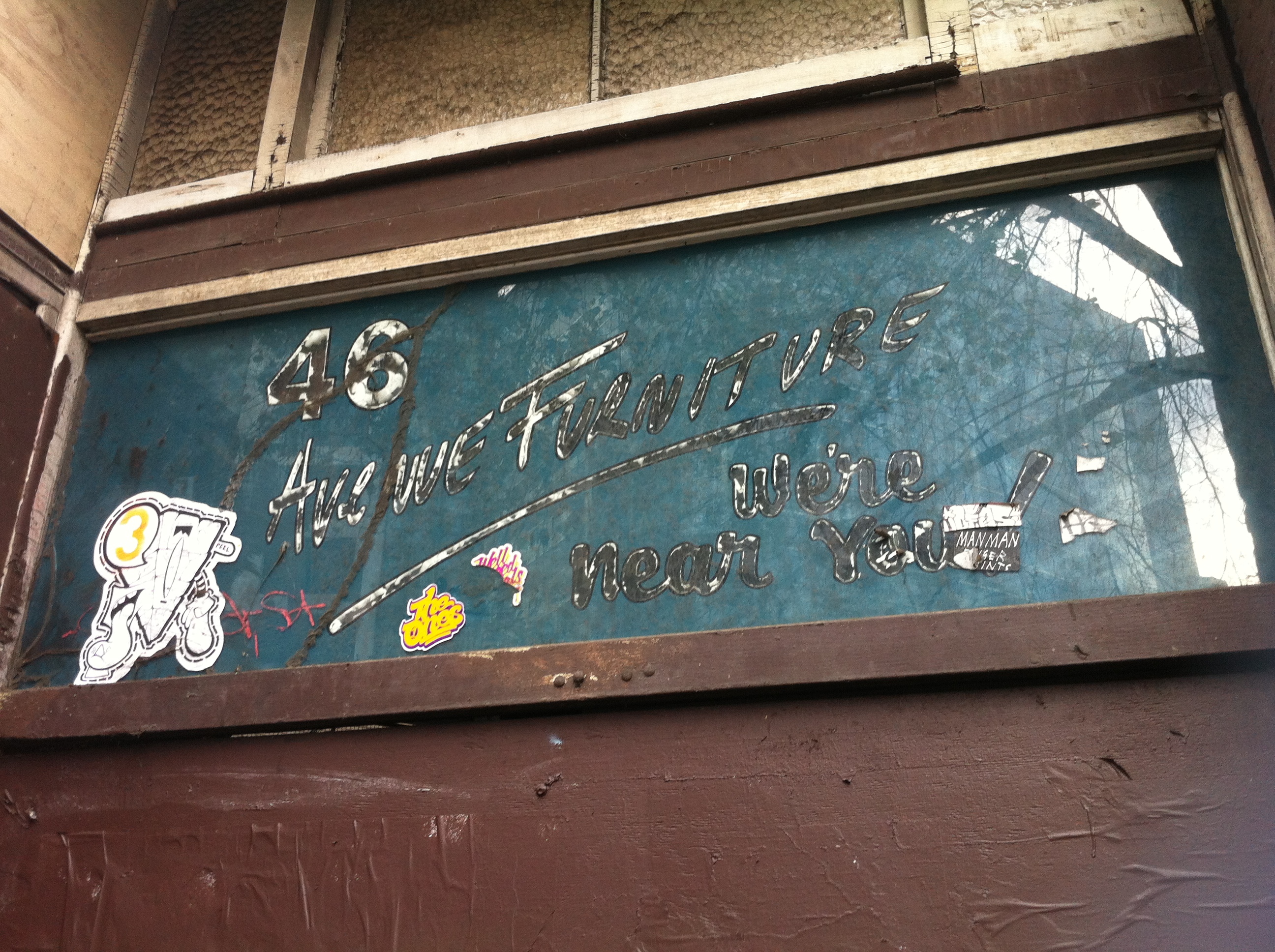 ‘We’re near you!’ if you happen to live in the neighbouring few blocks or like the idea of hauling furniture home via train.
 I’d have to imagine that whoever was selling Makita and Metabo power tools out of this place weren’t using the entire building. These signs have been here as long as I can remember, and probably even longer still. Bear in mind that while these power tools were being sold, there were still signs up for Avenue Furniture and Griffiths Teas; that’s confusing and sloppy. I mean, that’d be like if…or, maybe if…no, I mean like…hm. Never mind.
 It’s no surprise to find that Citilease, owned by Sydney’s own Howard Hughes, Isaac Wakil, is the villain of this piece, completely responsible for the disgusting state of this site. As previously mentioned, Isaac and Susan Wakil own millions of dollars worth of property around Sydney that they insist on leaving vacant. As a result, viable real estate close to public transport and universities is being left to rot. Wakil’s Citilease outfit (here disguised as ‘City Leasing’) has owned the building for at least 25 years, and don’t be fooled by the ‘for lease’ sign – there’s no 9 in front of the number.
 Late last year, some Sydney anarchists decided to conduct an inspection of the property on New Year’s Eve. Perhaps they had intentions of leasing? Of course, they made a few alterations while they were there and had to be forcibly evicted, but don’t worry Citilease, I think they’ll be back.
It’s worth pointing out that the Melbourne Griffiths Teas building, which you’ll remember was the headquarters for the whole operation, has been well preserved and turned into an upmarket hotel with vintage trappings, the Lindrum. Now, why didn’t we think of that?
Joyce Mayne Shopping Complex/Domayne – Auburn, NSW
If you grew up glued to the TV as some of us were, you may remember this funny old lady. You might have smiled as she used her elderly belligerence to implore you to buy a washing machine, but then threw in an interest free period as if to remind you that the kindly granny look wasn’t entirely an act. You might have cringed as she attempted to entice you into her complex from a bubble bath. You might also have wondered whatever happened to Joyce Mayne, the doyenne of discount whitegoods in the dying decades of the 20th century.
 Just in case we were confused.
Born in London, Mayne started out as an actress (and who’s surprised, given those ads) and a tap dancer. She arrived in Sydney in 1956, and the very next day got a job selling TVs at a shop in Penrith. A background in demoing gas and electrical appliances back in England, not to mention being the first woman to pass her all-male management course, didn’t hurt. When the shop owner’s wife learned that *gasp* a woman was selling TVs, she demanded Joyce be fired and replaced by a respectable gentleman. Unperturbed, Mayne went on to a job managing an electrical goods store in the same area, and in 1973 opened three of her own outlets. So great was her devotion to astrology that staff were recruited according to their star signs. “We prefer to employ Sagittarians, Scorpios, Capricornians and Aquarians – they’re the birth signs that produce the best sales people,” Joyce told the Sydney Morning Herald in January, 1979 – the eve of her greatest triumph as a retailer.
The ‘Joyce Mayne Shopping Complex’ on Parramatta Road, Auburn opened amid controversial circumstances in early 1980; filling the void left in the electrical retail scene by the 1978 death of Keith Lord, Joyce had the balls to hold the grand opening on a Sunday despite Sunday trading being completely illegal for a company of her size at the time. Damn. By exploiting a loophole in the law – subletting the 25 shops that made up her complex, thereby establishing herself and her tenants as equals – she was able to cash in on the more than 7,000 shoppers the centre would receive each Sunday. The downside? As a tenant, you had to endure the indignity of managing a store with a name like ‘Joycie’s Jean Barn’ (an actual 1982 store name), but for Joyce herself, business was booming. Aside from an abortive flirtation with car sales in 1982, Joyce stuck largely to whitegoods and furniture, with locations soon sprouting at Taren Point, Camperdown, Alexandria and Newcastle. So involved was Joyce with the business that you’d often find her manning the registers during busy weekends. I bet you didn’t see Jean Lord doing that.
Once she’d created the Joyce Mayne chain, she quickly became a star of Sydney television in a long-running series of commercials. Anyone who watched late night commercial TV between 1978 and 1996 would at some point have caught a glimpse of Mayne’s ads, which showcased a shameless, unique kitsch and a garish sense of glamour, even for that era. This was in an age where furniture and whitegood chain owners all had a crack at fronting their own commercials, thus forcing an unsuspecting public to invite the vacant John Coote or the reptilian Gerry Harvey into their living rooms on an uncomfortably regular basis.
Joyce’s borderline offensive commercials, including one involving Mayne enjoying a bubble bath with Mafia types and making them offers they couldn’t refuse, didn’t immediately endear her to the public (something the low, low prices and interest free periods must have done instead). A subscriber to the ‘any publicity is good publicity’ tenet, the ads kept coming despite the public’s distaste. So too the profits – by 1990 Mayne, Harvey and Bing Lee had risen to the top of the industry. The woman herself attributes her winning ways to astrology (and a lifelong love of gambling, particularly on the horses). She took the riskiest punt of all in 1985 when she published Joyce’s Winning Ways, a bizarre part-memoir in which she claimed the stars picked winners. Unfortunately for Joyce, the stars never divined any victory for her own horse, Defilace.
 Forever second, eh Defilace?
In 1986, Joyce began winding down her involvement in the brand she’d fronted for so long, with hopes of retiring to Queensland. She’d spent the year writing a never-released followup to Joyce’s Winning Ways (perhaps she’d discovered a few more) and had fallen in love with the Sunshine State, retiring to Townsville in the late 80s but sporadically appearing in further, increasingly cantankerous TV ads in Sydney. In just a few short years she was calling herself Queensland’s Leading Progressive Astrologer, and claimed she could forecast up to ten years into the future. Given that the ads seemed to stop in about 1996, it makes you wonder…did you see this coming, Joyce?
Information on the end of Mayne’s life is scarce; she appears to have died in Townsville sometime prior to 2006, in relative obscurity. This obituary of Bing Lee’s son and Mayne contemporary Ken Lee (d. 2007) mentions that ‘the reclusive multimillionaire was last seen at the funeral of Joyce Mayne‘. Just to make sure she was dead, right Ken? The electrical retail industry is cutthroat, as evidenced by the way Mayne’s turf was carved up after her death. 1998 saw ubiquitous retail overlord Gerry Harvey step in to purchase the Mayne stores for his wife to run. Something feels very…misogynistic about that. The Joyce Mayne brand name has since been banished from Sydney, with only a handful of outlets remaining in regional NSW and Queensland. Six of Mayne’s seven ageing stores inherited by Harvey Norman were rebranded Domayne in 1999 and given a more upmarket makeover; gone were the lurid pinks and greens and all the associated tacky charm, replaced with a sleek modern finish and a very cold, corporate feel.
 I bet there aren’t too many bubble baths in here.
And so it is at Auburn, formerly the site of the aforementioned Joyce Mayne Shopping Complex. The complex has been largely replaced by a Harvey Norman outlet and the Domayne centre itself…it’s a far cry from the pink and brown monument splashed all over town in Mayne’s commercials throughout the 1980s.
 You are the .01%…
But Joyce’s spirit lives on in this, the only feature in the entire complex that still bears her name. Yes, every time an item is taken away from the premises without a receipt, a part or fitting is pinched from a unit, a graffiti artist damages the property or the 99.99% of sensible, honest people feel the need for an apology, Joyce and her legion of invisible security cameras are there. The brutal juxtaposition of strongly worded threats in a bold, dangerous font signed by Mayne’s dainty typeface is classic Joyce, and wouldn’t seem out of place in one of her ads.
It’s sad that a pioneer like Mayne has been so thoroughly relegated to the annals of history, but by making herself the brand, Joyce may have inadvertently brought it on herself. Who was the real Joyce Mayne? An amusing excerpt from the SMH interview, January 1979 provides little illumination:
‘”And in another life I’d like to be a criminal law barrister,” she added mysteriously, without further explanation.’
Perhaps that life is being lived now, and maybe someday the full story will be told. For the time being, as always, if you know more, let Past/Lives know. Vaya con dios, Joycie.

 Past/Lives of the Near Future