TAB/Nothing – Homebush, NSW

Oh no! The Homebush TAB…it’s closed! It’s moved! However will I get my bet on now? I-eh?
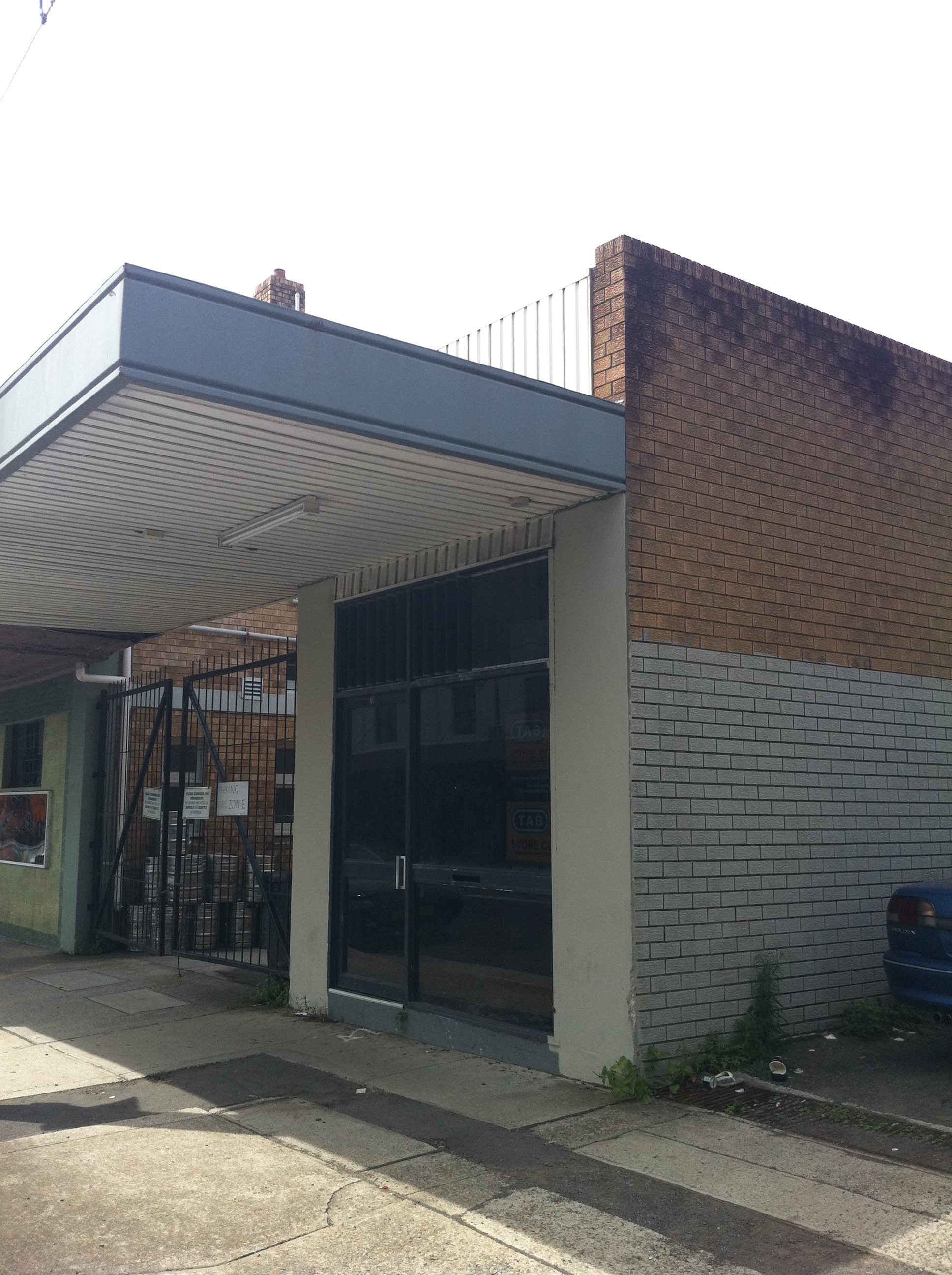
The TAB moved next door. To the Horse & Jockey Hotel. Which probably already had a TAB. The part I like is how specific the sign in the TAB is about exactly when it will close, but the part I don’t like is how there are people out there to whom that would have mattered dearly.
Bristol & Co Real Estate/Map World/Citymart – Sydney, NSW

The idea of a small real estate agent such as Bristol & Co. sitting in the middle of the city seems strange now. It’s hard to imagine that a small fry like Bristol could ever compete in an environment full of franchises and big name firms. Likewise, the current incarnation of the building, Citymart, seems ill-equipped to compete with the 7-Elevens and City Conveniences of downtown Sydney, primarily because it’s closed and near empty.
Map World is another instance of a shop too small for its ambitions. It probably did alright in 2000, but in an age where everybody’s phone knows the city better than your average taxi driver, Map World’s pretty much fallen off the map. With a track record of three duds, maybe it’s just an unlucky shop.
Western Distributor On-Ramp/Road Hammock – Sydney, NSW

Here’s something completely stupid: this carriageway is the Western Distributor passing over Kent, Day and Margaret Streets near Wynyard. Below it is…a bit of road that…goes nowhere, and does nothing.
The Western Distributor began life in the early 1960s as a way to relieve traffic on the Harbour Bridge. Sydney’s extensive underground rail system meant that the Distributor couldn’t be built as a series of tunnels, so viaducts were the sensible alternative. That’s where the sense stopped.
The only reason the Western Distributor existed was because the designers of the Harbour Bridge and existing road system didn’t use enough foresight. You’d think that planners of the WD would employ twice as much foresight to make sure that further modifications weren’t necessary. Well, two times nothing is still nothing.
The original plan for the Western Distributor had westbound traffic exiting the city via the Glebe Island Bridge. For those who aren’t familiar with the bridge in question, here’s a picture:
That’s it there, below that huge, multi-lane bridge. If you can’t see it, squint. The two-lane Glebe Island Bridge had been built in 1903 to provide access to the Glebe Abattoir, and it includes a swing bridge to allow boats through. Surprisingly, this bridge proved to be unable to handle the traffic spewing forth from the Western Distributor, and in 1984 the NSW Government proposed another bridge. Good thinking! The Anzac Bridge was completed by 1995 (!), and opened in December of that year. It features a great height to allow boats through.
Of course, when the Distributor had been designed, it was flowing towards a small bridge. Now that it had a giant, capable bridge to lead into, the one-lane road itself suddenly seemed a bit lacklustre. In 2002 (!!), work commenced to widen the Western Distributor throughout the city, which brings us back to our original ridiculousness.

Here’s the other end, just in case you were thinking it went somewhere.
This bit of suspended road was originally an on-ramp for the Western Distributor, with access from Margaret Street. When the road above our piece here was widened, it claimed the on-ramp’s space and ended Margaret Street’s usefulness in the scheme of things. For a time it was used as a parking bay (illustrating the lengths the City of Sydney Council is willing to go to to make a buck out of parking). The ramp was then severed at both ends, and now sits hanging above the street, useless and surreal.
The happy ending to this story is that after the implementation of each of these emergency patches to the highways of Sydney, traffic in the city was never a problem ever again.
New Kings Theatre/Greater Union/For Lease – Mosman, NSW

The New Kings Theatre, Mosman, 1937. Image courtesy State Library of NSW.
Over the years, the New Kings Theatre at Mosman went by a variety of names – the Kings, the Classic – until it was finally caught in the current of progress in 1976. The Village cinema chain took over the art deco theatre that year, and it ran in friendly competition with its nearby contemporary, the Cremorne Orpheum.
But in a story that’s all too familiar in the world of old theatres, suits suddenly appeared on the scene and started making decisions on behalf of business. Greater Union demolished the New Classic Kings Village in 1986, a move which shocked the community. The twin cinema that replaced it opened in 1988 to much fanfare; so cheesy and contrived was the whole venture that even the cinema’s phone number was 9969 1988. Sheesh.

On paper, you’d think replacing an old 30s single screen picture theatre with a modern twin would be like printing money, but 23 years after its grand opening, the Greater Union Mosman was printing termination notices for its staff.

The GU’s profits didn’t come anywhere close to those at the still-vintage Cremorne Orpheum, and in 2011 the twin closed its doors for the final time. It’s currently waiting, like much of Mosman’s shopping district, to be demolished and redeveloped into residential/commercial towers, but until that happens it stands as a testament to the Orpheum’s appeal and triumph over progress.
Broadway Theatre/Jonathan’s Disco/Phoenician Club/Breadtop – Ultimo, NSW
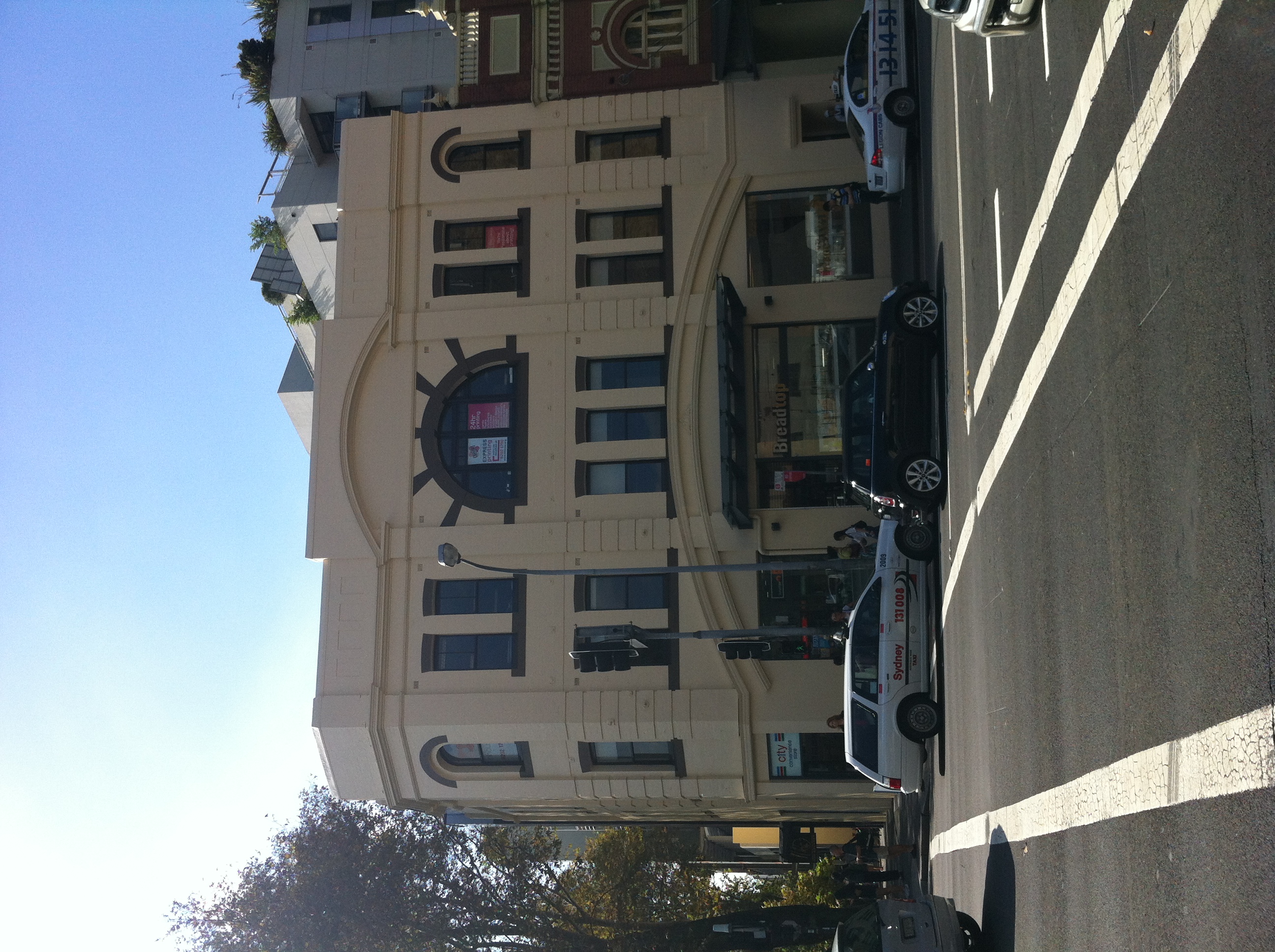
These days, this building on the corner of Mountain Street and Broadway, Ultimo, houses a convenience store, apartments, and our old friend Breadtop, but the inconspicuous facade hides a colourful and tempestuous history.
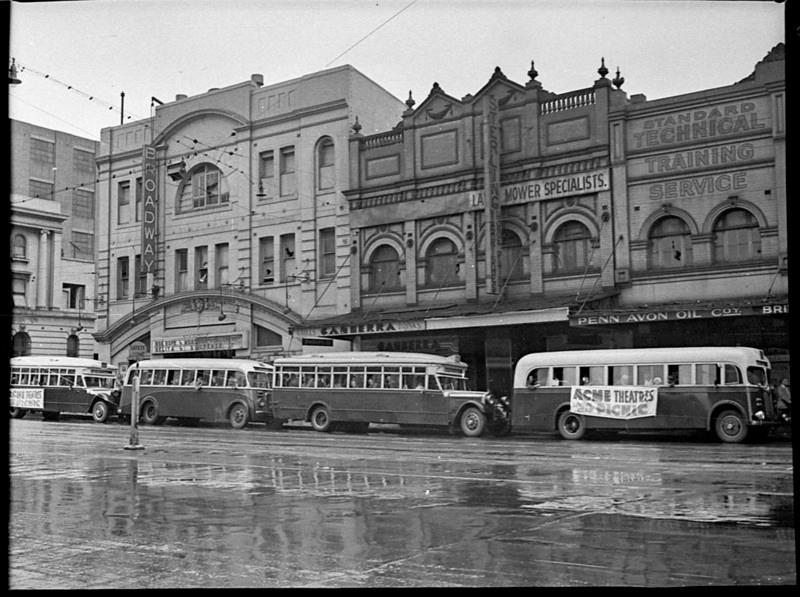
The Broadway Theatre. Image courtesy Sydney Cinema Flashbacks.
Built in 1911, the building started life as the Broadway Theatre, a cinema. With the advent of TV, this was one of many suburban cinemas that had fallen by the wayside by 1960, when it closed. In 1968, it was acquired by nightclub owner John Spooner and converted into Jonathan’s Disco, where it became well known as one of Sydney’s prime live music venues. Sherbet and Fraternity both got their big break at Jonathan’s, playing residencies involving six hour days for months on end. Imagine the poor disco staff having to listen to six hours of Sherbet a day for months. Perks of the job…

Jonathan’s Disco, post-fire, 1972. Image courtesy City of Sydney Archives.
In May 1972, Jonathan’s Disco was gutted by fire. I can’t help but think it was one of those beleaguered staff members. “HowZAT?” they’d’ve quipped as they flicked their cigarette into the freshly-poured puddle of gasoline. The damage was extensive, and required a complete internal refit before it was opened again in 1976 as a ballroom dancing studio.

Jonathan’s Disco interior, post-fire, 1972. Image courtesy City of Sydney Archives.
The Sydney City Council granted the Maltese community use of the premises as a licensed venue in 1980, when it became the Phoenician Club. Once more, the site became one of Sydney’s most popular live music venues with local bands such as Powderfinger and Ratcat playing gigs there throughout the late 80s and early 90s. Nirvana played their first Sydney show there in 1992 – a far cry from Sherbet. Around this time, the rave scene exploded in Sydney; a development that would lead to the end of the Phoenician Club.
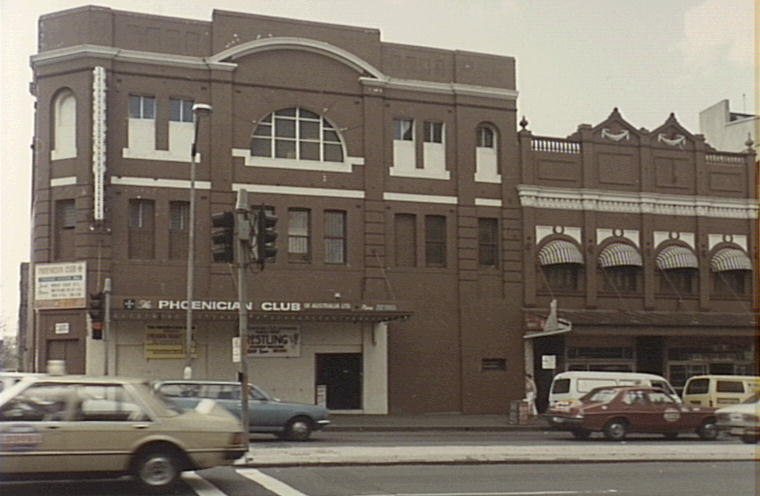
The Phoenician Club, mid-1980s. Image courtesy City of Sydney Archives.
Anna Wood, a 15yo schoolgirl from Belrose, attended an ‘Apache’ dance party at the Phoenician in October 1995, where she took ecstasy. Her resulting death shocked Sydney and enraged then-NSW Premier Bob Carr, who declared war on the Club. A series of fines and restrictions imposed on live venues in the wake of Wood’s death led to the closure of the Club in 1998 and the decline of Sydney’s live music scene which continues today. Good thing Wood wasn’t killed by a pokie machine.

The derelict Phoenician Club, 2000. Image courtesy City of Sydney Archives.
From 1998 the site sat derelict, just in time for the Olympics. Nothing international visitors like seeing more than abandoned, graffiti-tagged buildings. In 2001 it was completely redeveloped internally, and today satisfies Carr’s idea of a venue put to good use.

 Past/Lives of the Near Future