World 4 Kids/Best & Less and The Reject Shop – Bankstown, NSW

Toys R Us was coming. The American toy giant had lingered on the horizon of the Australian retail scene since 1984, when it had first ventured overseas. Now, in 1993, Toys R Us had made its intentions to establish itself in Australia very clear. In a panic, and desperate to beat Toys R Us to the punch, Coles Myer set up their own chain of toy stores that attempted to outdo the American company in every conceivable way; a ‘category killer’. It wasn’t the first time Coles Myer had employed the tactic: in the same year, it had established Officeworks, basing it on the US stationery chain Office Depot. To give you an idea of just how contrived the whole concept was, here’s a 1993 ad preempting the World 4 Kids launch. If you can look past the kid’s stylish fashion, note the cynical overuse of the dinosaur to ride the success of the year’s biggest film.
I can still remember the hype surrounding World 4 Kids at the time of its launch. It was relentless. The Bankstown Square location was enormous, taking up an entire floor. To a kid, it was mind-blowing. They had video games available to try everywhere around the shop. They had aisles – not just a few shelves, like Grace Bros, but aisles – of action figures. They even had a ‘kids entry gate’ as an alternative to the regular entrance. Sure, it was just an archway over a little bridge, but that was for YOU! You weren’t meant to walk in the normal way like the grown-ups! This wasn’t just some toy department of a bigger shop. There was no threat of being dragged off to look at clothes or other boring stuff. It was ALL TOYS.
The launch of World 4 Kids didn’t stop Toys R Us from opening, and the closest store to the Bankstown World 4 Kids was at Hurstville. As expected, the Toys R Us store blew World 4 Kids away: it was two-storey, they had more of everything, and the name explicitly promised toys, rather than merely alluding to them in the case of World 4 Kids, which sounds like it could easily have been one of those lame play centres with the ball rooms.
1993 was about the start of the last big era for toys. By the end of the 90s, video games had eclipsed toys by a wide margin. Also by the end of the 90s, World 4 Kids was a world about to end. The company had bombed hard in the wake of Toys R Us, haemorrhaging millions of dollars each year it was open. By the end, it was losing $36m a year, and cost Coles Myer more than $200m during its short lifespan. World 4 Kids, supposed to be the successor to K-Mart’s dominance of the toy market prior to 1993, closed in 2002, and the brand name was absorbed back into K-Mart, which adopted it as the name of its toy department.
This particular World 4 Kids took over the floorspace of Venture, itself formerly Waltons Department Store (but more on that another time), so by failing miserably, it was only carrying on the strong tradition established by those two brands. Where the one store once took up the entire floor, a chemist, the Reject Shop and Best & Less have taken up residence. Immediately following World 4 Kids’ departure, a JB Hifi was set up in its place, but in a rare move for JB it was closed a few years later. Even Toys R Us is struggling these days, with the Hurstville location having long since been reduced to just one floor.
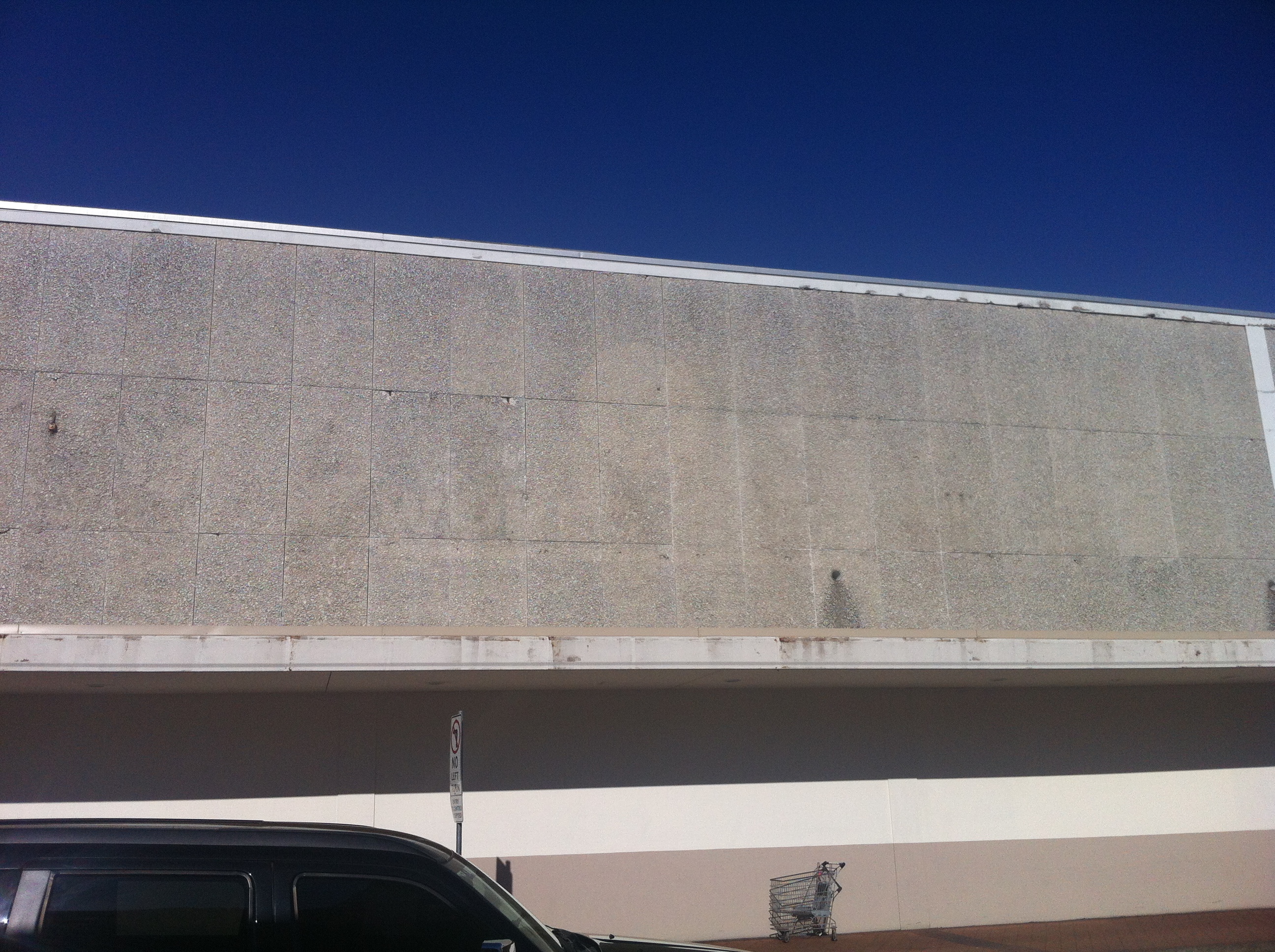
Note the poignant empty trolley.
The only evidence that World 4 Kids, the place that meant the world to so many kids in 1993, was ever a part of Bankstown Square is the faint afterimage of its sign on the outside facade of the building, along the Appian Way. Yesterday’s great hope is now just a stain on the wall. It’s a stark reminder that no matter how personally a store may appeal to you, it’s always business. After all, that’s the way of the World.
Flemings Fabulous Food Store/Woolworths Supermarket – Bexley North, NSW

If you visit the suburb of Bexley North, you’ll find a supermarket with an identity crisis. Flemings, or in this case, Flemings Fabulous Food Store, opened as a chain of supermarkets in 1930, but in 1960 sold up to Woolworths. This particular Flemings is one of only two left in New South Wales, the other being in Jannali. Inside, it’s all Woolworths branded, but the name and the building itself (and some of the items on the shelves) are all vintage Flemings.
Why Woolies is prolonging the death of this particular Flemings should become obvious when you look to the right of the picture. When the new block of units (built on a former petrol station) opens, they’ll want a bigger supermarket, and if Woolworths can buy up the other tiny shops on this strip, expect a big budget overhaul that’ll relegate Flemings to Supermarket Heaven alongside Clancy’s and Jewel. Nothing like a bit of competition.
Marchants Ltd Soft Drink Makers/R.J. McWhinney Panel Beating – Bexley, NSW

Image courtesy Museum Victoria.
In 1886, British migrant George Marchant purchased a Brisbane ginger beer manufacturing plant. By 1890, Marchants was the largest soft drink business in Australia, with a product range including hop beer, soft drinks and cordial, and with plants in Brisbane, Melbourne, Adelaide, Newcastle and Sydney. Oh, and Bexley.
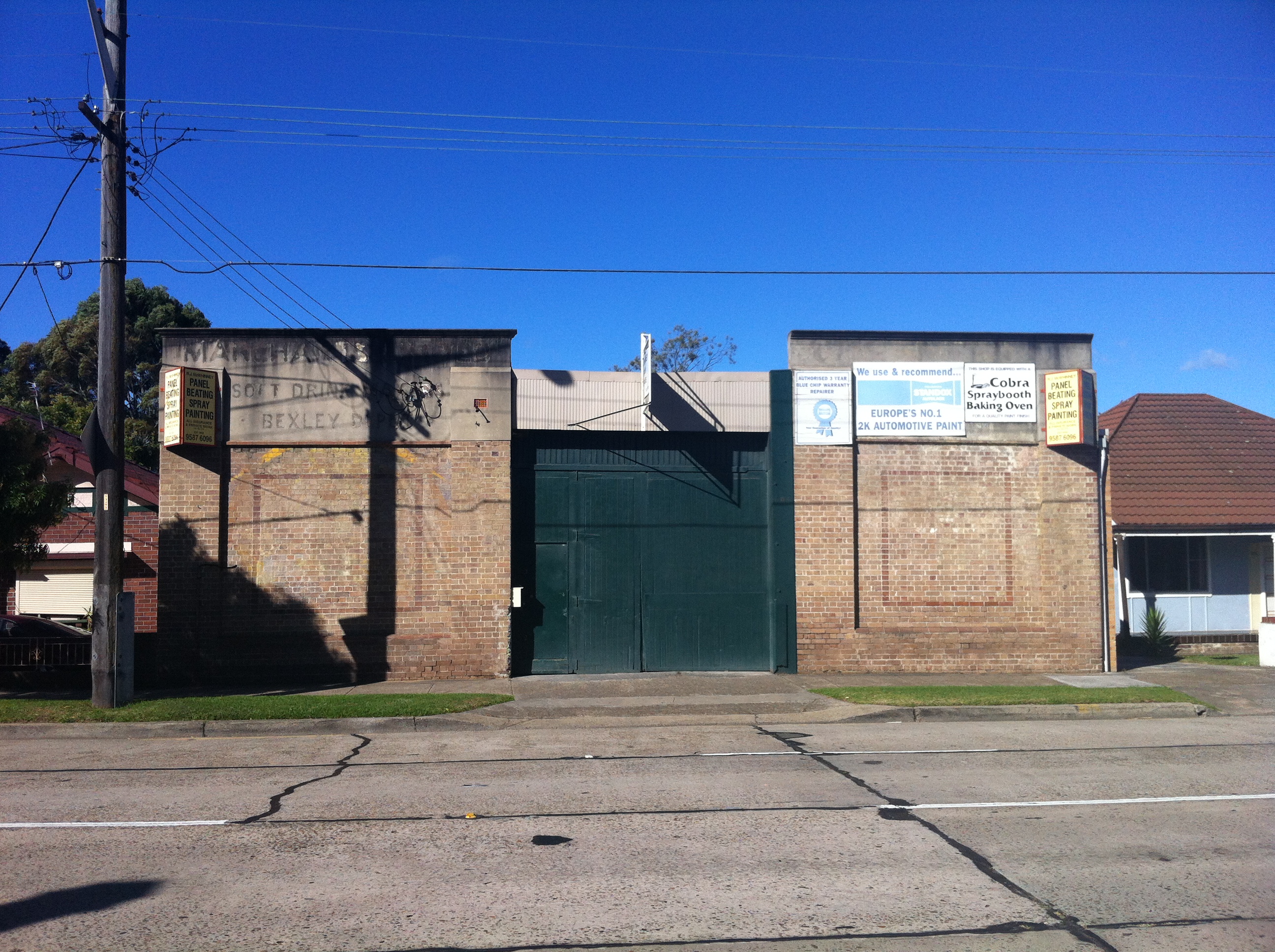
Let’s not beat around the bush – the building looks old. The Bexley depot of the Marchants soft drink empire may be a panel beater now, but it’s clear to see how it would have been back then. It looks like a horse and cart might explode from behind that door at any second in a frenzied rush to deliver kegs of creaming soda, just like in the olden days.
George Marchant was known for his strong belief in social equality, and women workers in his factories earned more than the average female wage in the food industry at the time. When the soft drink company’s registration was abandoned in 1917, the brand name was sold off and kicked around for decades between Pepsi, Shelleys, and ultimately Coca-Cola, which owns the brand today. Marchant himself died in 1941, by which time this site was long since out of the soft drink business. Hmm…I’m thirsty.
T.W. Green Wool Stores/Trojan Workforce Recruitment/For Lease – Glebe, NSW

Thomas W. Green established his wool handling and broking business in 1905, a time long before recruitment agencies. The Green empire spread itself over two locations; one in Queanbeyan and one here at Glebe. This was at a time when Glebe’s stores were full of first-hand wool. Stunning, I know.

TWG Wool, presumably renamed KFC-style in the 90s by a pony-tailed marketing man, was purchased by Landmark in 2005, and has practically disappeared since. The Glebe location was taken over by the terribly named Trojan Workforce recruitment company on the first level, and the awesomely named Ultraceuticals Pty Ltd on the second. They could literally put heroin or mutagen in a bottle marked Ultraceuticals and I’d down it without thinking twice.
While researching this place, I stumbled upon what may have been a contributing factor to T. W. Green’s desertion of this location:

Barrier Miner, Mar 22 1950
“I’m sorry, sir, but only the J. Wilson from J. W. Green is allowed to redeem this prize!”
It wouldn’t surprise me if a. that actually happened and b. NSW Lotteries did this kind of thing more often. “Oh, sorry Mr. Smith, but this prize can only be claimed by Mr. Snith. Check the results again.” Talk about pulling the wool over your eyes.
The Plaza Theatre/Maxy’s Roller City/Planet Hollywood/McDonald’s – Sydney, NSW

Image courtesy Simon Fieldhouse.
Sydney’s Plaza Theatre was once one of many elegant cinemas and theatres lining George Street’s entertainment strip. Like many cinemas, its business was damaged by the advent of television, and today it has the distinction of being arguably the world’s fanciest McDonald’s.

McDonald’s George Street interior, 2012.
Built for Hoyts in 1930, the Plaza sat alongside venues such as the Century Theatre (which became an indoor BMX track in what could only have been the 80s) and the Crystal Palace Arcade.

Erecting the neon sign, The Plaza Theatre, 1935. Image courtesy State Library of NSW.

Hoyts Plaza Theatre, 1966. Image courtesy City of Sydney Archives.
Despite many of its contemporaries being bulldozed around it, the Plaza stood firm until 1977, when it was closed as a cinema and reopened as Maxy’s, a disco skating rink. The changing face of entertainment.

The Plaza as Maxy’s, 1983. Image courtesy Helen Grant/Sydney Cinema Flashbacks.
Surprisingly, the idea of a disco roller rink wasn’t fashionable for long, and the Plaza played host to Mickey D’s and video arcades for most of the 1980s.
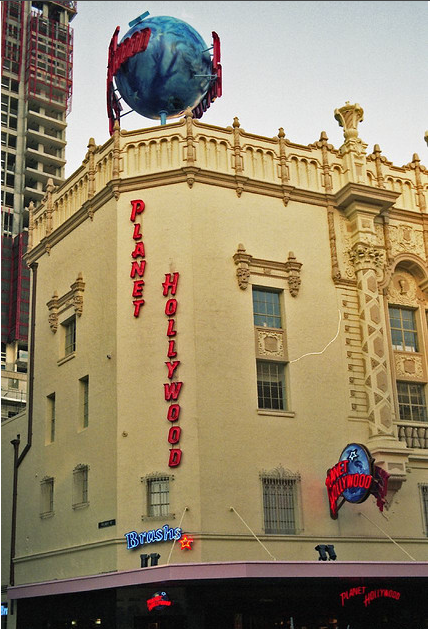
Planet Hollywood Sydney, 1996. Image courtesy Steve Newbury.
The Plaza’s northern end was once again immersed in the world of cinema in 1995 when the Stallone-Schwarzenegger-Willis-Moore joint Planet Hollywood came to Sydney, establishing itself in the former arcade. According to this photo taken in 1996, PH shared its space with Brashs, another 90s success story. By 1999, both ventures would be out of business.

Today, some lazy entrepreneur has taken the already-tacky Planet Hollywood aesthetic and adapted it into the Star Bar, another of modern George Street’s entertainment offerings. Not sure how many stars you’d see here these days. The Plaza in its present state is yet another example of Sydney trying to disguise the brazen pimping of itself to the lowest bidder by hiding behind facades of the past. If it looks vintage, it seems that much more respectable. What isn’t considered is that drunken eyes can’t appreciate all the lovingly preserved heritage fronts, and as George Street continues to slide into the gutter, the death grip it has on these buildings only serves to drag their illustrious reputations and history down with it.
STAR STUDDED UPDATE: Reader Cameron says: “Star Bar was originally created by Planet Hollywood to replace Brashs when it failed which had the same owner, Star Bar was created so Planet Hollywood could profit from gambling without tarnishing its family image. The two coexisted for a while. A bizarre fact, this restaurant was a real cash cow and extremely profitable when it closed, a case of embezzlement I believe. The real crime there was the removal of the original cinemas Spanish themed ceiling for the extra headroom and replaced with a high blue ceiling. The Star Bar is now run by the same group that has the even tackier Shark Bar! now with no sharks……”
Sounds like the sharks haven’t left at all, actually. It’s almost inconceivable that shady types would be running places like this (especially the Shark Bar), but there you go. Thanks, Cameron!

 Past/Lives of the Near Future