Kingsgrove Baptist Church/Beverly Hills Baptist Church – Beverly Hills, NSW
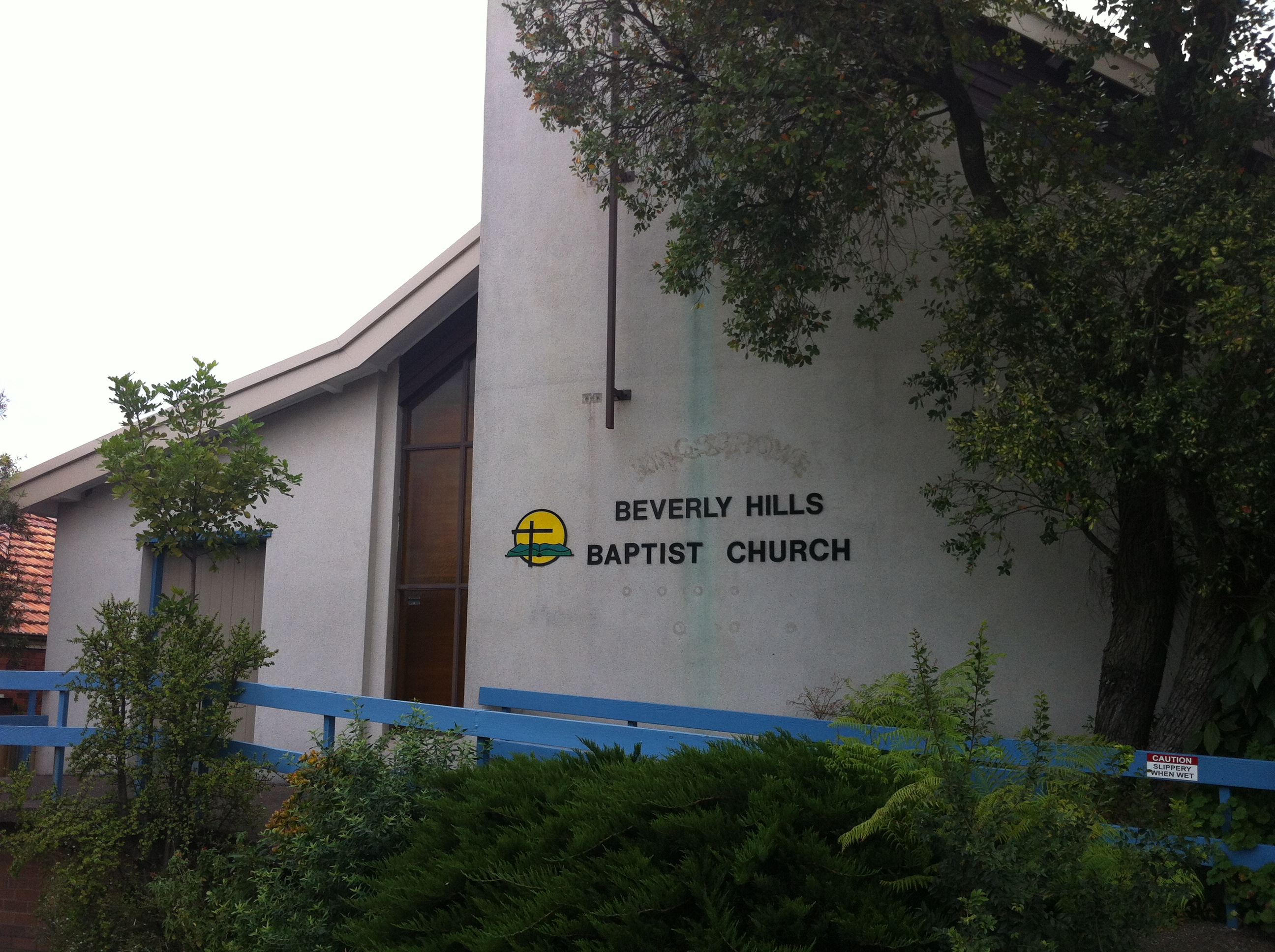
The alliteration temptation was evidently just too much for the Kingsgrove Baptists to bear.
Gateway Travel and Richardson & Wrench/Korean BBQ Restaurants – Strathfield, NSW
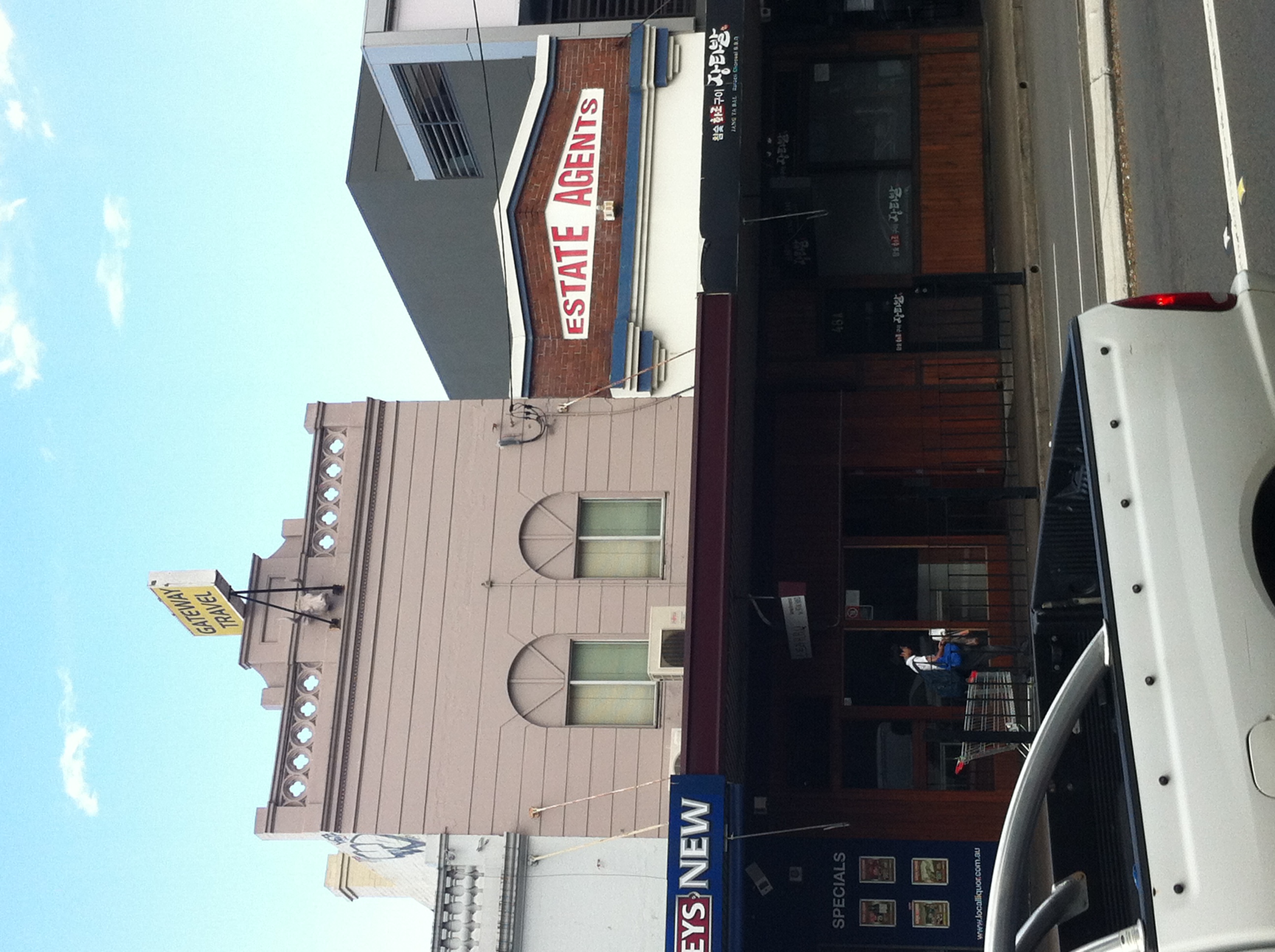
Strathfield’s The Boulevarde is now the scene of intense rivalry. Two culinary entrepreneurs were struck by idea lightning at the same time, and via a series of doubtlessly hilarious coincidences, have ended up with their Korean BBQ restaurants side by side. Fortunately, they were also both lazy enough to leave some traces of the buildings’ former occupants up for us to find.
Gateway Travel and ‘estate agents’ are both scintillating hints, but what if we could actually go back in time and see how they looked? Well, thanks to the outdated technology of Google Street View, that’s exactly what we’re going to do. Buckle up, Marty:
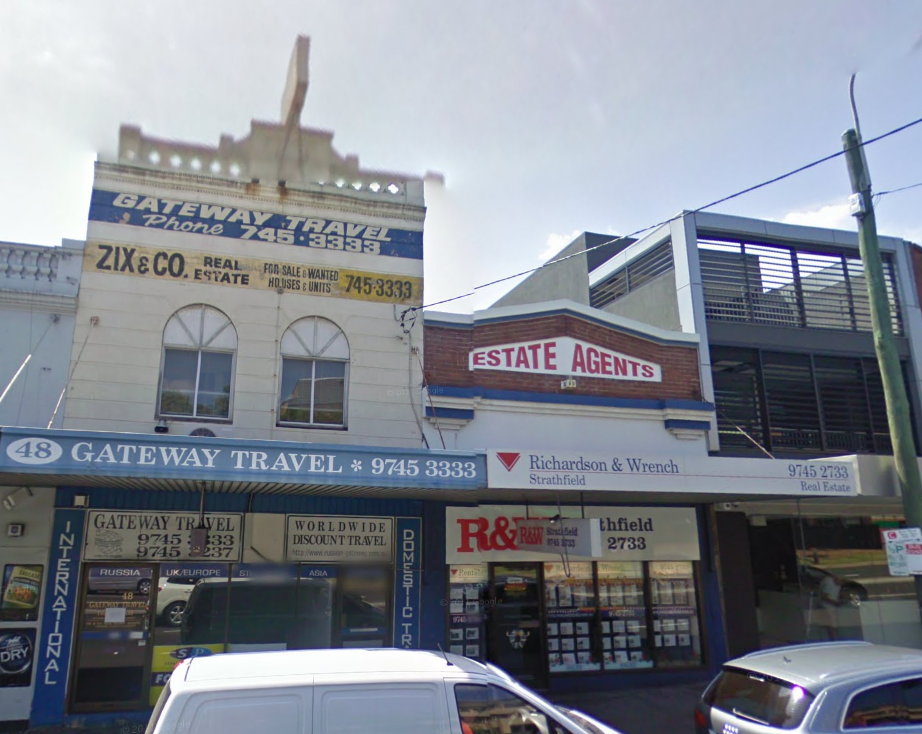
And so we emerge in the distant past of 2009, a time when Gateway Travel and Richardson & Wrench ruled. Gateway looks like it had been there a long time, given the seven digit phone number at the top. The Zix & Co Real Estate sign suggests a time when two estate agents stood side by side, locked in bitter rivalry…not unlike today’s BBQ brothers. History is doomed to repeat itself.
One last curious feature of the Gateway building that gives us an insight into a past beyond even Google’s reach is this gargoyle:
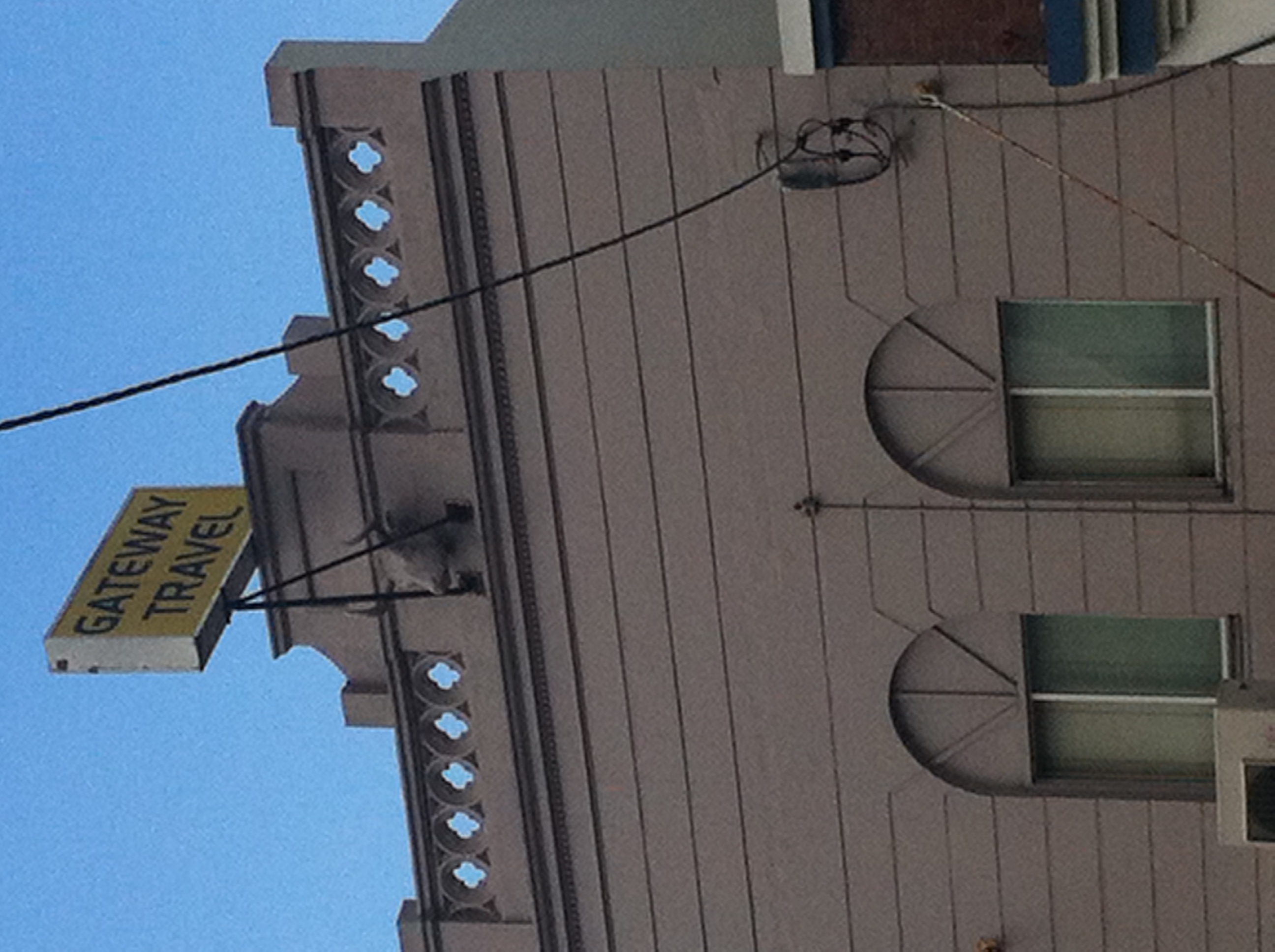
Perhaps its fate as a BBQ restaurant was in the cards all along.
Quinn’s/Breadtop – Bankstown, NSW

While I’m completely prepared to imbue you with the knowledge that Breadtop was once Quinn’s Shoe & Sports Store, I’d much rather take this opportunity to speculate. Indulge me…
When I look at this building, I see a proud store owner, Quinn. Quinn’s just bought this building, and he’s going to take the empty shell of opportunity and fill it with progress and achievement. His passion is sport, and he’s walked away from the certainty and stability of a public sector job in order to follow his dream of running a sports shop. He refurbishes his little miracle, which he’s worked hard for years to afford, and decks it out with the latest sports equipment: Dunlop volleys, Steeden rugby gear, Bankstown Canterbury Bulldogs merch, Kookaburra cricket bats. Friday afternoons and Saturday mornings are go time, and Monday and Tuesday are his weekends. Business is booming, life is good. This is Quinn’s shop, and it always will be.
But Quinn is a protective man. And who can blame him, this is his life’s work. This is QUINN’S Shoe and Sports Store, not yours. Certainly not those louts who come and lift socks or a three pack of golf balls every now and then. Quinn’s heart is so into the business, it sometimes blinds him. Like the time he caught young Jim Sawyer from Yagoona trying to pinch a protective cup. Quinn hit the boy several times, it was rumoured. He broke Jim’s nose. One customer said they found a tooth on the shop floor not long after. Quinn didn’t know that Jim was just too embarrassed to buy the cup himself, and even when he found out, Quinn didn’t care.
Times change. Quinn’s doesn’t. Suddenly, you can get three pairs of shoes for half the price at Rebel, or the Nike outlet. Quinn can’t compete with that. Nintendo and Sega take the place of a bat and ball in one too many homes. Quinn can’t even understand that, let alone compete with it. His children, uninterested in the shop, don’t bother to explain it. The time comes when Quinn fails to make that weekly quota he swore to himself he’d never drop under, and even though it pains him to admit it, he knows it’s time to call stumps.
The first of many would-be leaseholders is shown through the building by the real estate agent, and Quinn insists on coming along. After the third instance of Quinn shouting a prospective tenant out of the shop, the agent stops inviting him. When the deal is finally inked, Quinn can’t stand to see his shop being turned into an anonymous clothing store, or a two dollar shop, or worse still, a ridiculously named bakery. It breaks his heart every time he drives by, but he’s so set in his ways he doesn’t know any other route.
Now Quinn is gone, and the shop is long since sold. And everyone would have forgotten Quinn and his passion if it weren’t for one thing. One minor addition he made years before. Quinn hated the idea of besmirching his building with advertising or signs. His customers knew where to find him, and he wasn’t going anywhere. But when he could see the writing on the wall, he could think of no better way to make himself immortal than to spend his last big windfall on a big-ass sign tightly bolted in a hard to reach position.
This is Quinn’s shop, and it always will be.
Padstow Star Cinema/Civic Video – Padstow, NSW

These days, we know it as Civic Video (or just Civic, if you go by the shopfront sign. I bet they’re dying to be able to remove the word ‘video’ from the rest of their signs, despite how cost ineffective that would be), but prior to 1984 this was the Padstow Star Cinema:

Padstow Star Cinema, 1964. Image courtesy Joe Simiana.
Built in 1952 as the sister cinema to the not-too-distant Panania Star, the Padstow Star was one of many suburban cinemas of old. It’s a concept you can barely imagine now, unless you live in Beverly Hills. In 1985 the cinema closed, with Caravan of Courage: An Ewok Adventure being its last screening. See, Ewoks do ruin everything.
Ever since, it’s been a house of movies in a very different way:

The interior has been refurbished, but it’s still quite easy to see what it originally was. The screen is a dead giveaway:

The projection booth remains as well, and is now the manager’s office judging by the angry, managerial eyes staring out at me when I tried to take a picture of it. Given the impending death of video shops, it’ll be interesting to see if this building gets yet another lease on life in Civic’s wake, or whether the residents of Padstow will have to start drinking for entertainment on a Friday night, like the rest of us.
Yasmar – Ashfield, NSW

As you crawl along Parramatta Road, past the Vita Weat building, the Strathfield Burwood Evening College, the Homebush Racecourse, the Midnight Star, the Silk Road, the Brescia showroom and Chevy’s Ribs, you might notice these forbidding gates peeking out from behind a near-impenetrable wall of bushes. On a road full of head-turners and eye-catchers, a true time warp awaits the hand of progress to seize it by the overgrown scruff of its neck and haul it into the 21st century.
It can wait a little longer while we take a look. After all, it’s only existed in its present state for over 150 years.
The unusual name of Yasmar originated in 1856, when Haberfield landowner Alexander Learmonth erected his home on the estate, which he had inherited through marriage to the granddaughter of ubiquitous Sydney property tycoon Simeon Lord. Learmonth named the house Yasmar after his father-in-law, a Dr. David Ramsay. Surrounding Yasmar House was a magnificent garden, designed in the Georgian fashion to gradually reveal and present the house.

Very gradually, clearly.
In 1904, the property was leased by Grace Brother Joseph Grace, and became his Xanadu. Fittingly, Citizen Grace died in the house in 1911. The estate fell into the hands of the NSW Government in 1944, who promptly proceeded to establish a centre for juvenile justice on site.

When it dawned on the powers-that-be that years of horticultural neglect had created the Alcatraz-style escape proof prison seen today, the estate was turned into a juvenile detention centre, which lasted from 1981 to 1994, when the Department for Juvenile Justice relocated, presumably using machetes. From then until 2006, the grounds housed NSW’s only female juvenile justice centre, and since that time, politicians have argued back and forth to have Yasmar made available to the public.

These days, it appears that Yasmar is used as a government training facility. The entrance is around the side in Chandos Street, giving visitors a sense of the sheer scale of the site.

Seeing as the gate was open, I went right in, ignoring the deterrent magpies perched threateningly in nearby trees.
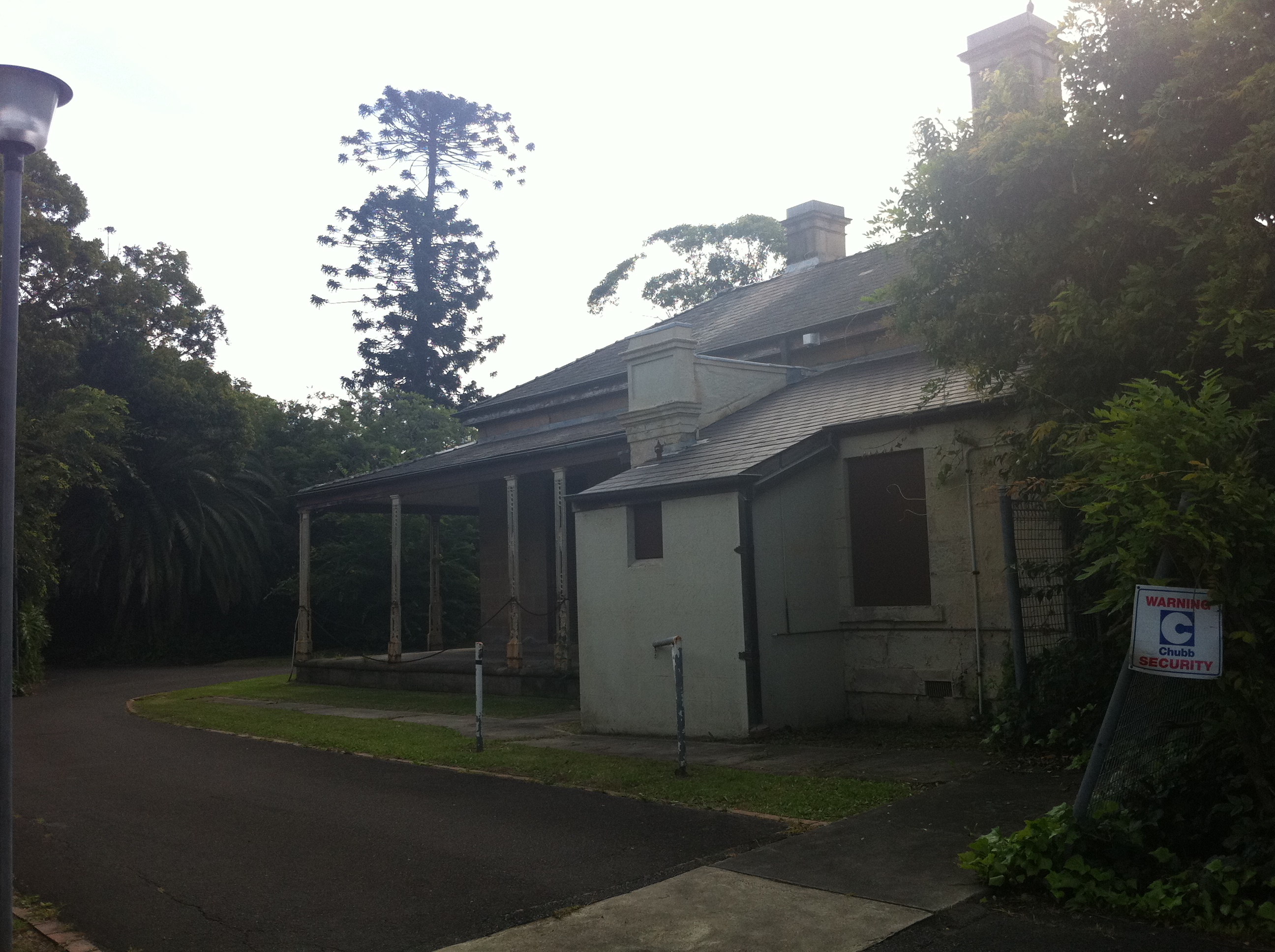
Yasmar’s gardens are huge, but much is now taken up by the training and detention facilities. The open day held in late July allowed visitors a rare look around the grounds and inside the house. What’s that? You didn’t make it? Lucky for you I was there. Read on…

It’s believed that this may have been Australia’s first ever swimming pool, but a more common theory is that it acted as a sunken garden. Either way, it had long since fallen into dereliction by the time I got to have a look.
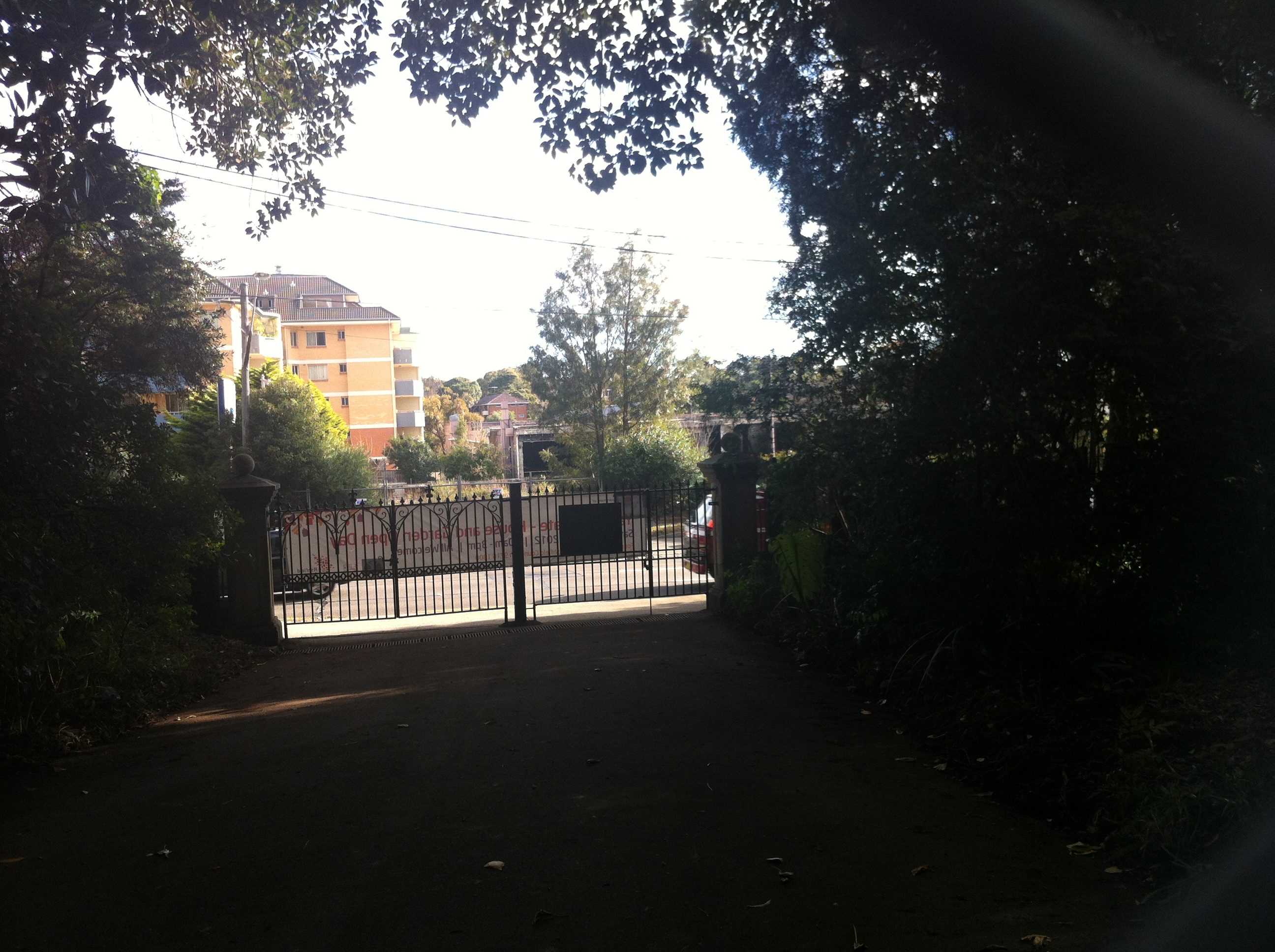
The view from the inside. There have only been a handful of open days held here since the early 90s, and this year’s was the first since 2007, so this isn’t a view many people get. It’s…great.
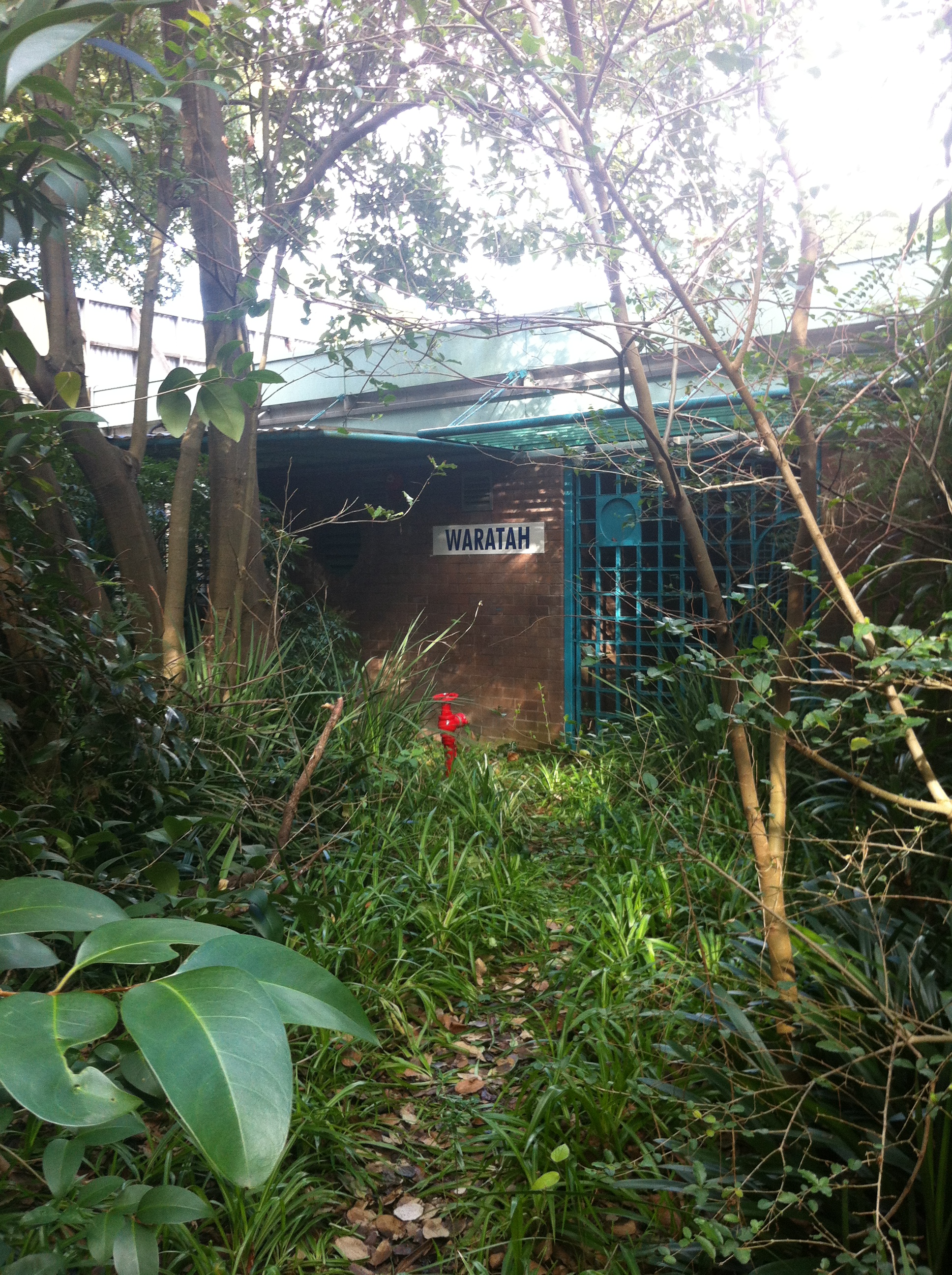
Through the thick foliage you can see the various detention and training facilities located around the grounds.

A better view of the house itself. It’s not all that impressive on the outside. I was expecting something grander. Inside, however…

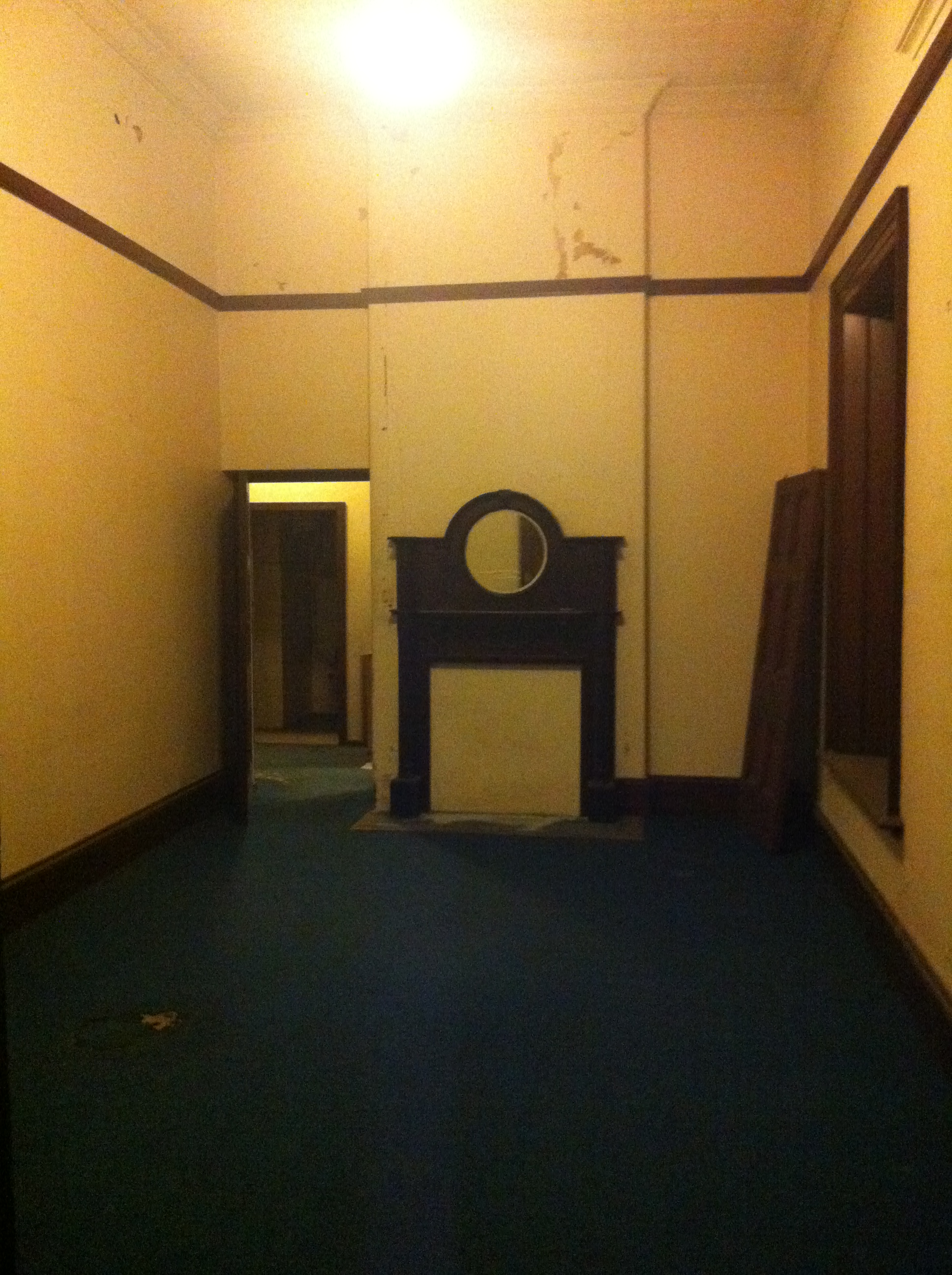


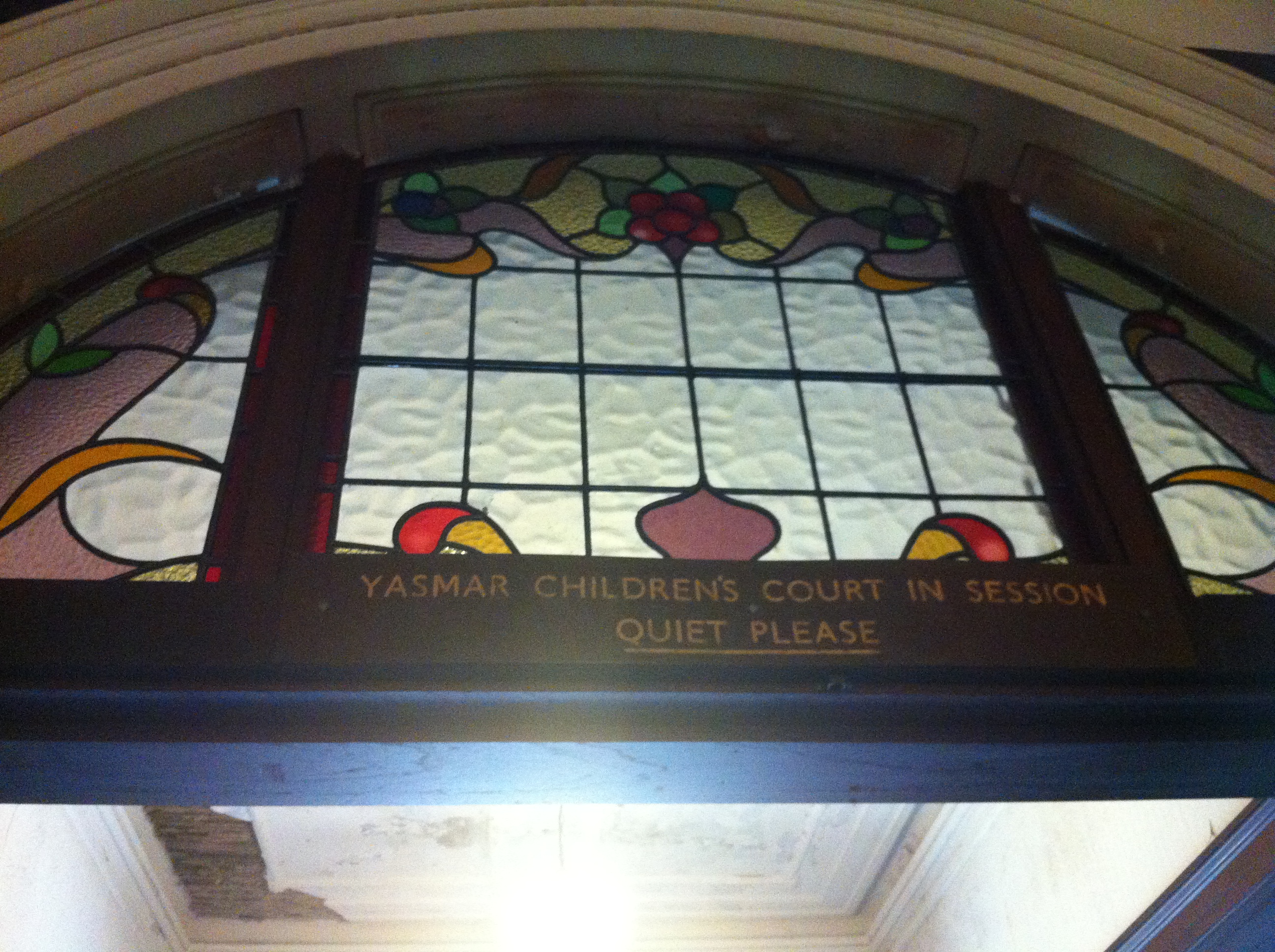
…it’s still just an old house. No, it’s actually fascinating in its own ancient way, and the weight of history here is pretty hefty. Many of those visiting for the open day were former inmates. One hadn’t lost his rebellious nature at all over the years, ducking under the ‘do not cross’ tape to venture deeper into the house before being shouted at by the supervisor. The system doesn’t work.

You wonder just how much they cared about child welfare back then.
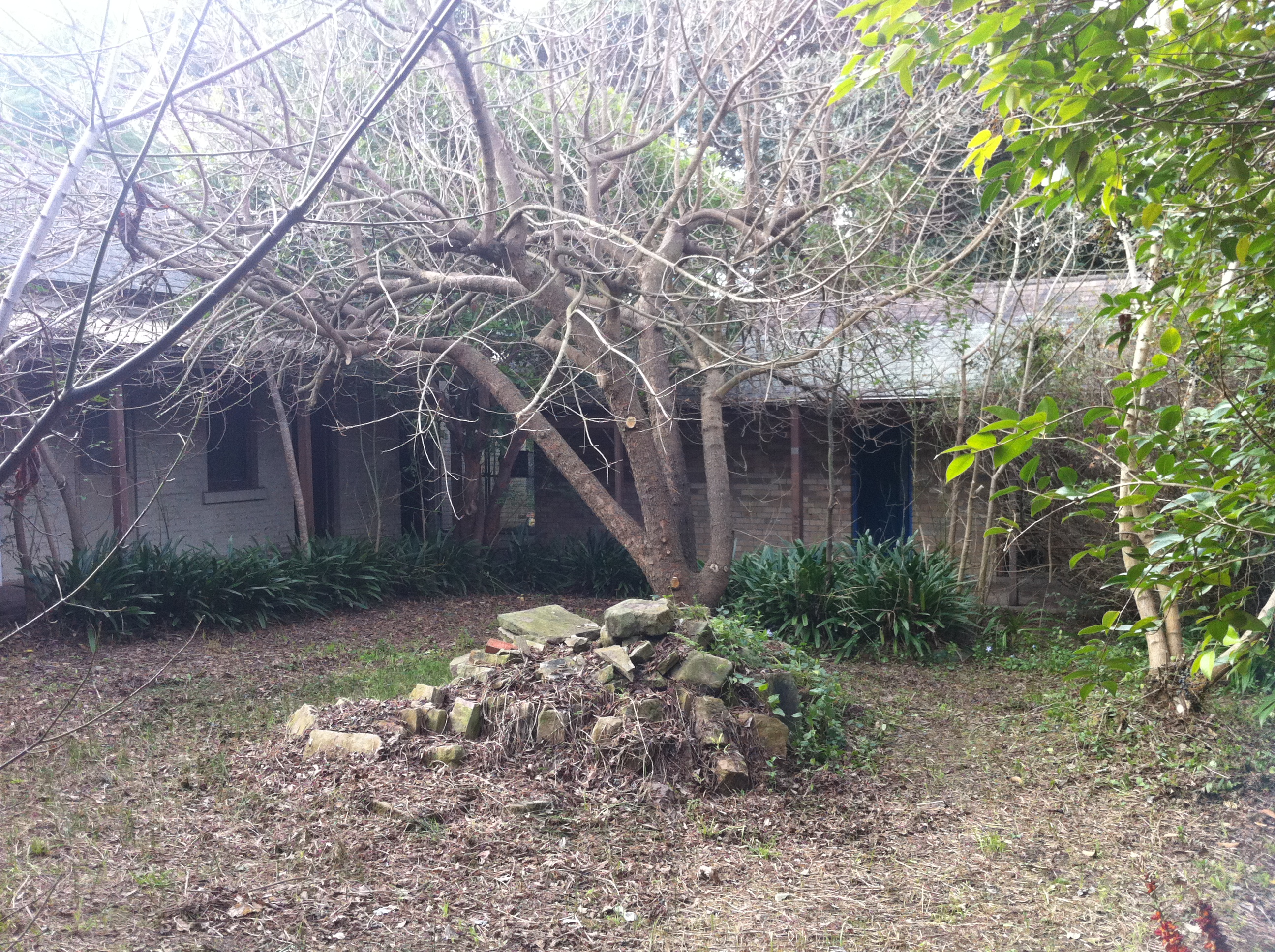
Out in the courtyard it’s pretty bleak. Though they did have one great feature I’m consistently a sucker for:
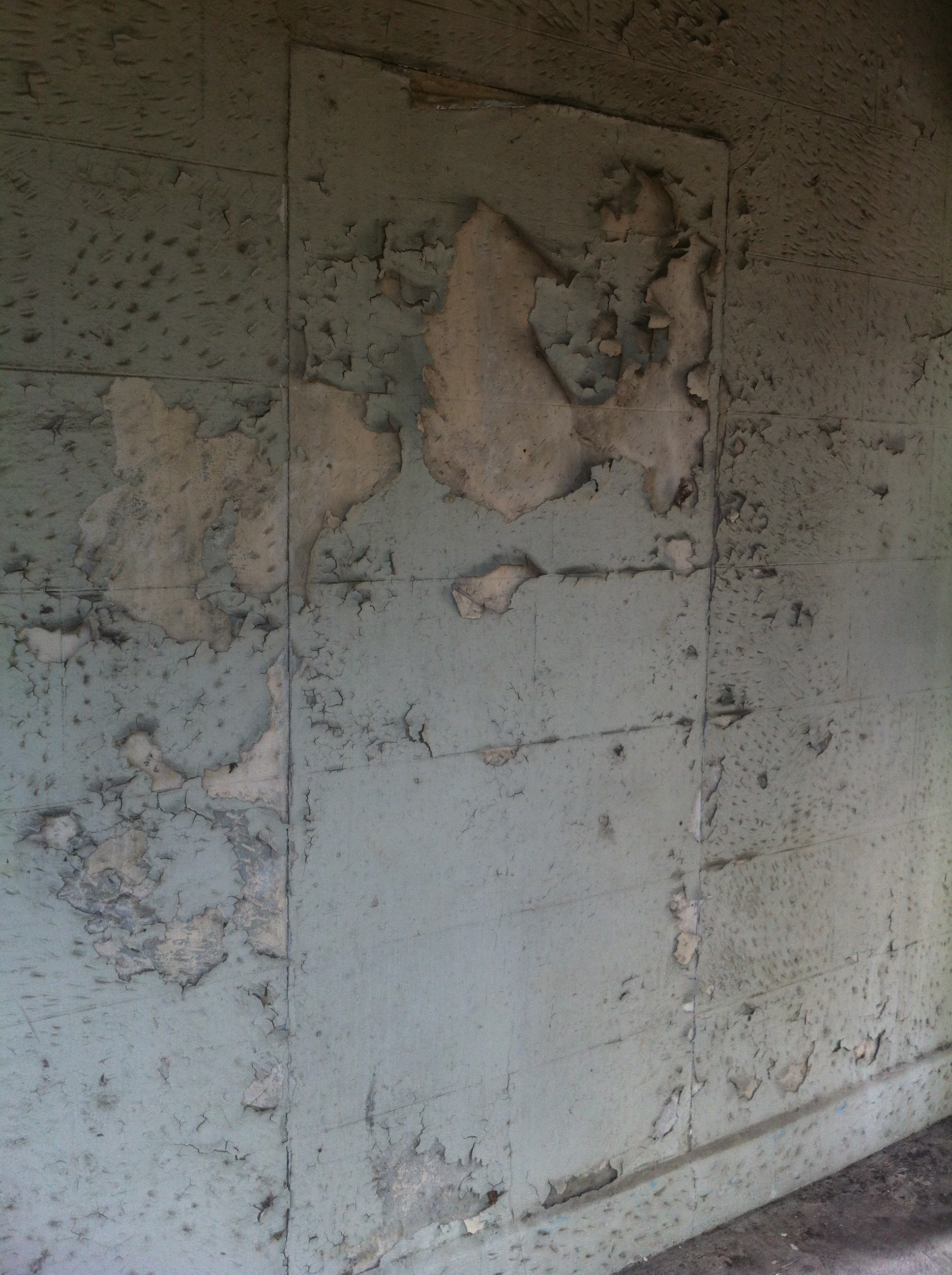
Yes, that’s right. The door to nowhere.
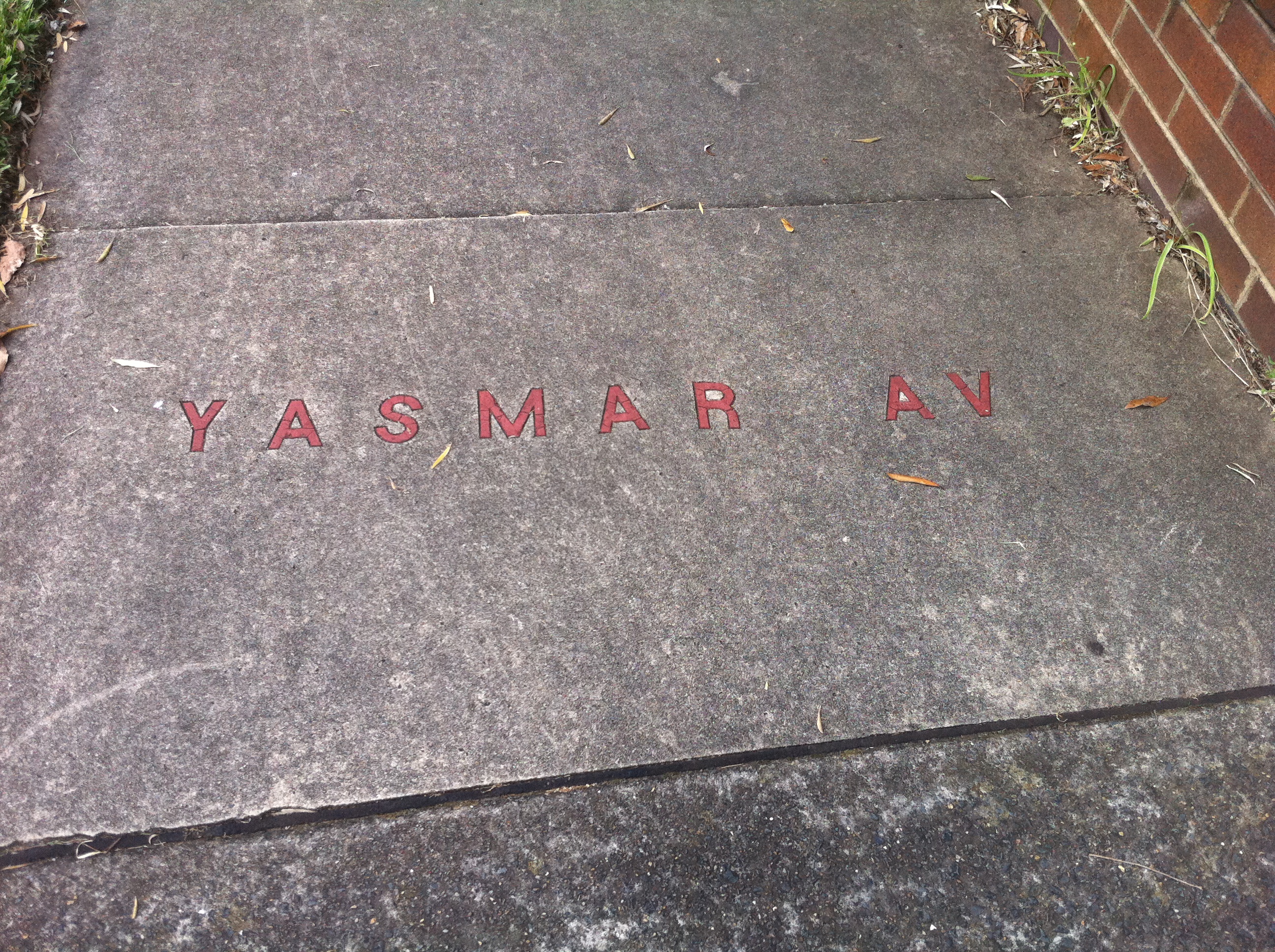
What’s also notable is the nearby Yasmar Avenue, further adding to the sense of entrenchment of the estate within the Ashfield area.
Although neglected and misunderstood like so many of its inmates, Yasmar, Sydney’s Mayerling, exists as a unique example of a 19th century estate virtually unchanged since its establishment. While governments and councils have fooled around for decades over Yasmar’s fate, the estate itself has become an integral part of the Parramatta Road experience. In its current state, it is to Parramatta Road what that ancient expired carton of milk is to your fridge – an indicator of just how bad a housekeeper you are.
For more on the illustrious history of Yasmar, check out Sue Jackson-Stepowski’s excellent write-up here.

 Past/Lives of the Near Future