The Hartee’s Saga, Part III – Punchbowl, NSW

Continued from Part II…
1974 saw further expansion by Hartee’s that almost bordered on arrogance. The original Earlwood store was deemed too small to fit into Hartee’s plan for national dominance, and was closed. The new head office at Mascot suddenly wasn’t good enough either, and a new head office was established at Botany. New outlets were still being opened in the suburbs, like this one at Punchbowl in 1975:

Until recently a Bank of Queensland branch, this location has changed hands more than a few times since Hartee’s left. This was the final Hartee’s store to open, and strangely, it isn’t a drive-thru like all other new stores had been. Maybe Hartee’s knew something we didn’t? Press reports at the time had suggested that Hartee’s had incurred an operating loss of $918,000 AUD in 1973, and were continuing to lose money as time went on. Perhaps they were starting to employ cost cutting measures…
Choys 1000 A.D./MH BBQ Restaurant – Haymarket, NSW

Since 1913, this address on Hay Street in Haymarket had been used as a produce merchant, importing and exporting goods to and from China and Hong Kong. The first leaseholder was a ‘Lee Sang & Co, and throughout the first half of the 20th century, all subsequent leaseholders were companies run by descendants of those involved in the Lee Sang & Co outfit. These companies provided fruit, vegetables and other fresh produce to the city produce markets across the street, now Paddy’s Markets. When the produce markets moved to Flemington in 1977, this address was taken over by Dominic Choy, an architect who had emigrated to Australia in 1962. He refitted the building and opened a restaurant, Choys 1000 A.D. in 1981.
At that time Choy already had other restaurants in Randwick and Gordon, and by 1989 he had six locations all around the city (you might say Sydney was spoiled for Choys), each with a distinct theme. The rustic theme of 1000 A.D. was ancient China, with large wooden tables and benches replacing the traditional restaurant setup. Choys 1000 A.D. seems to have closed sometime after 1996, and today only Choys Randwick remains of the Choy Chinese restaurant dynasty. Even its reputation appears to have declined in recent years, but it says a lot about the well-regarded 1000 A.D. that it took three businesses to replace it: MH BBQ Restaurant, the Hay Street Dental Care above that, and a massage parlour above that. You’d probably have a memorable date night taking them all on in a sort of Game of Death-style tower challenge. I’m not sure what became of the man himself, all I could find was this. For his sake, I really hope he isn’t that kind of architect.
The Commercial Banking Company of Sydney Limited/Burberry – Sydney, NSW

Yeah, this one’s an easy target but it’s Friday, so gimme a break. If we look past the brand name for a moment we can see this building belonged to the Commercial Banking Company of Sydney Limited (CBC). The CBC was established in 1834, and here’s its seal:

Now, I know what we’re all thinking: “How can I find out more about the boat in that seal?”
The CBC website answers our prayers:
“Thermopylae was an extreme composite clipper ship built in 1868 by Walter Hood & Co of Aberdeen to the design of Bernard Weymouth of London for the White Star Line of Aberdeen.
She measured 212’0″×36’0″×20’9″ and tonnage 991 GRT, 948 NRT and 927 tons under deck. The under deck coefficient was 0,58. Rigged with royal sails, single topgallant and double top-sails.
She was designed for the China tea trade, and set speed records on her maiden voyage to Melbourne — 63 days, still the fastest trip under sail. In 1872 she raced the clipper Cutty Sark from Shanghai back to London and won by seven days after Cutty Sark lost her rudder. In 1895 she was sold to Portugal and used as a naval training ship. The Portuguese Navy torpedoed her at sea in 1906.”
But for every nagging mystery solved, another pops up in its place, such as why Burberry needs a safe deposit area:
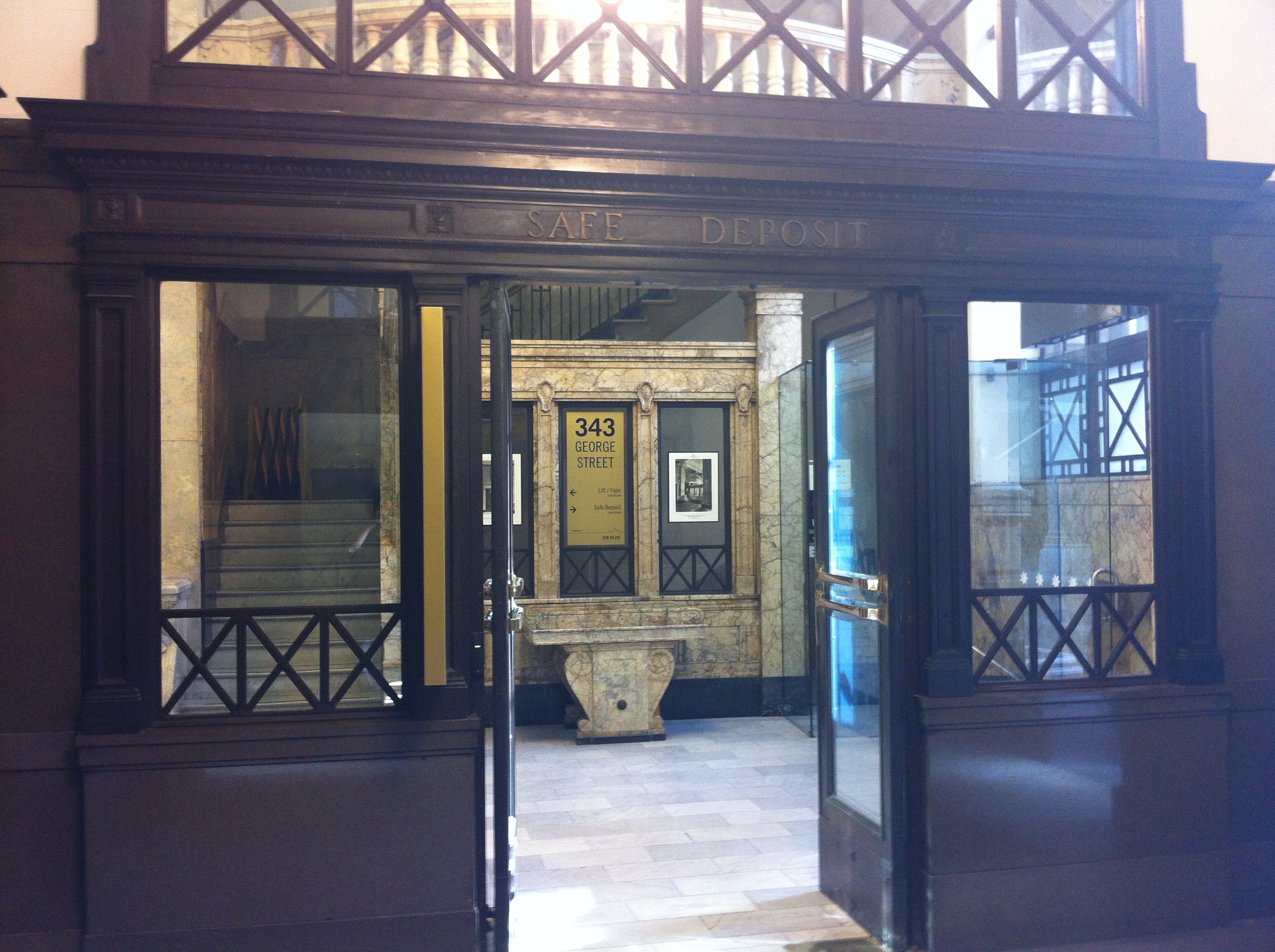
But that just goes to show that they used to build banks to last. To these designers, the CBC was going to rule the waves forever, but the truth is much more banal. In 1981 it was absorbed by the National Australia Bank, whose logo can be found bolted to the front of this building. Looking inside, we can see the extent of the bank’s lavish furnishings:

After having a look at some of those price tags, I can safely say that even though Burberry has only been at this location for a year (it was previously Sydney’s only Virgin Megastore), it’s banked fatter coin than the CBC ever did.
Garden Palace/Royal Botanic Gardens – Sydney, NSW

In 1877, the Royal Agricultural Society of NSW decided to stage an international exhibition. As planning commenced, it became clear that the Intercolonial Exhibition Building in Prince Alfred Park wasn’t going to cut it as a venue. After applying some pressure on the NSW Government, which did not want to appear foolish on the world stage, money found its way to the right place, and the enormous Garden Palace was built in the Royal Botanic Gardens in only eight months, just in time for the exhibition.

The building featured restaurants, tea rooms, a fountain, and yet another statue of Queen Victoria. It contained the city’s first hydraulic lift (they really loved their hydraulic lifts back then, didn’t they?). It also boasted primarily timber architecture, which didn’t work out so well.
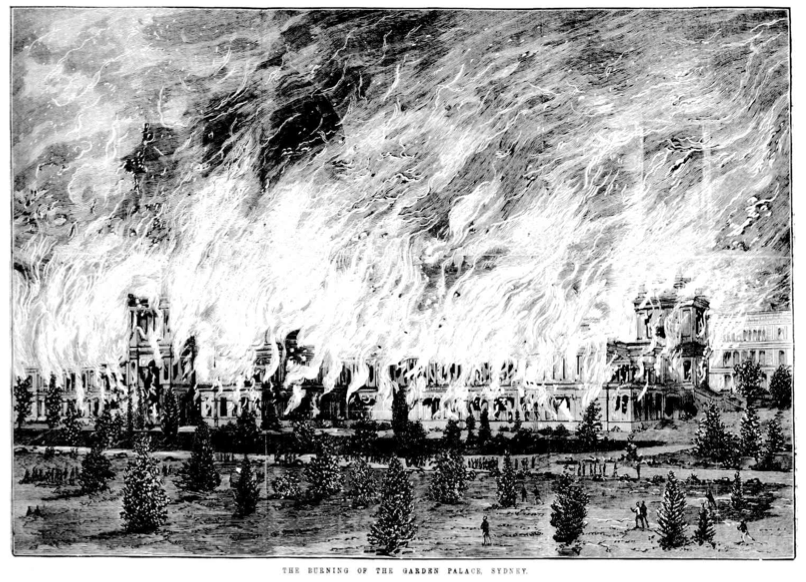
In late September, 1882, the Palace caught fire and burned to the ground. The cause of the blaze has never been established, but in the years following the International Exhibition, there was much consternation about what purpose the Palace would then serve. All I’m saying is, I’m sure there were a few people not sad to see it go. Mourners of the Palace seemed to be most upset by the wastefulness of it all, and by 1890 it had largely been forgotten.

These gates are the only reminder that it was ever there, despite having been erected in 1889 to commemorate the Palace. So wait, people were upset about the wastefulness of the Palace’s destruction, but were okay to build giant gates to a place that was no longer there? So Sydney, so chic…

This tastefully coloured fountain marks the spot of the Palace’s 210 foot tall dome. I’m surprised that’s not Queen Victoria perched on top.

Timbrol Chemicals/Union Carbide/Residential – Rhodes, NSW

Image courtesy retronaut.co
Following on from the Homebush Abattoir is the story of Rhodes, NSW. ‘We’re judged by the company we keep’ has never been truer than in the case of Rhodes, an industrial suburb closely identified with chemicals for most of the 20th century. The winning of the 2000 Olympic Games and subsequent renewal of the former abattoir site at Homebush Bay forced the NSW Government to remediate Rhodes, on the other side of the bay. It was hoped the suburb would be reborn as heavy residential by 2000, but this goal has still not been achieved. The primary reason is this site:

Timbrol was Australia’s first major organic chemical manufacturer, and was established here on Walker Street in 1928. Chemicals manufactured by Timbrol between 1928 and 1957 include chlorine, weed fungicide, and the insecticides DDT and DDE. To commemorate this achievement, a neighbouring street has been named after Timbrol:
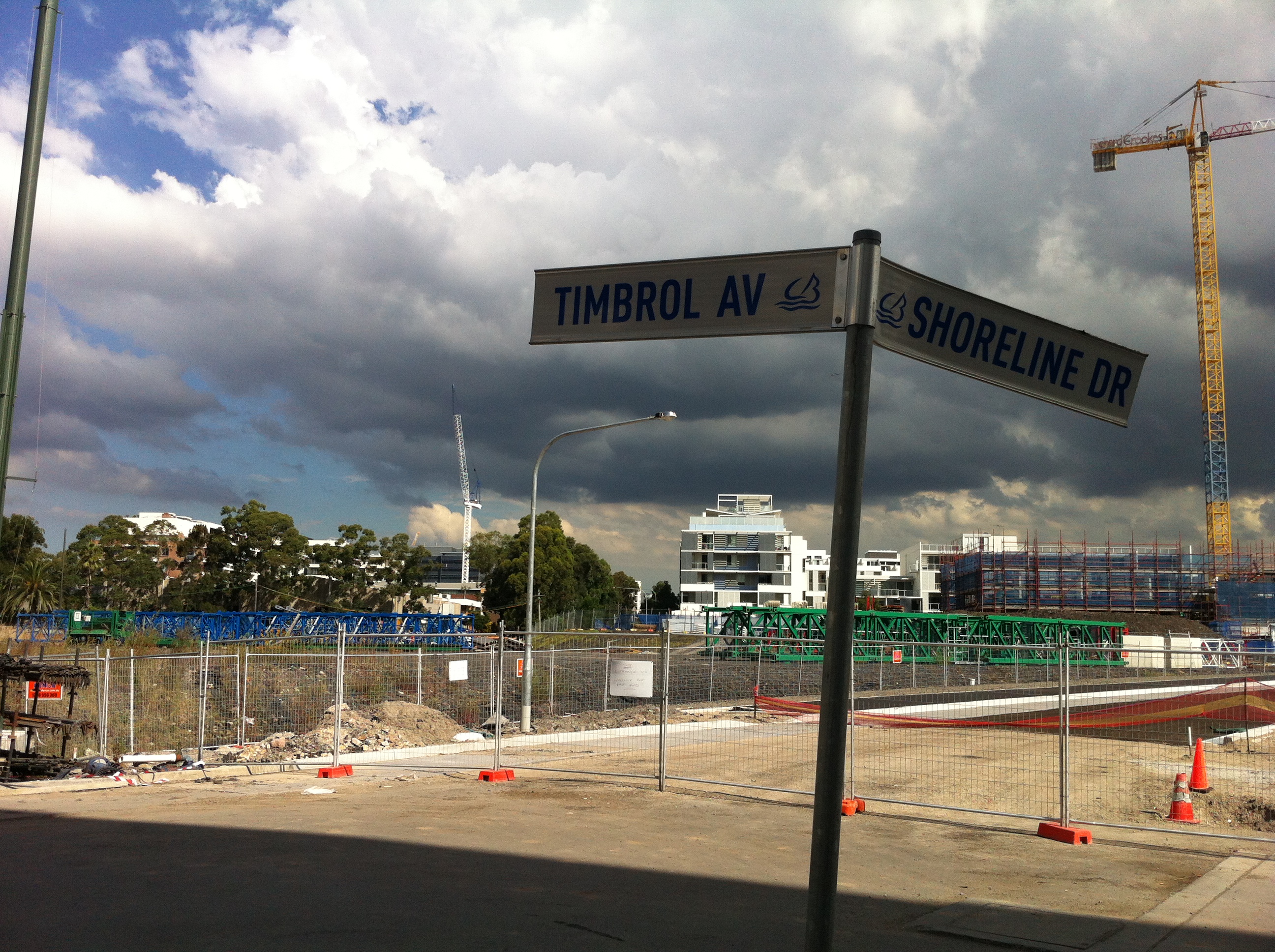
In 1957, Timbrol merged with the American chemical concern Union Carbide to form Union Carbide Australia. Union Carbide had a reputation as an innovator within the chemical manufacturing industry. Facing competition from the neighbouring CSR plant, Union Carbide stepped up production of existing chemical products and created many new ones. During the Vietnam War, Union Carbide produced Agent Orange at their Rhodes site.

Union Carbide site, Rhodes, circa 1960s. Image courtesy Concord Heritage Society.
Whenever Union Carbide would reclaim land from Homebush Bay, it would do so by dumping toxic waste and building over it. This method was extended to the Allied Feeds site further up Walker Street. In 1997, Greenpeace found 36 rusting drums of toxic waste on the former Union Carbide site.
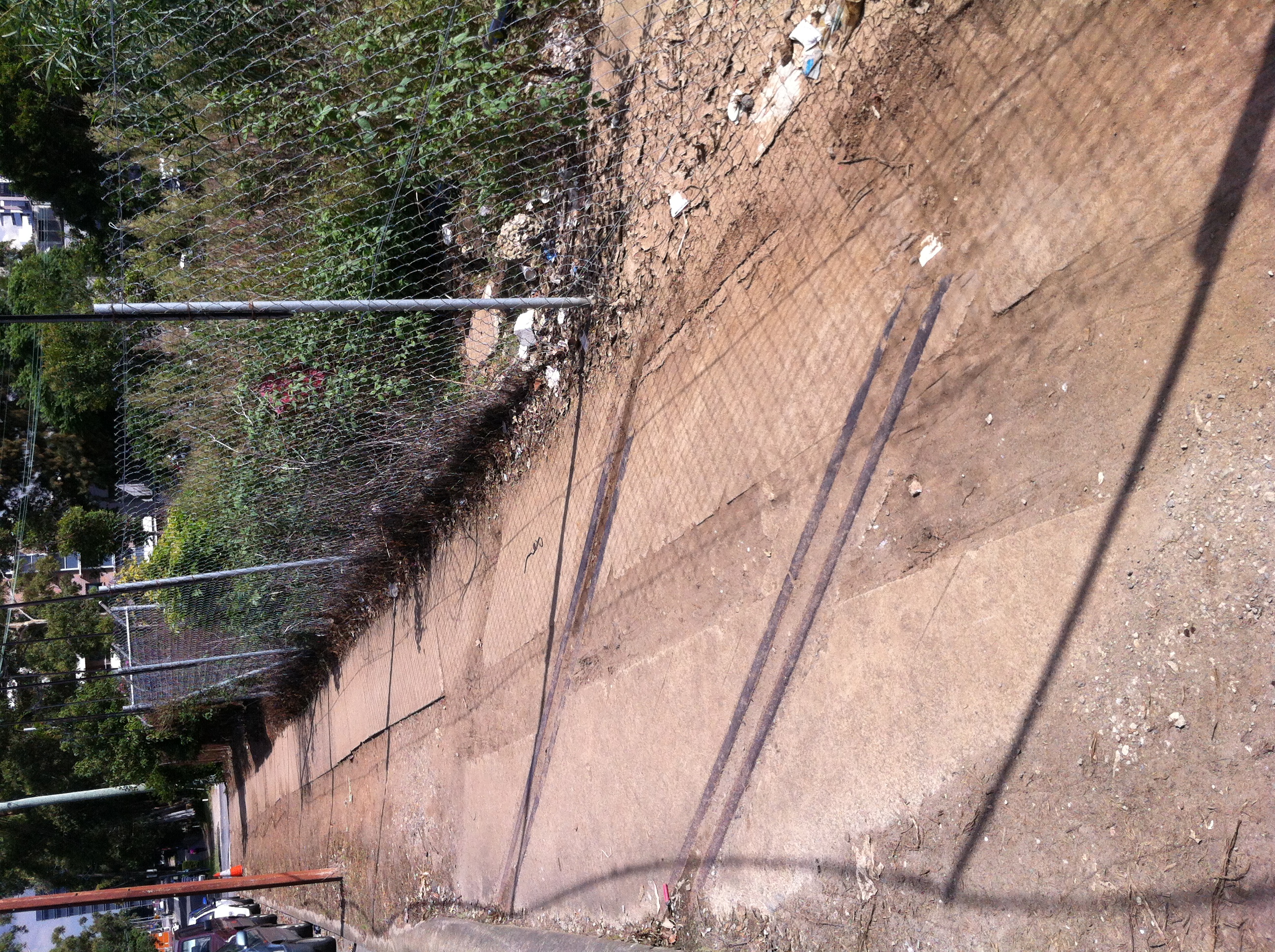
Goods train tracks still exist at the former entrance to Union Carbide.
Faced with declining demand, diminishing returns and increasing competition, Union Carbide abandoned its Australian operations entirely in 1985. They were allowed to leave without conducting any kind of cleanup of the Rhodes site. Between 1988 and 1993, the NSW Govt began remediation attempts with the intention of using Rhodes as an Olympic village for the 2000 Sydney Games, but it was only in 2005, with the onset of private residential construction on the sites, did any serious remediation work take place. Many blocks of units were completed between 2005 and 2011, but remained empty as the ongoing cleanup work made the area too toxic to live in. Remediation was completed in early 2011, and construction has resumed.
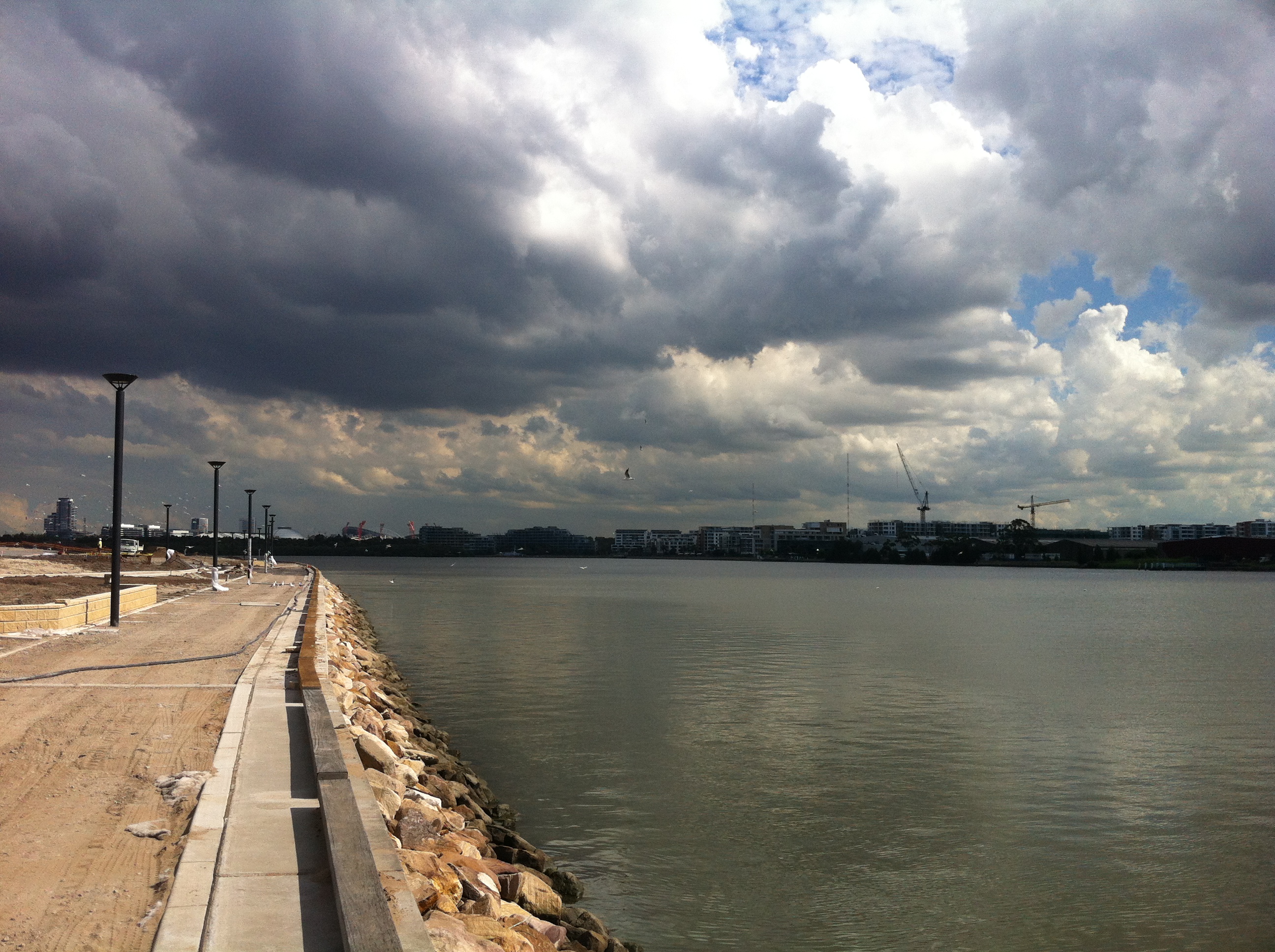
Homebush Bay remains toxic – swimming and fishing are prohibited, and any fish caught in the bay are too poisonous to eat. The remediation work by Meriton and Thiess and has supposedly made the area safe to live in, but only time will tell.
UPDATE: It’s one year later. Is it safe yet? Find out.

 Past/Lives of the Near Future