Food Fair/ANZ Bank/The Base Store/No1 Butchery – Hurstville, NSW
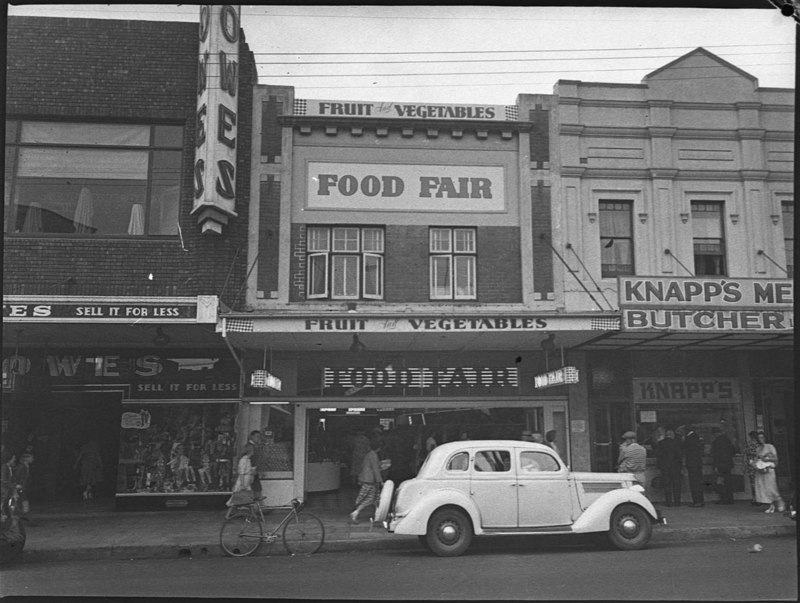
Food Fair, Forest Road, 1951. Image courtesy State Library of NSW.
Sometimes it can be fun to take a look at the evolution of a shop over time. It reveals a lot about the changing face of the suburb, shoppers’ tastes and the sensibilities of the time, among many other things. In this case, we’re looking at 274 Forest Road, Hurstville. In 1951, it was Food Fair, an extremely 50s looking fruit and vegetable shop. Now, take a good look at this picture. You’d never get away with parking a car on Forest Road like that these days, and you certainly wouldn’t ever see your bike again if you just left it unattended and unchained like that. Before the advent of the Westfield, or the Super Centre above the Hurstville train station, these shops were the lifeblood of the suburb that coursed through the vein that is Forest Road.
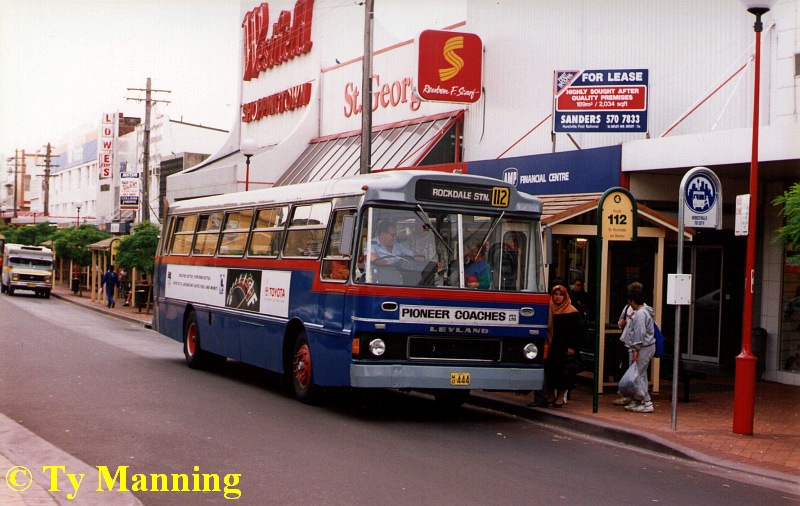
Hurstville, circa 1986. Image courtesy Ty Manning, clearly.
This one’s a stretch, but use your enthusiasm to zero in on the barely visible ANZ logo next to the Lowes, which is still there 30 years later. It makes sense that by the 80s, the banks had staked out territory amongst the little shops along the street. Food Fair would have had nowhere else to go but bust even if it had survived the 1978 opening of Westfield (which I’m guessing it didn’t).

Hurstville, 2002.
Here we are again, in the new millennium. Now the shop is home to The Base Store, a $2 shop/party goods outlet. How shops like these were able to flourish in the 90s/00s is beyond me, but think back – they were everywhere. It all started with the novelty of the Reject Shop, and then things got out of hand. We only have ourselves to blame. By this point the bank is long gone, a victim of the online revolution and branch closures. Firing workers is the best way to save money, you know.
 Which brings us to today. Oh, how things have changed (except Lowes, which appears to be the foundation Hurstville was built around). The former Knapps Butchery has become a Chemist Warehouse, and the party’s over for the Base Store. It’s now Butchery No. 1, or No1 Butchery as Google likes to call it, and fittingly too – it’s anonymous as hell. There’s the Rav 4 parked in the same place as the car in 1951, and they both have the spare tyre on the back. The custom facade of the Food Fair has long since been covered up by the dirty venetian look of ANZ, which itself has left an ugly stain (what a visual metaphor). The ubiquitous-yet-defunct Anata Awning has ensured that Food Fair’s legacy is lost to the world, but I can’t help but think if you tore that facade down, the Food Fair shopfront would be waiting patiently behind it for one more day in the sun. It sounds fair to me.
UPDATE: One year later, No. 1 Butchery is #10 in the Past/Lives Flashback series. Check it out.
Washington H. Soul Pattinson & Co. Chemist/Key College House/Derelict – Sydney, NSW
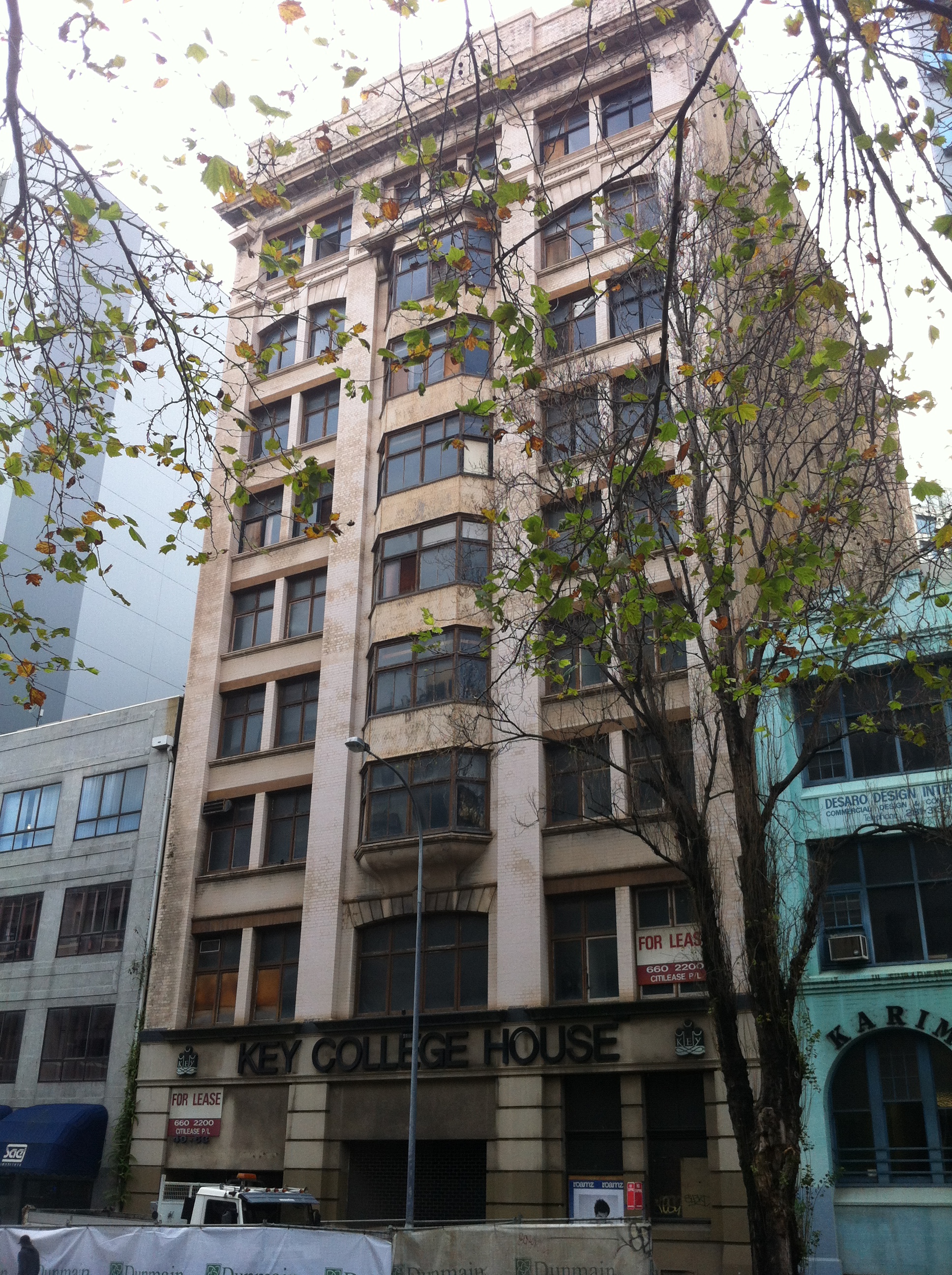
Thanks in part to the TV show, hoarding has recently risen in prominence in the public consciousness. That strange compulsion to keep every little thing ‘just in case’ quickly turns houses into landfills and cars into garbage trucks. It’s heartbreaking. When you’re rich, being a hoarder means you have to step things up a notch; for example, Sydney real estate moguls Isaac and Susan Wakil. The Wakils, through their essentially-defunct Citilease company, own a variety of vacant buildings around the inner city and Pyrmont, including the Terminus Hotel, the Griffiths Tea building, and Key College House. In true hoarder fashion, those wacky Wakils refuse to allow anything to be done with these buildings, even if it makes financial sense, and as a result they’ve become either a squatter’s paradise or in the case of the Key College House, a neglected monolith spreading an atmosphere of dereliction amid an already destitute area.

Courtesy SMH, 25 Aug 2003.
It’s hard to find much on the building’s history. Depending on who you listen to (Soul Pattinson or the city), the building was constructed in either 1916 or 1930 as a modern warehouse and factory for Washington H. Soul Pattinson & Co, and still features a huge, partially obscured sign for the chemist on its side. Soul Pattinson’s operations outgrew the building and moved to Kingsgrove in 1960.
Key College House features For Lease signs with six digit numbers, so they’ve been there since before 1994. Key College itself is located in Surry Hills, an initiative of Youth Off the Streets. I’m not entirely certain if there’s a connection, but even if there isn’t, think of all the youth that could be kept off the streets should Key College House be redeveloped into viable accommodation.
Newsagent/Dalat Hot Bread – Concord West, NSW

Here’s a fun instance of ‘street musical chairs’. Exhibit A: Dalat Hot Bread in Concord West. An ordinary shop with an ordinary awning…

But on closer inspection we can see that it says Financial Review. Clearly, this was once a newsagent. But Concord Westians still need newspapers, so where did it go?

A few doors up along Concord Road is what is now the newsagent, but looking at that sign it was clearly once something else. It’s a tough sign to read, so I’ll leave open to interpretation, but I wonder why the newsagent moved? Was the rent too high two doors along? Were there not as many customers at that specific latitude?
The Tradesman’s Arms Hotel/East Village Hotel – Darlinghurst, NSW

The owners of the East Village Hotel in Darlinghurst have tried their best to reinvent the place as a hip, relaxed pub in the middle of a trendy area, but it’s hard to miss the hotel’s old name – the Tradesman’s Arms – at the top. These days it’s hard to imagine tradesmen’s arms anywhere near this place, unless it’s to subject the pub’s period interiors to another refit.

The Tradesman’s Arms, circa 1930
Speaking of period, the Tradesman’s Arms dates back to 1918, and during its lifetime was known as the ‘Bloodhouse’, due to the extreme violence often on show within. It’s creepy to think that there was a pub in the Darlinghurst-Kings Cross area that stood out for its violence; nowadays it’d probably be considered pretty tame. In a time when tradesmen were wise to arm themselves with razor blades, this place was a favourite watering hole of Sydney underworld figure Tilly Devine, which should absolutely not come as a recommendation. No wonder they changed its name.
Sharpie’s Golf House/Harmex Golf/Derelict – Sydney, NSW

I see you back there, Edwards & Co. Ltd. You’ll get your turn…
Yes, the kitschy neon sign is what Sharpie’s Golf House is best known for, but there’s a bit more to it than that. For starters, the sign has been gone for years, having been taken down by the City of Sydney in 2007 for ‘refurbishment’. How long does it take to replace a few tubes?
The origins of Sharpie’s Golf House lie in the shop next door. It’s currently the empty shell of the former Gold Sun Supermarket, but in 1918, when Russian immigrant Harry Landis bought it, it was the Railway Loan Office, named for its proximity to Central Station. Landis moved into the current Sharpie’s address in 1923, and proceeded to divide the pawn shop into two sections: musical instruments and sporting goods, with an emphasis on golf.

After the Second World War, the sporting side was renamed The Golf House, and in 1964 the animated neon sign featuring the world’s best golfer (he always gets a hole-in-one) was erected after six years of construction. Until its removal, it was Australia’s second oldest neon sign (Melbourne features the oldest. You gonna take that lying down, Sydney?). The music business moved to Park Street in 1977, and the Golf House became Sydney’s premier golf store. This prestige attracted pro golfer Lindsay Sharp, who bought the shop in 1985 and renamed it after himself, forcing a change to the neon sign. That’s why the red ‘Sharpie’s’ part looks so out of place.

Sharp himself sold the ever-declining business in 1999, and in 2004 it became Korean-owned Harmex Golf, which limped on for a few years before closing its doors for good in 2007. Looking around the area it’s not a surprise – what was once a thriving business zone has become a wasteland with a bad reputation, filled with backpacker hostels and husks of businesses long gone. I’m not complaining; it’s great for what I’m doing. But it’s a sad look for the city, especially so close to the train line. Besides, it’s not like there are any golf courses in the immediate vicinity, so it’s not hard to imagine the golfing community getting fed up with making the trek out here every time they wanted a decent 5-iron. At least they made for good weapons when they stepped back out into the street.

The building today is a mess. Sharpie’s has been dulled. It’s dirty, covered in posters and falling apart. Even by Elizabeth Street standards it’s an eyesore. The part I’m having a hard time getting over is the indoor driving range. It had an indoor driving range! For how long? How did it work? I’ve played those virtual golf simulators indoors before, but surely this was set up long before those were around. It’s not even that long a building, how did Sharpie have room to get his drive on?

Do all those hole-in-ones count if he’s been playing the 19th hole all these years? Image courtesy SMH, 25 Aug 2003
It’s alleged that the sign sits inside, heritage listed, waiting for a spit and polish that’ll likely never come. There have been a few proposals submitted to the Sydney City Council to demolish the current site and reincorporate the sign into whatever is built in its place, but all have been declined. It’s not like they’re going to build another Golf House, so why not just leave it in the past? Why not take the opportunity to breathe some life back into this part of town, and create tomorrow’s heritage listed signs? For all the talk of preservation, Sharpie was quick to flush a 20-year-old sign down the toilet to remake it in his image. It’ll likely go the way of the Regent Theatre on George Street, and we’ll be able to live in Sharpie Tower in 20 years time. There’s something to look forward to.

 Past/Lives of the Near Future