John Sands Building/For Lease – Wynyard, NSW
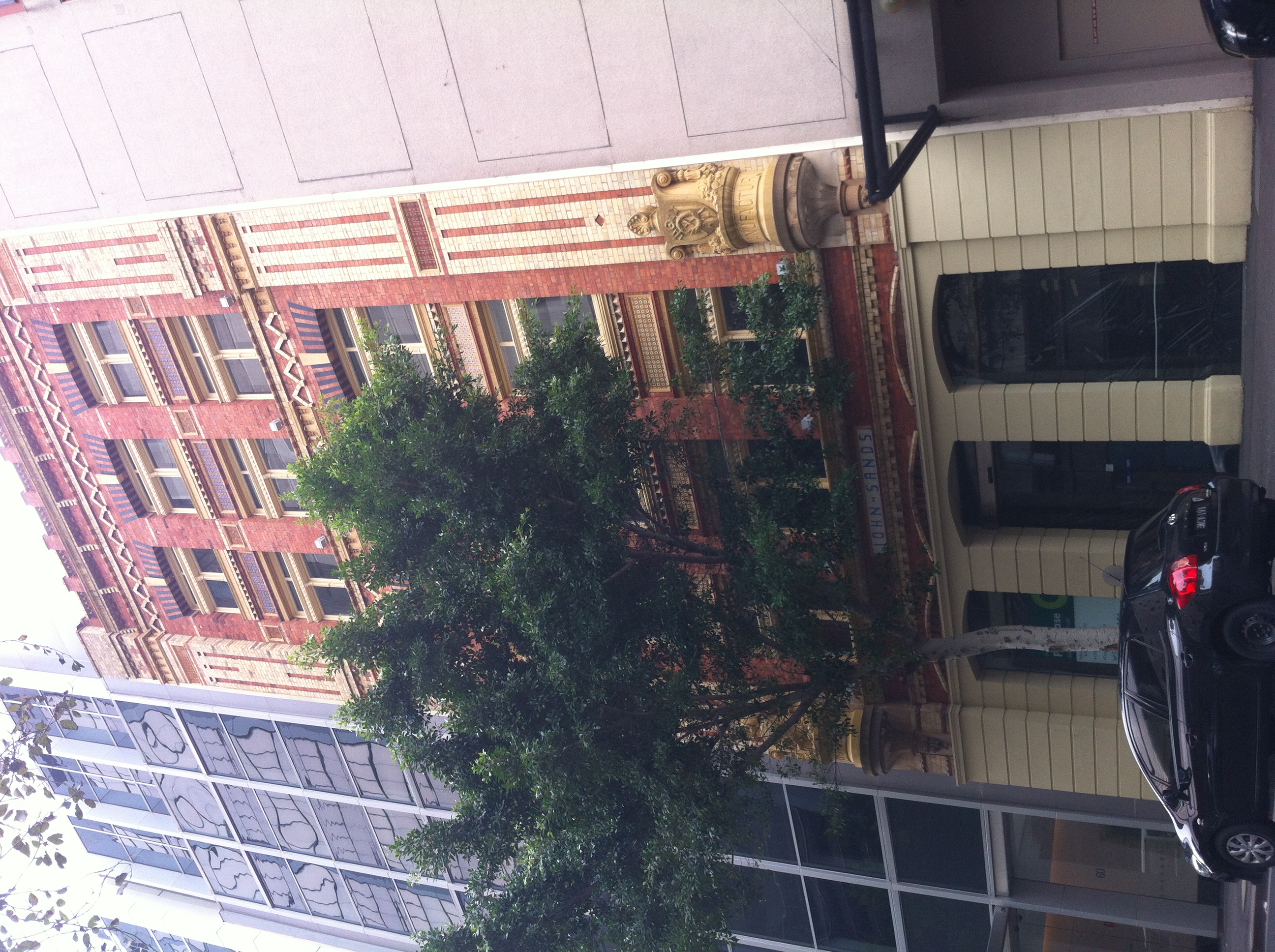
If you’ve ever had a birthday, chances are you’ve received a card from John Sands. Although John (1818-1873) has been indisposed for a fair period of time now, he never forgets a birthday, a funeral, an unexpected pregnancy, or any other occasion requiring a “social expression”. These days, John Sands is owned by the fittingly named faceless corporation American Greetings, but back before he sold out, Sands ran his operations from locations (dunes?) in Druitt Street, the flagshop in George Street, and here, in Clarence Street.
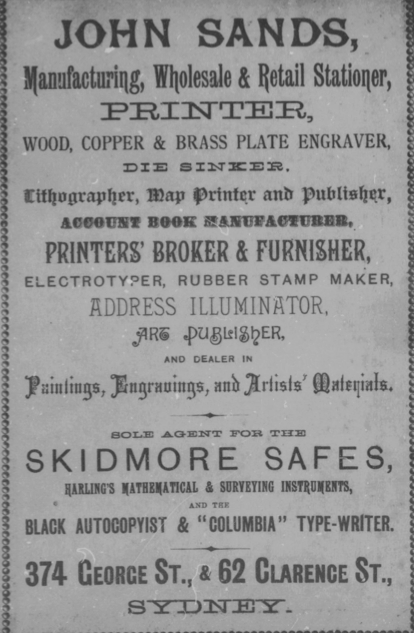
As you can see, John and the other Sands made a living sinking dies, engraving plates and printing all manner of stationery. Someone was canny enough to have engraved the business name all over this building too, because now it’s heritage listed. Despite the listing, it’s currently for lease, despite plans in recent years to convert it into an Italian restaurant and a Nando’s chicken shop, among other things. To survive a Nando’s incursion…that’s staying power. I guess you might say [Terrible sand erosion pun removed for everybody’s sake – Ed].
Demco Machinery/Mao & More – Surry Hills, NSW

Demco Machinery, 1989. Image courtesy City of Sydney Archives, SRC15993.
The Demco Machinery site, on Cleveland Street in Surry Hills, is made up of two separate buildings. The one in the foreground here is the oldest, first used as a tobacco factory in 1911, and then a tea company until the 1920s. Once Demco moved in around 1930, they patiently waited for the St Margarets Hospital for Women Dispensary next door, built in 1906, to fall on hard times. They didn’t have to wait long:

SMH, April 19, 1938.
Strangely, although the building’s address is currently 267-271 Cleveland Street, advertisements prior to 1953 give Demco’s address, as well as that of the hospital and the tobacco factory, as 243-247 Cleveland Street. There must have been a renumbering of Cleveland Street around that time, as to avoid confusion, from 1948 Demco started advertising their address as ‘corner of Cleveland and Buckingham Streets’.
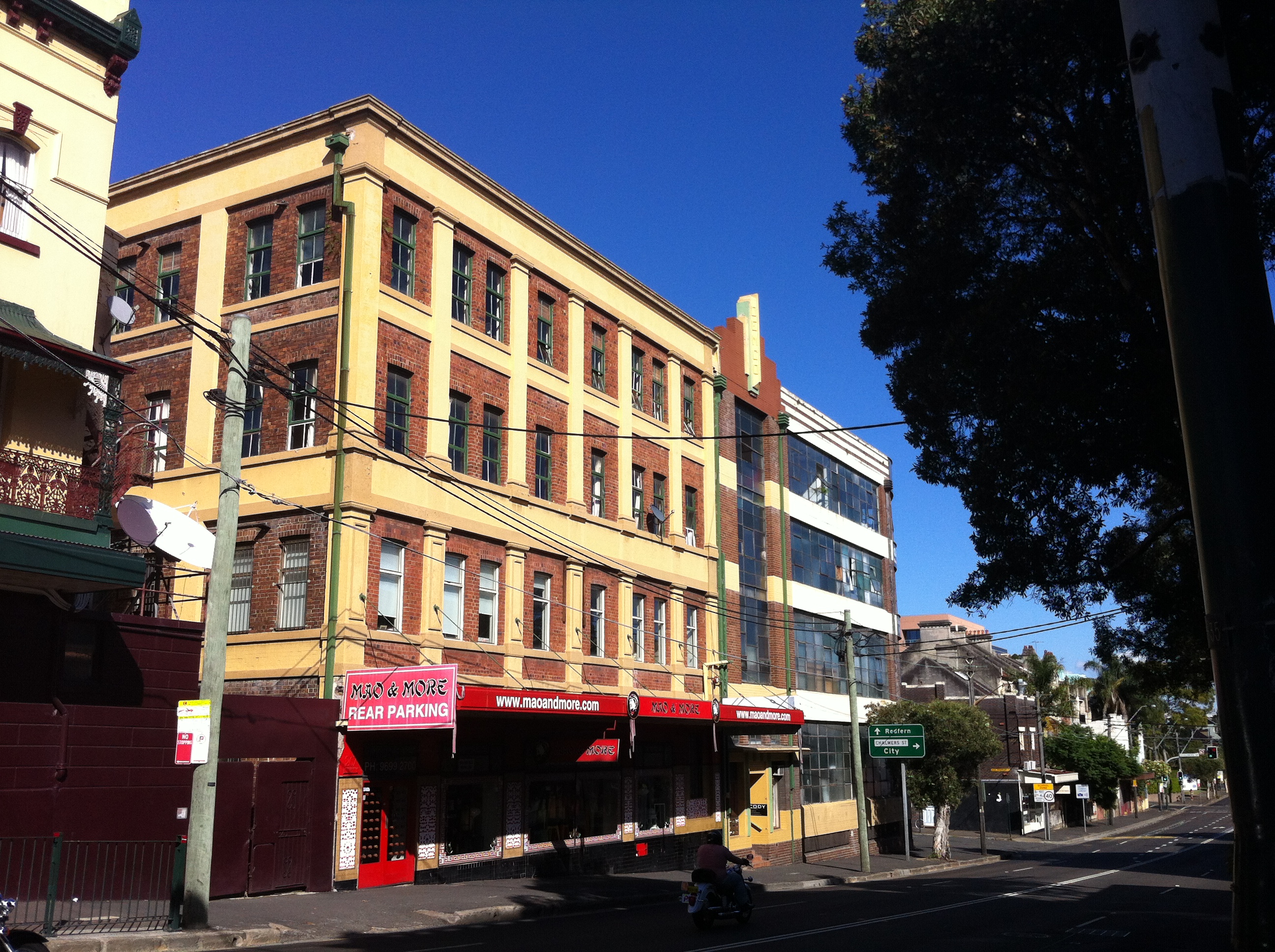
Demco building, 2012.
Demco packed up its city operations in 1989, moving out to Greenacre as part of the industrial migration to Sydney’s west. Since 2002, the older half has been occupied by Mao & More, a Sinophile’s paradise of kitschy Oriental paraphernalia very at home in the increasingly gentrified area. The showroom half of ‘modern design’ Demco were so proud of currently consists of several businesses, including The Gingerbread Man, a film and web production company located in the basement; and a sportswear manufacturer. The only evidence of Demco’s time here is the art deco Demco sign still sitting atop the building.
Tulloch’s Phoenix Iron Works/Rhodes Corporate Park – Rhodes, NSW
Let’s return to Rhodes one more time…

In 1913, Robert Tulloch relocated the Phoenix Iron Works from Pyrmont to Rhodes, cementing, along with the Hoskins cast iron foundry and Timbrol Chemicals, the suburb’s reputation as an industrial area.

Tulloch’s Phoenix Iron Works stood on what is now the HP building at Rhodes Corporate Park. During the Second World War, Phoenix produced a number of ships, and in the 1960s, manufactured CityRail’s rolling stock of train cars. RailCorp’s modern-day tendency to keep crusty old trains servicing high volume areas can be seen as a tribute to Tulloch’s work.
A tribute of another kind exists opposite the Corporate Park:


Yes, what better way to honour a man who’d spent his life in Iron Works than to erect an Iron Work in his memory.

Aeroplane Press, September 1974.
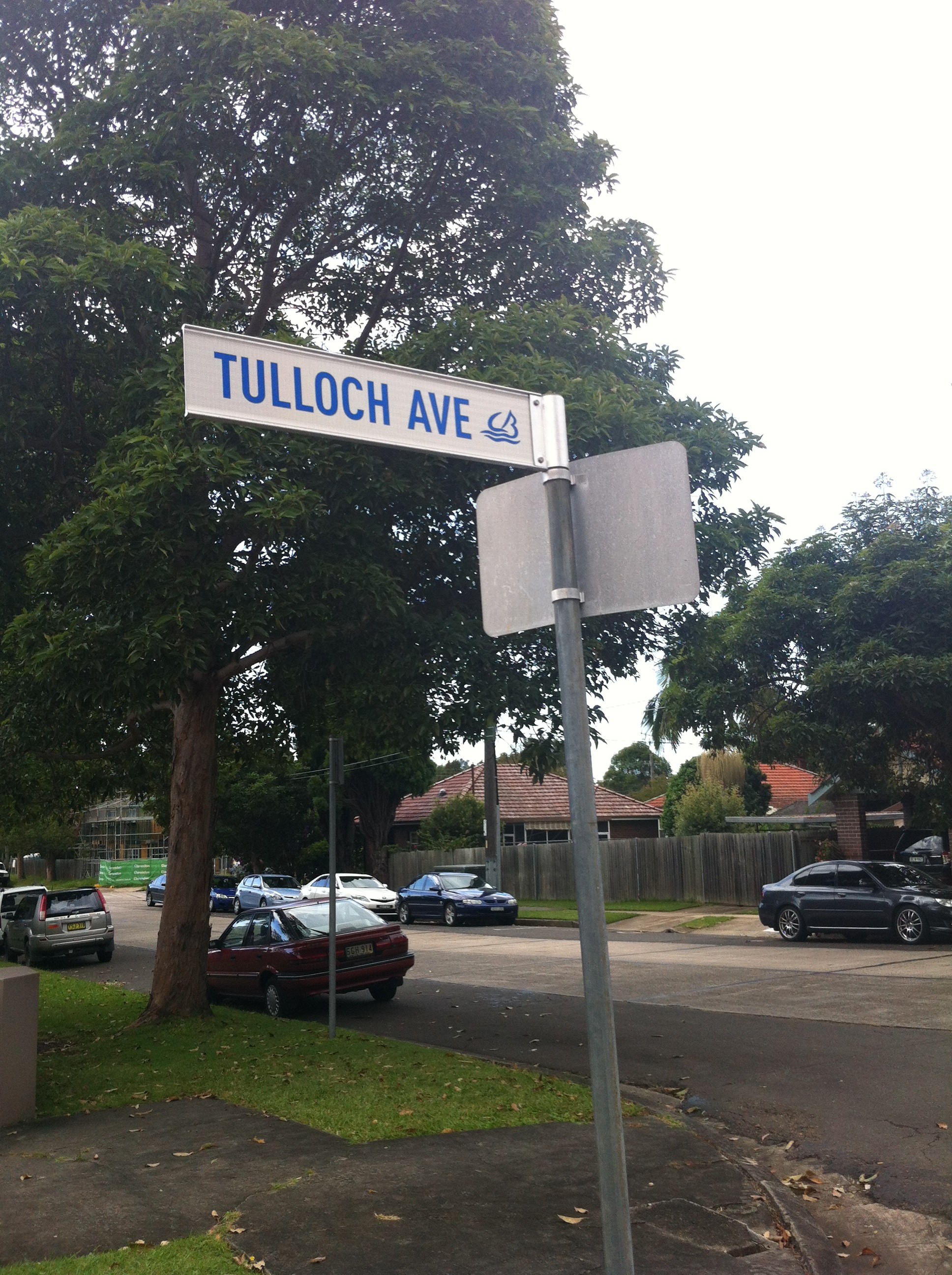
The Phoenix Iron Works closed in 1974, but other reminders remain in the area, including Phoenix Ave, seen above, and Tulloch Ave:
The Chinese restaurant in the nearby Rhodes shopping centre is also named Phoenix. It’s a fitting metaphor for Rhodes, rising as it did from the ashes of industrial abuse to become a vibrant suburb in the 21st century.
Timbrol Chemicals/Union Carbide/Residential – Rhodes, NSW

Image courtesy retronaut.co
Following on from the Homebush Abattoir is the story of Rhodes, NSW. ‘We’re judged by the company we keep’ has never been truer than in the case of Rhodes, an industrial suburb closely identified with chemicals for most of the 20th century. The winning of the 2000 Olympic Games and subsequent renewal of the former abattoir site at Homebush Bay forced the NSW Government to remediate Rhodes, on the other side of the bay. It was hoped the suburb would be reborn as heavy residential by 2000, but this goal has still not been achieved. The primary reason is this site:

Timbrol was Australia’s first major organic chemical manufacturer, and was established here on Walker Street in 1928. Chemicals manufactured by Timbrol between 1928 and 1957 include chlorine, weed fungicide, and the insecticides DDT and DDE. To commemorate this achievement, a neighbouring street has been named after Timbrol:
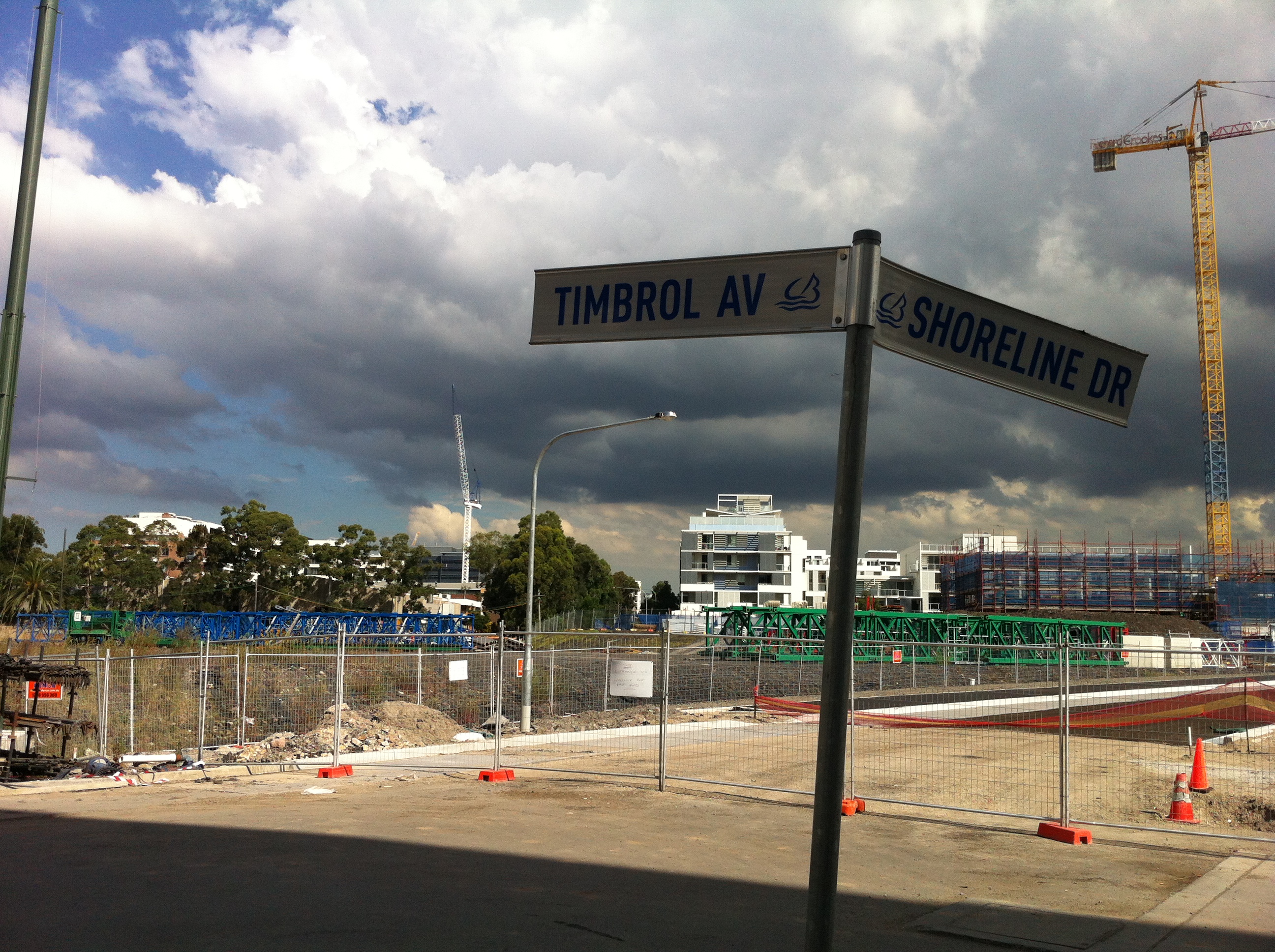
In 1957, Timbrol merged with the American chemical concern Union Carbide to form Union Carbide Australia. Union Carbide had a reputation as an innovator within the chemical manufacturing industry. Facing competition from the neighbouring CSR plant, Union Carbide stepped up production of existing chemical products and created many new ones. During the Vietnam War, Union Carbide produced Agent Orange at their Rhodes site.

Union Carbide site, Rhodes, circa 1960s. Image courtesy Concord Heritage Society.
Whenever Union Carbide would reclaim land from Homebush Bay, it would do so by dumping toxic waste and building over it. This method was extended to the Allied Feeds site further up Walker Street. In 1997, Greenpeace found 36 rusting drums of toxic waste on the former Union Carbide site.
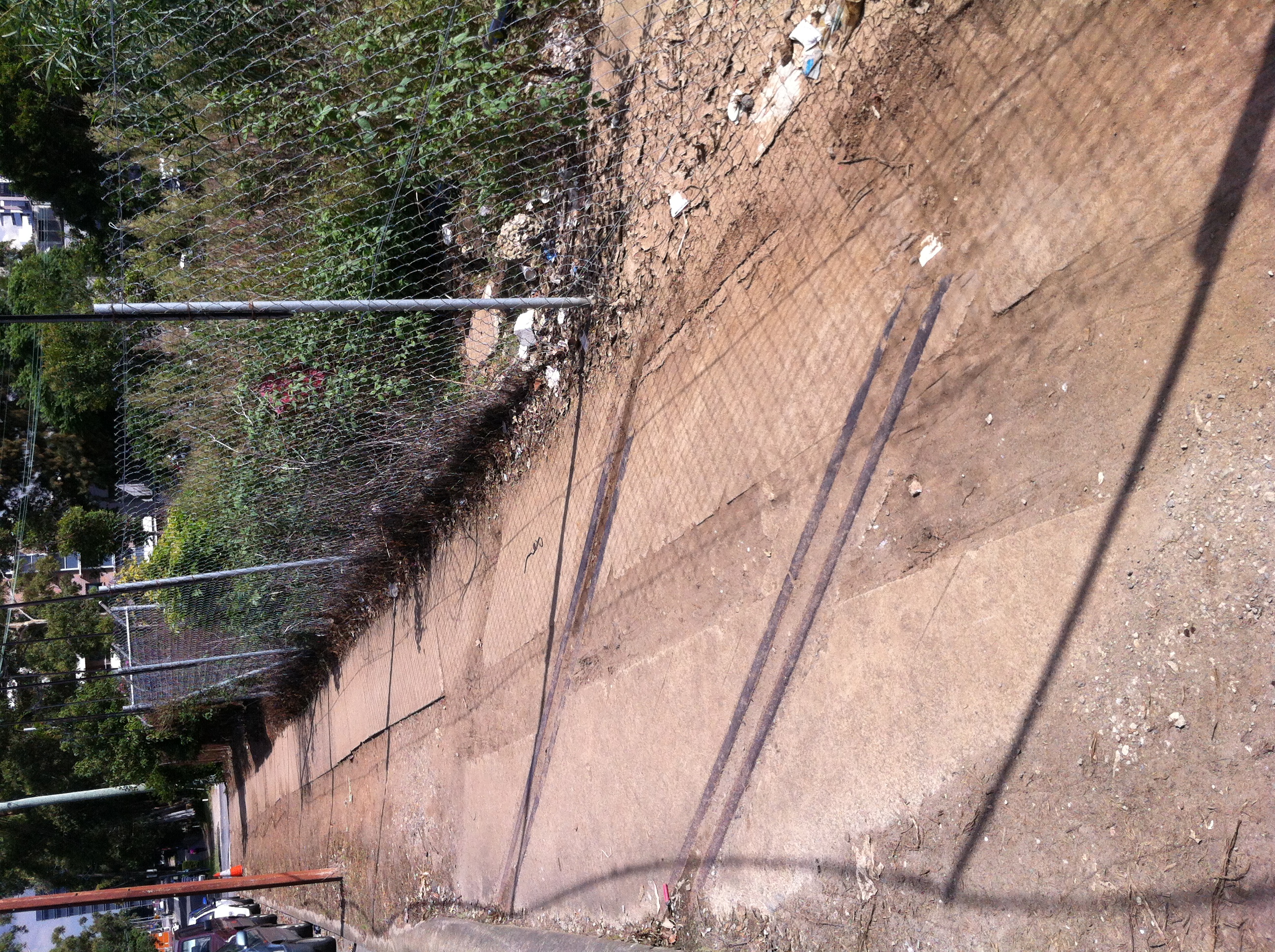
Goods train tracks still exist at the former entrance to Union Carbide.
Faced with declining demand, diminishing returns and increasing competition, Union Carbide abandoned its Australian operations entirely in 1985. They were allowed to leave without conducting any kind of cleanup of the Rhodes site. Between 1988 and 1993, the NSW Govt began remediation attempts with the intention of using Rhodes as an Olympic village for the 2000 Sydney Games, but it was only in 2005, with the onset of private residential construction on the sites, did any serious remediation work take place. Many blocks of units were completed between 2005 and 2011, but remained empty as the ongoing cleanup work made the area too toxic to live in. Remediation was completed in early 2011, and construction has resumed.
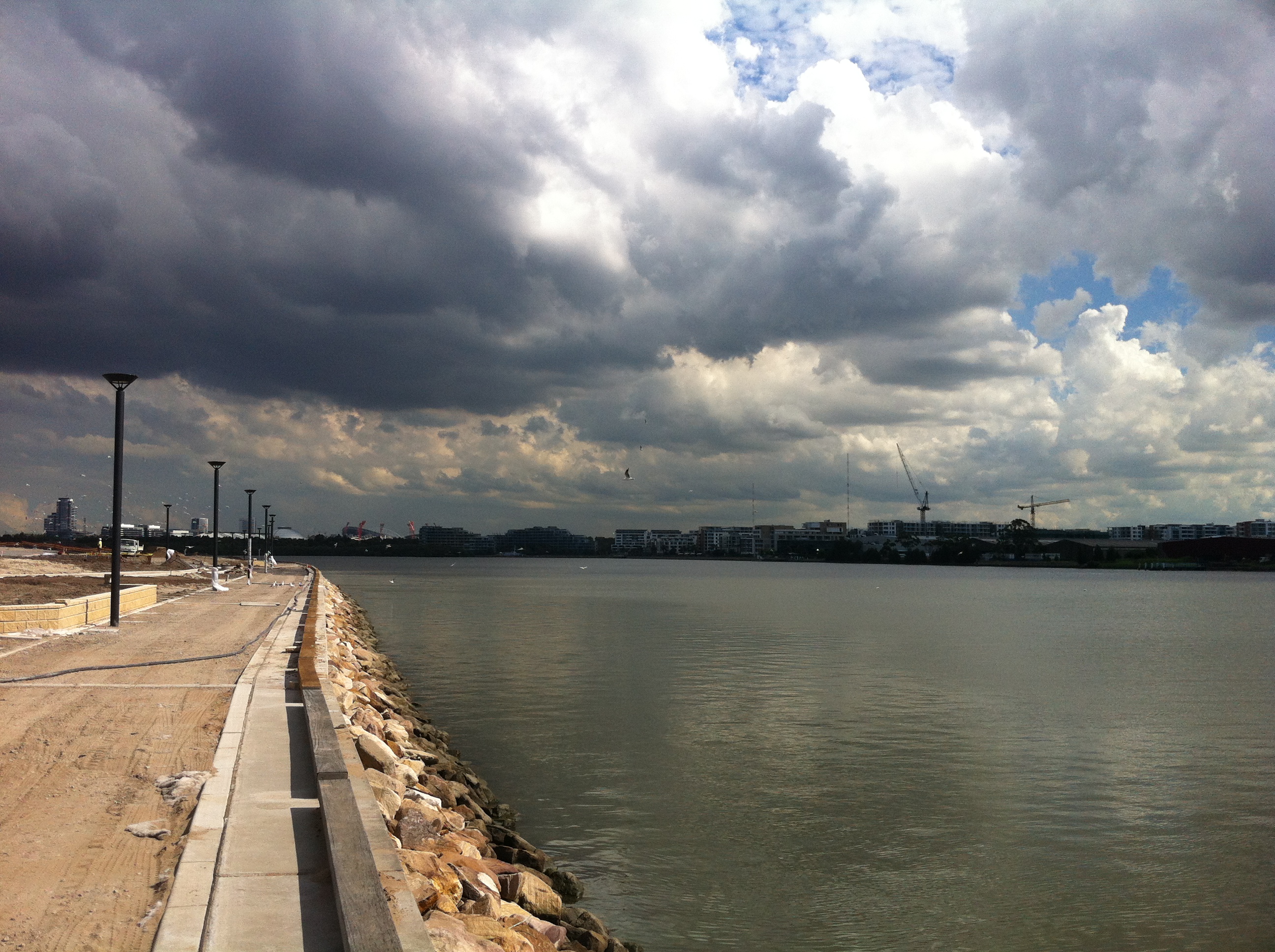
Homebush Bay remains toxic – swimming and fishing are prohibited, and any fish caught in the bay are too poisonous to eat. The remediation work by Meriton and Thiess and has supposedly made the area safe to live in, but only time will tell.
UPDATE: It’s one year later. Is it safe yet? Find out.

 Past/Lives of the Near Future