The Commercial Banking Company of Sydney Limited/Burberry – Sydney, NSW

Yeah, this one’s an easy target but it’s Friday, so gimme a break. If we look past the brand name for a moment we can see this building belonged to the Commercial Banking Company of Sydney Limited (CBC). The CBC was established in 1834, and here’s its seal:

Now, I know what we’re all thinking: “How can I find out more about the boat in that seal?”
The CBC website answers our prayers:
“Thermopylae was an extreme composite clipper ship built in 1868 by Walter Hood & Co of Aberdeen to the design of Bernard Weymouth of London for the White Star Line of Aberdeen.
She measured 212’0″×36’0″×20’9″ and tonnage 991 GRT, 948 NRT and 927 tons under deck. The under deck coefficient was 0,58. Rigged with royal sails, single topgallant and double top-sails.
She was designed for the China tea trade, and set speed records on her maiden voyage to Melbourne — 63 days, still the fastest trip under sail. In 1872 she raced the clipper Cutty Sark from Shanghai back to London and won by seven days after Cutty Sark lost her rudder. In 1895 she was sold to Portugal and used as a naval training ship. The Portuguese Navy torpedoed her at sea in 1906.”
But for every nagging mystery solved, another pops up in its place, such as why Burberry needs a safe deposit area:
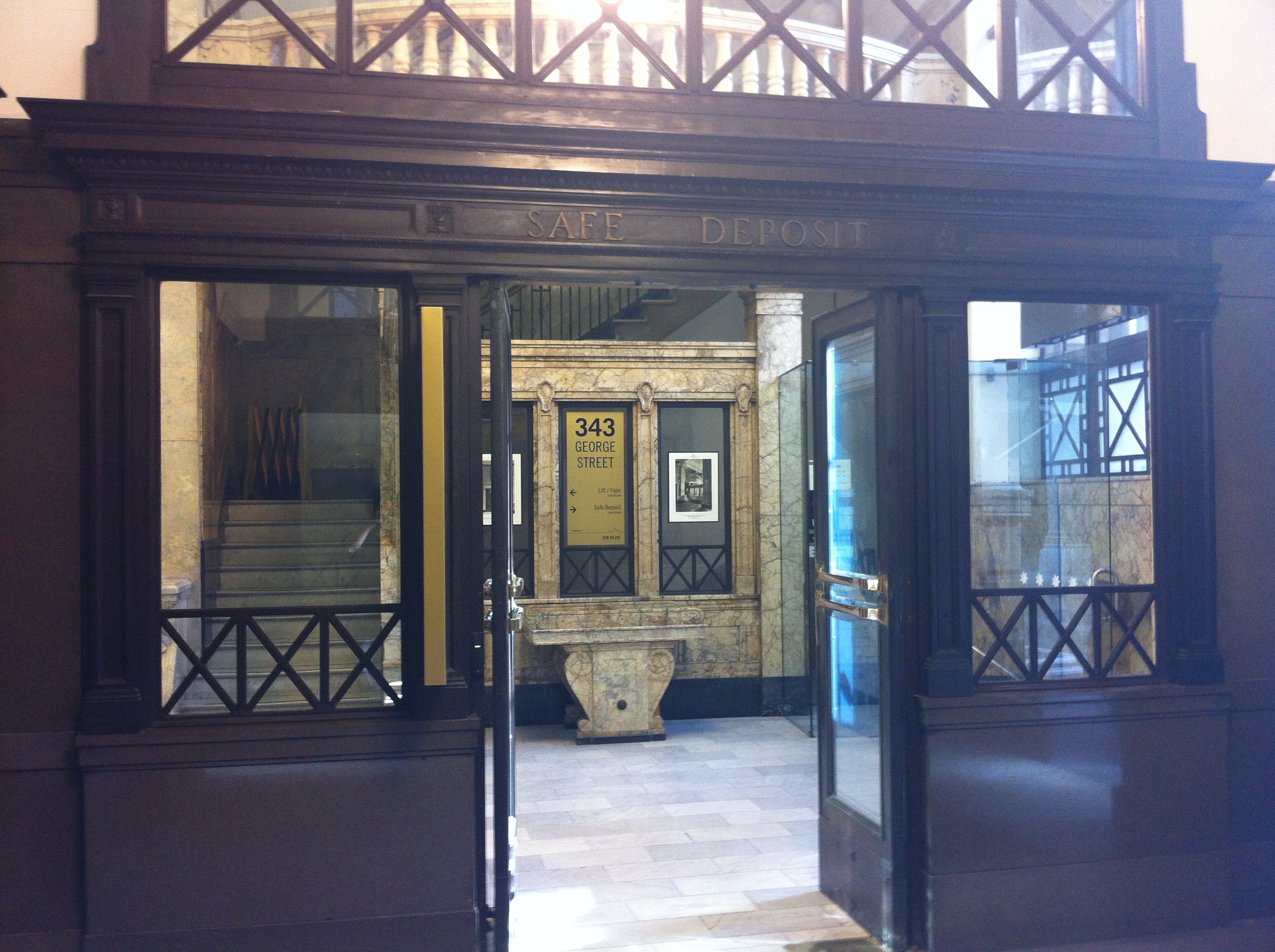
But that just goes to show that they used to build banks to last. To these designers, the CBC was going to rule the waves forever, but the truth is much more banal. In 1981 it was absorbed by the National Australia Bank, whose logo can be found bolted to the front of this building. Looking inside, we can see the extent of the bank’s lavish furnishings:

After having a look at some of those price tags, I can safely say that even though Burberry has only been at this location for a year (it was previously Sydney’s only Virgin Megastore), it’s banked fatter coin than the CBC ever did.
Garden Palace/Royal Botanic Gardens – Sydney, NSW

In 1877, the Royal Agricultural Society of NSW decided to stage an international exhibition. As planning commenced, it became clear that the Intercolonial Exhibition Building in Prince Alfred Park wasn’t going to cut it as a venue. After applying some pressure on the NSW Government, which did not want to appear foolish on the world stage, money found its way to the right place, and the enormous Garden Palace was built in the Royal Botanic Gardens in only eight months, just in time for the exhibition.

The building featured restaurants, tea rooms, a fountain, and yet another statue of Queen Victoria. It contained the city’s first hydraulic lift (they really loved their hydraulic lifts back then, didn’t they?). It also boasted primarily timber architecture, which didn’t work out so well.
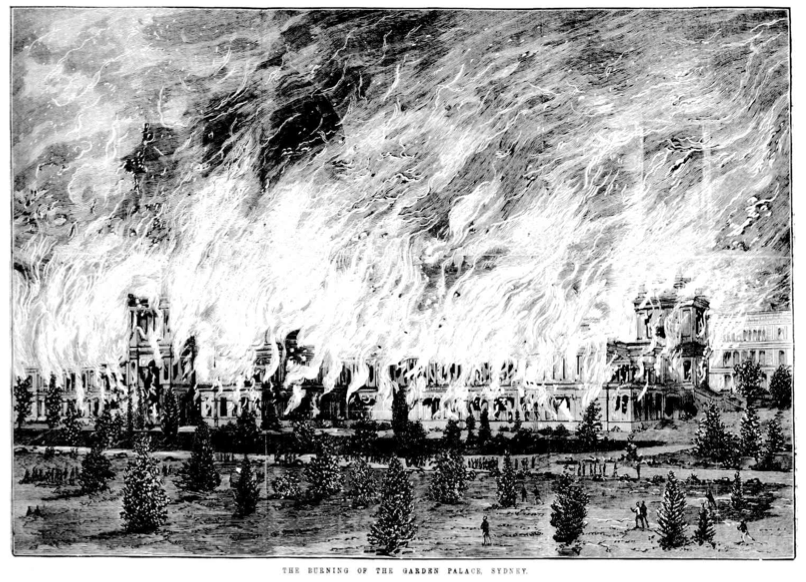
In late September, 1882, the Palace caught fire and burned to the ground. The cause of the blaze has never been established, but in the years following the International Exhibition, there was much consternation about what purpose the Palace would then serve. All I’m saying is, I’m sure there were a few people not sad to see it go. Mourners of the Palace seemed to be most upset by the wastefulness of it all, and by 1890 it had largely been forgotten.

These gates are the only reminder that it was ever there, despite having been erected in 1889 to commemorate the Palace. So wait, people were upset about the wastefulness of the Palace’s destruction, but were okay to build giant gates to a place that was no longer there? So Sydney, so chic…

This tastefully coloured fountain marks the spot of the Palace’s 210 foot tall dome. I’m surprised that’s not Queen Victoria perched on top.


 Past/Lives of the Near Future